-
-
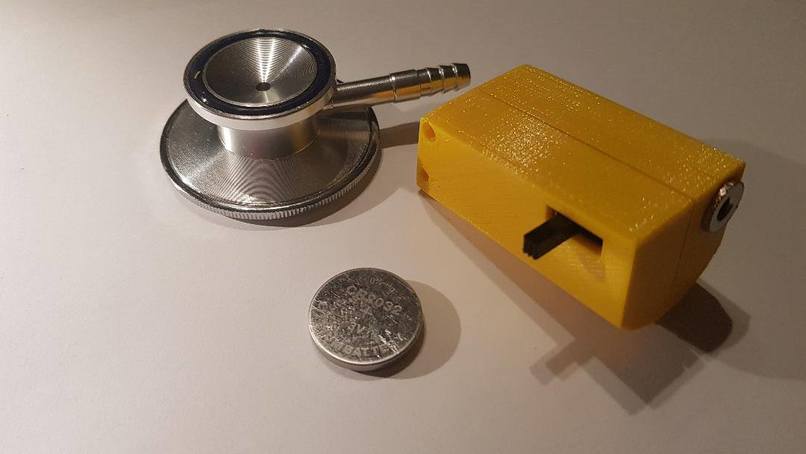
First prototype ready to be tested..
-
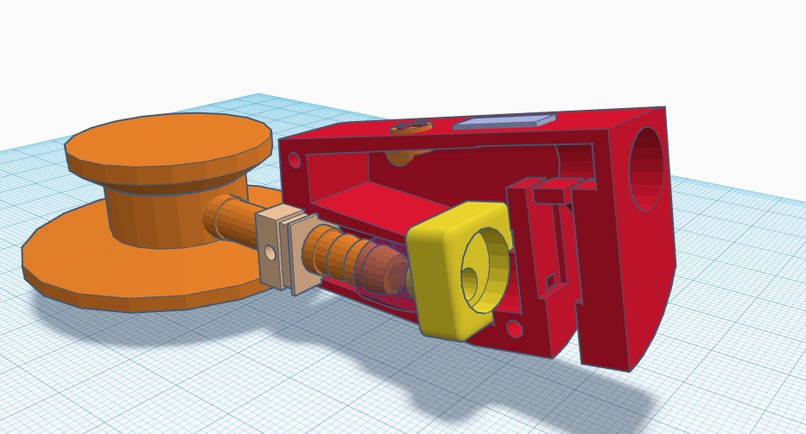
case design
-
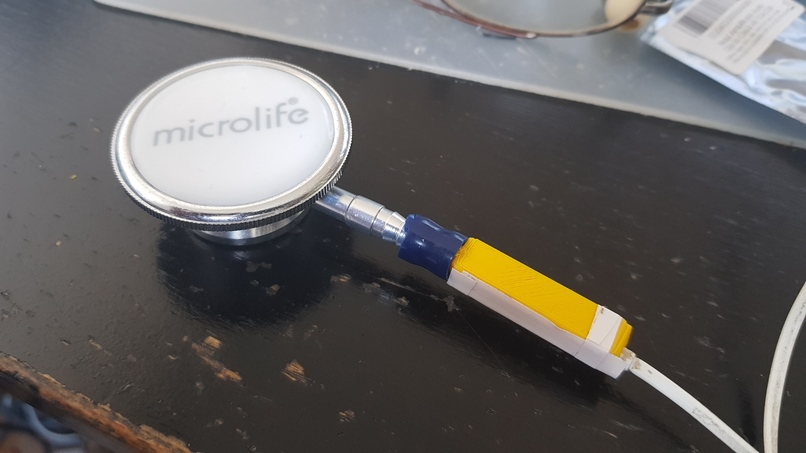
simple mems microphone no power required


Inspiration
A team member read an article about the intubation of a Covid-19 patient in a Romanian hospital. The physician who performed the intubation did not have a video laryngoscope available nor could he use an ordinary stethoscope to verify the correctness of the intubation, for fear of contamination. Thus she realized that, in order to perform the auscultation of heart and lungs of a highly contagious patient, an ordinary stethoscope is not enough, the eartips being impossible to use under the hood of the protective suit for safety reasons. That's why we thought that using audio headphones instead of eartips can help medical staff perform their tasks safely. Thus in order to solve the problem of safe examination of the heart and lungs of contagious patients, we did the initial steps in the research, requirements identification and realization of a prototype of simple, reliable, cheap, disposable electronic adapter device that can be attached to the chest piece of a stethoscope that transforms it in an electronic one that can be used even when wearing a protective suit and mask. When the need for protective equipment disappears, the doctor can reuse the chest-piece of the stethoscope (easy to disinfect) by simply reattaching its stem to the stethoscope tubing. Maybe, in a modern medical unit, acoustic stethoscopes can be seen as obsolete but in a remote location or from developing countries or when just a preliminary examination is needed this can make a difference in the protection of the medical personnel.
What it does
The conventional stethoscope is an acoustic device used for the auscultation of heart and lungs[1], helping doctors to evaluate the activity of the internal organs and make correct diagnosis that transmits the sounds captured from the surface of the body through an air-filled tube to the physician's ears. These sounds are mechanical vibrations at a frequency ranging from 20 to 20000Hz. Normal frequency of pulmonary sounds varies from 100-1000 Hz, even higher, above 2000 Hz in case of wheezing or stridor while heart sounds frequency ranges from 20 to 500 Hz [2] Constructively an acoustic stethoscope does not transmit accurately the sounds of the internal organs [4] but most of the physicians are still accustomed to the sound they perceive in the acoustic stethoscope and are able to discern between the fine changes that can indicate a specific pathology behavior. Modern digital stethoscopes are able to receive and transmit very accurately the real sounds of the organs[3] but this comes at a rather high cost of the device and specific training needs.
Design considerations
The proposed device must attach mechanically and acoustically to a "normal" stethoscope and transform the sound into electronic signals that are amplified and sent to a headset worn by medical personnel over the protective suit. The integrity of the protective gear of the medical personnel must be maintained while transferring the sound to the headsets. The headsets to be used must have a removable cable so to be able to disinfect it after usage. Current design can be used with glasses as face protection mean. If headsets must be be worn over a face shield then is better to incorporate them into the protective suit and keep them in place by velcro type of attachment. As the protective suits do not have any pockets the device must be held from neck by a strap.
Power supply should be provided at low voltage and by using easy to find cell batteries like. Power consumption should be very low to enable a minimum of 4h of continuous usage from one battery. In case of depletion the battery must be changed easily and there must be a notification that battery is low. The device should be electrically compatible with phones and headsets using 3.5mm audio jack and mechanically with a cheap range of disposable stethoscopes. The board must be covered with silicone or resin to enable disinfection. The stethoscope itself can be a 3d printed one. Initial prototype will be transferring the sound by audio cable directly to the headsets but can also transfer it to the phone and from there can be captured, stored, analyzed and classified locally using a phone app or sent to cloud storage. Automatic Gain can be a nuisance but can also be useful in suppressing high sound levels thus both ways of working must be maintained. Furthermore, by using cloud based AI recognition of a cleaned sample, an initial automatic diagnosis can be provided in absence of sophisticated medical devices and highly qualified medical personnel. For recording a special treatment of the signal will be needed.
The simple version of the device can be built (hacked), depending on the desired quality and level of the sound and available materials, by using specialized chips and electret (cheap) microphones or from much simple materials such as a simple phone headsets (MEMS) using just the amplification capabilities of a mobile phone and freely available applications to design, build, test the device, capture and store the sound. The device should be inexpensive and easy to replicate anywhere in the world by using only affordable materials and tools like 3d printer, minimum soldering skills and cheap hardware with arduino-type modules that can be sourced in sufficient quantities. The price of the components should be low (below 10 usd) to treat the contaminated parts of the device as disposable items.
Differentiators
- very low voltage and power consumption 3v ~ 4mA
- 60 DB gain in a 3.5 mm audio jack headset
- very cheap and disposable ~ 15 -20 eur
- can target low income countries
- protype case is built out of PLA which is biodegradable
- even inaudible sounds (below 50hz) can be transmitted further enabling more efficient analysis.
How we built it
We have researched the requirements that need to be fulfilled by such device. We have designed a case able to adapt mechanically to a range of simple stethoscopes and conduct the acoustic signal to a highly sensitive but cheap electret microphone. The microphone is connected to an amplifier that provides up to 60 db and automatic gain. We have identified an amplifier board that can be built or sourced easily in sufficient quantities responding to the design requirements above. We have determined the hacks that need to be done to the standard board in order to meet the requirements.
Challenges we ran into
- The shape of the case must not impede the normal manipulation of the stethoscope.
- Electret microphone signals that must be amplified are in the range of 1-2 mv (heart) and in the next stage of development active noise cancellation must be implemented using a differential noise cancellation audio chip.
- Power consumption must be very low while still providing a usable signal level.
- The device must be easily to be disinfected or properly disposed of.
- It is not easy to obtain a sufficiently low production price.
Accomplishments that we're proud of
- We have identified many of the requirements that such a device must be able to fulfill.
- We were able to build, print, test, document and submit a workable prototype during the weekend.
- Cooperation inside the team was excellent.
What have we learned
The stethoscope is just one of the many many usual devices that, in short future, will need redesign as "low touch devices".
What's next for Electronic Stethoscope Adapter
- A version using BLE for signal transmission can be built using a smaller electret microphone and a far field noise cancellation chip.
- Next gen may be built using I2S Sound transmission DSP noise suppression and a very cheap small SoC.
Bibliography
- https://www.nursetheory.com/stethoscope-parts-and-names/
- The Relationship between Normal Lung Sounds, Age, and Gender, Volker Gross, Anke Dittmar, Thomas Penzel, Frank Schuetler, Peter von Wichert, 1999, PubMed: 10988103
https://www.atsjournals.org/doi/full/10.1164/ajrccm.162.3.9905104 - Frequency shifting approach towards textual transcription of heartbeat sounds, Farshad Arvin, Shyamala Doraisamy, Ehsan Safar Khorasani, 2011, PMCID: PMC3396354 https://www.ncbi.nlm.nih.gov/pmc/articles/PMC3396354/
- Digital stethoscope: technology update Supreeya Swarup, Amgad N Makaryus, 2018, PMCID: PMC5757962 https://www.ncbi.nlm.nih.gov/pmc/articles/PMC5757962/?fbclid=IwAR2YQyIqozQwzJYurMDa-eQRifsLXHfGgkn7YcrCAGGRZhIS6JoeAt9S7OY
Built With
- 3dprinter





Log in or sign up for Devpost to join the conversation.