-
-
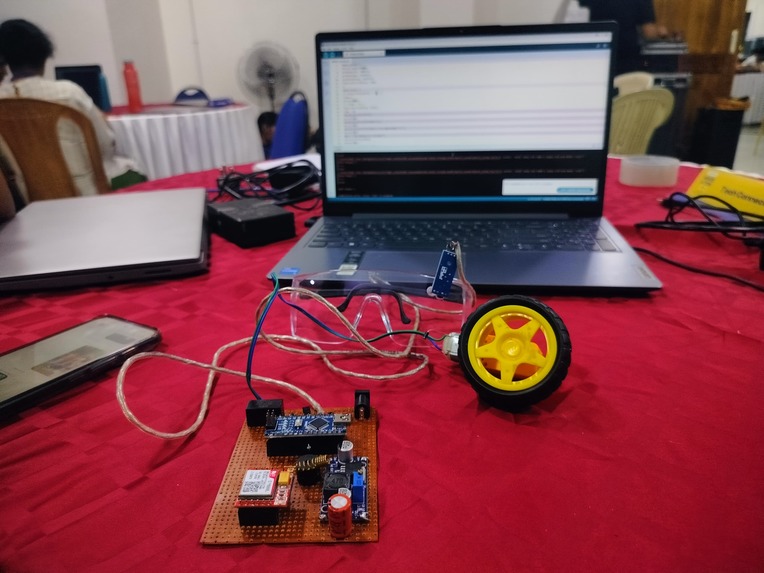
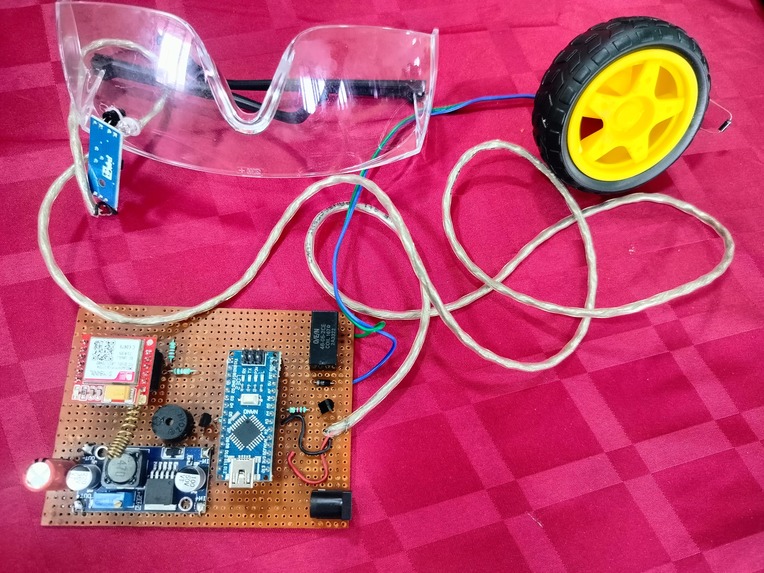
Final Product
-
What we have done in the Hackathon !


Inspiration:Inspired by the tragic loss of lives due to driver drowsiness, this project proposes a novel and efficient driver drowsiness detection system using the SIM800 module, Arduino microcontroller, an IR sensor, and a buzzer.
What it does:This project looks at how to detect drowsiness in a driver in real time by looking at eye
closure. This technology has the advantage of detecting tiredness early on and sounding an alarm before an accident occurs with an alert message. The use of IR Sensor and Arduino are considered to be more suitable for this application based on the design of the proposed work because it meets the relevant requirements such as cost, power, and size. Eye closure is easily detected by this technology. It can detect whether the eyes were open or closed during monitoring. A warning signal will be issued if the eyes have been closed for an extended period of time along with a buzzer sound.
How we built it: The basic components used are IR Sensor, 5V Relay, Step Down Transformer and GSM module. Once the driver starts the vehicle, the IR sensor automatically detect the closure of the eyes. In this device the output from the sensor is provided for comparison with Arduino. When the value reaches the set level, the buzzer will automatically vibrate, a message will be sent to the respective authority and the car stops automatically when the IR sensor receives a signal. lf the eyes are closed for more than 2 seconds the output will be set high. When the value reaches the set level, the buzzer will automatically vibrate, a message will be sent to the respective authority via GSM module and the car(motor) stops automatically as the signals are received.
Challenges we ran into:IR sensors are typically used to detect eyelid closure, which is a key indicator of drowsiness.However, people can blink for a variety of reasons, such as to remove dust from their eyes or to signal to another driver. It is important for the system to be able to distinguish between normal blinking and drowsiness-related blinking.IR sensors can be affected by a number of factors, such as ambient light, head and body movements, and the driver's wearing glasses or sunglasses. This can make it difficult to accurately detect drowsiness.It also need to be able to operate reliably in a variety of environmental conditions, including extreme temperatures and humidity.
Accomplishments that we're proud of:We are very proud to implement our project idea that this project looks at how to detect tiredness in a driver in real time by looking at eye closure. This technology has the advantage of detecting tiredness early on and sounding an alarm before an accident occurs with an alert message. The use of IR Sensor and Arduino are considered to be more suitable for this application based on the design proposed work because it meets the relevant requirements such as cost, power, and size. Eye closure is easily detected by this technology. It can detect whether the eyes were open or closed during monitoring. A warning signal will be issued if the eyes have been closed for an extended period of time along with a buzzer sound. At a limited period of time we are able to generate more than 90% of our product.
What we learned: We had learned the interfacing of IR sensor, Arduino Nano and GSM module. The project implementation helps as to gain more knowledge in doing PCB design more professionally.
What's next for ELECTRO-SAFEGUARD SMART GLASS:The model can be improved incrementally by using other parameters like blink rate, yawning, state of the car, etc. If all these parameters are used it can improve the accuracy by a lot. We plan to further work on the project by adding a sensor to track the heart rate in order to prevent accidents caused due to sudden heart attacks to drivers. Same model
and techniques can be used for various other uses like Netflix and other streaming services can detect when the user is asleep and stop the video accordingly. It can also be used in application that prevents user from sleeping.
