-
-
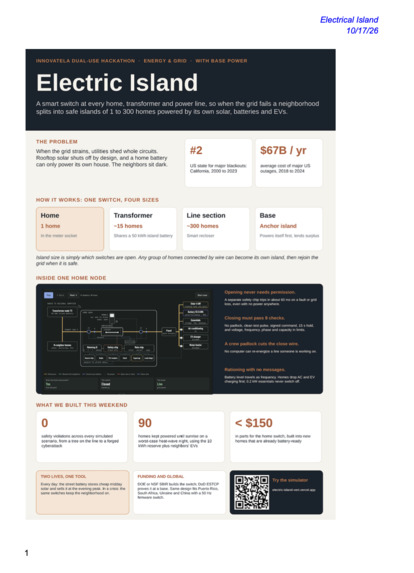
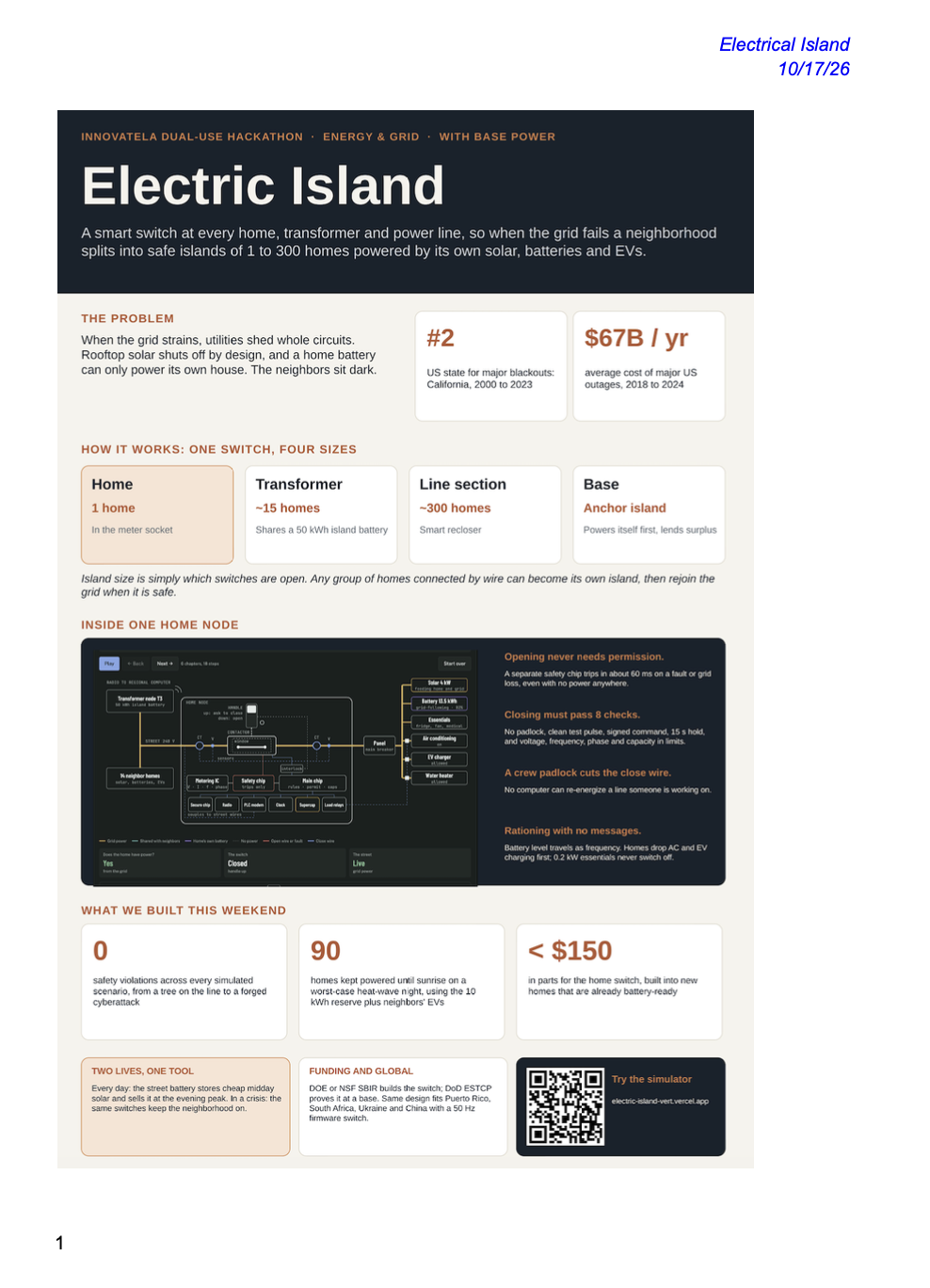
Poster
Inspiration
California's energy code calls for solar on new homes, yet when the grid goes down, most of those panels shut off. They're designed to disconnect so they can't shock a lineworker on a dead line. Heat waves and wildfire shutoffs keep cutting power to whole neighborhoods that already have enough rooftop solar, home batteries and parked EVs to run themselves. We wanted a grid that could break into small, safe islands and keep the lights on, instead of all or nothing.
What it does
Electric Island puts a smart switch (a "node") at every level of the grid. There's one in each new home's meter socket, one on every transformer (about 15 homes), one on each feeder section (about 300 homes), and one at a military or research base at the end of the line. Together they let the grid split into islands of any size, from 1 home to 300 or any connected group, then rejoin when it's safe. Island sizes can be adjusted. The microcontroller at every node also gathers the data and sends it to a central computer, which allows for the efficient distribution of electricity, further preventing possible collapses.
- One rule at every size: opening never needs permission. Closing must pass 8 checks: no padlock, a clean test pulse, a signed command, a 15-second hold, and limits on voltage, frequency, phase and capacity.
- Lineworker safety: a crew's padlock physically cuts the close wire, and no remote command can ever switch a home off.
- Rationing with no messages: island batteries signal how full they are through frequency, and each node's clock caps its home at night (1.0, then 0.5, then 0.7 kW). Homes never drop below a 0.2 kW essentials circuit.
- Storage that pays: each transformer runs a 50 kWh island battery. 10 kWh is locked for emergencies and can only discharge while the island is cut off from the grid. The other 40 kWh buys cheap midday solar and sells at the evening peak, so owners earn the most when power is scarcest. EVs share only in emergencies, and never below their owner's 40% driving reserve.
How we built it
We built a simulator of 90 new homes, 6 transformers, 3 feeder sections, two substations and a base. It runs four layers of control computers, from the home node (about 10 ms) up to a central computer (about 10 s). The engine is plain JavaScript. Every tick finds the islands, runs fault protection, the 8-check close permit and battery drain, across 11 scenarios ranging from a tree on the line to a cyberattack sending forged mass-shutoff commands. The website is hand-built HTML and SVG, deployed on Vercel from GitHub, and includes a step-by-step story of what happens inside one home's switch. We wrote automated tests that run every scenario and flag any safety violation. We also checked the design against a patent search and real California data on the energy code and solar export prices. We used Claude as a coding and research partner throughout.
Challenges we ran into
- Batteries can't push enough current to blow a fuse, so normal fault protection doesn't work inside an island. We switched to comparing the current entering and leaving each section, plus a test pulse before any close.
- The heat-wave night: with only 12 of 30 home batteries working and no caps, the whole neighborhood went dark before 11 PM. That led to the clock caps, the frequency signal and the island battery's locked floor.
- Our own tests caught bugs. A short on a battery-fed street left homes dark, homes flickered on and off at sunrise, and some stayed on rationing after the sun came up.
- The patent search showed that most single pieces already exist, so we had to be precise about what's actually new.
Accomplishments that we're proud of
- Zero safety violations across all 11 scenarios: no energized faults, no power into a padlocked line, no two substations tied together, and no back-feeding a dead substation.
- In the worst-case heat-wave night, island batteries sold to empty leave the neighborhood dark at 12:04 AM. The 10 kWh floor pushes that to 2:09 AM, and the floor plus 14 neighbors' EVs (derived from the percentage of EV owners in CA) keeps all 90 homes on all night.
- A home node with as little as $132 in parts that fits in the meter socket, like the meter collars utilities already approve.
- One simple rule that works the same in a 200 A home switch and a feeder recloser.
What we learned
- Splitting the grid is easy. Rejoining it safely is the hard part, and that's where most of the design went.
- At night, the limit is stored energy, not switching. Rationing by the clock bought more hours than anything else.
- Money and reliability can point the same way. The hours when power is worth the most are the hours the grid needs batteries most, as long as an emergency reserve is protected.
- Most ideas have prior art. The value is in how the pieces fit together.
What's next for Electric Island
- Read the claims of the closest patents (University of Tennessee and GridOn) to pin down exactly what's new.
- Model a real feeder in OpenDSS to test the electrical physics the simulator simplifies.
- Build three bench nodes from a microcontroller, metering chip and relay on a 240 V test rig.
- Work out who owns the island battery and which rate it sells power under.
- Pilot one transformer of new homes with a utility partner.

Log in or sign up for Devpost to join the conversation.