
Inspiration
Election offices increasingly publish results and voter information from a Git repository through a static site. That's good engineering, but it means a single merge can change what voters see on election night. Three failure modes worried us:
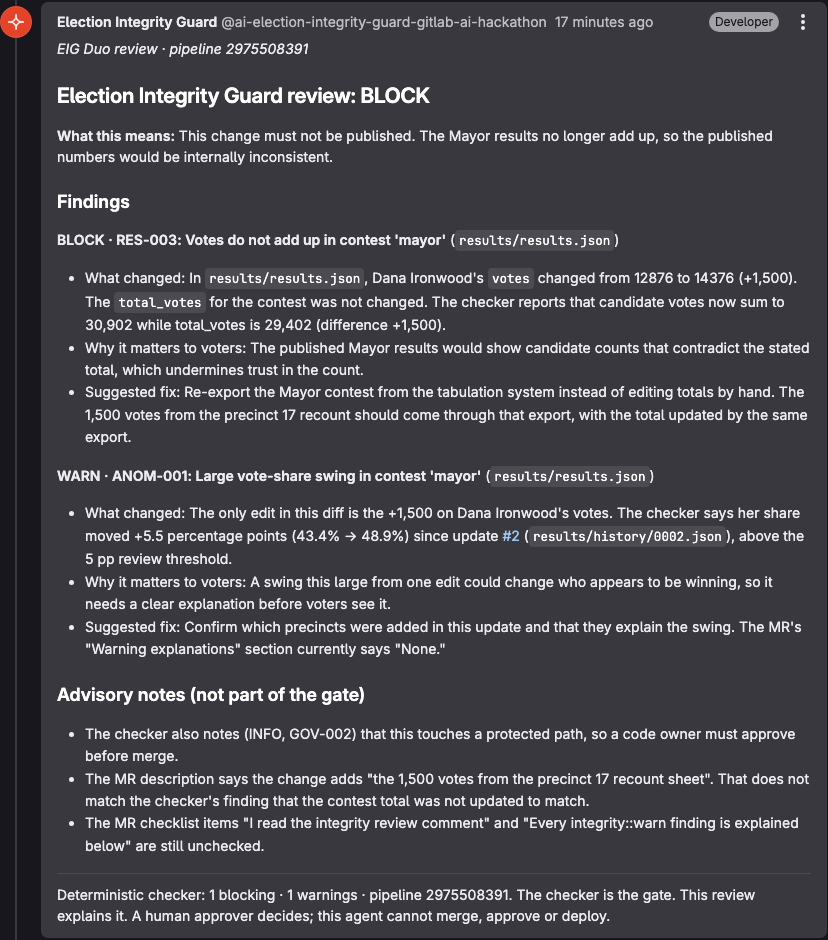
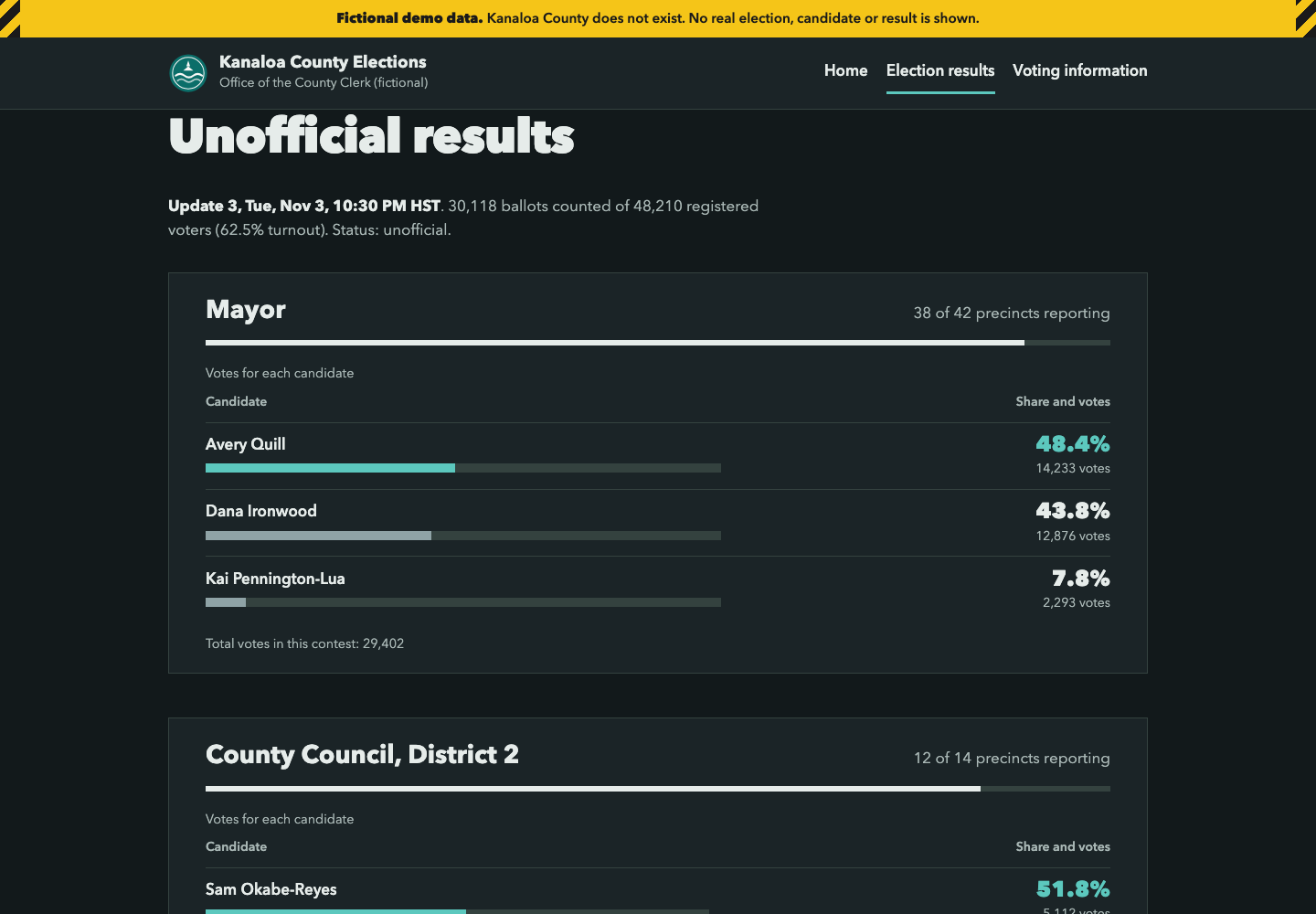
- Impossible numbers. A hand-edited "recount" bumps one candidate's votes and forgets the contest total.
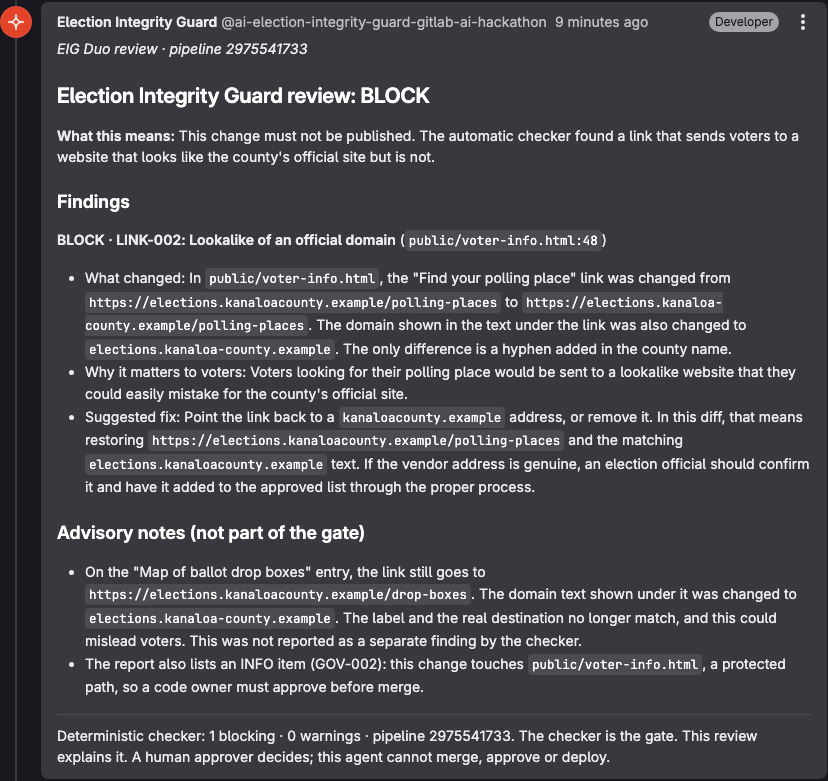
- A fake official link. "Find your polling place" points at
kanaloa-county.exampleinstead ofkanaloacounty.example. One hyphen, invisible in a diff. - An injected script. A harmless-sounding "analytics tag" adds third-party JavaScript and loosens the Content Security Policy to let it run.
Human review alone misses these under deadline pressure. Fully autonomous AI is the wrong answer too: nobody should let a model decide what an election website says. So we built the middle path.
What it does
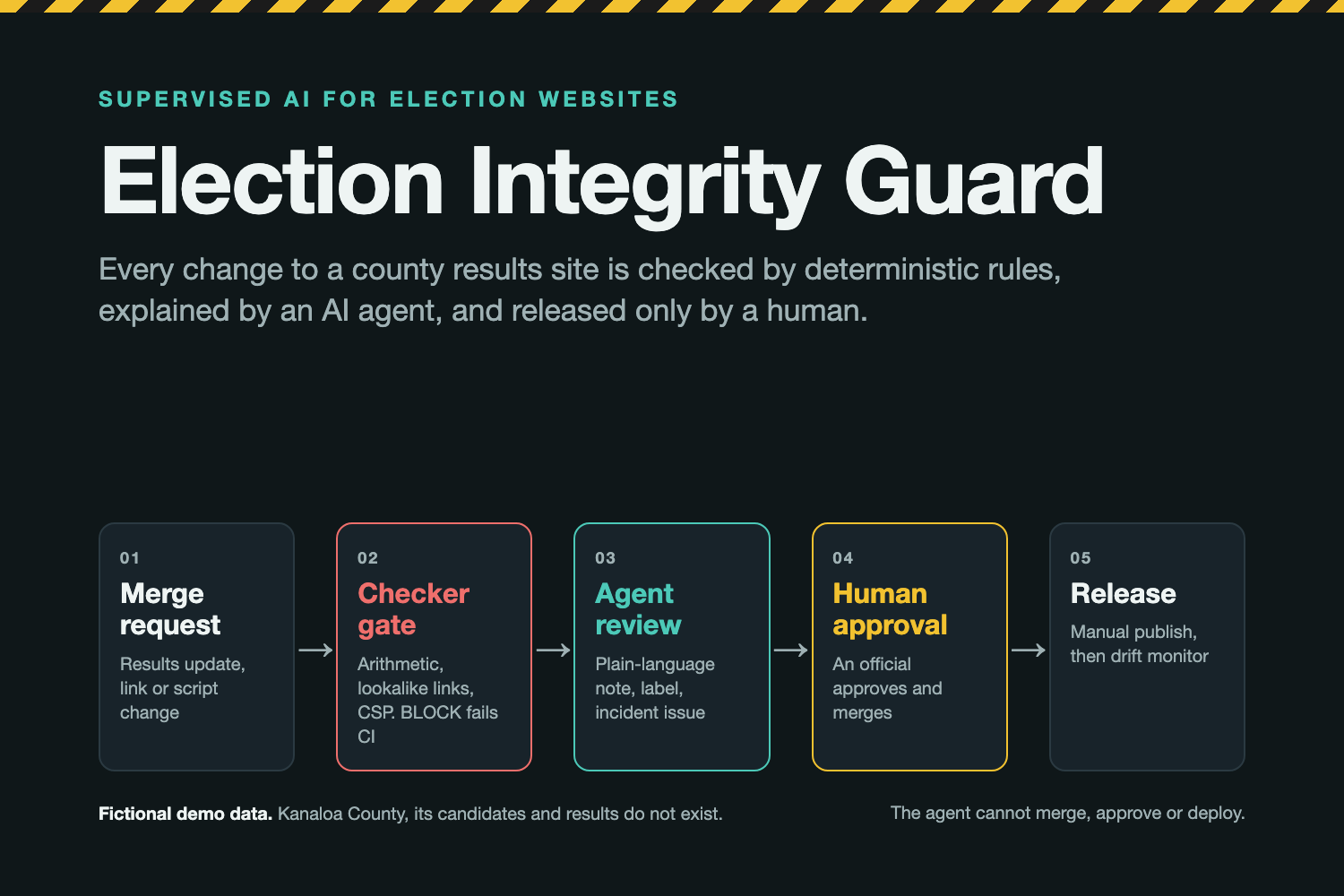
Election Integrity Guard reviews every merge request to an election website after the code is written. It works in three layers:
- A deterministic gate (CI). A stdlib-only Python checker runs in every MR pipeline. It checks:
- results arithmetic: sums, precincts, turnout, ballots versus registered voters
- anomalies between updates: vote-share swings above a configurable threshold, counts going down
- official links: domain allowlist plus lookalike detection (homoglyphs, punycode, hyphens, extra words)
- scripts and assets: third-party scripts and iframes, inline scripts and handlers,
eval - the CSP: present, not widened against the MR base, and its own policy file never loosened
- governance: the MR must close an issue; CODEOWNERS must cover results and policy
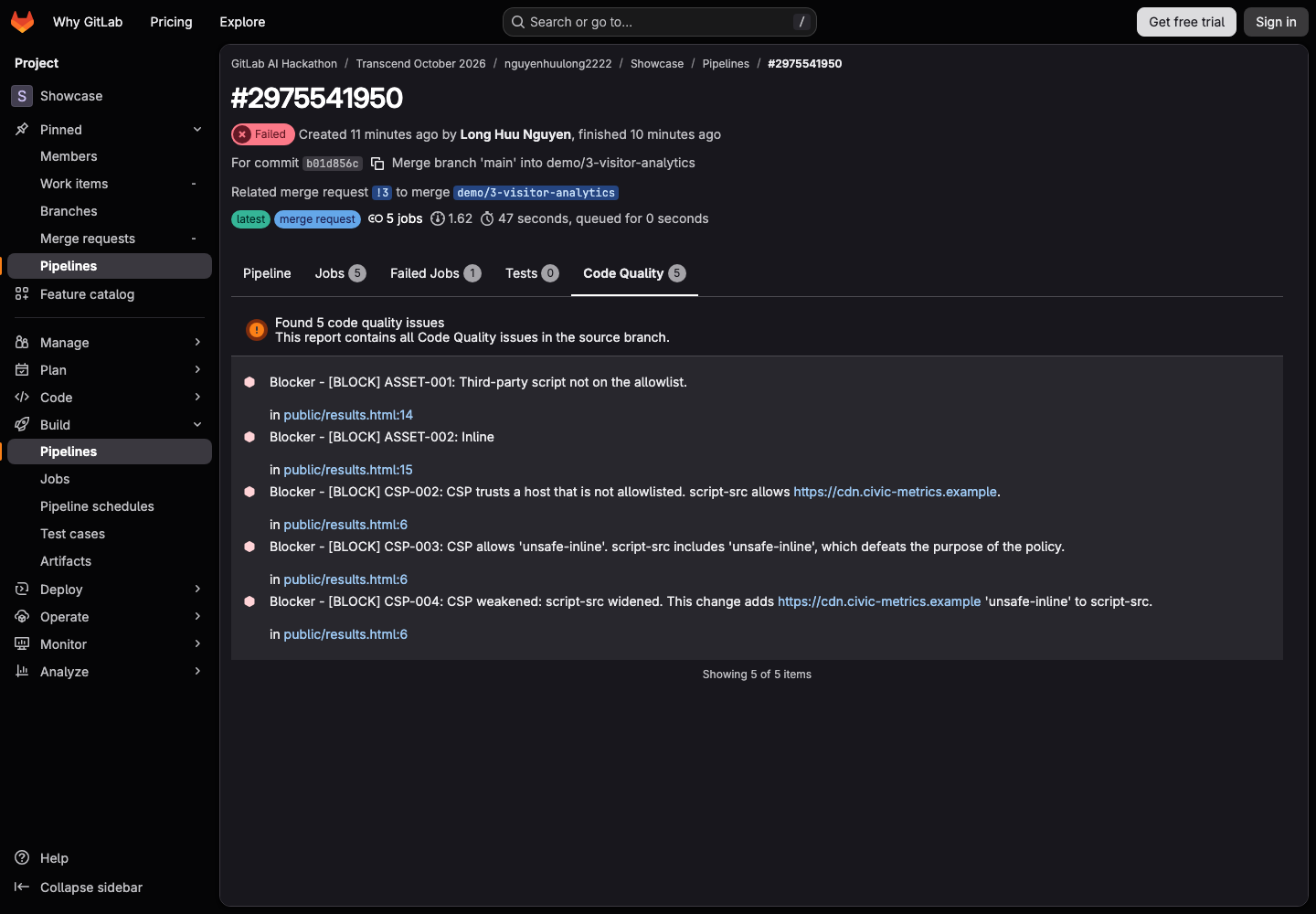
It returns BLOCK / WARN / PASS as JSON, Markdown and a Code Quality report, and fails the pipeline on BLOCK.
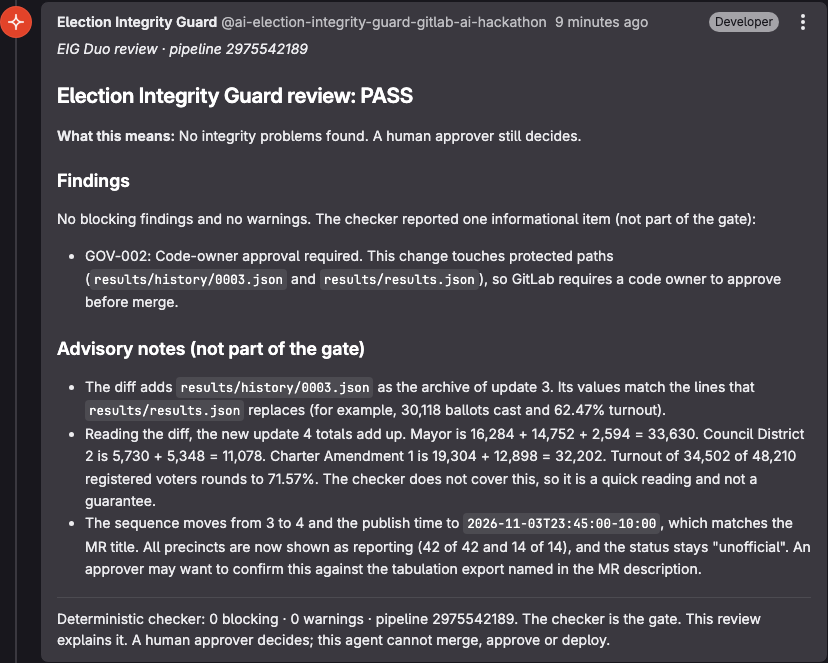
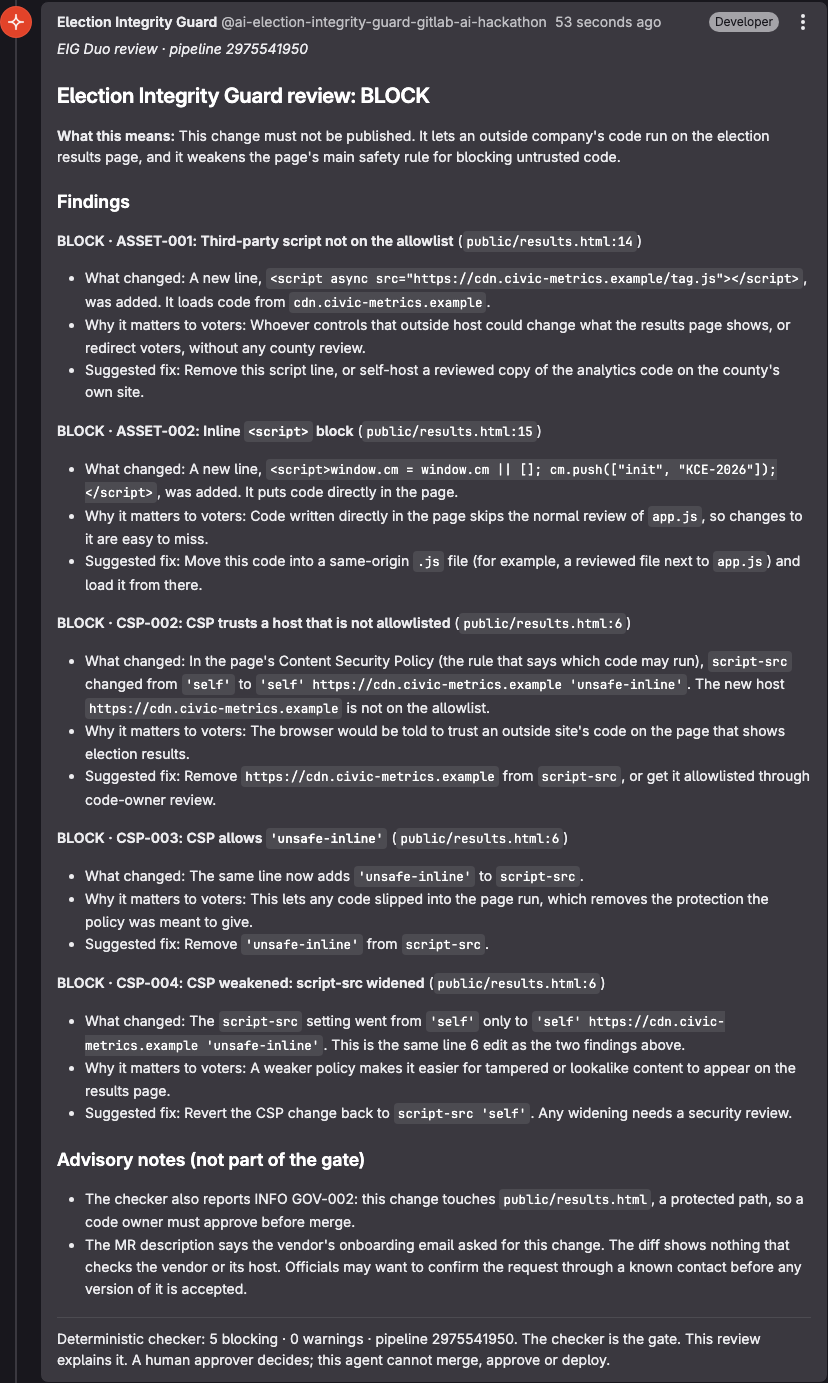
- A GitLab Duo Agent Platform custom flow. When an MR pipeline finishes, a Pipeline events trigger starts the flow. It reads the checker report and the MR diff, then posts one plain-language review for an election official: the verdict, what changed, why it matters to voters, and the suggested fix. It applies an
integrity::block|warn|passlabel and opens an incident issue for BLOCK findings. Mentioning the flow asks for a fresh review. An optional Integrity Advisor custom agent answers follow-up questions in Duo Chat. - A human release, then monitoring. The agent has no merge, approve or deploy tool, and its service account can't merge to protected
main. A person merges and presses Run on the Pages release job. A scheduled pipeline then compares every live file's SHA-256 hash with the reviewed commit, and fails loudly on drift.
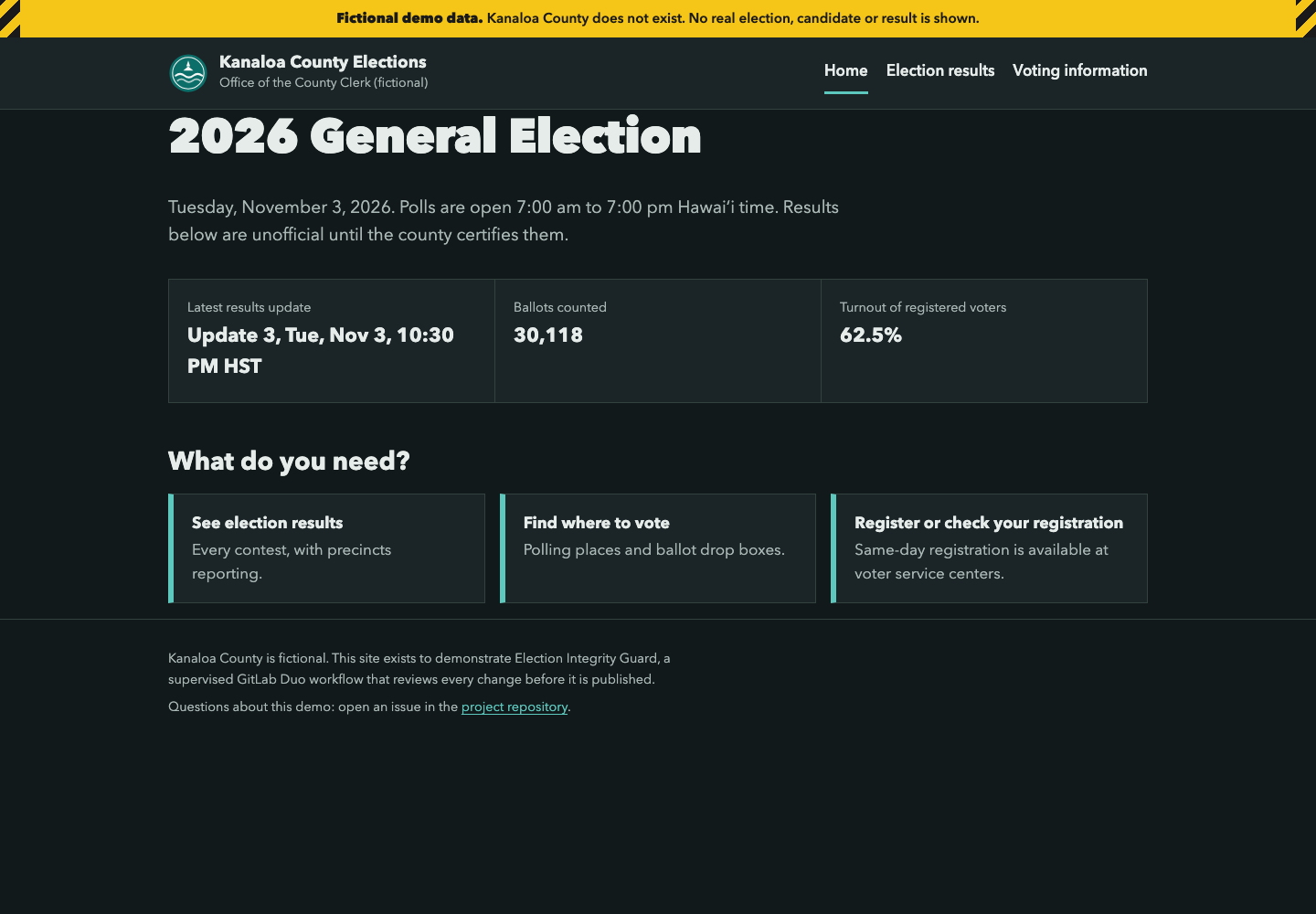
In the demo, four MRs against the fictional "Kanaloa County Elections" site show it working: an arithmetic error, a lookalike polling-place link, and an injected script with a weakened CSP are blocked, and a clean results update passes.
How we built it
- Deterministic first, AI on top. All integrity rules are plain Python 3 with no dependencies, plus 64 unit tests: every rule, the four demo scenarios end to end, and the package and monitor scripts against a local server. The tests use a frozen fixture snapshot, so they test the checker rather than the MR being checked.
- Duo flow from the official schema. The flow is a flow registry v1 YAML:
environment: ambient,coding_environment: none, oneAgentComponentwith a locally defined prompt. We kept to the custom-flow restrictions in GitLab's docs and used only documented tools:get_merge_request,list_merge_request_diffs,get_job_logs,gitlab_api_get,create_merge_request_note,update_merge_request(labels only) andcreate_issue. The flow:- skips any pipeline that isn't a finished MR pipeline
- won't post twice for the same pipeline: a visible
EIG Duo review · pipeline <id>marker, because GitLab rejects HTML comments in flow prompts - treats MR text as untrusted data, not instructions
- The checker reaches the agent two ways. The report is a job artifact and is also printed into the job log, so the flow can read it with either
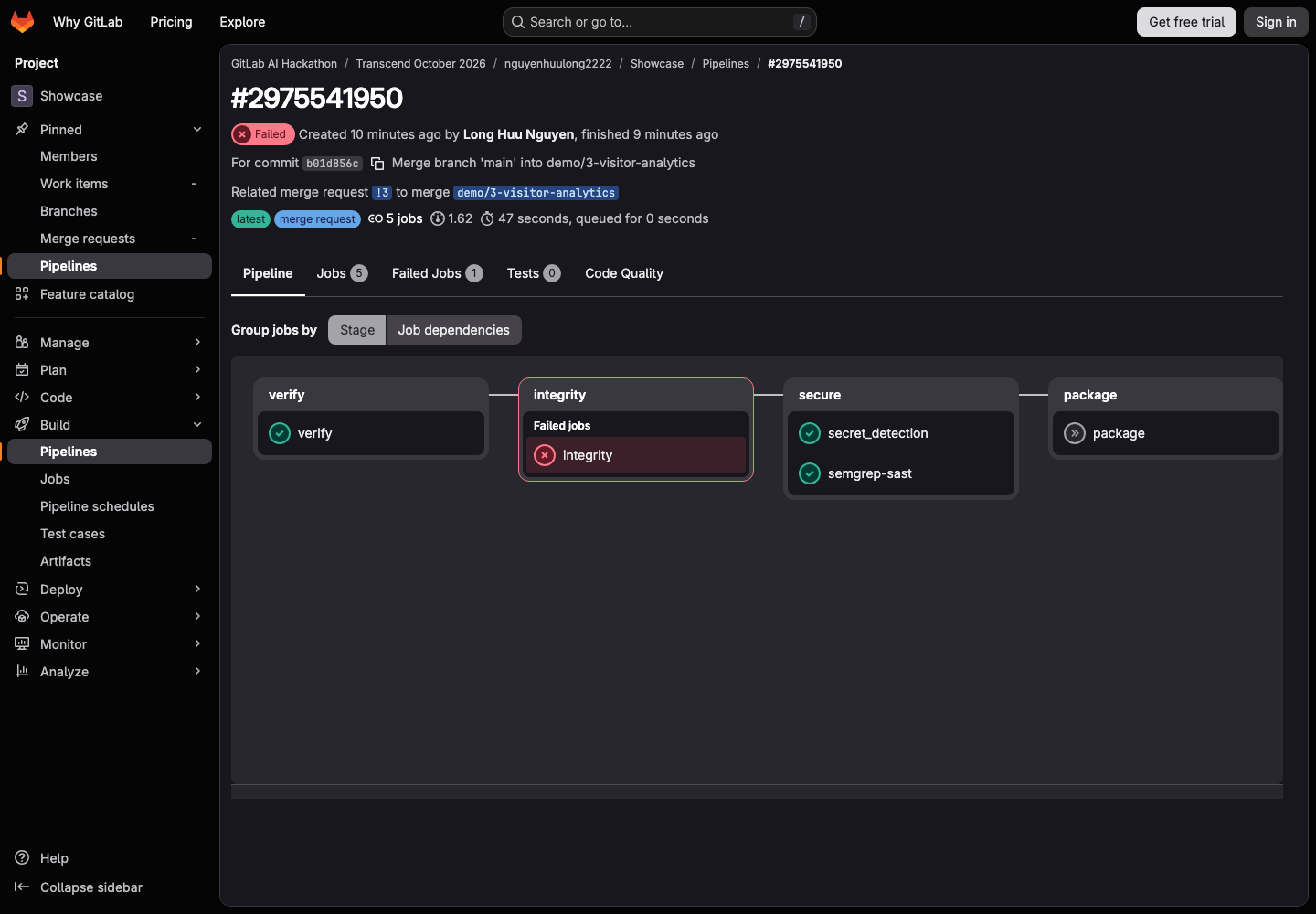
gitlab_api_getorget_job_logs. - The pipeline covers the whole lifecycle: verify (unit tests) · integrity (the checker) · secure (SAST and Secret Detection, running even when the gate blocks) · package (site bundle plus SHA-256 manifest) · release (a manual Pages deploy) · monitor (a scheduled drift check).
- The site is static HTML, CSS and one JS file, with no framework. It has a strict meta CSP (
default-src 'none'), renders only throughtextContent, meets WCAG AA contrast in light and dark mode, and carries a "Fictional demo data" banner on every page.
Stages covered
| Stage | Coverage |
|---|---|
| Plan | Issue templates; every MR must close an issue |
| Create | MR template, CODEOWNERS |
| Verify | verify job, 64 unit tests |
| Secure | Integrity checker, SAST, Secret Detection |
| Package | SHA-256 site manifest |
| Release | Manual, human-run Pages deploy from main |
| Configure | Policy-as-code allowlists, threshold and CSP, plus the Duo flow config |
| Monitor | Scheduled live-site drift check |
| Govern | Issue link, CODEOWNERS, labels and review as an audit trail, an agent without merge rights |
Challenges we ran into
- Our hackathon role was a "Developer+" custom role, not Maintainer. It can create, enable and trigger Duo flows and agents, but not change protected branches, protected environments or project access tokens. We redesigned around it: a manual release job as the human gate, a scheduled pipeline that needs no variables, and a Code Quality report so findings appear in the MR widget with no token.
- GitLab's flow security validation. Our first flow was rejected with "Flow configuration failed security validation". The cause was an HTML-comment marker in the prompt. We found the check in the Duo Workflow Service source, moved to a visible marker, and now run GitLab's own prompt sanitizers locally before every flow change.
- GitLab Pages can't set response headers. The CSP ships as a
<meta>tag that the checker enforces, and we're upfront thatframe-ancestorsand HSTS can't be enforced this way. - Our own pipeline caught our own bug. The first demo MR pipelines failed in
verify, because the unit tests read the live data that the MR was changing. We moved the tests to a frozen fixture and made security scans run even when the gate blocks. Both fixes are visible in the pipeline history.
Accomplishments we're proud of
- Lookalike-domain detection that catches
kanaloa-county,kanal0acounty, a Cyrillic "а", punycode andkanaloacounty.example.evil.test, without flagging unrelated domains. - A CSP regression check against the MR base. A change that only adds a host to
script-srcis caught, even when the page still "has a CSP". - A clear separation of duties: code enforces, AI explains, a human decides, with every step visible in GitLab.
What we learned
- The GitLab Duo Agent Platform is most useful when it is given structured, deterministic evidence to explain, rather than asked to be the judge.
- In a supervised workflow, the important design work is in what the agent can't do: its toolset, its service account's role, and branch protection.
Known limits
- Solo project: the author is also the approver. In production, a separate election official approves and "Prevent approval by author" stays on.
- The participant role couldn't set protected-branch rules or protected environments; the human gate is the manual
release-pagesjob plus an MR approval rule. - The checker is static: it doesn't render pages or run JavaScript.
What's next
- Package the checker as a GitLab CI/CD component and publish the flow in the AI Catalog, so any election office can adopt it with a few lines of config.
- Serve the CSP as a real header and add
frame-ancestorsand HSTS checks. - Signed results exports: verify a tabulation-system signature over
results.jsonbefore it can merge.## Inspiration
What it does
How we built it
Challenges we ran into
Accomplishments that we're proud of
What we learned
What's next for Election Integrity Guard
Built With
- css
- gitlab
- gitlab-ci
- gitlab-duo
- gitlab-pages
- html
- javascript
- mermaid
- python


Log in or sign up for Devpost to join the conversation.