-
-
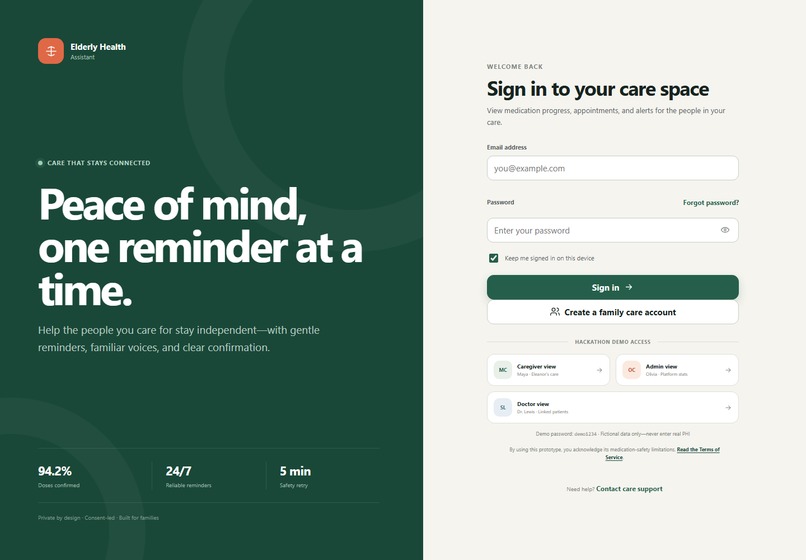
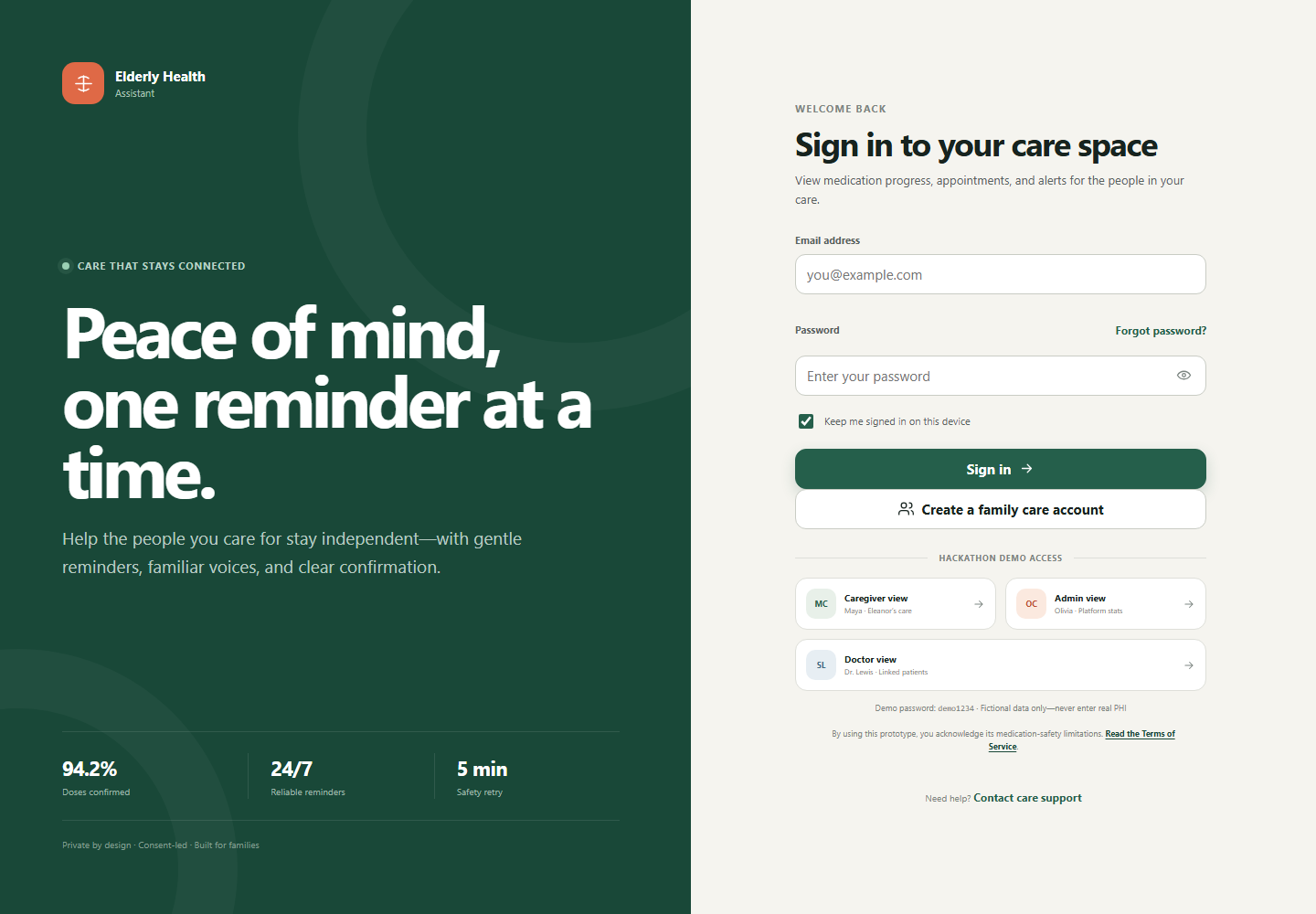
Caregiver, doctor, and administrator experiences are isolated from the first screen.
-
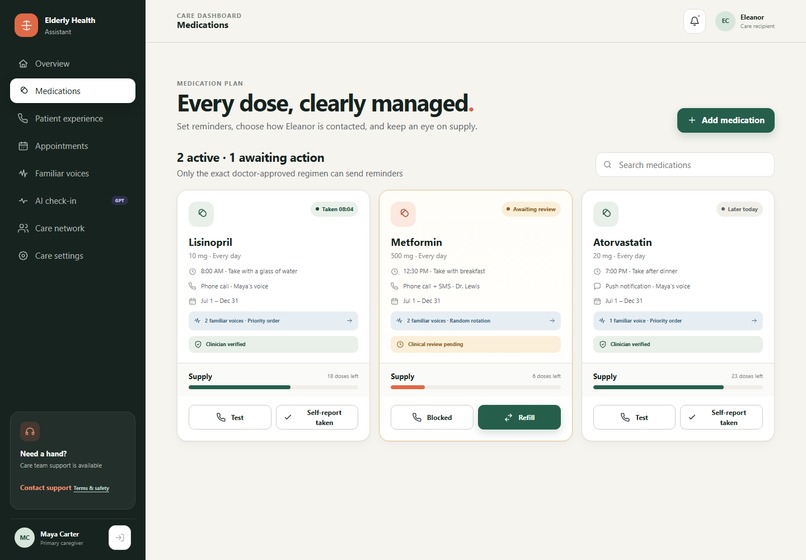
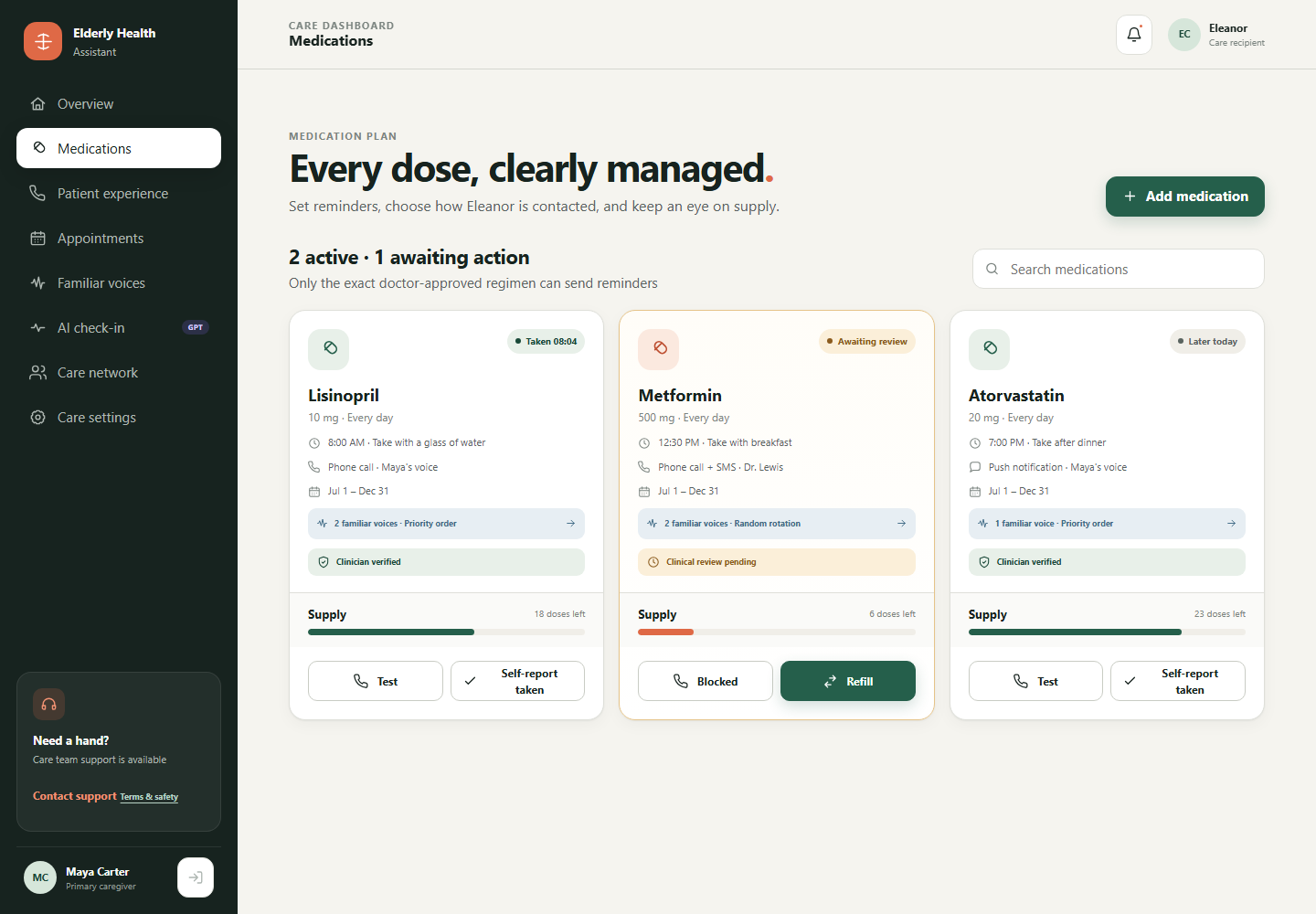
Reminders remain blocked until the exact regimen version is approved by the related doctor.
-
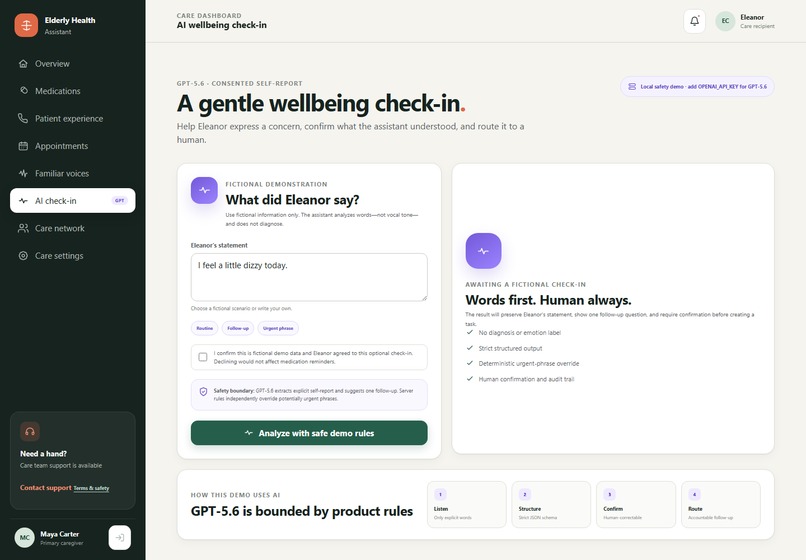
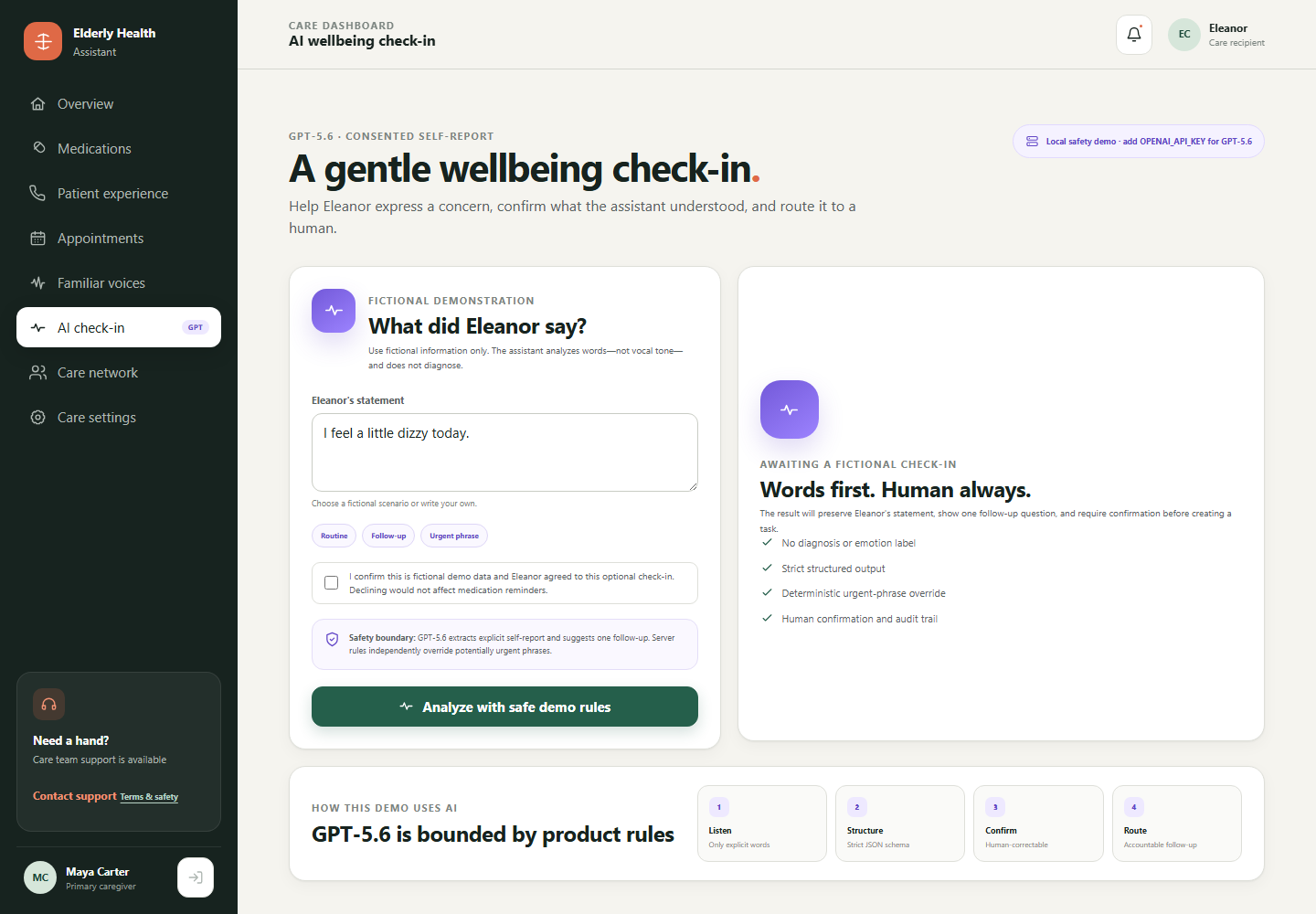
Explicit patient words become one follow-up and a human-confirmed summary, never a diagnosis.
-
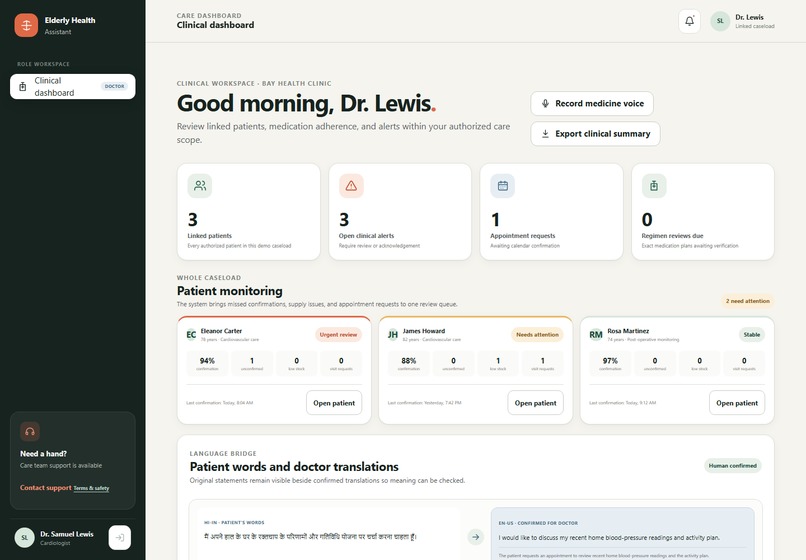
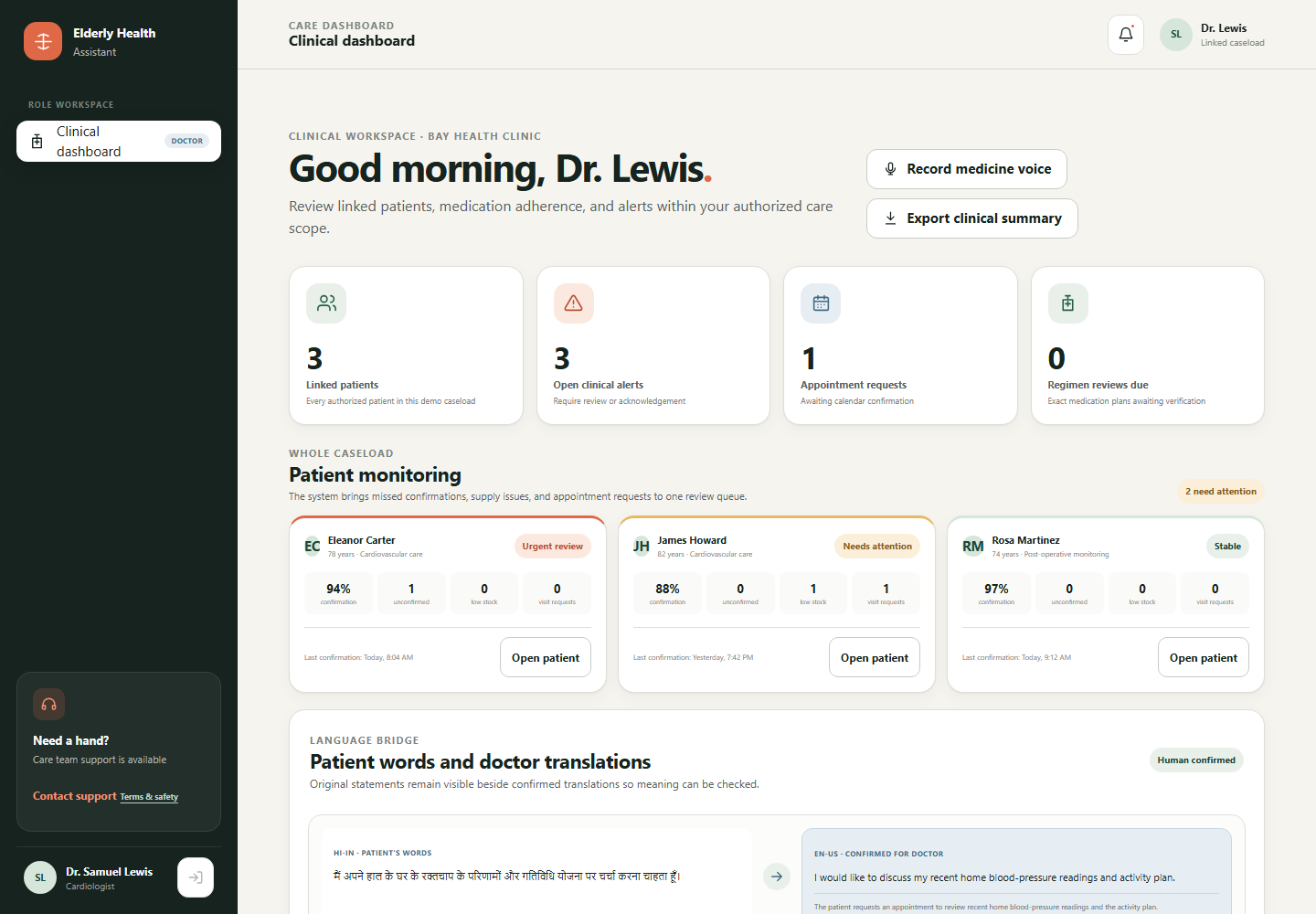
The doctor sees linked patients, missed confirmations, refill risk, and appointment requests.
-
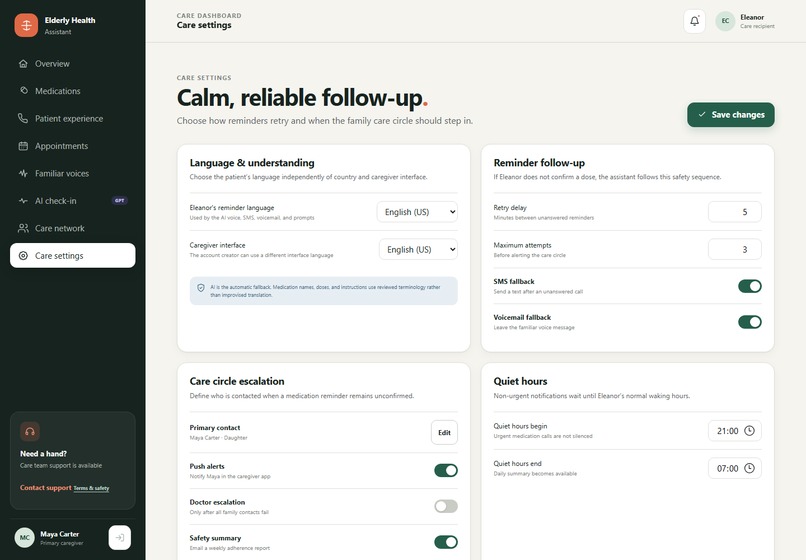
The product discloses fictional data, JSON persistence, simulated delivery, and queue status.
-
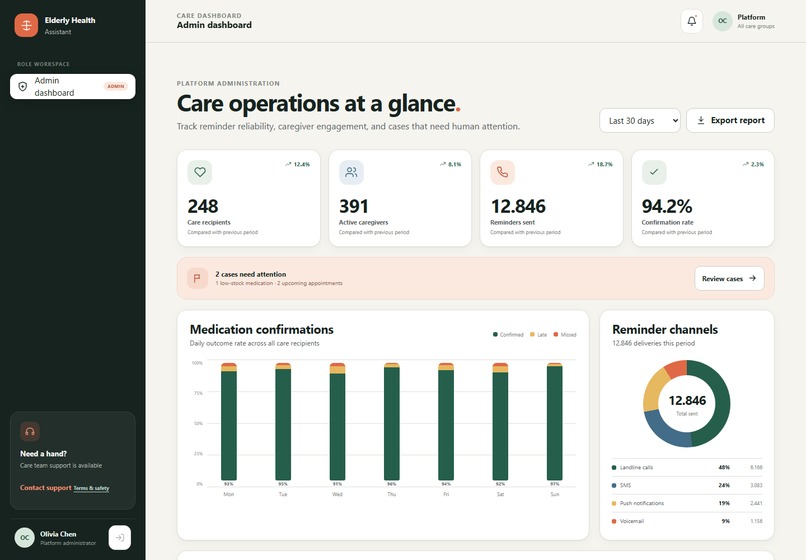
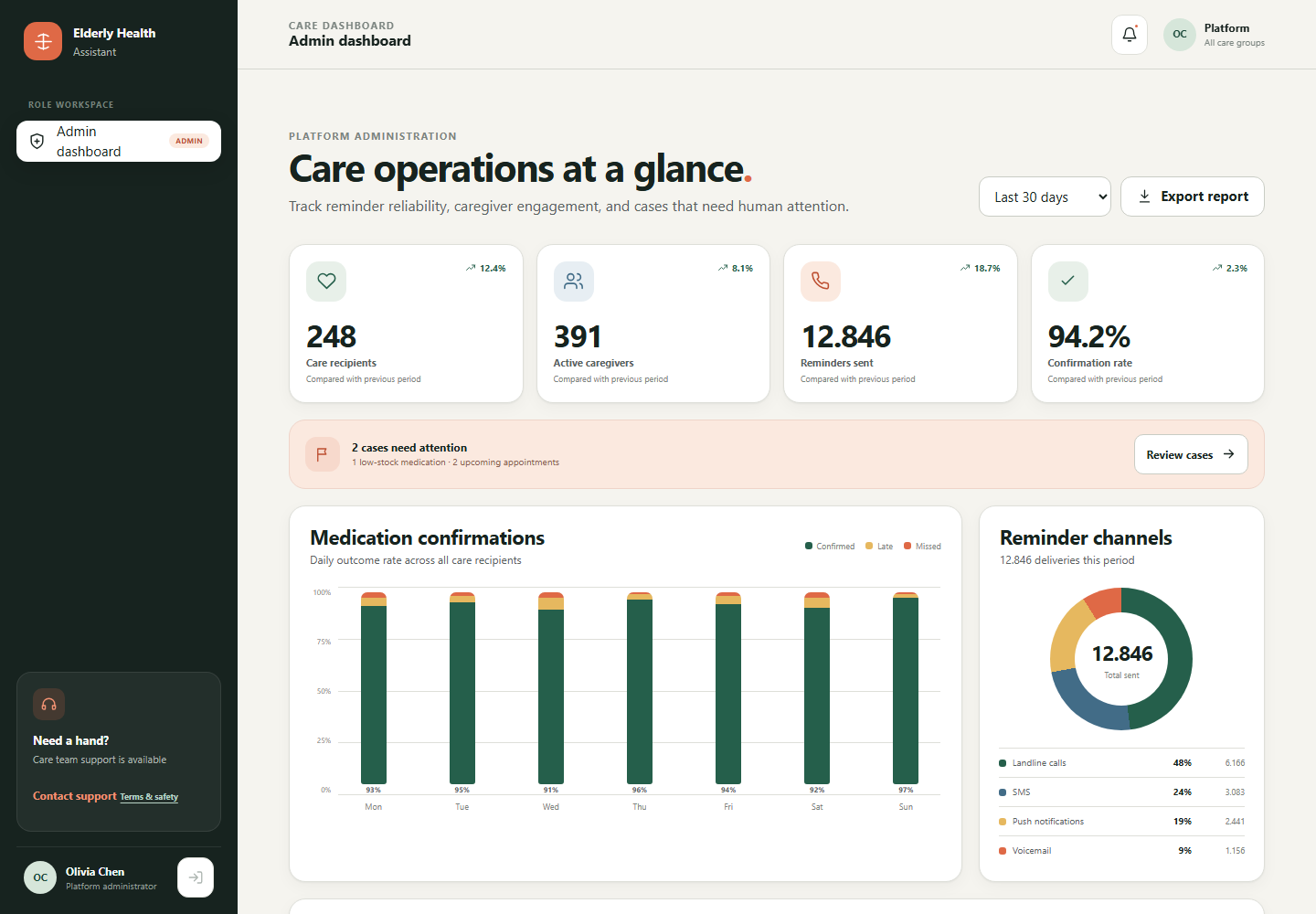
Administrators see platform statistics and service health rather than caregiver menus.
-
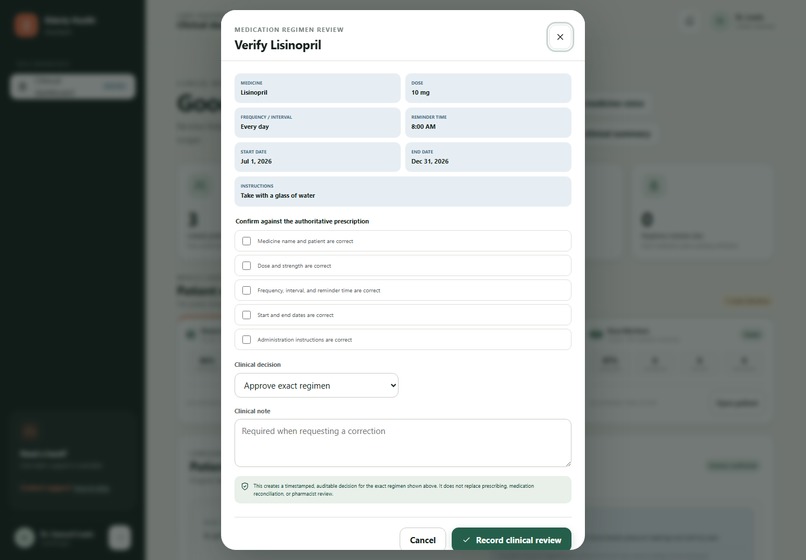
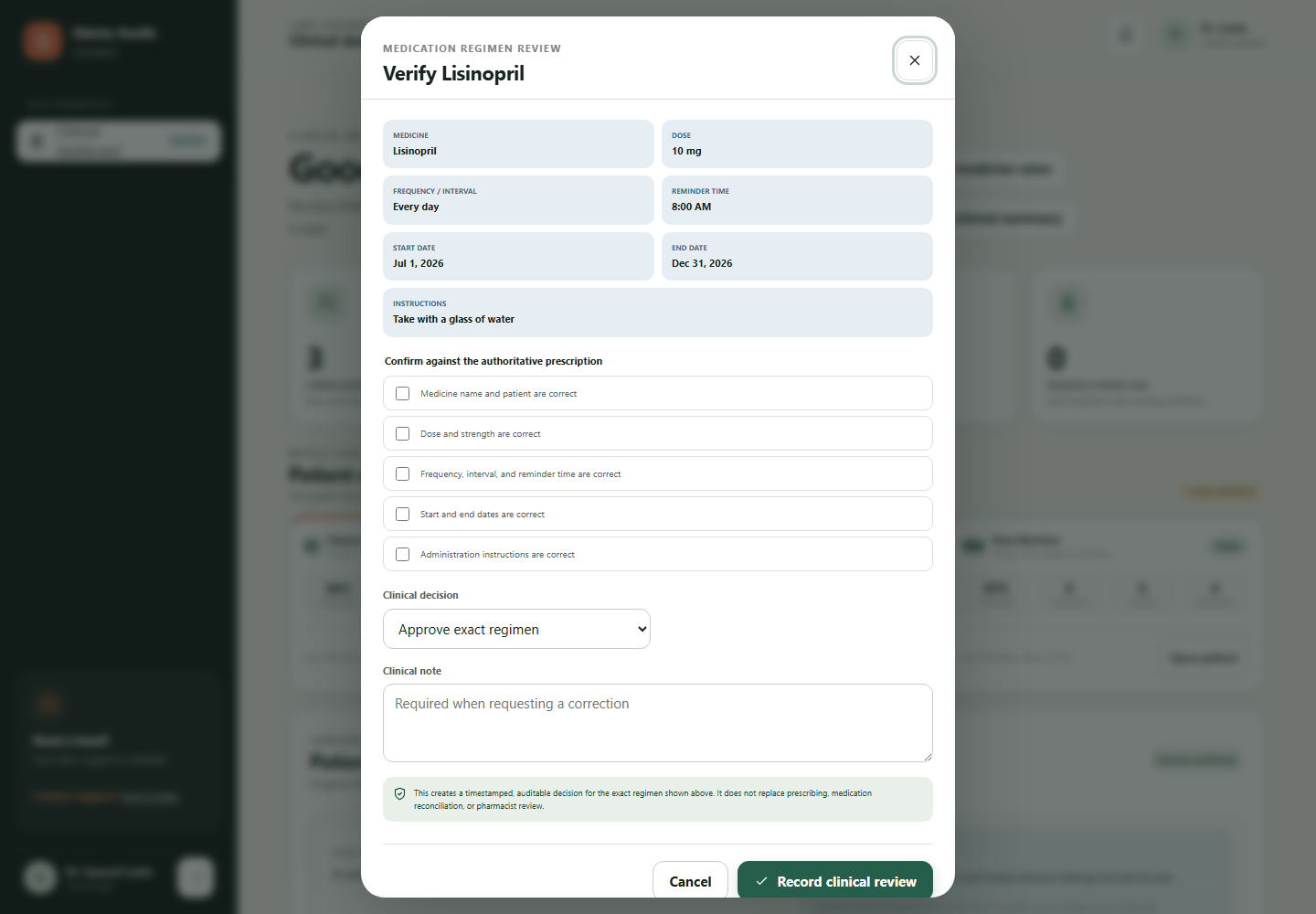
Medicine, dose, schedule, dates, time, and instructions require a timestamped clinical decision.
-
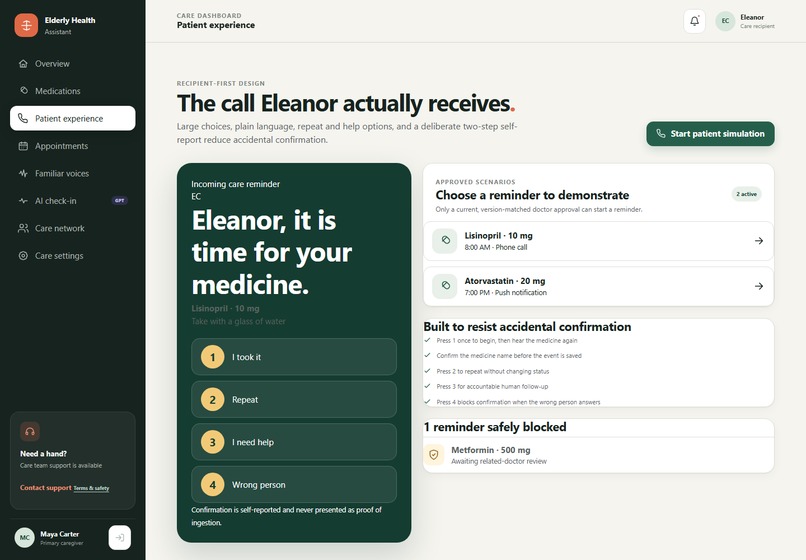
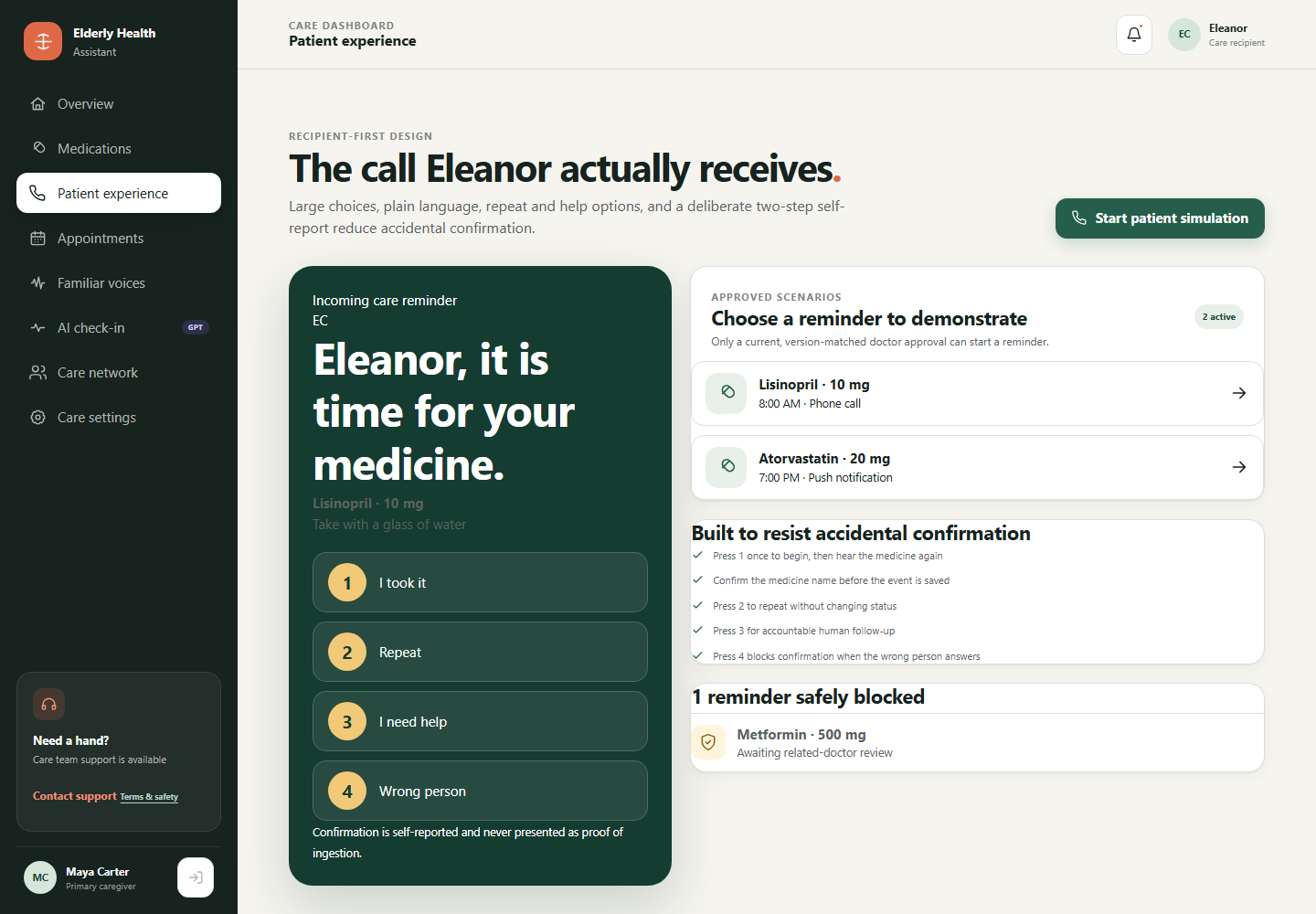
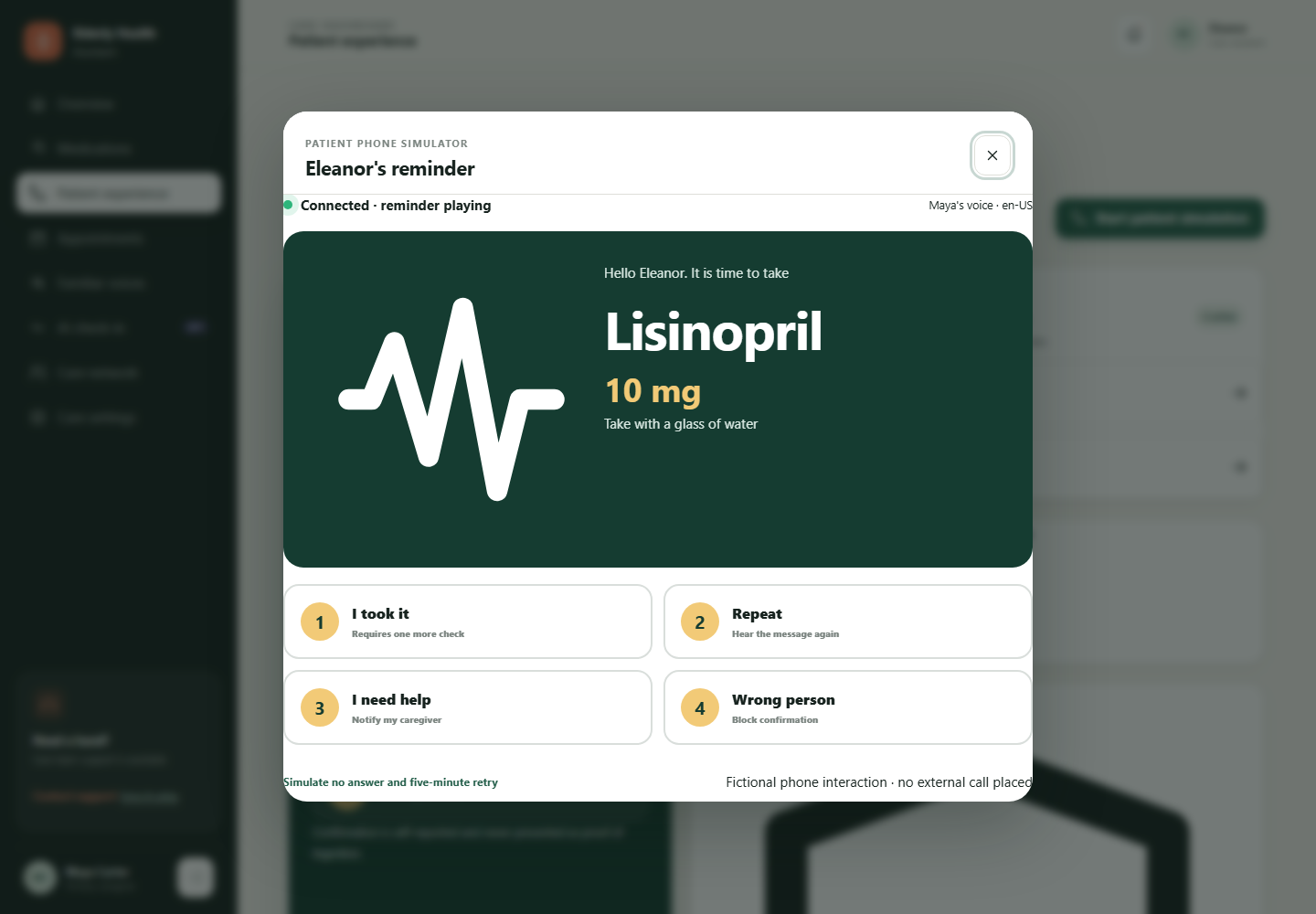
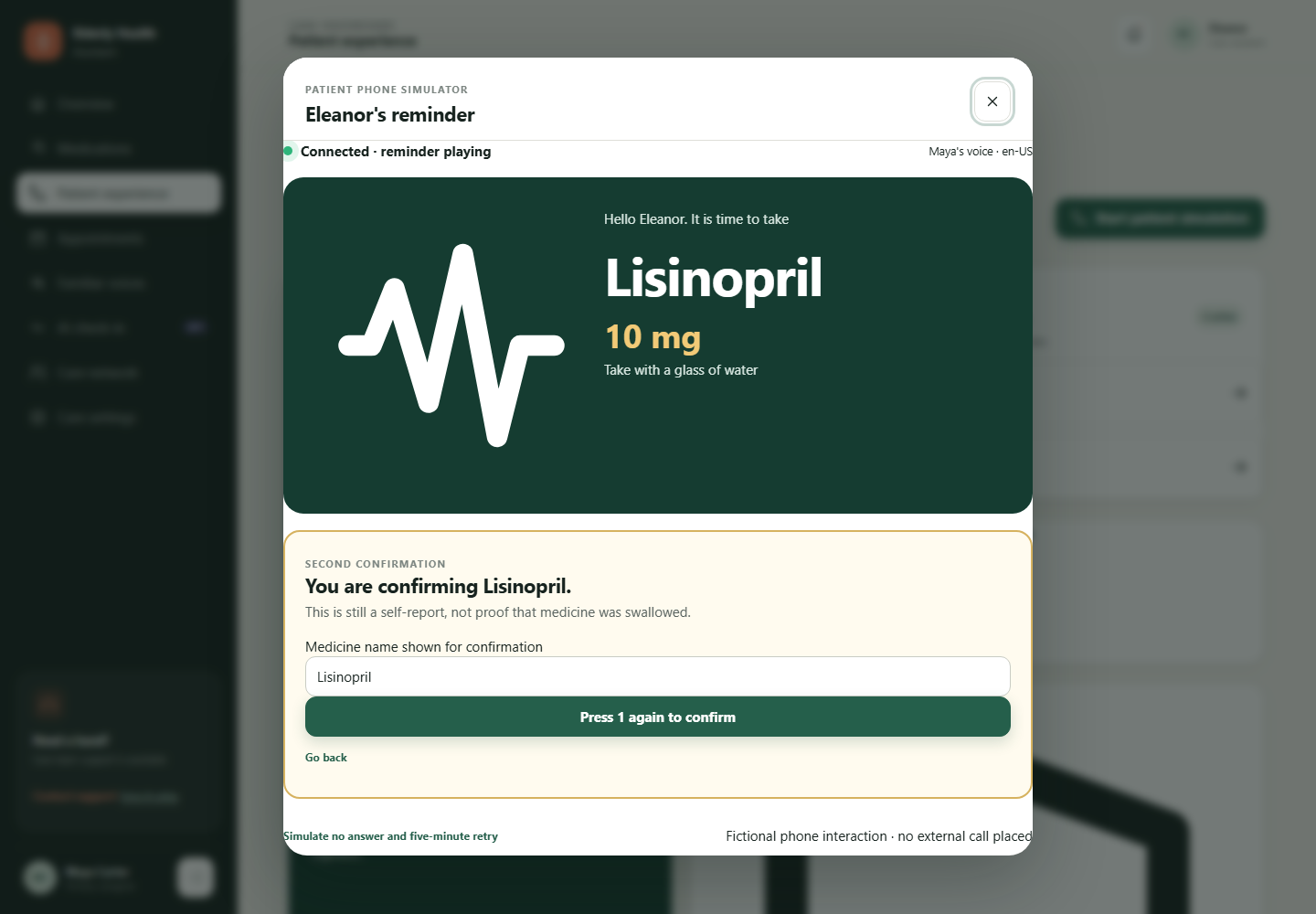
The patient receives large, plain-language choices on the phone they already use.
-
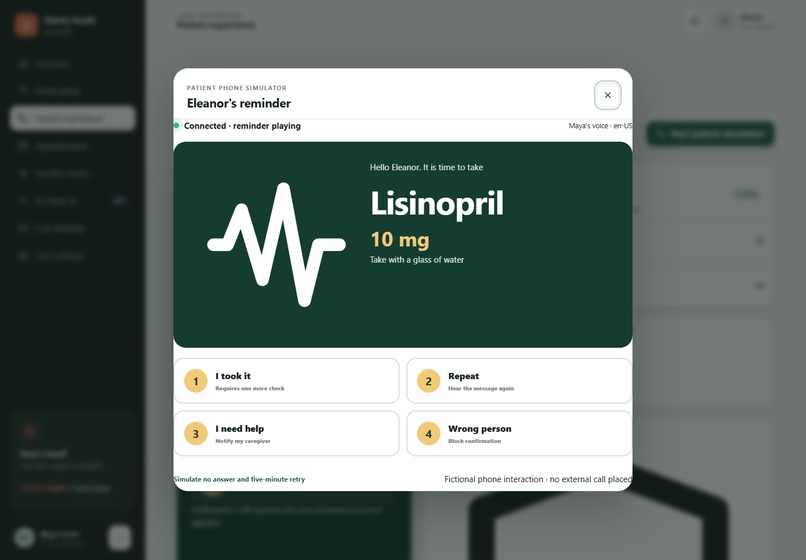
Confirm, repeat, help, and wrong-person choices prevent silence from looking like success.
-
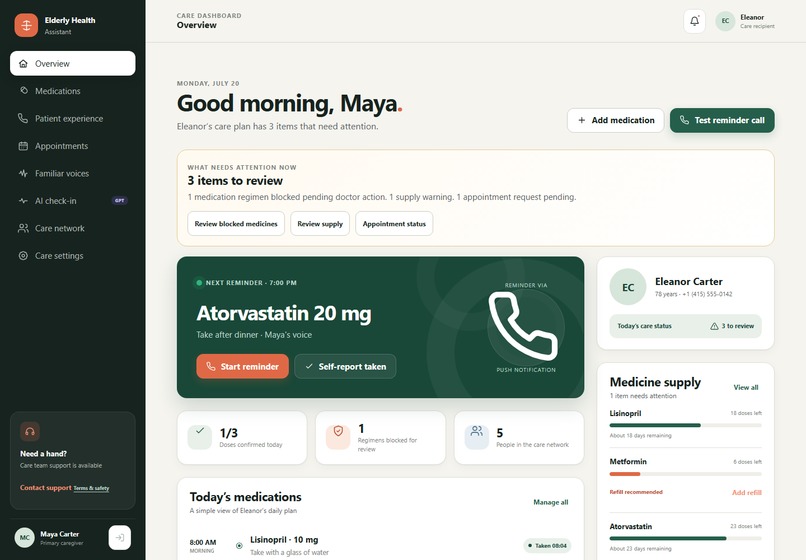
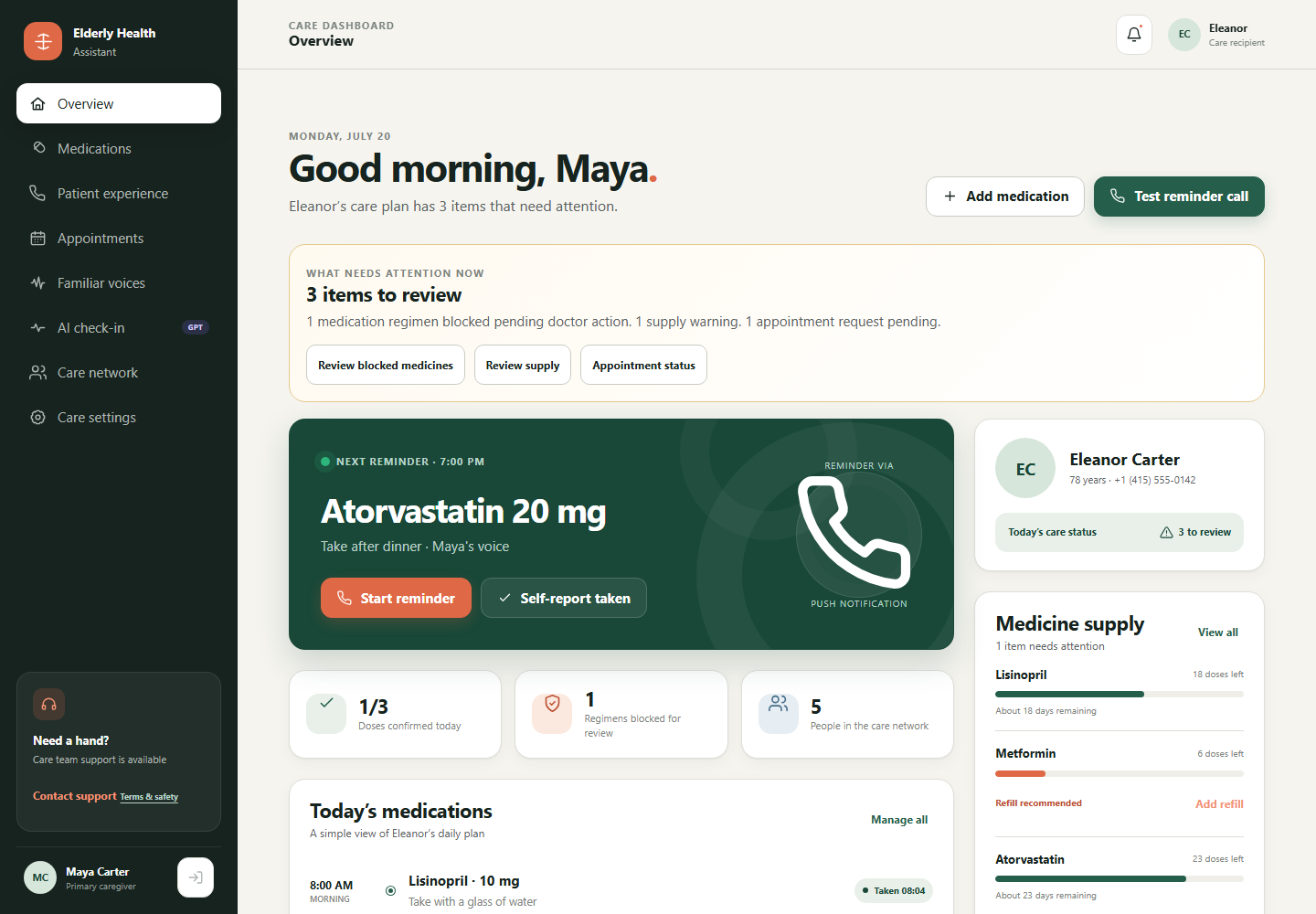
Maya sees blocked regimens, supply risk, confirmations, and the next safe action.
-
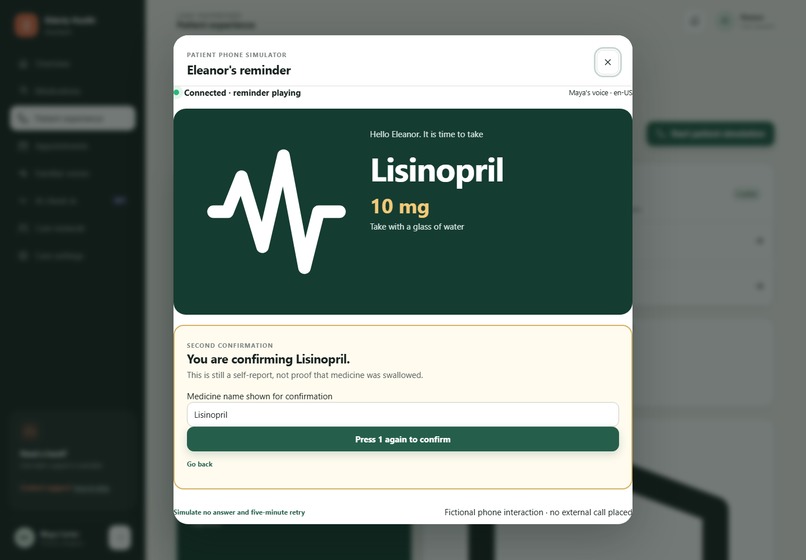
A medicine-specific second input records an enhanced self-report—not proof of ingestion.
Elderly Health Assistant (EHA)
I have had this idea for a while and just looking for an opportunity to implement it. When I saw this hackathon, I said, that’s it, let me focus on it for a few days and finish it. Then I made it. I had another idea a few months ago that implemented with help of another AI and from scratch but here and for this hackathon, I just used OpenAI Codex (GPT-5.6 Sol) and started from scratch again and even built screenshots and videos with help of Codex to unveil its power. It’s amazing.
Inspiration
The idea began with a very simple scenario:
At 9:00 PM, Grandma receives an automated phone call in her son's familiar voice: “Hi Mom, it's Michael. Please take one tablet of Metformin now.” She presses 1, hears the medicine name again, and presses 1 a second time to report that she took it. If she does not answer, the system retries after five minutes and can notify a caregiver.
I have had this idea for some time and improved the idea by adding more features such as controlling the medicine at home and trying to get more before reaching a threshold or scheduling an appointment with a doctor automatically. Additionally, I talked about the idea with a few friends to have more feedback and even think about a business plan to really launch it.
Many older adults are comfortable using a landline but may find smartphone applications, small screens, or unfamiliar automated notifications difficult. At the same time, their children and caregivers want reassurance without constantly calling or taking away their independence.
With the help of AI coding agents, I was able to turn the idea into a working MVP, that’s great. I also see a much larger path ahead: stronger privacy and security, real telephone and messaging integrations, better accessibility (for example, a family account that covers all the children or anyone else approved by the patient), connect the app to doctors and pharmacies to order the required medicine automatically and post it to home of the patients, and careful alignment with requirements such as HIPAA and GDPR. This prototype is the starting point, not a claim of completed regulatory compliance.
What it does
Elderly Health Assistant helps families coordinate medication reminders, medicine supply, appointments, familiar voices, and care-team access.
An authorized caregiver can create a private care profile for a parent, grandparent, relative, or client and enter:
- Medicine name, dose, instructions, start date, end date, interval, and reminder time
- Preferred reminder channel and phone number
- Current medicine supply and refill threshold
- Familiar voice recordings and the medicines they may be used for
- Doctor appointments and preparation notes
- Family caregivers and multiple related doctors
When a dose is due, the intended production system calls the older adult's landline or mobile phone and explains what to take. The reminder can use an approved recording from a child, grandchild, caregiver, doctor or AI. The recipient confirms with a simple keypad action. If no confirmation arrives, the workflow retries after five minutes and can escalate through voicemail, SMS, push notification, or a caregiver alert. The app can send the alert to the related doctors as another escalation step.
The MVP simulates this closed-loop call flow in the browser. It also includes:
- A caregiver dashboard with today's doses, confirmations, supply warnings, and appointments
- A medicine-management flow with schedules, channels, voices, phone numbers, and stock
- Multiple voices per medicine with caregiver-controlled priority or random rotation
- A care network containing family members and different specialists
- Scoped clinician access to related medicines and record categories
- A doctor dashboard with authorized patient context and clinical alerts
- Whole-caseload doctor monitoring that surfaces missed confirmations, refill risk, declining adherence, and patient appointment requests
- Preference-aware appointment requests that rank the nearest available doctor times and require doctor confirmation before booking
- A fictional Hindi-to-English appointment language bridge that preserves the patient's original words, requires caregiver review, and shows both versions to the doctor
- Exact-regimen doctor verification for medicine, dose, instructions, start/end dates, interval, and reminder time; any change requires a new review
- Server-enforced reminder blocking until that exact regimen version is doctor-approved
- An elderly-first phone simulator with large confirm/repeat/help/wrong-person choices and deliberate double confirmation
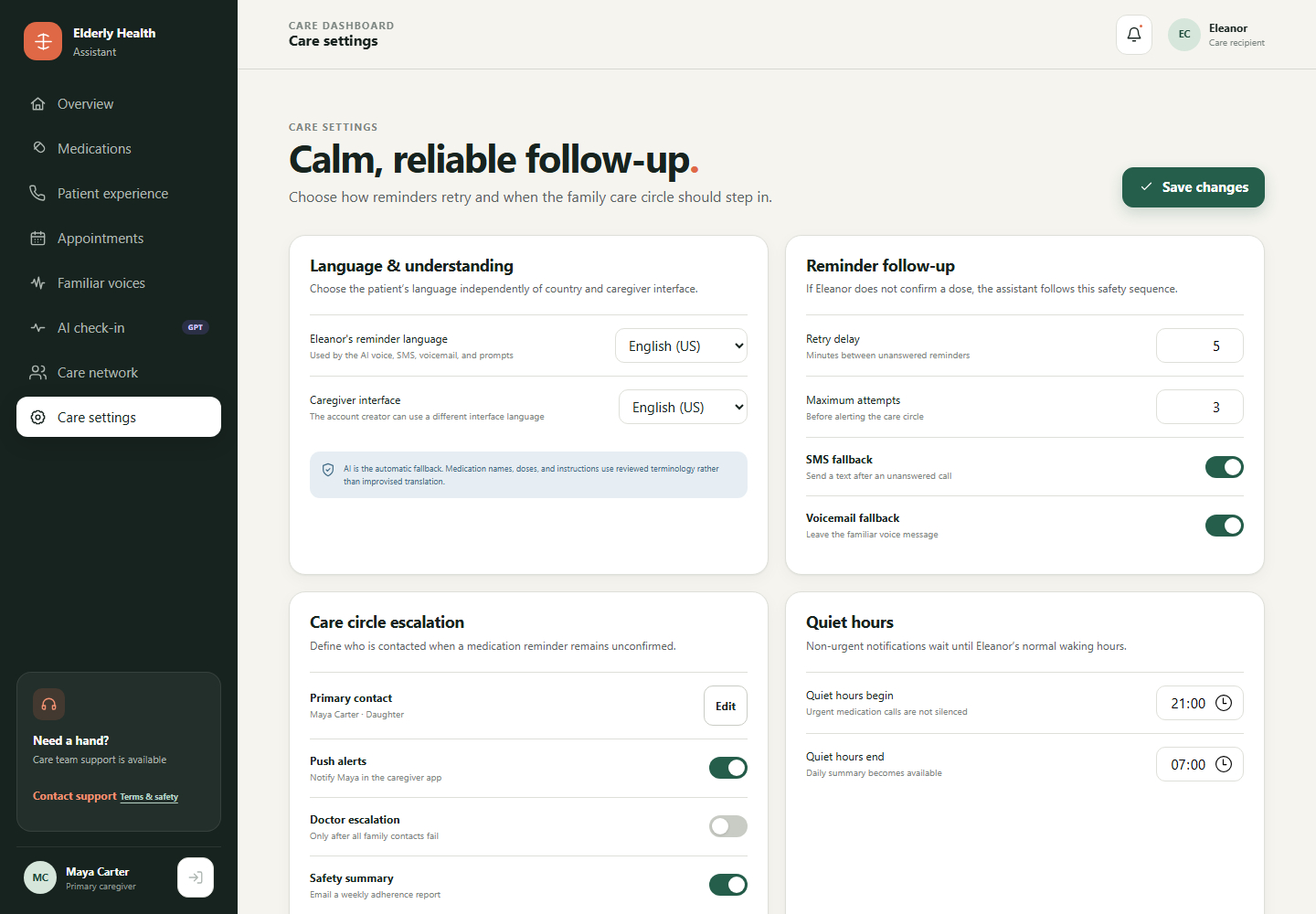
- Patient-specific language preferences independent of country, with multilingual AI as the default and approved family/doctor recordings as optional language-compatible overrides
- An administrator dashboard with aggregate statistics, escalations, organizations, and service health
- Prototype consent, audit-event, data-export, and privacy-request workflows
The MVP now includes an opt-in GPT-5.6 wellbeing check-in. It structures concerns the person explicitly reports, produces one bounded follow-up question, drafts a minimum-necessary caregiver summary, and requires human confirmation before routing. A deterministic server rule can override potentially urgent phrases. Analysis of vocal characteristics remains future work requiring separate consent and clinical validation; the implemented feature does not diagnose from vocal tone or promise emergency detection.
Why it stands out
- It reaches patients through a landline (as the first priority) instead of assuming smartphone. A very simple solution for elderly people.
- The patient chooses a reminder language independent of country; multilingual AI is always available, while approved family and doctor recordings can provide a personal override.
- It closes the loop through self-reported confirmation, five-minute retry, supply awareness, and accountable escalation.
- Related doctors receive specialist-scoped access and verify the exact, version-bound medication regimen.
- GPT‑5.6 structures what the patient explicitly reports and routes it to humans without claiming diagnosis from vocal tone.
- Role isolation, consent behavior, audit events, and honest compliance boundaries make trust part of the product rather than an afterthought.
- It tries to build an ecosystem and close more gaps by adding pharmacies, post, …
How I built it
I built the hackathon MVP as a solo developer. It is a dependency-free web application so judges can run it locally without installing packages or configuring cloud accounts and etc.
- Frontend: HTML, responsive CSS, and vanilla JavaScript
- Backend: Node.js using the built-in HTTP and cryptography modules
- API: JSON endpoints for authentication, care plans, medication, appointment matching and translation review, voices, clinicians, statistics, consent, and privacy workflows
- Current persistence: a local JSON file containing fictional demo data
- Production data design: a PostgreSQL schema for care recipients, medicines, schedules, reminder attempts, confirmations, inventory, appointments, care-circle permissions, recordings, consent, and audit events
- Security patterns demonstrated: server-side sessions, role-based routes, scoped API responses, password hashing for created accounts, same-origin checks, restrictive browser headers, consent status, and audit events
- OpenAI integration: Responses API with
gpt-5.6-sol, strict structured output, low reasoning,store: false, server-only credentials, rate limiting, deterministic safety overrides, and a transparent local fallback
The interface was designed around three roles:
- A family caregiver who coordinates the care plan
- A doctor who sees only the information authorized for their specialty and relationship
- A platform administrator who monitors aggregate operations and service health
AI coding agents helped me accelerate UI implementation, API development, schema design, testing, documentation, and threat-oriented review. I covered the idea, product decisions, use cases, scope, implementation choices, and final evaluation of the generated work.
Challenges I ran into
The main challenges that I faced during implementation of this application are:
Balancing hackathon portability with production architecture
The current MVP uses a local JSON file so it starts immediately on a judge's computer. That is useful for a demo but is not suitable for real health data. A production deployment would require PostgreSQL transactions and tenant isolation, encrypted object storage, durable queues, MFA, signed provider webhooks, monitoring, backups, and formal operational controls.
Avoiding false compliance claims
HIPAA and GDPR compliance cannot be achieved through a few UI controls. It also depends on the deploying organization, legal roles and bases, vendor agreements, risk analysis, policies, training, incident response, retention, and ongoing verification. I therefore describe the project as a privacy-conscious fictional-data prototype rather than a compliant production system.
Accomplishments that I'm proud of
- Turned a simple phone-call scenario into a coherent multi-role care platform
- Implemented caregiver registration and separate caregiver, doctor, and admin experiences
- Connected dose confirmation with medicine-supply awareness
- Supported several approved voices per medicine with priority and random strategies
- Modeled family access and multiple specialist relationships instead of assuming one caregiver and one doctor
- Added minimum-necessary clinician views, visible consent state, privacy workflows, and audit events to the MVP
- Designed a production-oriented data model, API boundary, durable reminder architecture, privacy controls, and phased roadmap
- Integrated GPT-5.6 through the Responses API with strict output, human confirmation, a server safety override
- Added a credible subscription model with communication-cost guardrails, care-organization expansion, and no advertising or sale of health data
- Built an auditable request-to-calendar-proposal-to-doctor-confirmation workflow with double-booking protection
What I learned
The biggest lesson is that accessibility is not only about larger text or better color contrast. It is also about choosing the right interaction channel. For some older adults, the most accessible interface is the telephone they already know.
Privacy and security decisions shape the product itself. Consent, revocation, scoped access, auditability, and transparent language cannot be postponed until after the interface is finished.
Finally, AI agents can dramatically accelerate an MVP, especially across design, code, schema, documentation, and testing. They work best when guided by a clear human scenario, explicit boundaries, careful verification, and honest decisions about what is implemented versus what remains on the roadmap.

Log in or sign up for Devpost to join the conversation.