-
-
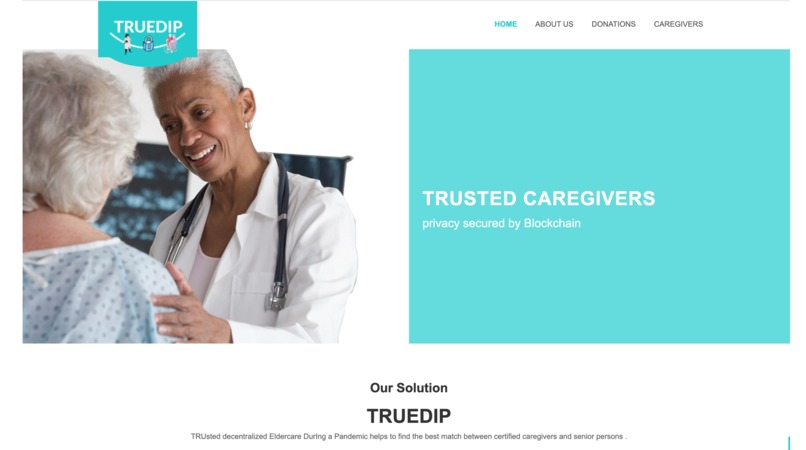
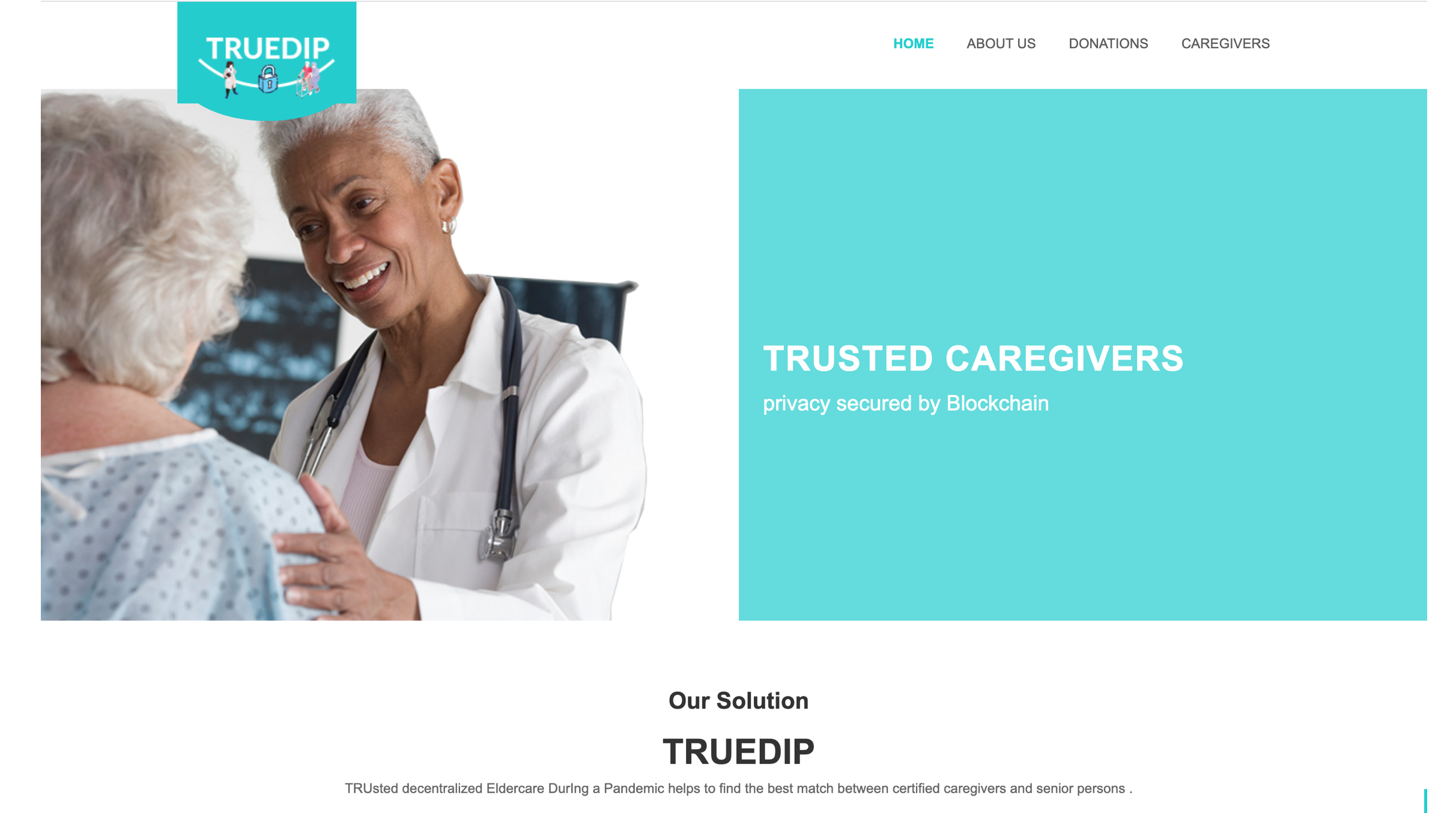
TRUEDIP: Trusted caregivers
EPI Team: Nguyen Duc Lam (technical leader), Dick Carrillo Melgarejo, Arun Narayanan, Pedro Elkind Velmovitsky. Plinio Morita, Pedro Nardelli, Petar Popovski.
Video Demo & Full text Proposal
Inspiration
Taking care of the elderly population is of crucial significance during a pandemic due to (1) higher mortality rate and (2) longer times for which they are affected by lockdown; that is, they may have the most restricted movement. Caregivers need to help seniors not only in household tasks but also buying groceries, shop for supplies or transport them to another place. All this must be done by people that, with a high likelihood, are negative for the virus. The proposed TRUEDIP system is expected to help via a mobile APP and a webpage to find the best match between certified caregivers and seniors. The proposed solution – and our main innovation – is to build such a platform based on the blockchain technology, for increased security and privacy.
What it does
TRUEDIP is a service app that efficiently and accurately connects caregivers to the elderly who need assistance. In detail, TRUEDIP creates and provides a trusted database of verified caregivers. The database will include critical information such as certification of their health conditions based on recent negative tests to COVID-19 as well as other harmful diseases. In addition, each caregiver will have a profile showing their history of diseases and care work, as well as the availability (related to location and time) and possibly associated price (if related to private service). The features of the proposed solution are:
1. It builds a trusted database of caregivers that are monitored for symptoms/infection.
2. Incentivization of the caregivers to use the platform by the collection of metrics and proven track record. For example, showing the number of collected points/cryptocurrency to a state agency offering elderly care and claim payment.
3. Other services and professions can be made part of it. For example, if taxi drivers are part of TRUEDIP, then they are monitored for health condition to be able to offer transport to the elderly.
4 Older adults traditionally do not have technology knowledge. Blockchain can improve on that in two ways: (1) by guaranteeing, more than any other technology, that data security and privacy are preserved, so elderly will trust it and do not have to worry about any privacy concerns; (2) by potentially allowing, in the future, self-sovereign identity to be implemented on the blockchain, and therefore elderly (and caregivers) can easily be verified. This identity could be linked to the aforementioned other service providers in order to be admitted and certified.
5. Offer a possibility and interface for external parties to donate money to the platform by buying cryptocurrency tokens and thus helping to finance the payment claims in points 2 and 3.
6. Provides an easy to use interface for patients and caregivers to interact with a complex system as blockchain, which is critical considering often observed challenges that seniors have when interacting with technology. Seniors and caregivers will not need to interact with the blockchain directly; rather, they will access it through the user-friendly interface developed with the end-users in mind and blockchain will run in the background to secure data from seniors and caregivers.
How we built it
On Friday, the team brainstormed to decide about the proposed solution. After converging in the topic of supporting care of the elderly population, the most vulnerable to COVID-19, via blockchain, the team organized the action plan based on the individual expertise and time availability. Lam was nominated as the team leader due to his technical expertise in blockchain. The activities started on Saturday morning based on different fronts, as follows.
Technical: Lam defined the conceptual architecture and developed the backend and Dick on the frontend. Arun and Pedro V. also provided technical support.
Conceptual: Preparation of presentation material (slides and report). This was a collective work between Pedro N., Pedro V., Plinio, Arun and Petar. Lam and Dick also provided inputs related to the more technical part.
The solution’s impact to the crisis
The mortality ratio of older adults is much higher than in other groups. This is specially concerning in Europe, as 29 out of top 30 countries with the largest population of older adults are EU members. Countries like Sweden (which has applied less strict restrictions compared to Denmark, Finland or Iceland), with reasonably high life standards, are suffering from the COVID-19 pandemic, leading to thousands of deaths - the majority of which in this vulnerable group. Even in countries with higher restrictions but with a high percentage of older adults living alone, such as Finland, a trustworthy control of caregivers (potential vectors of virus) is a must.
Our solution provides a trusted database, enabled by blockchain technologies, that guarantees that the data related to care personnel was not modified (purposefully or not) and then provides a certification of the professionals. This solution has the potential to greatly improve the management and care of older adults during this pandemic, since it can:
(1) provide optimal match between the elderly living alone (or his/her responsible) and the caregiver. This solution would help to control the contacts between senior persons and caregivers, tracking their network of contacts and avoiding unnecessary contacts, which is expected to help to control COVID-19 propagation.
(2) allow residents of understaffed nursing homes to find certificated care workers during the crisis, which will provide a better care of older adults living in care facilities and increase staff to monitor and comply with COVID-19 regulations.
The value of TRUEDIP after the crisis
While the current pandemic has shed a light on several limitations in elderly care, these limitations existed in healthcare systems prior to COVID-19. Nursing homes are severely understaffed, and healthcare workers underpaid, despite being extremely important to allow the care of seniors. Older adults are the most affected by this, as they will not receive proper long-term care to age successfully and well. In the case of older adults living alone, finding a certificated caregiver with a proven track record of successful care is essential. However, this is not currently possible. TRUEDIP may provide a technological tool that may trigger a change. By recording information on the caregiver on a blockchain-enabled trusted database, including existing health conditions, previous care and work experiences, adverse events with prior patients, specializations, and price (in the case of a private caregiver), our solution will allow residents of long-term care homes to find the best caregivers, as well as older adults ageing at home (or his/her responsible) to find the caregiver most qualified and suited for their needs.
In addition, older adults traditionally do not have a lot of technology knowledge. The use of blockchain as the foundational technology of our solution can build on this by guaranteeing, more than any other technology, that data from the solution (e.g., location and age of an older adult, whether the senior requires a caregiver) is secure and private. Therefore, the elderly population will not have to worry about any privacy concerns. The same goes for caregivers enrolled in the platform: the blockchain back-end will also be used to secure their data in the platform and guarantee that it is not tampered with, ensuring its privacy. Another potential use case of blockchain technologies is the implementation of digital identities. By providing an immutable ledger, blockchain can securely store records, registries and, in this case, identities. Once a person’s identity is verified and authenticated, the digital identity will be securely stored in the blockchain and accessed for later use. This would allow easier verification of older adults, which would not require complicated bureaucracies to access the platform. In the same vein, older adults would have complete confidence that the caregivers are verified and who they say they are. This is a feature that the TRUEDIP team wishes to implement in the future, as it can be incorporated to admit other associated services (e,g, taxi drivers).
In summary, TRUEDIP can quickly provide a secure way of connecting older adults and nursing homes to qualified and trusted caregivers, improving elderly care not only during this current pandemic but beyond and, ultimately, saving lives.
Challenges we ran into
Developing design ideas was a bit challenging especially because none of us were experts in web design. For example, we had problems in designing a friendly application for everyone, and specifically for elders. We first have a chance to start with a local Ethereum test site. Then, we went online and tested in an unstable test environment.
Accomplishments that we're proud of
(1) We are proud to have contributed to the community to fight against Covid-19.
(2) We were able to leverage our skills to come up with an important idea and then to build a tangible, useful product.
(3) We were able to quickly build a basic proof-of-concept solution.
(4) We focused on trust and security.
(5) We co-ordinated extremely well with a multinational team to complete the report, presentation, and this webpage in a nice and informative manner.
What we learned
During the Hackathon, we have learned how to interact with basic tools about Blockchain as Metamask, RSK, and Solidity environment. Creating a Blockchain-enabled Smart Contract system to defense Covid-19 in a short time frame is tough but worth trying. We are amazing in teamwork and collaboration.
What's next for TRUEDIP
To continue with the proposed TRUEDIP, there is the need of support of local governments and authorities in testing caregivers, as the results of these tests will inform the platform and allow verified and healthy caregivers to care for older adults. In addition, financial resources to implement a blockchain network throughout the EU is necessary. With nodes throughout all member countries, extensive contact tracing between older adults and caregivers will be provided. The platform will allow seniors across Europe to find caregivers and receive proper care.


Log in or sign up for Devpost to join the conversation.