-
-
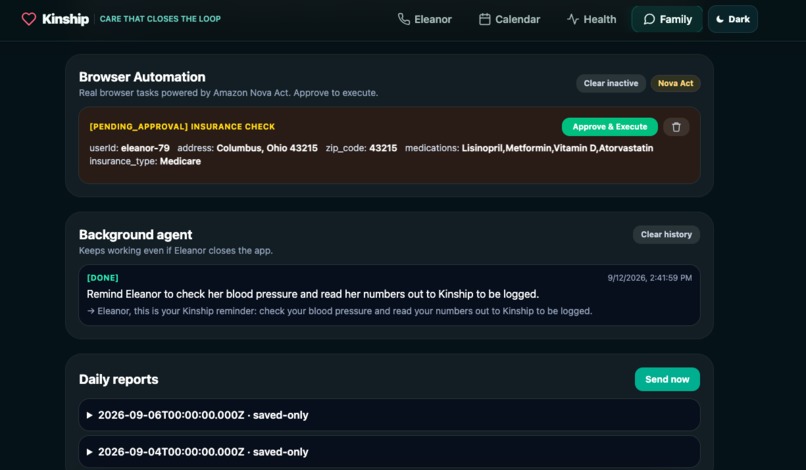
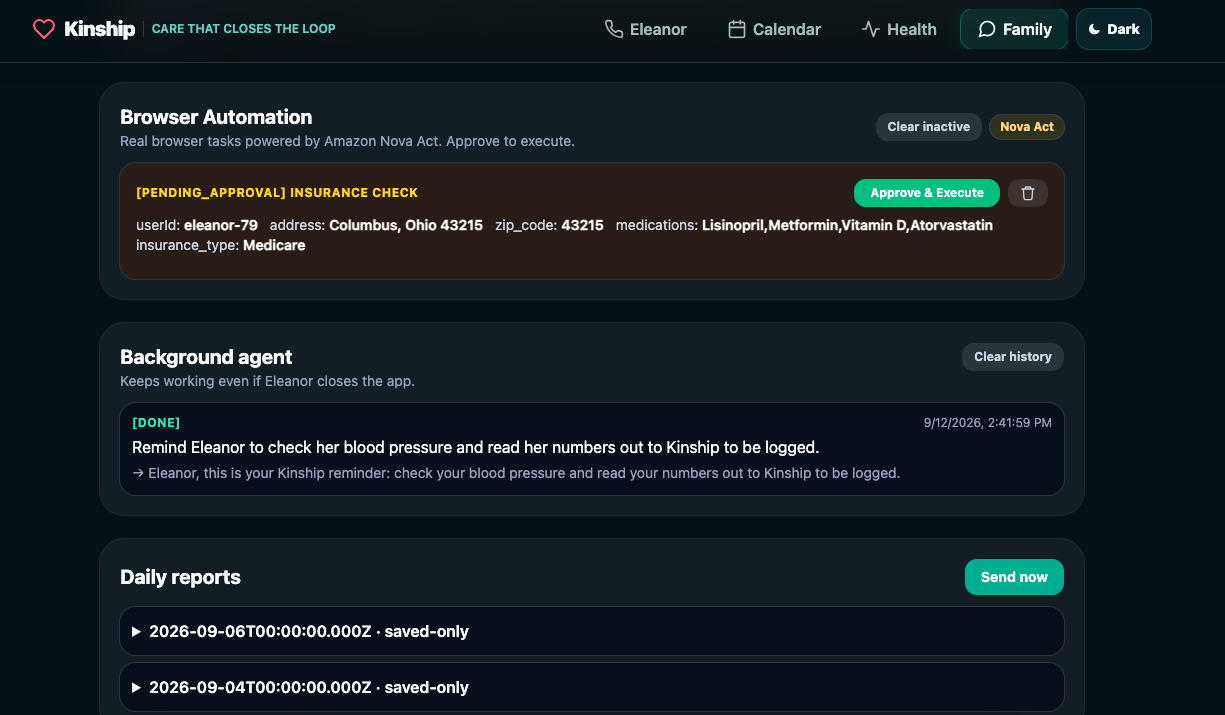
Sarah approves a bounded Medicare provider-search request
-
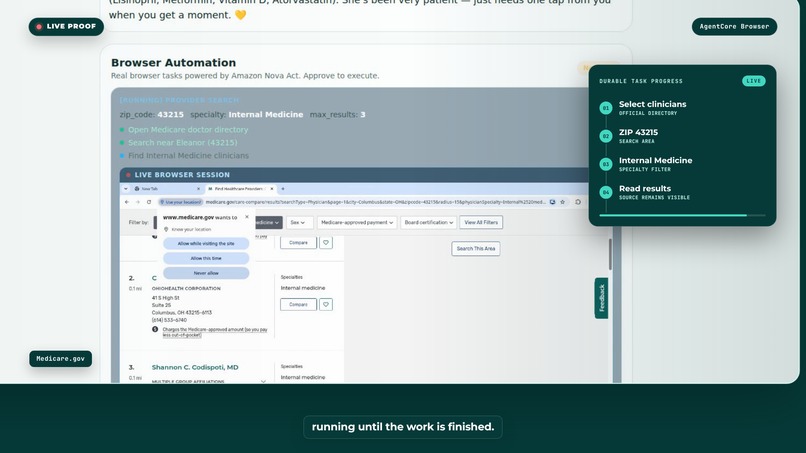
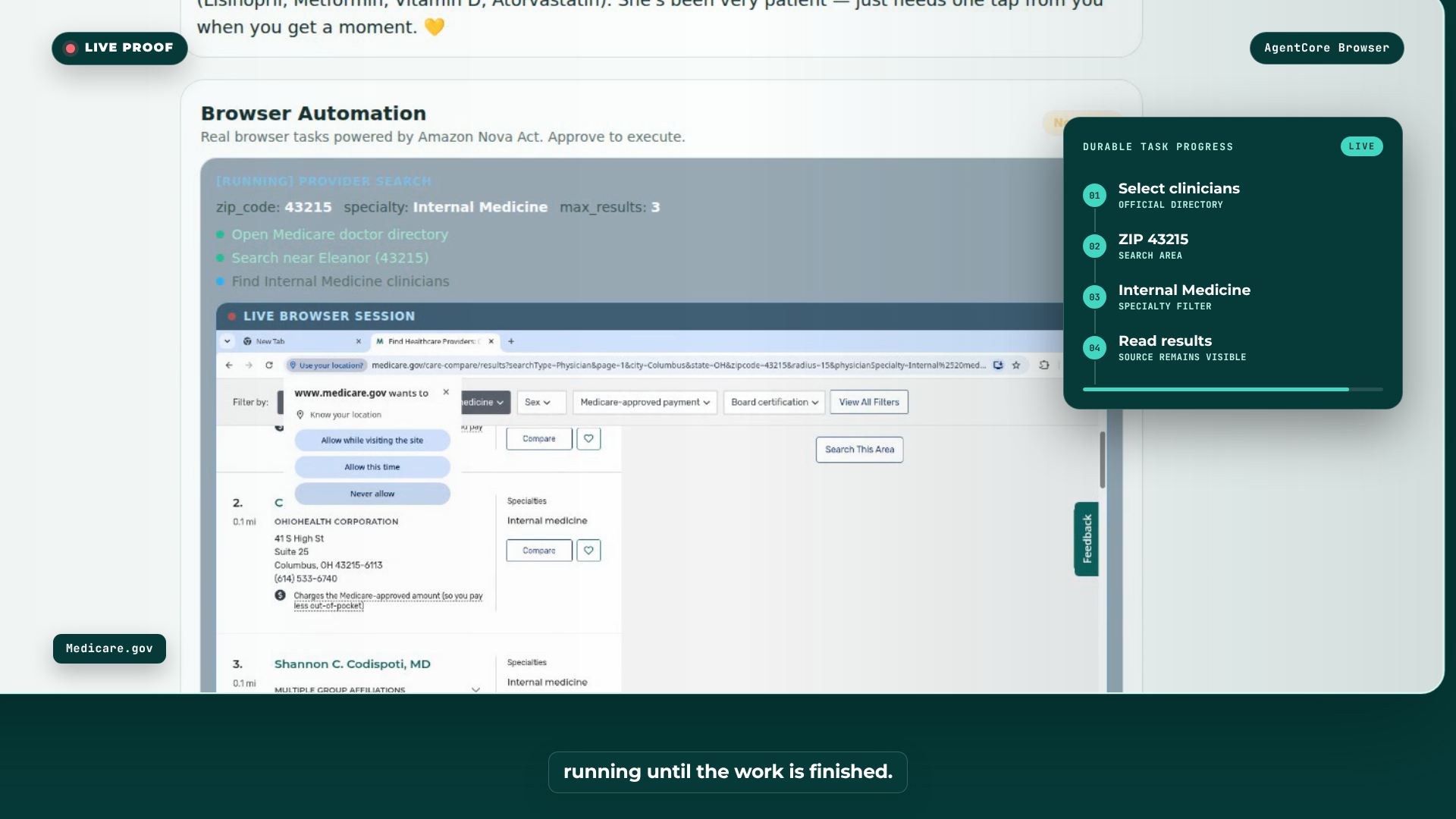
Nova Act executing inside a live AgentCore Browser
-
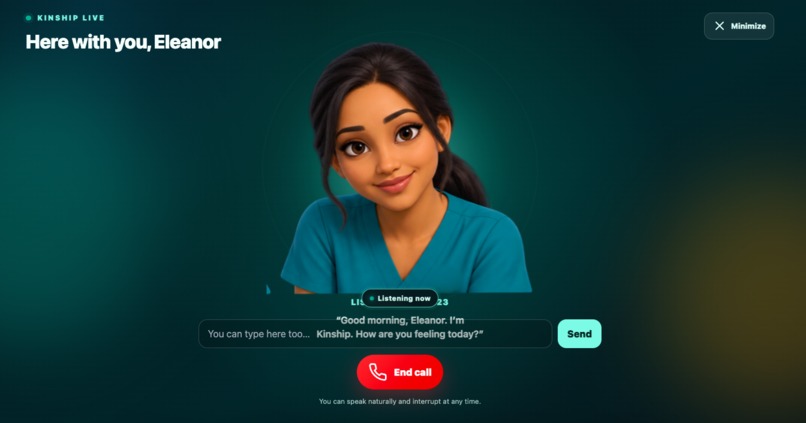
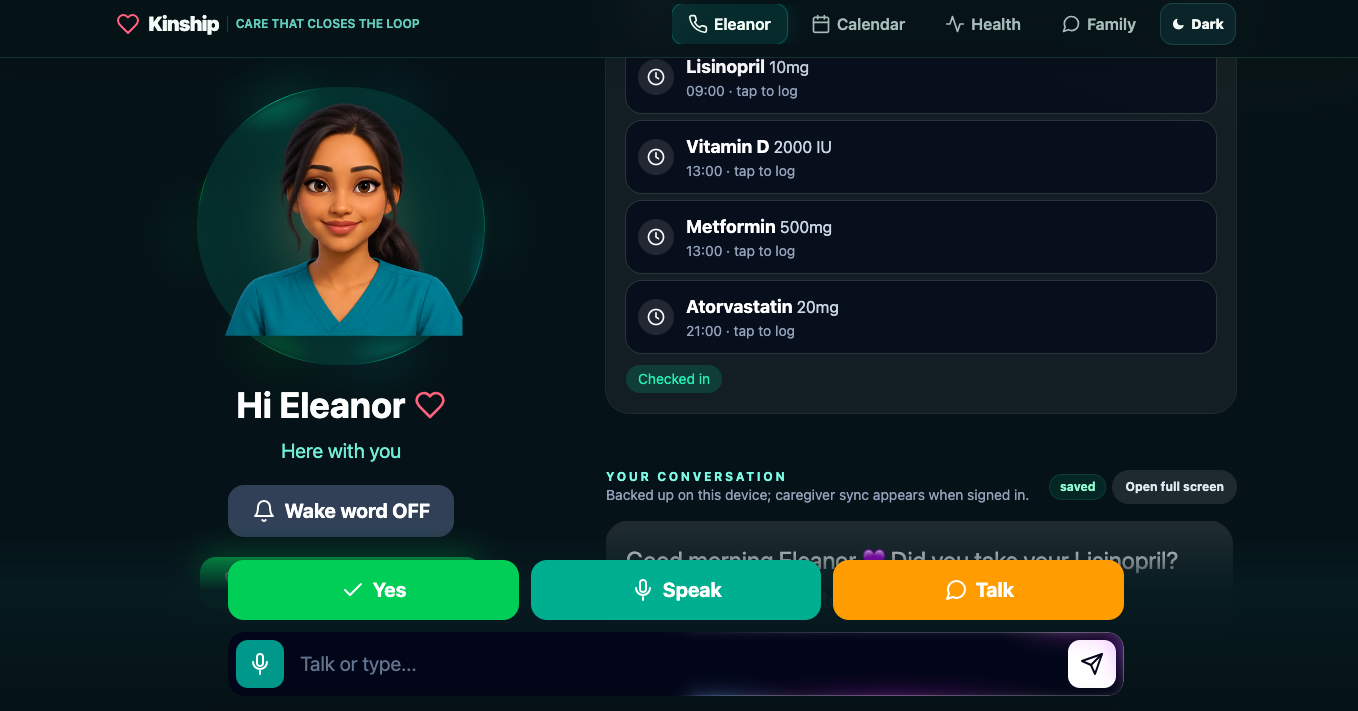
Eleanor’s accessible voice-first care experience
-
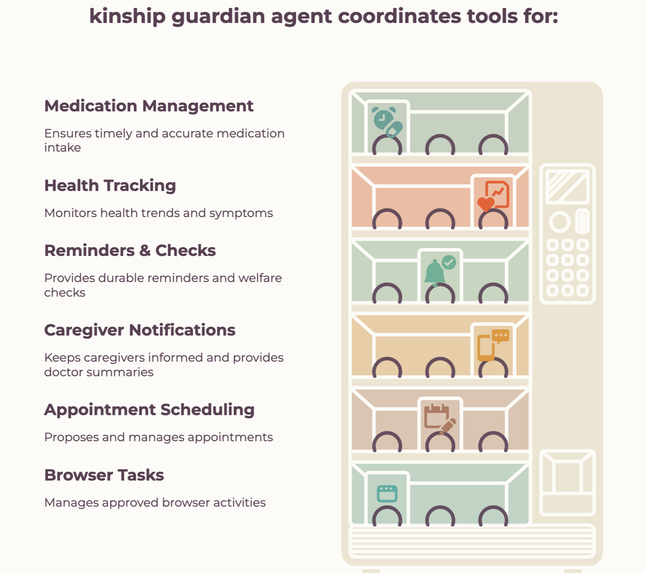
kinship features
-
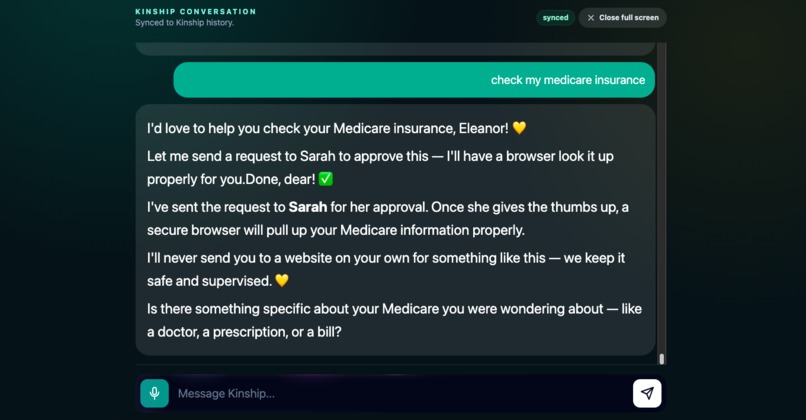
kinship chat
-
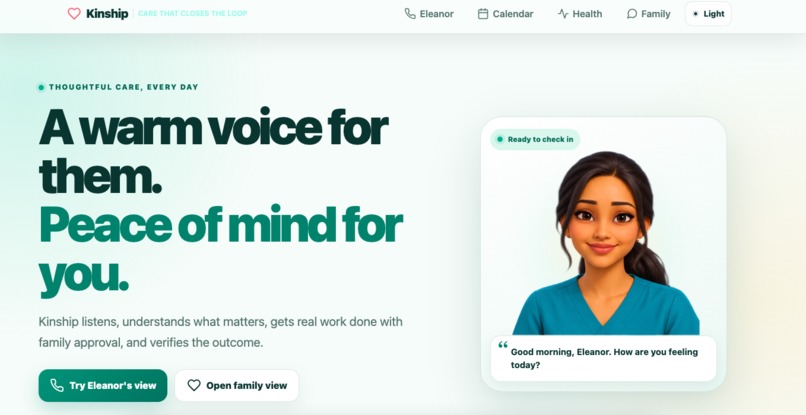
kinship
-
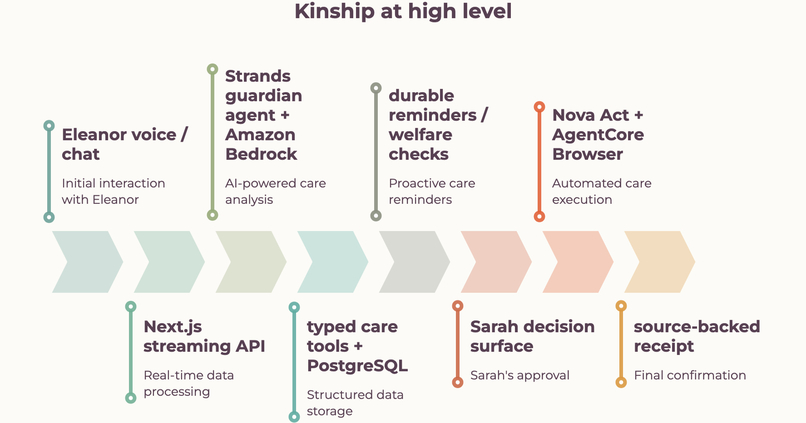
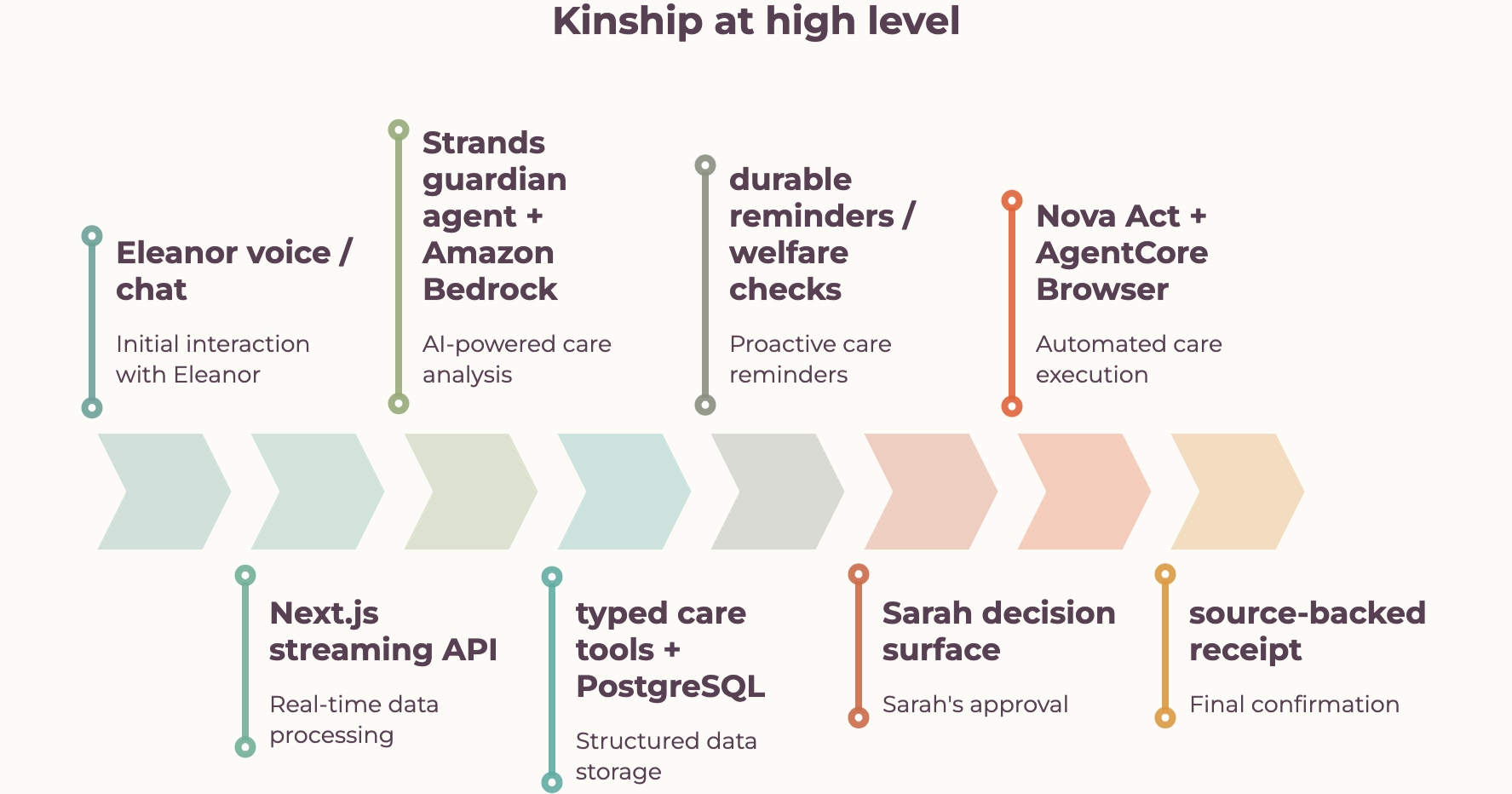
kinship high level
-
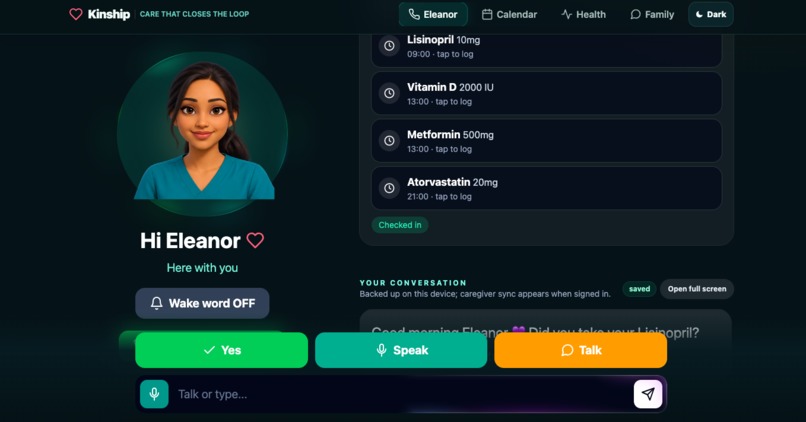
kinship senior
-
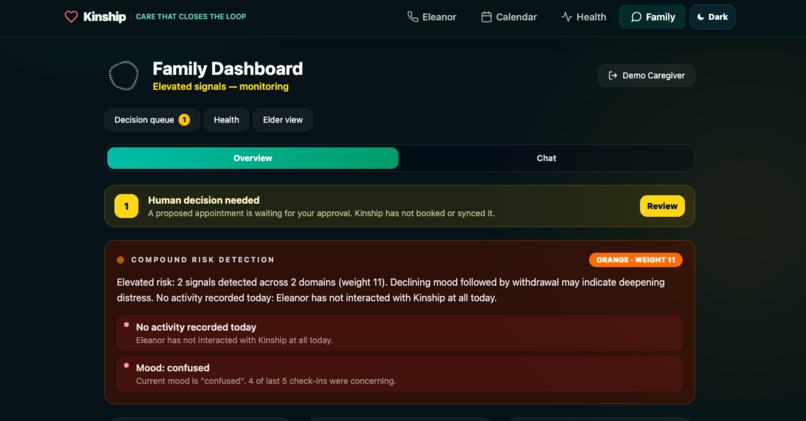
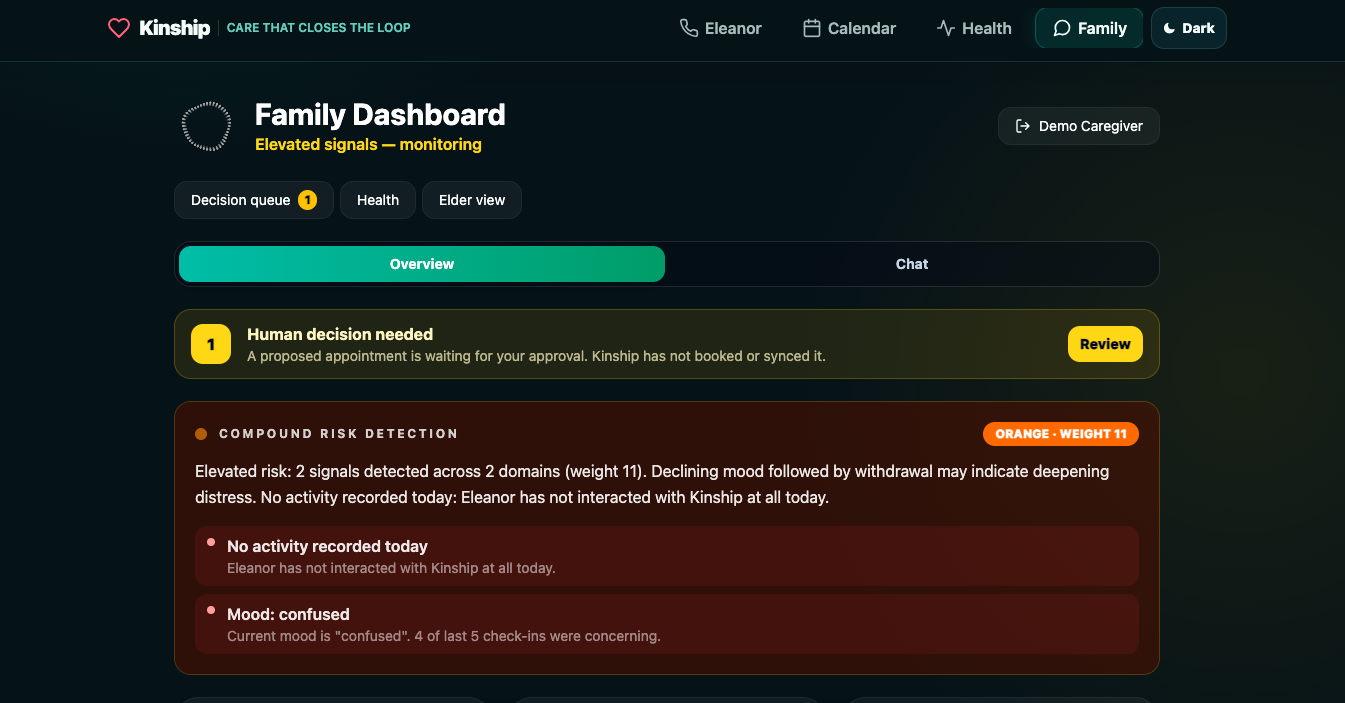
kinship caregiver dashboard
-
kinship logo
Kinship - An AI Care Agent for Older Adults Living Alone
Track: Everyday Agents
Elevator pitch: Kinship talks with older adults, logs medications, schedules and monitors follow-ups, and uses Amazon Nova Act to complete caregiver-approved tasks such as finding Medicare doctors—alerting family only when a risk or real decision needs them.
Inspiration
Family caregiving is a second shift made of small, relentless questions:
- Did Mom take her medication?
- Is today’s silence normal?
- Was the appointment confirmed?
- Which nearby doctor accepts Medicare?
- Did anybody follow up?
Most care products turn those questions into more alerts. They detect something, notify a daughter, and leave her with the same work and the same uncertainty.
We built Kinship around a different idea: the agent should handle repetition quietly and involve family only when human judgment or approval is required.
What it does
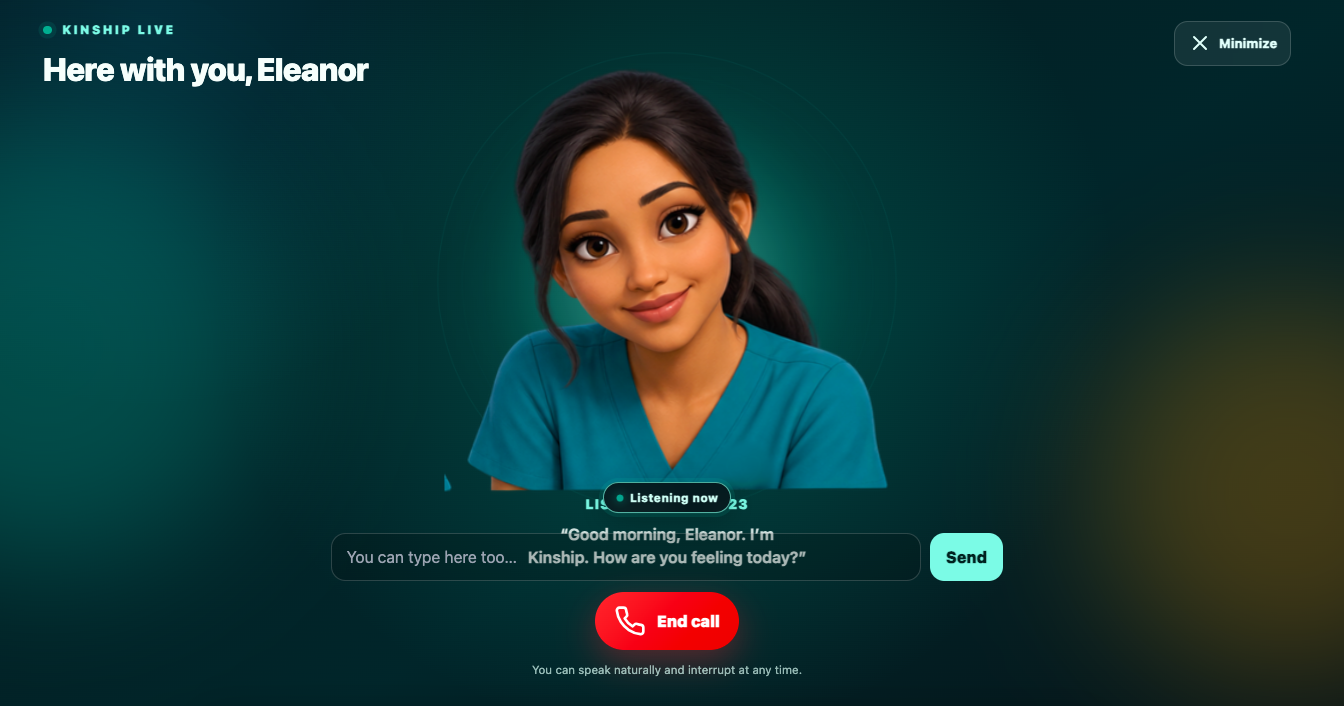
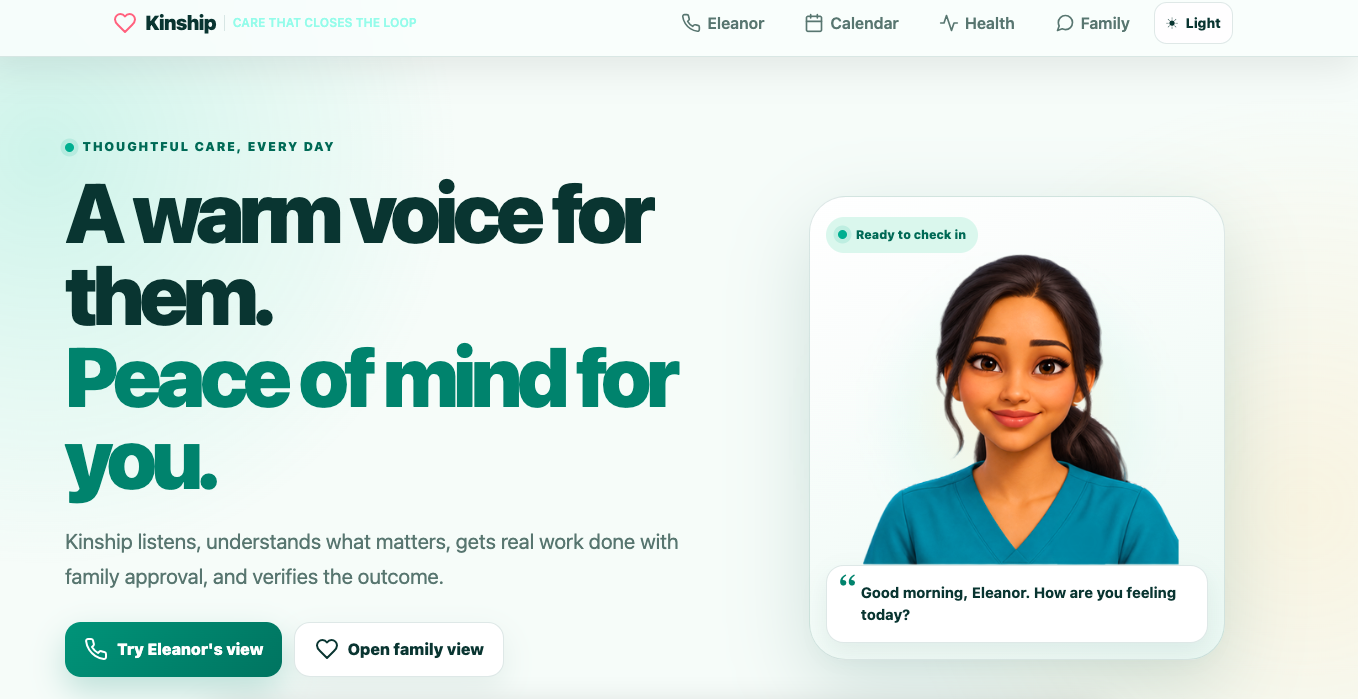
Kinship is a voice-first AI care companion for older adults living independently and a decision surface for their families.
Our demo follows Eleanor, 79, and her daughter Sarah.
Eleanor can speak naturally to Kinship or use a simple senior-friendly interface. In one real production interaction, she says that she took her Metformin and asks for a blood-pressure reminder. Kinship:
- Streams its response in real time.
- Calls the medication tool and safely records the dose.
- Creates a durable follow-up task.
- Keeps that task running after the conversation ends.
- Shows the exact task on Sarah’s caregiver dashboard.
- Alerts Sarah only if Eleanor misses the follow-up or a decision is required.
Kinship also connects medication adherence, symptoms, mood, activity, health signals, appointments, and conversation history into one care context. It does not diagnose or change dosages.
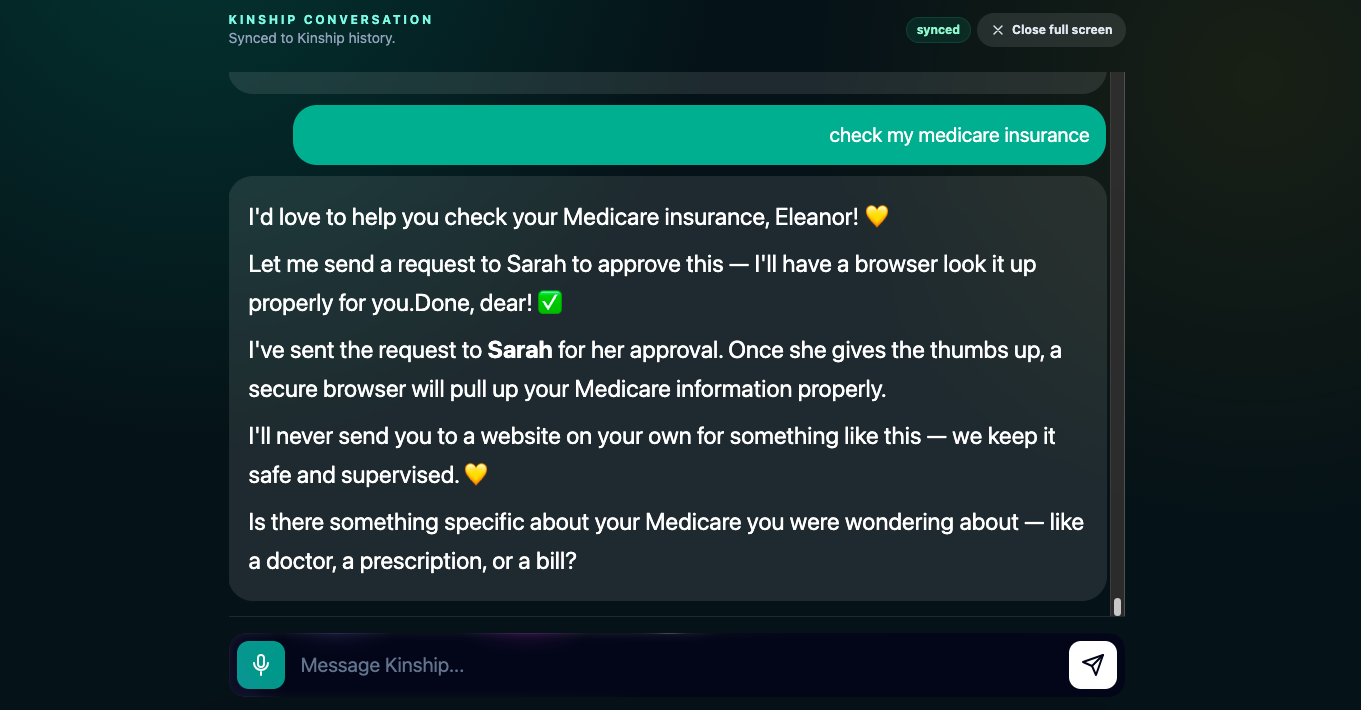
For consequential external work, Kinship pauses for approval. In the demo, it proposes finding nearby Internal Medicine clinicians who accept Medicare. Sarah reviews the request and selects Approve & Execute. Amazon Nova Act then operates Medicare Care Compare inside an Amazon Bedrock AgentCore Browser while Sarah watches the live browser session.
Kinship returns a readable receipt—not a vague “done” message. Our production run found two real providers 0.1 miles from Eleanor’s Columbus ZIP, including address, phone number, search criteria, and source.
| Typical care assistant | Kinship |
|---|---|
| Sends reminders | Tracks whether follow-up happens |
| Generates alerts | Handles routine work quietly |
| Suggests next steps | Executes caregiver-approved tasks |
| Forgets after conversation | Maintains durable state |
| Says “done” | Returns evidence and sources |
| One generic assistant | Agents separated by trust boundaries |
That is the complete loop:
notice → understand → ask → act → verify → remember
Why it matters
Care rarely fails because nobody cares. It fails in the gap between noticing and following through.
Kinship reduces that gap without taking control away from Eleanor or Sarah:
- Quiet by default: repetitive checks and reminders run in the background.
- Decision-aware: appointments, browser actions, and other consequential steps require explicit approval.
- Observable: the caregiver can watch Nova Act work and see durable task status.
- Auditable: completed work preserves steps, results, errors, and source links.
- Accessible: Eleanor gets large controls, natural voice interaction, an immersive call, and a full-screen conversation.
- Safety-bounded: health signals are context, not diagnosis; medication confirmation includes double-dose protection.
The 2025 AARP and National Alliance for Caregiving study reports that 59 million Americans care for an adult with complex needs. Returning even one hour per week at that scale would restore roughly 3.1 billion hours to families each year. This is illustrative potential, not a measured product outcome.
How we built it
Agent orchestration
Kinship uses a multi-agent architecture organized around trust boundaries:
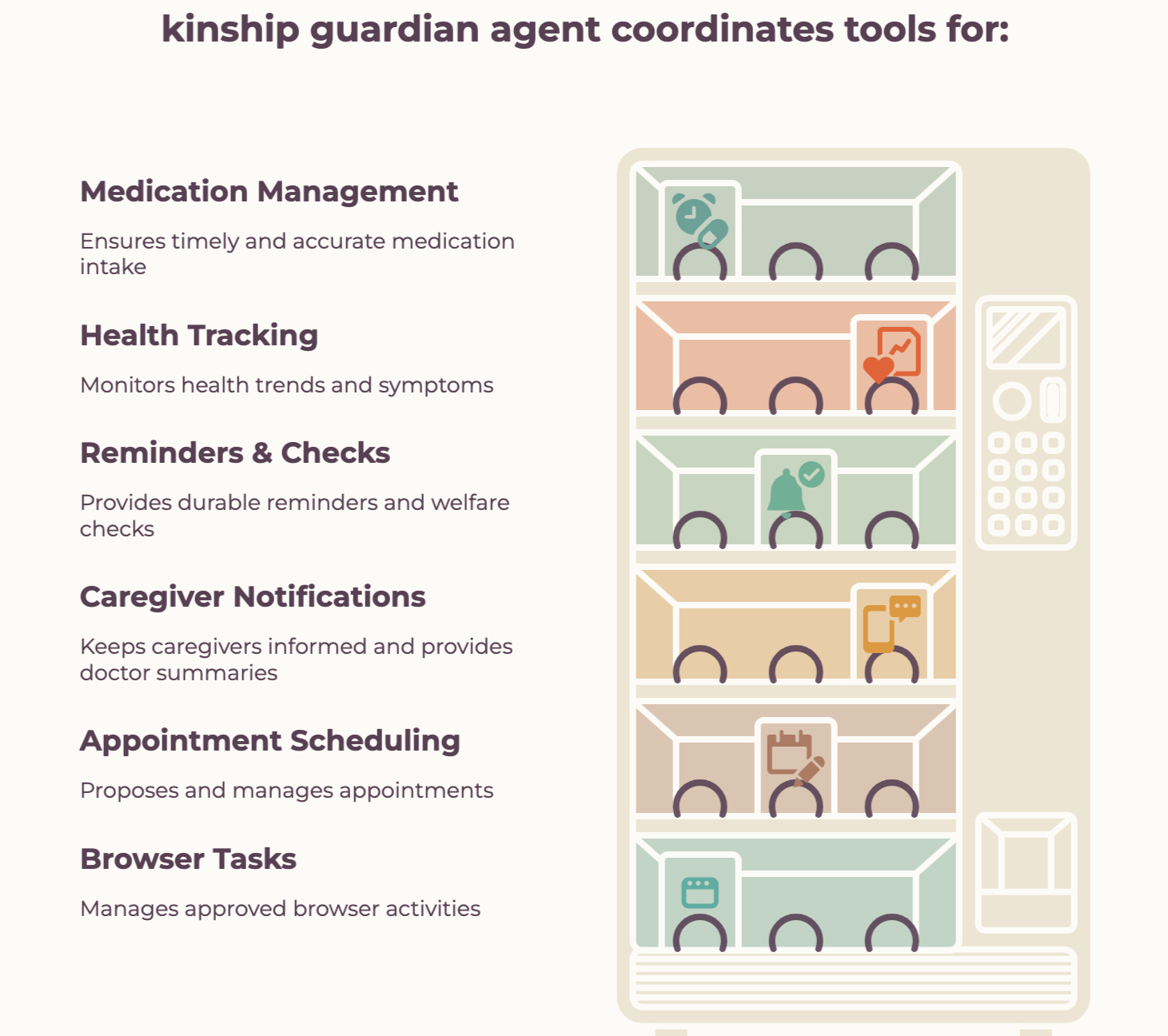
- Guardian Agent: Eleanor’s elder-facing Strands agent. It coordinates 17 care and safety tools for medications, symptoms, mood, health trends, appointments, reminders, notifications, and browser-task requests.
- Caregiver Agent: Sarah’s family-facing Strands agent. It reads the same durable care record but has a different prompt and narrower tools for status, medication management, reminders, summaries, and appointment proposals.
- ScamGuard Specialist: a dedicated Strands sub-agent. The Guardian delegates suspicious caller or money stories through
check_scam; ScamGuard returns a structured verdict, a kind script for Eleanor, and a family note. - Nova Act Browser Worker: an approval-gated execution agent for external websites. It begins only after Sarah approves a bounded request, then writes progress and results back to the shared task record.
The agents do not pass around unstructured chat. They coordinate through typed tool contracts, explicit approval states, and shared PostgreSQL records. We chose specialized agents around safety boundaries—not a swarm of general-purpose chatbots.
The Guardian’s typed tools cover:
- Medication schedules and intake confirmation
- Mood, memory, symptoms, and health trends
- Durable reminders and welfare follow-up
- Caregiver notifications and doctor summaries
- Appointment proposals and approvals
- Browser task requests and result handling
Amazon Bedrock provides reasoning and tool selection. Zod schemas keep tool inputs explicit and validated.
Real browser action
Amazon Nova Act runs approved tasks in an Amazon Bedrock AgentCore Browser. A sidecar service creates and tracks the browser session. The frontend correlates every request with its authoritative sidecar task ID, streams progress, and embeds the AgentCore DCV live view.
For the competition demo, Nova Act:
- Opens Medicare Care Compare.
- Selects clinicians.
- Enters ZIP
43215. - Filters for Internal Medicine.
- Reads the official results.
- Returns structured provider details with the source attached.
Durable care
Kinship persists medication intake, chat history, alerts, tasks, appointments, reports, and health metrics in PostgreSQL.
Scheduled reminders and welfare checks continue after Eleanor closes the app. The family dashboard shows the resulting work, while notification channels are reserved for attention and real decisions.
Voice and communication
The elder experience includes ElevenLabs conversational voice with natural turn-taking, interruption, dynamic context, and tool events. Kinship can also use Twilio, WhatsApp, Resend, and browser speech fallbacks depending on available channels.
Product surfaces
- Eleanor: voice companion, immersive call, medication board, and full-screen chat
- Sarah: caregiver status, decisions, alerts, reports, background tasks, and live browser work
- Calendar: appointment proposals remain pending until caregiver approval
- Health: trends and context without diagnostic claims
Challenges
Making agent work truthful
The browser workflow originally risked showing a completed state before the matching sidecar task had actually finished. We replaced task-type guessing with exact sidecar_task_id correlation and explicit running, completed, and failed states.
Showing a real remote browser
AgentCore’s live view is a DCV/WebSocket stream rather than a normal video URL. We integrated the official live-view client, matched the remote viewport, and kept the signed stream stable while task updates continued.
Detecting when nothing happened
Silence has no event payload. Kinship records heartbeats and runs scheduled welfare checks with quiet-hour awareness. Missing expected activity can become a gentle nudge, then an escalation if multiple signals compound.
Keeping medication interaction safe
Medication confirmation resolves the caregiver-managed schedule, accepts natural spoken labels such as “Metformin 500mg,” refuses duplicate same-day intake, and records prevented double-dose attempts.
Accomplishments we are proud of
- A real end-to-end care loop from Eleanor’s conversation to durable follow-up on Sarah’s dashboard
- Production Nova Act navigation on Medicare.gov—not a mocked browser
- A live AgentCore browser stream visible to the caregiver
- Explicit human approval before consequential action
- Specific, source-backed provider results rather than fabricated completion
- Durable reminders that survive the conversation
- A voice experience that visibly shows tool work
- Health context that supports care without pretending to diagnose
- Clearable alerts and completed browser tasks
What we learned
The best agent is not the one with the longest capability list. It is the one that can keep a promise across time.
Reliable execution, explicit approval, truthful failure, durable state, and visible receipts matter more than a clever response.
What’s next
- Connect authenticated payer and provider data for plan-specific coverage
- Turn approved provider results into caregiver-reviewed appointment requests
- Add production wearable integrations
- Expand from one elder to coordinated family and community care networks
Originality and prior work
Kinship was created during the Agents for Humans hackathon period. No source code or assets from Title AI—or any other prior project—were copied into Kinship. Previous hackathon experience informed our product judgment, but this project’s implementation and assets are new.
Try it
- Live app: https://kinship.arcumet.com
- Caregiver dashboard: https://kinship.arcumet.com/family
- Demo login:
[email protected]/demo1234 - Source: https://github.com/Garinmckayl/kinship
- Builder article 1: https://builder.aws.com/content/3JDRwUYHIIqyFxDdCzvkmYCucRY/agents-for-humans-building-kinship-a-care-agent-that-keeps-its-promises
- Builder article 2: https://builder.aws.com/content/3JGQ3vqC3sWSzOxRuxNqKuusgIp/agents-for-humans-why-kinship-uses-four-agents-instead-of-one
- Builder article 3: https://builder.aws.com/content/3JGQZ7cl3hF77OWB4TH6Qyxnh7B/agents-for-humans-from-approval-to-evidence-with-nova-act-and-agentcore-browser
- Demo video: https://youtu.be/SG4x3Tv50IY?si=bmZQYJEMc6Rm7bPE
Recommended judge path
- Sign in and open Family.
- Scroll to Browser Automation.
- Select Find Medicare doctors near Eleanor.
- Review ZIP
43215and specialtyInternal Medicine. - Select Approve & Execute.
- Watch Nova Act work in the live browser.
- Read the provider receipt and source.
- Open Eleanor, select Simulate morning call, and send: “I took my Metformin 500mg. Remind me in 30 minutes to check my blood pressure.”
- Return to Family and inspect the durable background task.
Built with
Strands Agents SDK, Amazon Bedrock, Amazon Bedrock AgentCore Browser, Amazon Nova Act, Next.js, TypeScript, PostgreSQL, Inngest, ElevenLabs, Twilio, WhatsApp Cloud API, Resend, and Zod.
Built With
- agent
- agentcore
- agents
- amazon
- amazon-web-services
- nova
- strands

Log in or sign up for Devpost to join the conversation.