-
-
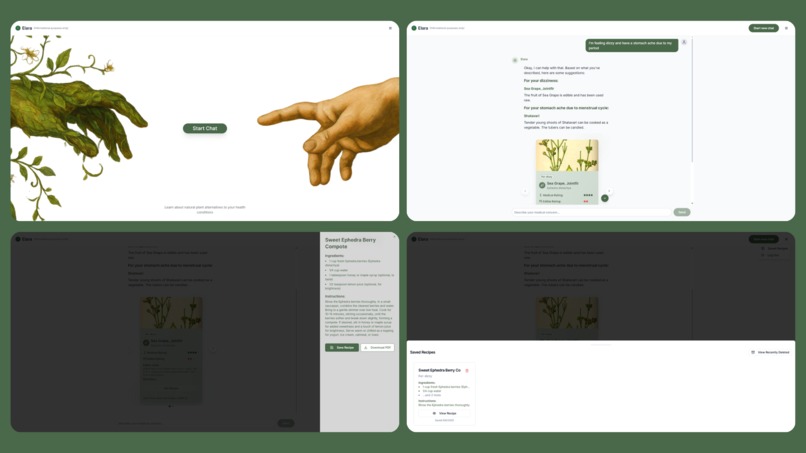
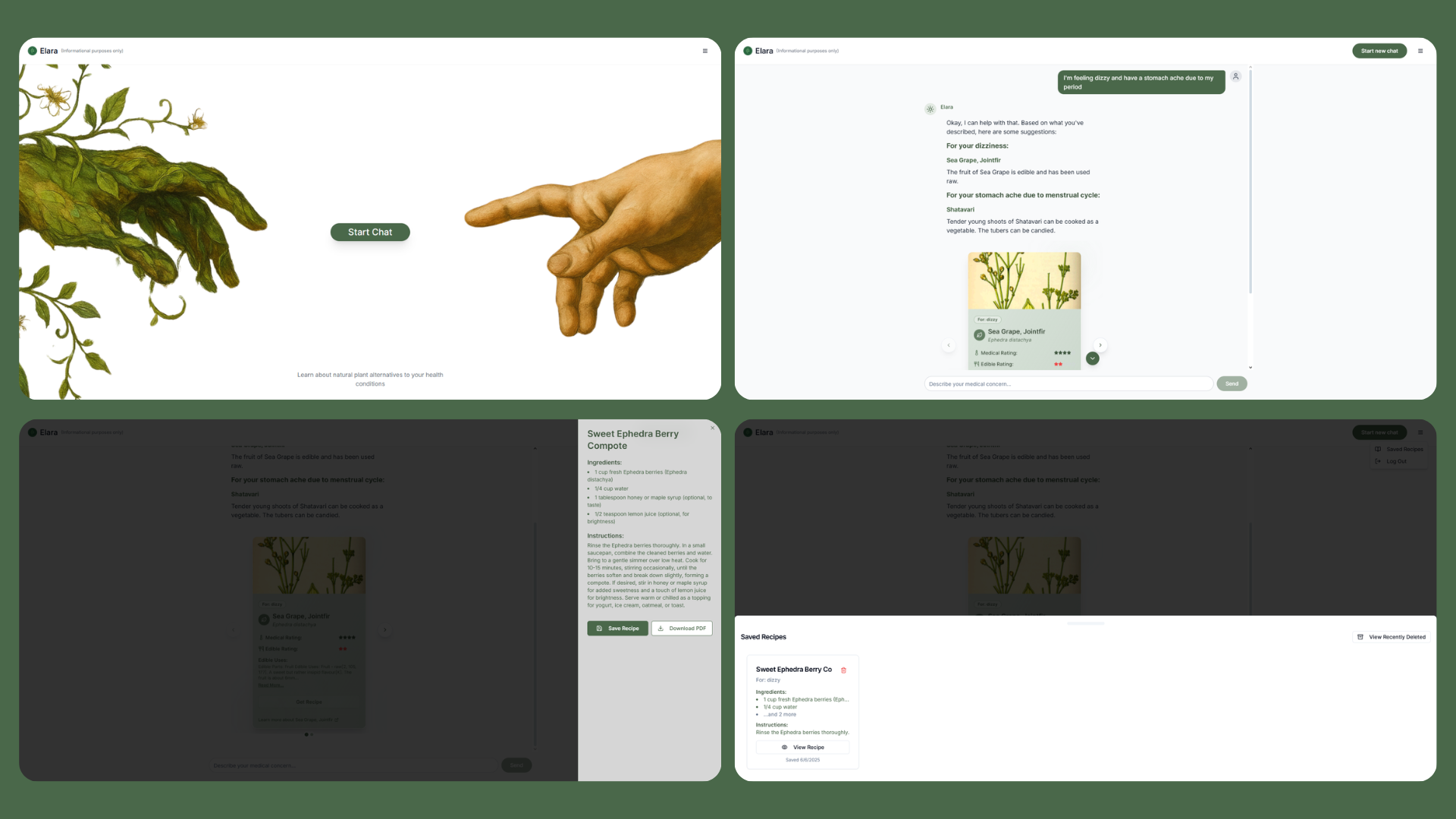
Screenshots of our application
-
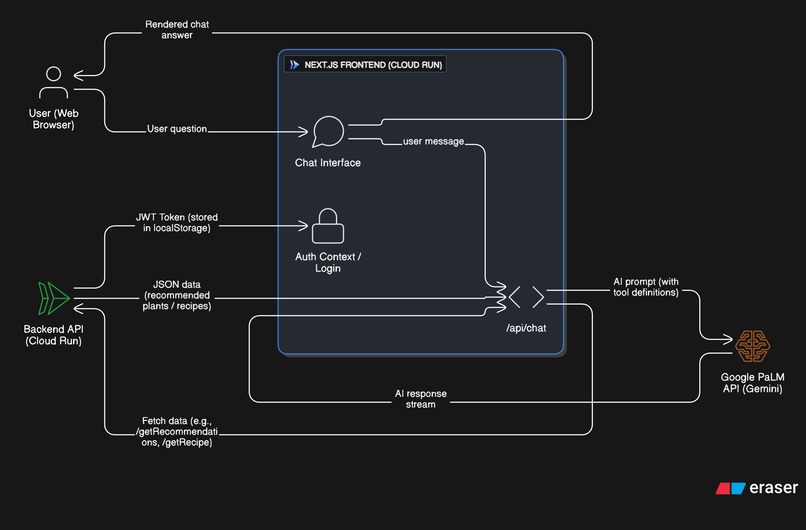
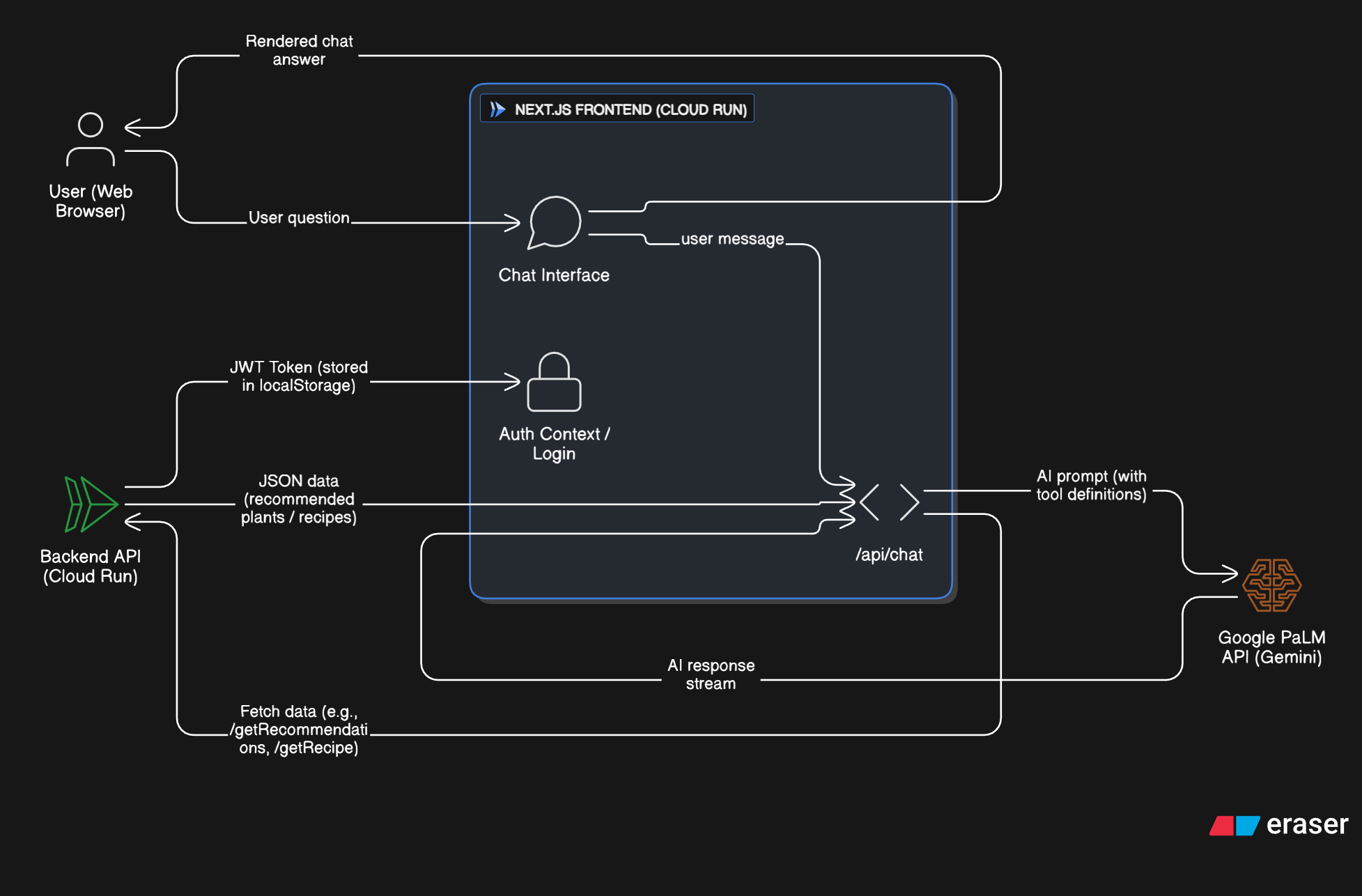
Frontend diagram flow
-
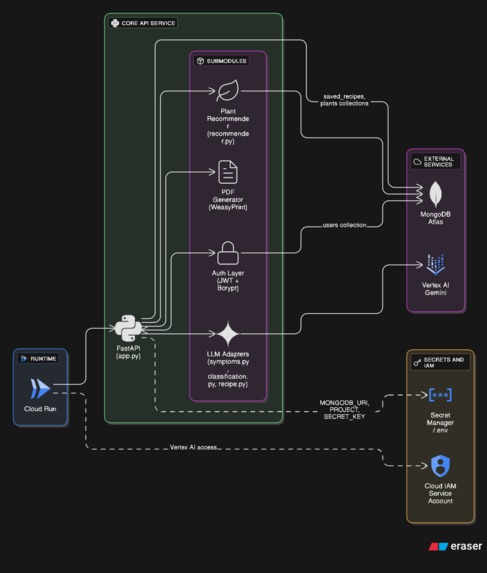
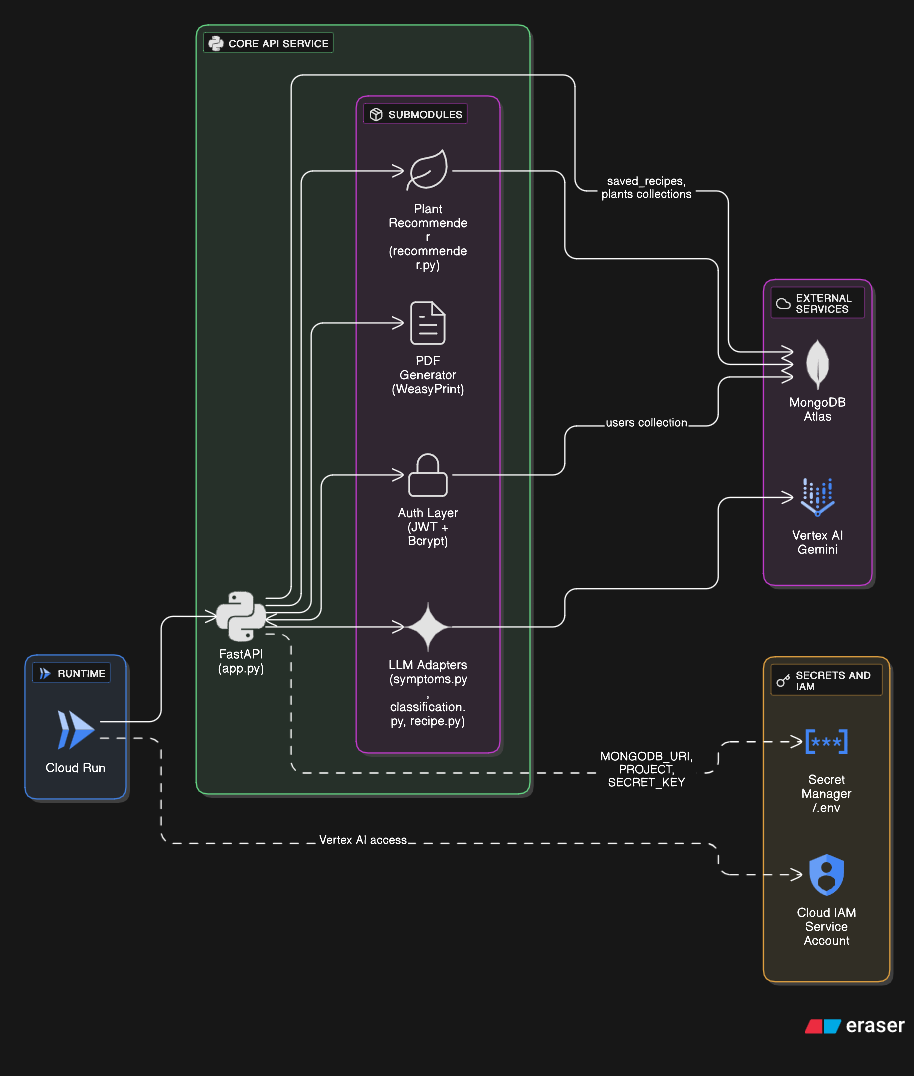
Backend diagram flowy
Elara AI :))))))))))))))))))))))))))
💡 Inspiration
We got inspired by trying to find natural, healthier and more unique alternative solutions to day-to-day health complications. We are not fans of taking a lot of medications due to their side effects, and would also seek learning what mother nature has to offer us. This led us to explore how AI could bridge the gap between traditional herbal knowledge and modern accessibility.
v1 video: https://youtu.be/PdrG6mv6QmM
🌿 What it does
Elara is a generative UI chat application that interacts directly with the PFAF (Plants For A Future) plant database: https://pfaf.org/user/, to enable unique and knowledgeable recommendations for health conditions. Users can discover plants and learn about natural alternatives through an AI-built recipe system that comes with detailed plant information cards, allowing people to explore medicinal plants in an interactive and educational way. It allows users to explore the dataset by prioritizing recommendations based on medicinal or edibility rating. We also have a live-retrieval tool that enables users to ask for further medical information for a specific plant and receive advising on its usage.
🛠️ How we built it
We built Elara using a modern, scalable tech stack with a sophisticated AI orchestration architecture:
Technical Architecture & Data Flow
Our system follows a multi-tier architecture where the Vercel AI SDK acts as the primary orchestrator, coordinating between user interactions and specialized Gemini models deployed as tools on Google Cloud's Vertex AI platform.
Frontend AI Orchestration (Edward):
- Next.js with TypeScript and App Router - Modern React framework for the web application
- Vercel AI SDK as the Central Orchestrator - Manages the entire conversation flow and coordinates tool calls
- Tailwind CSS + Radix UI - Consistent styling and accessible component library
- Google Cloud Run - Scalable containerized deployment
Backend AI Tools & Services (Daria):
- FastAPI with Python 3.11 - High-performance API framework serving as the backend
- Vertex AI with Multiple Gemini Models as Specialized Tools:
- Gemini Lite (2.0-flash-lite-001) - Symptom extraction from natural language
- Gemini Flash (2.5-flash-preview) - Medical condition classification and recipe generation
- WeasyPrint + Jinja2 - PDF generation system for recipe downloads
Detailed Data Flow Pipeline
- User Input Processing:
- User describes symptoms in natural language through the chat interface
Vercel AI SDK captures and validates the input
- Symptom Extraction (
/utils/symptoms.py):
- Symptom Extraction (
Gemini Lite processes natural language to extract distinct symptoms
Returns structured JSON:
{"symptoms": {"headache": "stress", "nausea": ""}}- Medical Classification (
/utils/classification.py):
- Medical Classification (
Gemini Flash maps extracted symptoms to specific medical use categories
Uses comprehensive botanical medical use dictionary (100+ classifications)
Output:
{"stomach ache": "Carminative", "anxiety": "Nervine"}- Plant Recommendation (
/utils/recommender.py):
- Plant Recommendation (
MongoDB aggregation pipeline queries plants by medical use classification
Filters out plants with known hazards for safety
Ranks by medicinal rating (1-5 scale) and returns highest-rated matches
- Recipe Generation (
/utils/recipe.py):
- Recipe Generation (
Gemini Flash creates practical recipes using plant's edible properties
Structured output with ingredients, instructions, and preparation methods
- Response Orchestration:
Vercel AI SDK streams results back to the frontend in real-time
Dynamic UI components render plant cards and recipes as data arrives
Database Infrastructure (MongoDB Atlas)
Plant Data Storage:
- Primary Collection: 7,000+ medicinal plants from PFAF database
- Indexed Fields:
uses(medical applications) - ASCENDING index for fast classification lookupmedicinal_rating,edibility_rating- DESCENDING compound index for rankinghazards- Sparse index for safety filtering
- Document Structure: Scientific names, common names, ratings, uses, cultivation info, images
User Management:
- Users Collection: Stores user credentials with bcrypt-hashed passwords
- Authentication: JWT tokens with configurable expiration
- Session Management: Secure token-based authentication flow
Recipe Persistence:
- Saved Recipes Collection: User-generated recipe storage with TTL indexing
- Soft Delete System: 10-day retention for "deleted" recipes with automatic cleanup
- Recovery Feature: Users can restore recently deleted recipes
Google Cloud Platform Integration
Vertex AI Services:
- Multi-Model Strategy: Different Gemini variants optimized for specific tasks
- Structured JSON Output: Configured response schemas ensure consistent data format
- Safety Settings: Disabled content filtering for medical content processing
- Project Integration: Centralized authentication through service accounts
Cloud Run Infrastructure:
- Frontend Service: Auto-scaling Next.js application (0→N instances)
- Backend Service: FastAPI container with health checks and graceful shutdown
- Container Registry: Artifact Registry for Docker image management
- Networking: Internal service-to-service communication with external API access
Security & Secrets Management:
- Secret Manager: Centralized storage for MongoDB URIs, JWT keys, and API credentials
- Service Accounts: IAM-based authentication for Vertex AI access
- Environment Variable Injection: Runtime secret mounting for containerized services
Development Workflow
We split responsibilities effectively:
- Daria: Backend architecture, AI model orchestration, database design, and cloud infrastructure
- Edward: Frontend experience, chat interface, AI SDK integration, and component design
This architecture allows for real-time symptom processing, accurate plant recommendations, and seamless recipe generation while maintaining scalability and security through Google Cloud's managed services.
🚧 Challenges we ran into
Model Selection & Performance
Initially, we planned to use the MedGemma model, but hosting it on Google Cloud was expensive and response times were too slow for a good user experience. We pivoted to focus on the medicinal plant approach using Vertex AI's Gemini models.
Data Acquisition
The PFAF database didn't offer a direct export option - it was only available as a live website. We had to implement our own web scraper to extract plant data as CSV files for MongoDB ingestion. The initial scraping estimate was 22 hours, which was too long for our hackathon timeline.
Automated Data Pipeline
We solved the scraping time issue by splitting tasks across multiple GitHub Actions, reducing the process to just 2 hours. This approach also gave us automated data ingestion capabilities for future updates.
AI Integration Complexity
We started with the basic Gemini API but discovered that Vertex AI offered better configuration options, including structured JSON output capabilities that improved our plant recommendation accuracy.
Cloud Deployment & Secrets Management
Figuring out Google Cloud Run deployment with proper secrets management took significant time. We eventually created custom YAML configurations and implemented manual deployment workflows that properly handled environment variables and service account authentication.
🏆 Accomplishments that we're proud of
- Automated Data Pipeline: Successfully built a scalable web scraping and ingestion system
- Clean, Minimal UI: Created an intuitive chat interface with dynamic plant information cards
- Google Cloud Mastery: Successfully deployed both frontend and backend on Cloud Run
- Accurate Plant Recommendations: Implemented AI-driven condition classification and plant matching
- Value-Added Recipe Generation: Enhanced plant recommendations with practical, AI-generated recipes
- Comprehensive Authentication: Built secure JWT-based user system with recipe saving capabilities
📚 What we learned
Technical Growth
- Google Cloud Ecosystem: Discovered powerful services like Vertex AI, Cloud Run, and Secret Manager that we want to explore further, including ML Agents and Workflows
- Team Collaboration: Working as a team and effectively splitting responsibilities significantly accelerated our development process
- AI SDK Mastery: Became proficient with Vercel AI SDK and structured AI prompt engineering
- FastAPI Infrastructure: Gained deep experience with FastAPI, authentication patterns, and API design
Project Management
- Scope Pivoting: Learned how to quickly adapt when initial technical approaches proved unfeasible
- Automation Benefits: Discovered the power of automating data pipelines for long-term maintenance
Community contribution
Since PFAF.ORG does not provide a downloadable dataset for immediate usage, we built our own scrappers and used github action workflows to tackle parallel scrapping without being rate limited. We later shared this compiled dataset in kaggle, as an open source contribution, for which to this moment has achieved over 144 downloads, and community code contributions: https://www.kaggle.com/datasets/edwardgaibor/pfaf-medical-plants-use-dataset
🚀 What's next for Elara
Monetization Strategy
Elara plans to open for public use, but hosting costs require implementing a sustainable paywall system to manage AI and infrastructure expenses.
Shopping Integration
We want to add Google Shopping API integration to help users find where to buy recommended plants or recipe ingredients, making the platform more consumer-friendly and actionable.
Medical AI Enhancement
Plans to integrate a MedGemma instance to add a medical validation layer to our plant recommendations, providing additional safety and accuracy to our suggestions.
Enhanced Data Sources
Expand beyond PFAF to include additional botanical databases and traditional medicine knowledge sources for more comprehensive recommendations.
Mobile Application
Develop native mobile apps to make plant identification and recipe access available on-the-go for better user engagement.
Built With
- fast-api
- google-cloud
- mongodb
- nextjs
- pfaf
- python
- react
- shadcn
- tailwindcss


Log in or sign up for Devpost to join the conversation.