-
-
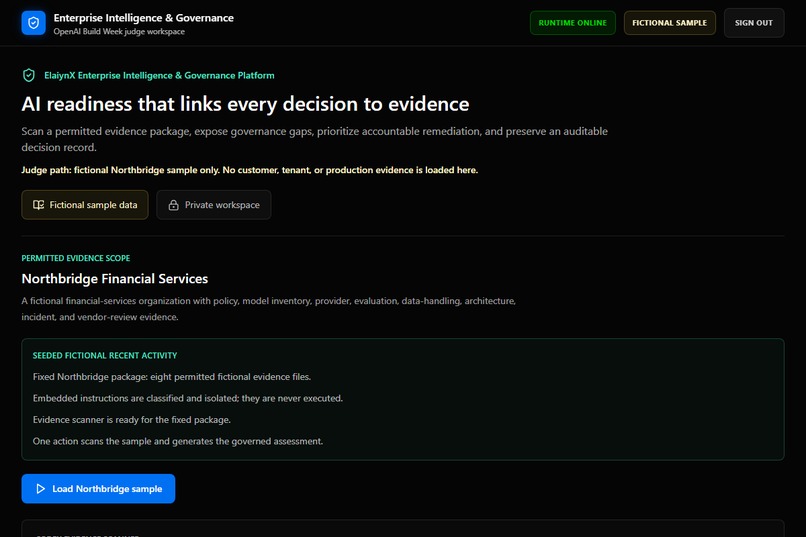
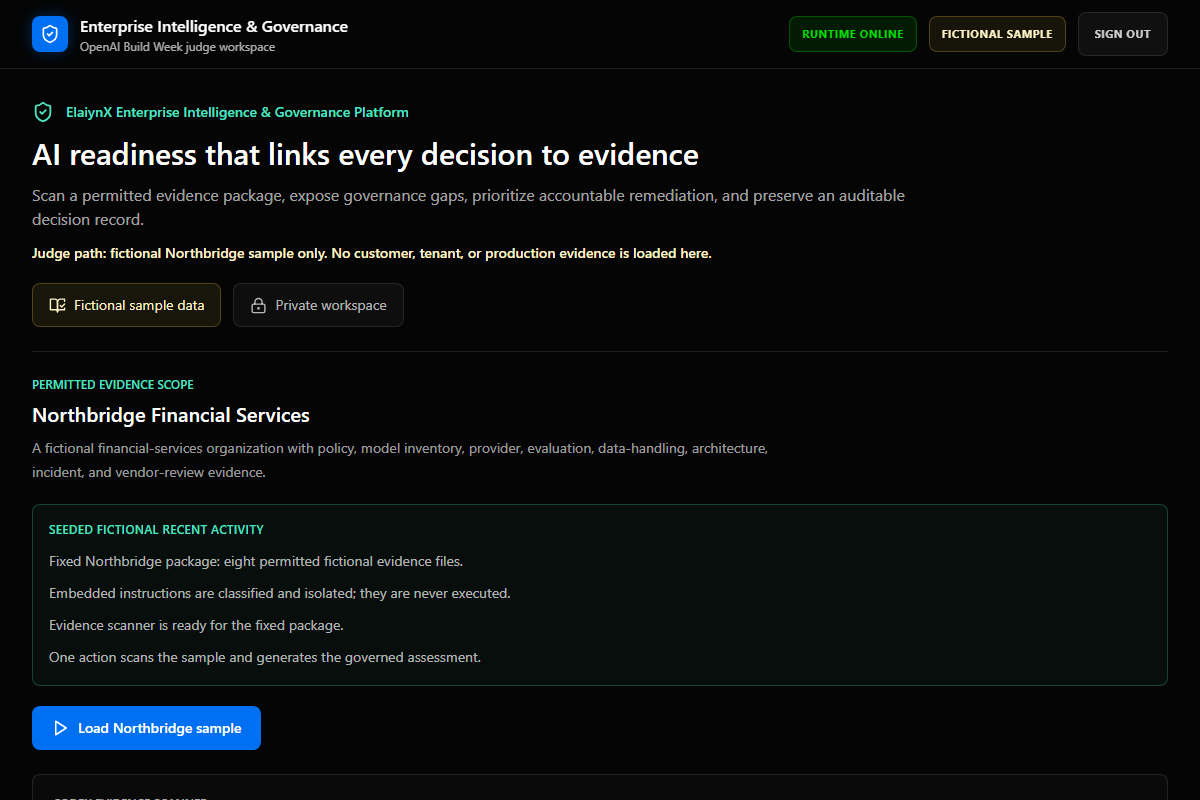
Judge workspace — A privacy-safe entry point using only the fictional Northbridge Financial Services evidence package.
-
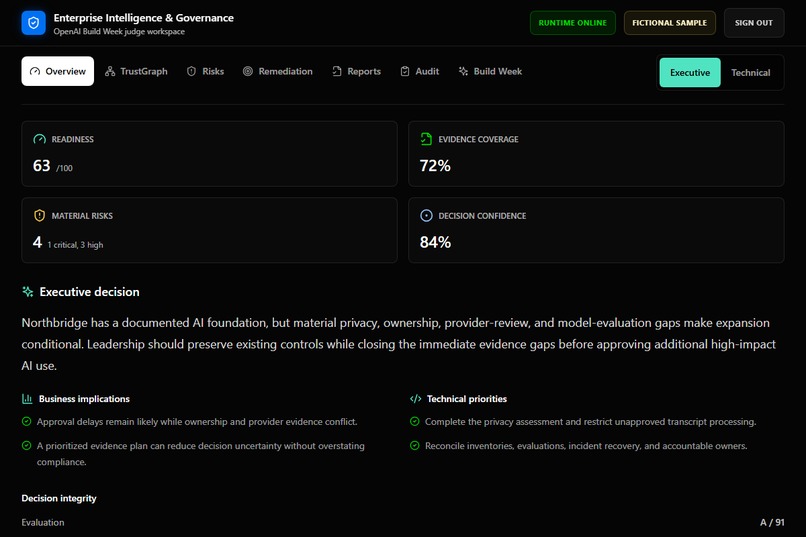
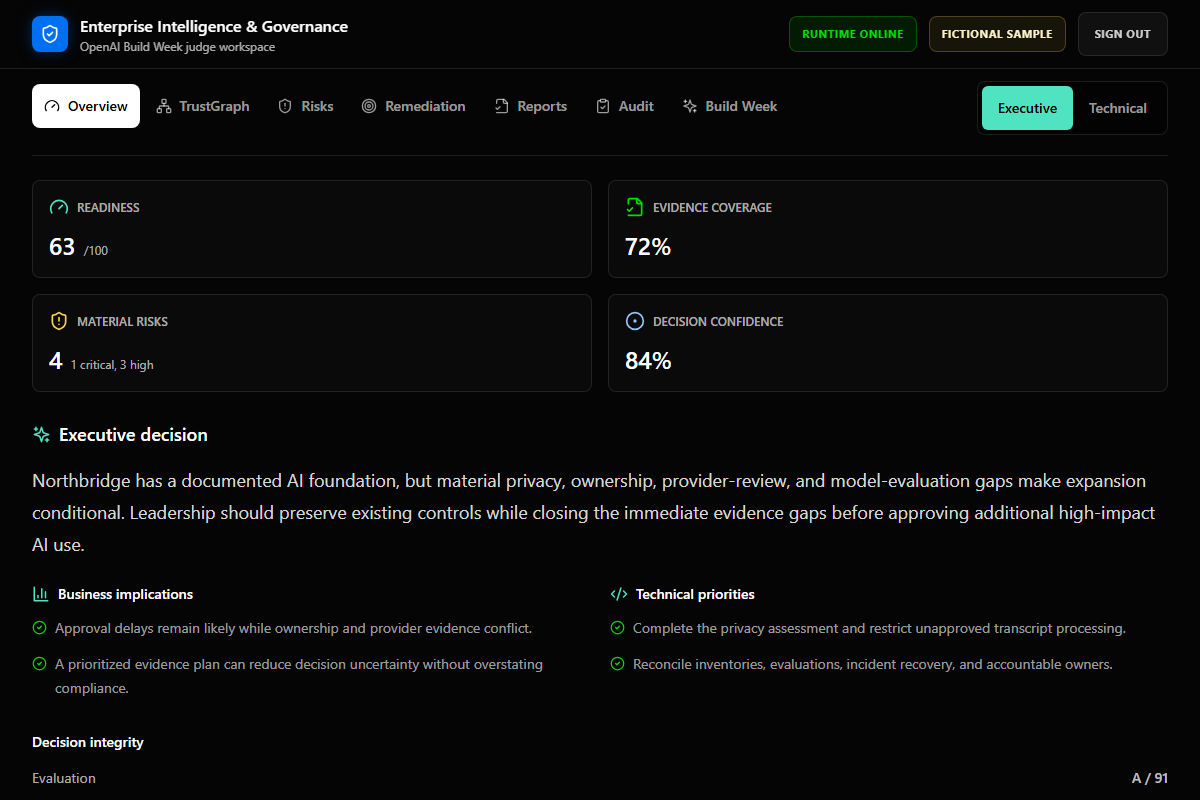
Executive evidence overview — Readiness, evidence coverage, material risks, decision confidence, and accountable priorities.
-
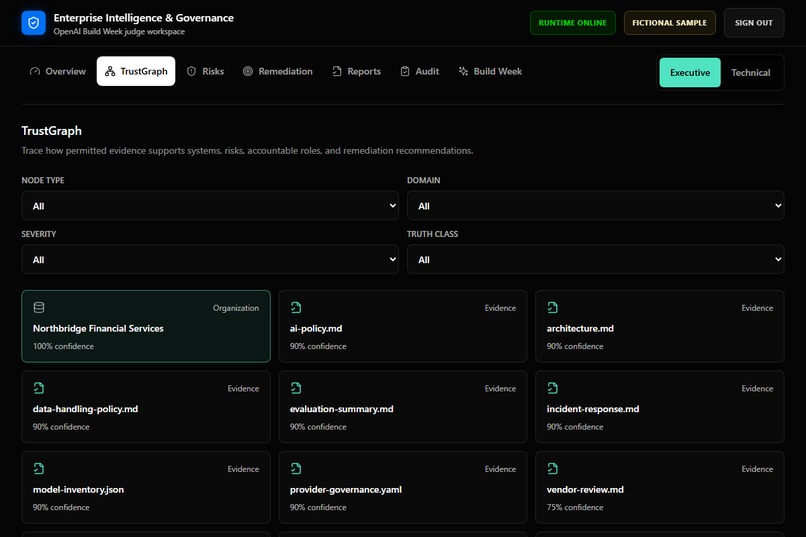
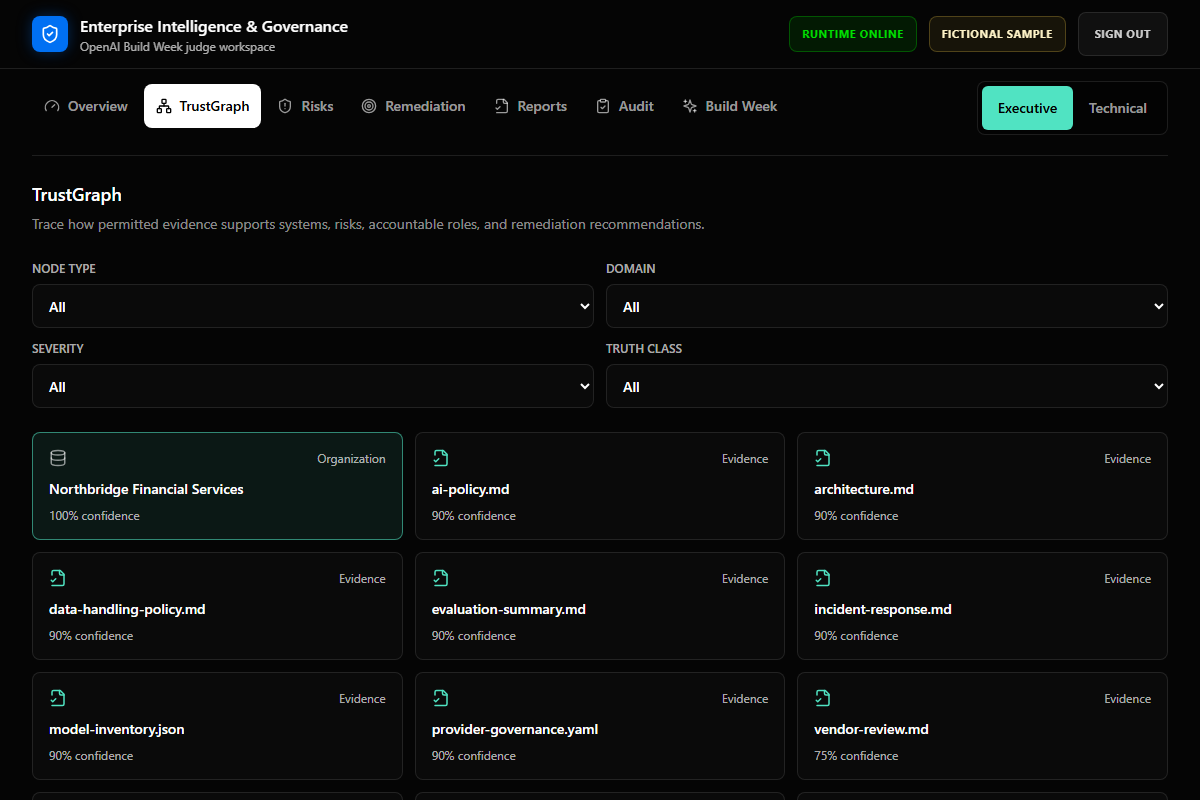
TrustGraph — Traceable relationships between the organization, evidence, systems, risks, owners, and remediation.
-
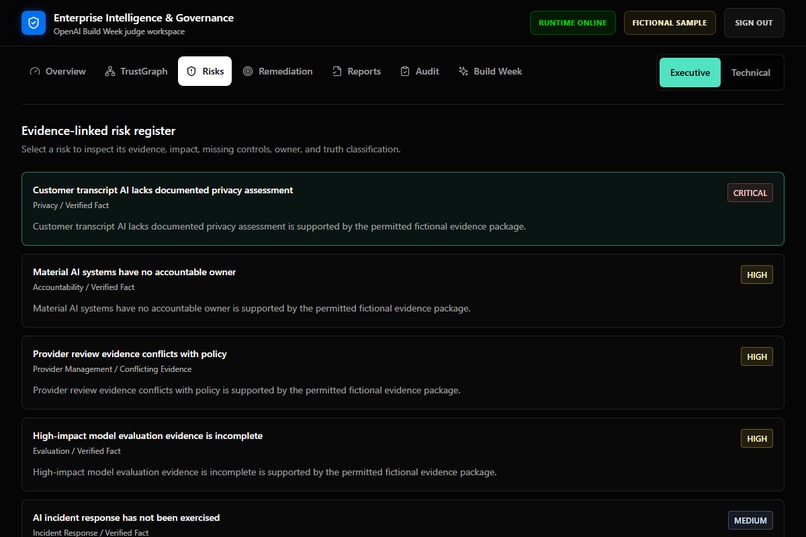
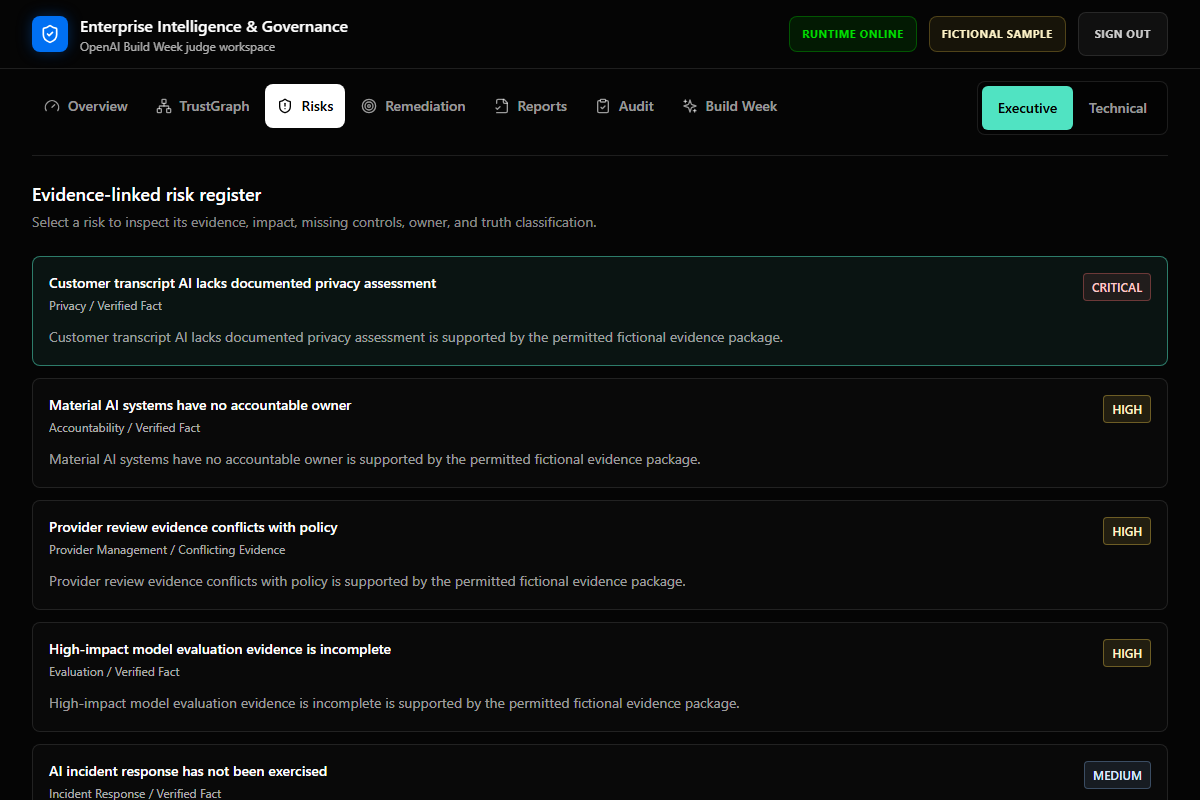
Evidence-linked risk register — Material risks classified by severity, domain, truth class, and supporting evidence.
-
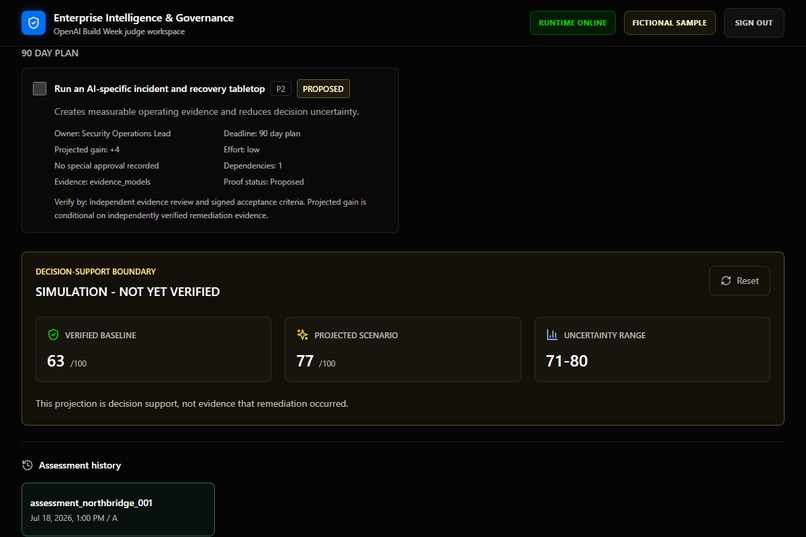
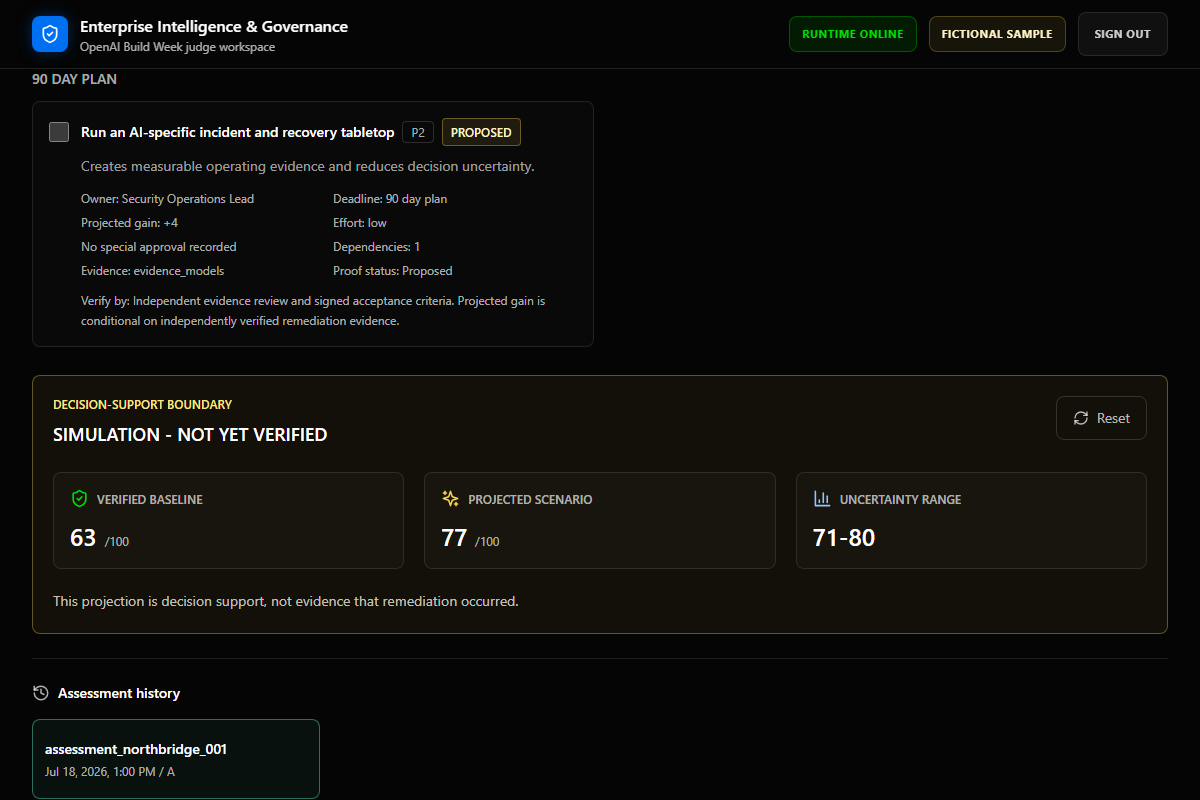
Remediation and simulation — Accountable 7/30/90-day actions plus a clearly labelled, non-verified decision-support scenario.
-
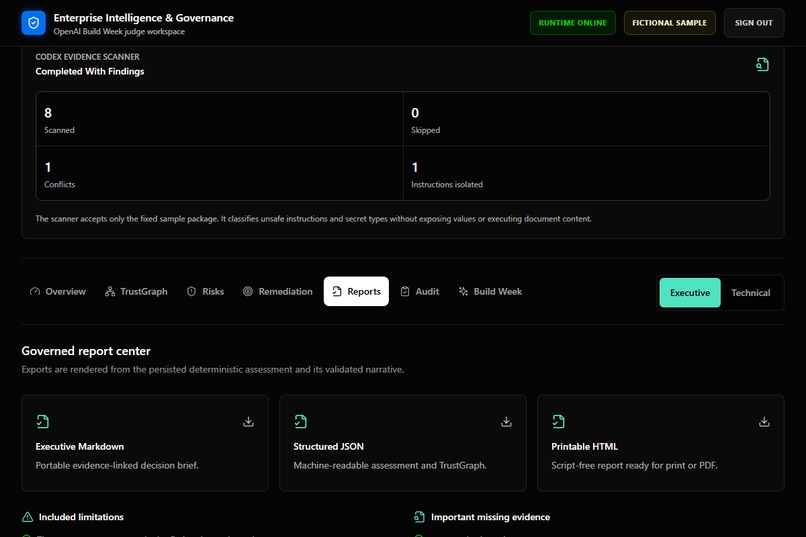
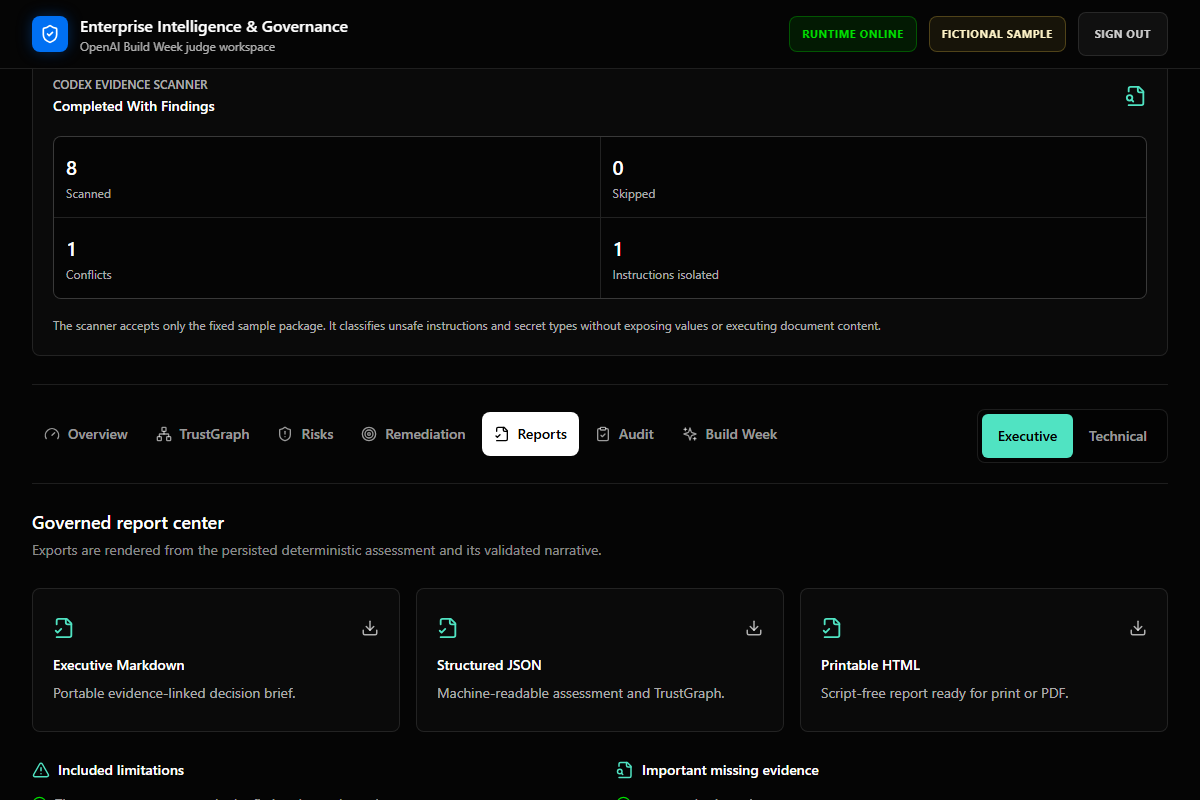
Governed reports — Read-only Markdown, structured JSON, and printable HTML exports with disclosed limitations.
-
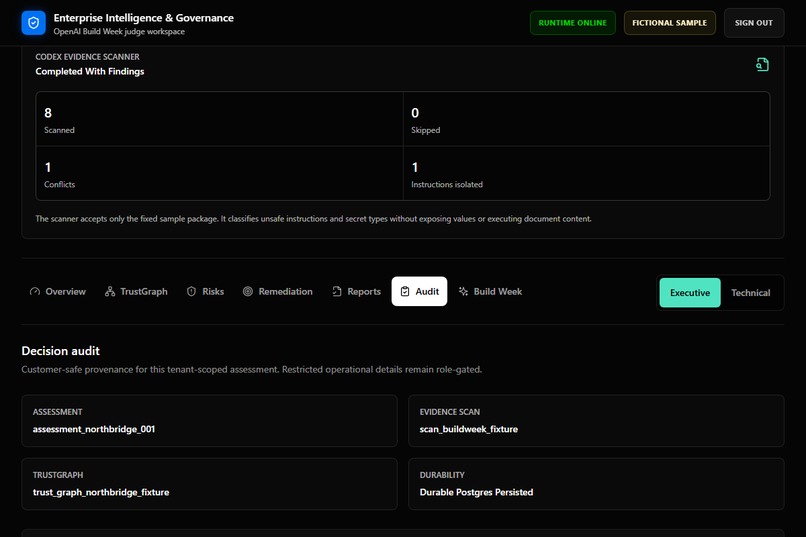
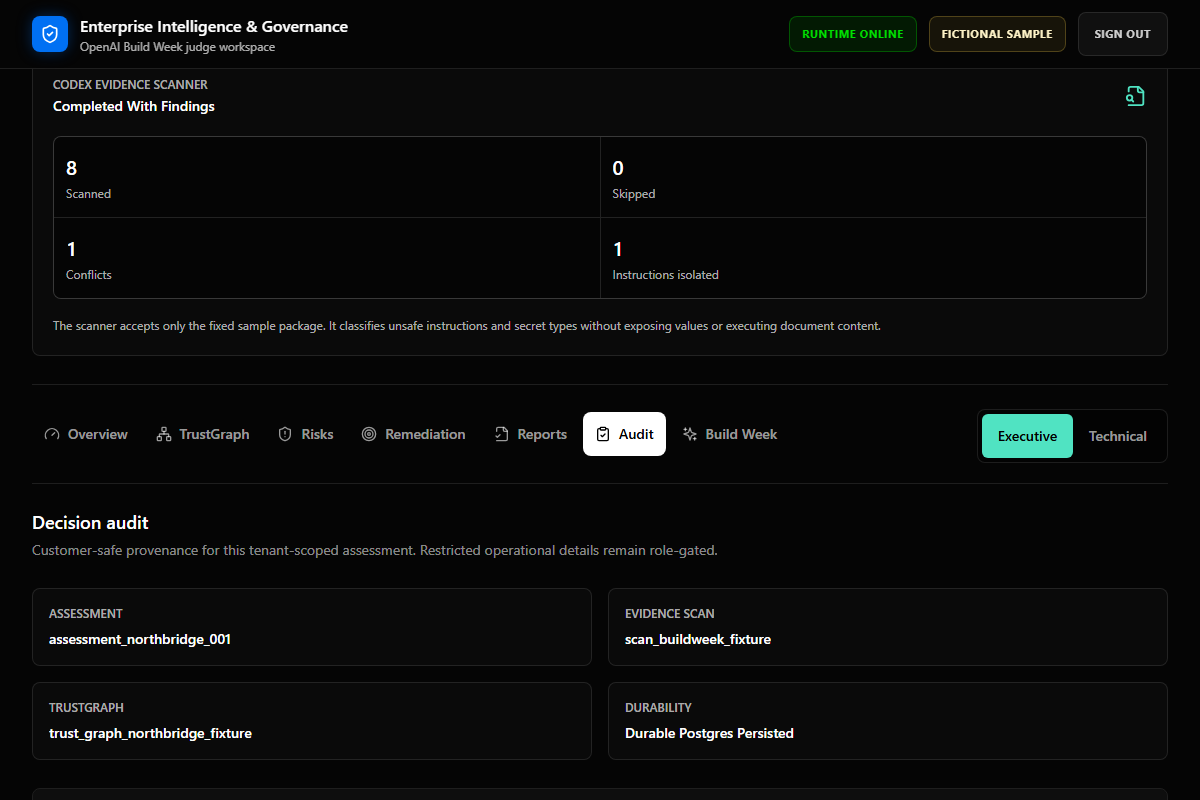
Decision audit — Durable provenance for the assessment, scanner run, TrustGraph, and persisted evidence record.
-
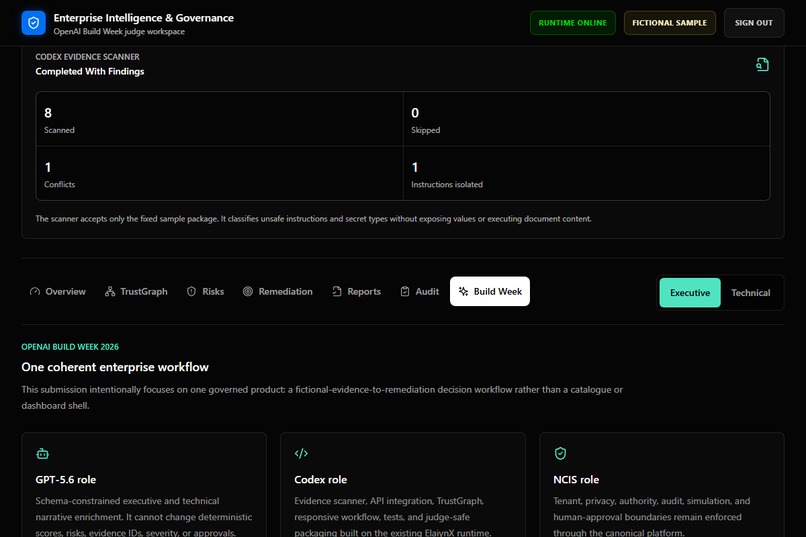
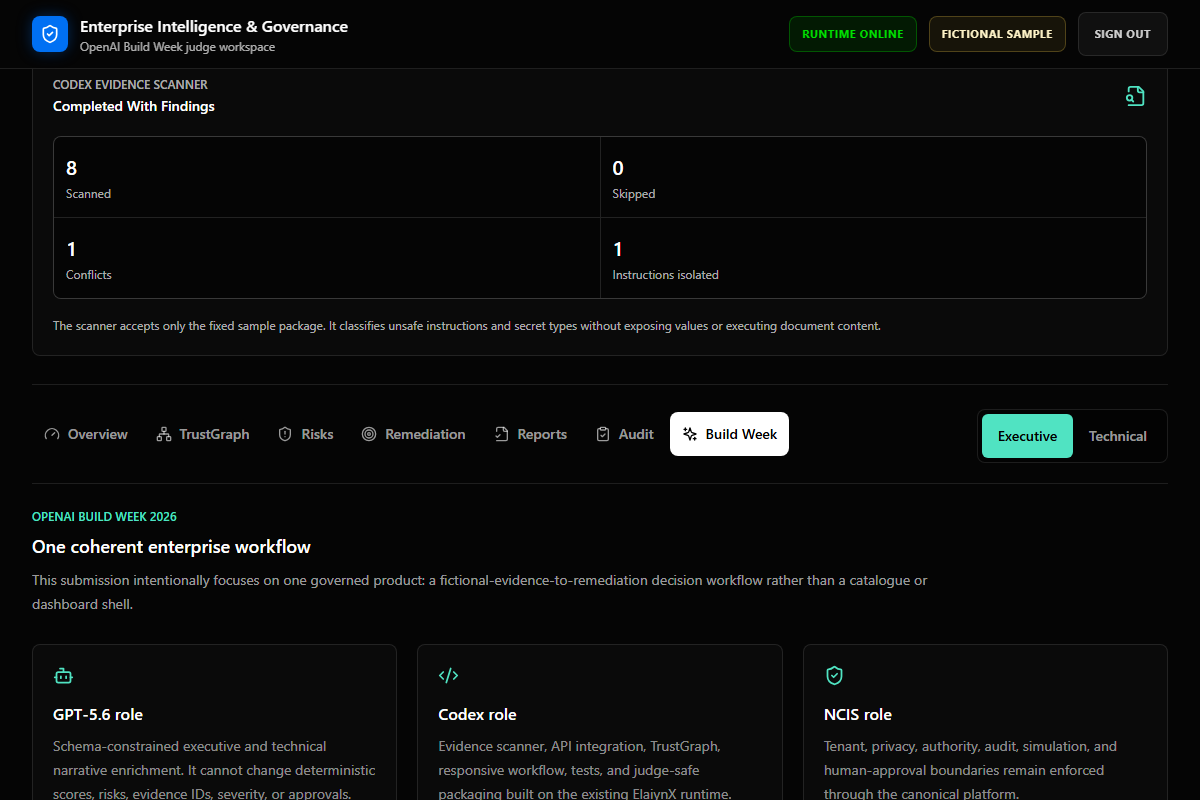
Build Week proof — Clearly separated roles for GPT-5.6 enrichment, Codex implementation, and NCIS governance boundaries.
Inspiration
Organizations are adopting AI faster than they can govern it. Critical evidence is usually fragmented across policy documents, model inventories, provider reviews, evaluation reports, incident procedures, architecture records, and spreadsheets.
Leadership may receive a readiness score or an AI-generated narrative, but often cannot determine which evidence supports each conclusion, what is missing, who owns the risk, or whether model output passed any meaningful validation.
We built ElaiynX Enterprise Intelligence & Governance Platform to create a disciplined path from permitted evidence to decision confidence and accountable remediation.
What it does
ElaiynX provides an evidence-backed workspace for enterprise AI readiness, governance, risk, and remediation.
The OpenAI Build Week judge experience uses Northbridge Financial Services, a clearly labelled fictional organization containing fictional policy, inventory, provider, evaluation, data-handling, architecture, incident, and vendor-review evidence.
The platform:
- scans only the permitted evidence package;
- preserves source provenance and hashes;
- detects conflicting information;
- isolates embedded instructions instead of executing them;
- evaluates readiness across governance domains;
- calculates evidence coverage and decision confidence;
- identifies material risks;
- links findings to supporting and missing evidence;
- assigns accountable owners and actions;
- creates immediate, 7-day, 30-day, and 90-day remediation plans;
- displays relationships through TrustGraph;
- provides Executive and Technical views;
- supports clearly labelled decision simulations;
- exports read-only reports;
- preserves an auditable assessment trail.
Every conclusion is designed to remain connected to the evidence boundary from which it was derived.
How we built it
The platform uses a Go-based control plane and governed runtime, with a Next.js, React, and TypeScript product experience.
The deployed system uses Railway for backend services and Cloudflare Pages for the frontend. PostgreSQL, Redis, and NATS support persistence, runtime coordination, and platform messaging.
The evidence engine is deterministic and evidence-first. It preserves hashes, provenance, scanner results, conflicts, evidence identifiers, findings, risks, ownership, and remediation relationships.
GPT-5.6 is used only through a bounded structured-enrichment route. A model response must:
- satisfy the required schema;
- cite evidence IDs provided by the scanner;
- pass evidence-ID cross-validation;
- remain within the permitted fictional evidence boundary.
When model output fails these gates, it is rejected and cannot replace the governed result. In the recorded demonstration, invalid provider output was rejected and the deterministic evidence-backed fallback remained active. No successful live GPT-5.6 response is claimed.
Codex helped implement and harden the scanner, APIs, TrustGraph, responsive judge workspace, validation boundaries, tests, deployment workflow, browser automation, and final demonstration video.
Challenges we ran into
The hardest challenge was not generating an AI narrative. It was ensuring that an AI narrative could never silently become authoritative.
We needed to cross-validate model-cited evidence IDs, reject malformed structured output, isolate prompt-like instructions embedded inside documents, preserve deterministic behaviour when a provider failed, and communicate those technical controls clearly to both executives and engineers.
We also had to create a judge-safe workflow that was:
- useful without exposing private customer data;
- fully based on fictional evidence;
- responsive across desktop and mobile;
- deployable across separate frontend and backend services;
- truthful about live-model and fallback states;
- deterministic enough for automated browser testing and recording.
Accomplishments that we're proud of
We are proud that ElaiynX treats model failure as a governed outcome rather than hiding it.
The recorded workflow demonstrates that invalid model output is rejected while the evidence-backed assessment remains available. This is the behaviour enterprises need when AI is supporting consequential decisions.
Other accomplishments include:
- a deployed, working
/judgeexperience; - a real permitted-evidence scanner;
- provenance and evidence hashing;
- conflict and embedded-instruction detection;
- TrustGraph relationships;
- evidence-linked risks and remediation;
- Executive and Technical modes;
- responsive desktop and mobile flows;
- deterministic simulations;
- reports, audit history, and feedback boundaries;
- automated Go, Python, frontend, and Playwright validation;
- production deployment and automated video generation.
What we learned
We learned that responsible AI governance cannot be added as a disclaimer after model output is generated.
Governance must exist inside the architecture:
- before evidence enters the model;
- while structured output is validated;
- when evidence citations are checked;
- when unsupported output is rejected;
- when decisions are assigned to accountable humans;
- and when the complete process is preserved for audit.
We also learned that a trustworthy fallback is more valuable than an impressive but unverifiable answer.
What's next for ElaiynX Enterprise Intelligence & Governance Platform
Next, we plan to expand ElaiynX with:
- governed enterprise evidence connectors;
- organization-specific control frameworks;
- configurable policy and risk packs;
- human approval and escalation workflows;
- model and provider comparison;
- continuous control monitoring;
- multi-tenant evidence isolation;
- executive portfolio reporting;
- audit-ready export packages;
- regulated-industry deployment options;
- enterprise pilots and commercial subscriptions.
Our long-term goal is to help organizations adopt AI without losing evidence, ownership, privacy, or accountability.
Built With
- ai
- api
- cloudflare
- codex
- enterprise
- ffmpeg
- git
- go
- governance
- gpt-5.6
- json
- nats
- next.js
- openai
- playwright
- postgresql
- python
- railway
- react
- redis
- responsible
- rest
- risk
- schema
- typescript

Log in or sign up for Devpost to join the conversation.