-
-
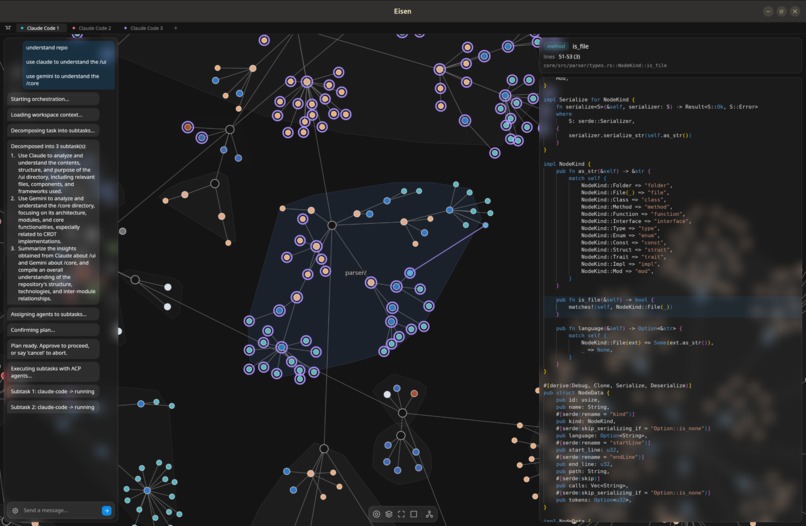
view of orchestrator running with file opened to the right

Inspiration
We are all developers in our group. Everyone has different projects, ideas, passions but we are united in the same shared pain points: agent cost and context bloat. For all of us the worst is reaching a proper development loop just to hit "compaction" and lose all quality and understanding of the context. Therefore, we wanted investigate if we can see the agent's context, where the agent goes and what it does to explore the repository and gain context. That way we could debug the agent's trace easier and bring into context files it has not explored yet or explain dependencies to avoid redundant agent calls. We therefore created "Eisenlabs" with our "eisen-core" at the heart of agent observability.
What it does
This rust based application is a lightweight visual representation of your codebase, through the eyes of the agent. As you chat with the agent, you see the agent execute tools calls and traverse the graph that is your codebase. With our app you can see dependencies between files, read code through node selection, monitor agent context for multiple agent sessions concurrently, and more. We additionally have an orchestrator mode that creates plans based on your workspace, your session stats, and your agent preferences - tracking each agent's task status from one chat window!
How we built it
We planned this app around a central tauri app that has its core in rust for speed and low latency, which was most important when reading and tracking agent state as it happens. We built a graph with react-force-graph and a file editor with Monaco to be able to see the codebase, visualize agent context and edit files in our app directly. Using Paid.ai we aimed to trace and observe agent cost initially with plans to create own agents and have users optionally pay for them. We created an auth service to handle api authentication for our app in future version, handles stripe billing with working subscriptions and user authentication for our main website. The main website shows off what our idea is and lets users sign in/up to create their API key and manage their subscription to our pro/premium accounts.
Challenges we ran into
The app in its entirety was a large stretch -- we aimed to have this as an extension but decided on a full fledged app in order to support more features and more customizability in the future. A notable challenge was handling and maintaining multiple chat sessions concurrently, which was solved by making sure that each chat window and agent connection is decoupled and referenced separately in the ui. Another challenge was how to display orchestration results and what way is best to communicate what things the orchestrator learned or observed from its sub-agents.
Accomplishments that we're proud of
We created a full app from scratch, built an entire client-server model for website and authentication, build a Masta.ai agent to orchestrate workflows, used ACP standard to observe and maintain agent context.
What we learned
How to build within a Tauri app and what work and effort goes into developing a full fledged app with many different features. We learned how to integrate Paid.ai and monetize our orchestrating agent which is specialized to each workspace. We also learned to stop editing the same files.
What's next for Eisen
- Bug fixes
- Hot zoning certain code regions to scope agents
- self-corrective prompts via DSPY backend container that analyzes the workspace asynchronously
- pricing tiers for different agent features
- Stability and rendering improvements
- Create our own Paid.ai agents that users can optionally pay for to get better workspace recommendations and prompts
Built With
- agent
- google-cloud
- mastra.ai
- next
- prior-knowledge
- rust
- stripe
- tailwindcss
- tauri
- tokenizer
- typescript
- vercel

Log in or sign up for Devpost to join the conversation.