Inspiration
The idea for Einstime started from a strange but familiar observation.
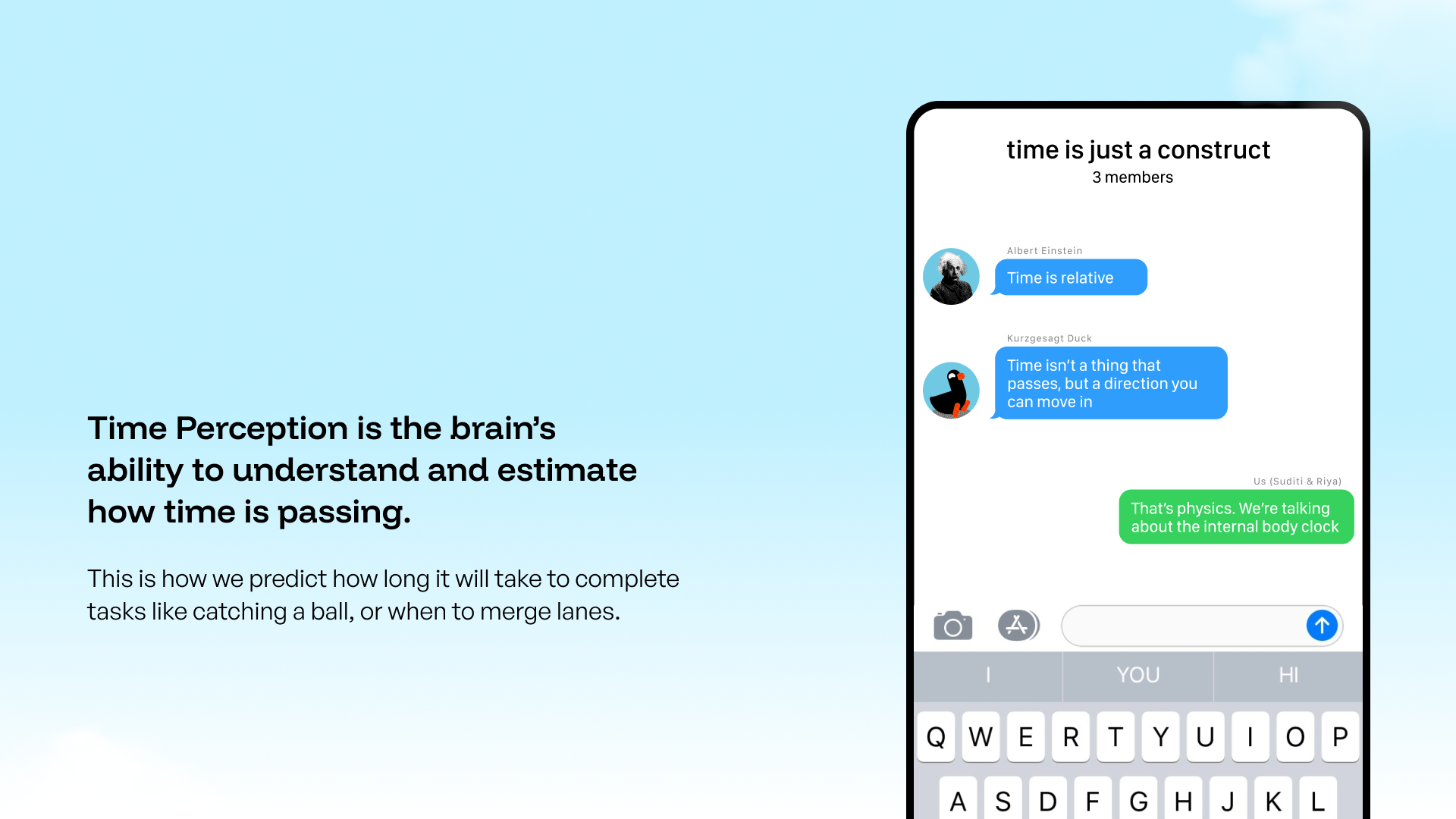
The way that we perceive time informs our behaviours—like avoiding work when you think you can’t finish it in time. When you're doing something you love, hours disappear in minutes, but when you're doing something mundane, even a few minutes feel painfully long.
This led us down a series of rabbit holes: videos, research papers, and discussions exploring the relationship between time and human experience. We explored how time connects with grief, culture, linguistics, memory, and emotion.
Across these domains, one pattern kept appearing: Time is not just measured by clocks. It is felt by the brain. The challenge being that no two people think alike. One person may feel the task pass quickly. Another may feel trapped in it.
That lead us to a simple question: What if we could measure how time actually feels to a person?
But more importantly; what if we could influence it?
What it does
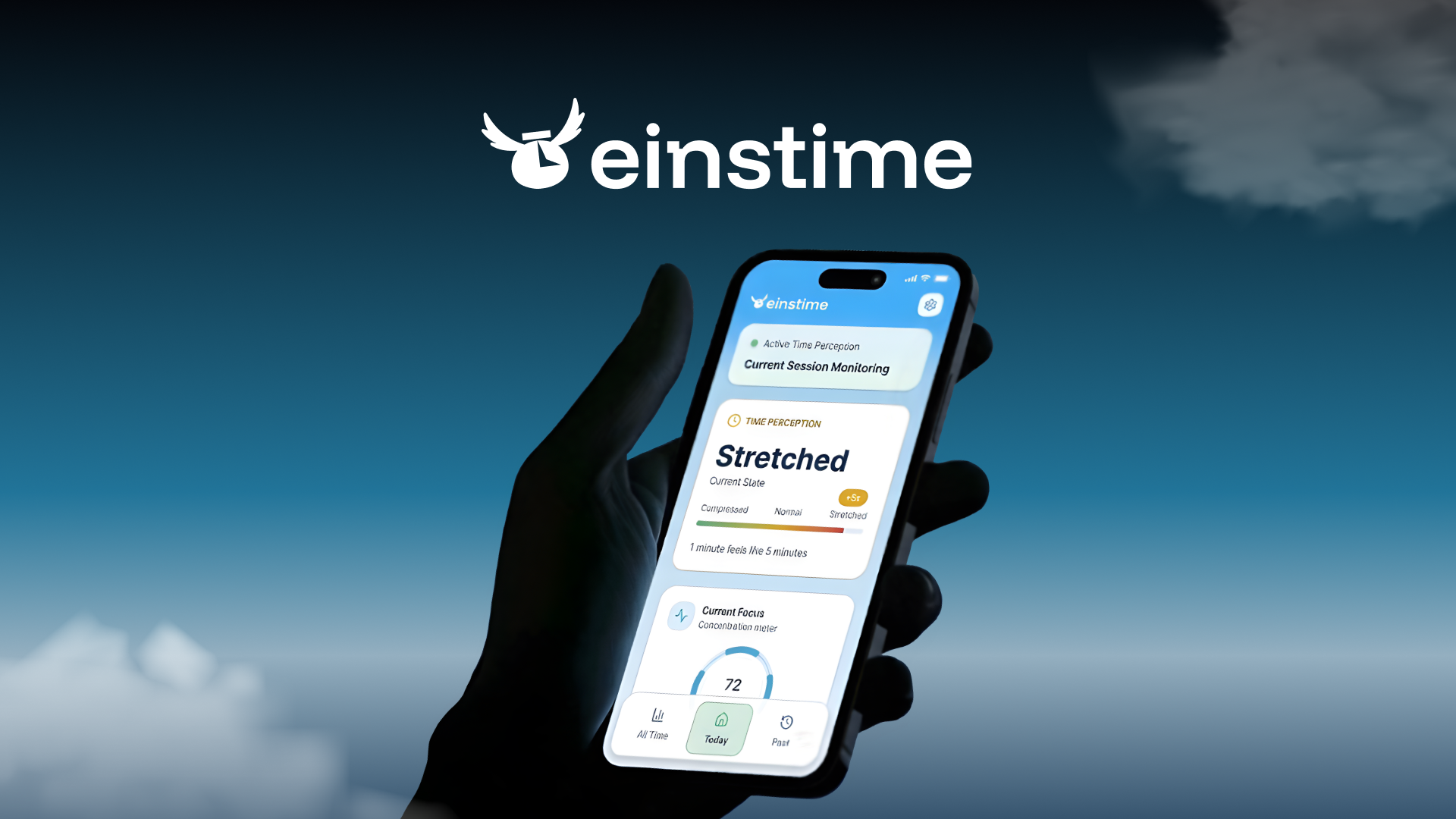
Einstime is designed to detect and respond to a person’s perception of time in real time.
It tracks patterns in the brain related to attention, engagement, and dopamine, and combines it with behavioural signals to understand whether a user is experiencing time as accelerated or slowed down. When the system detects that time is beginning to feel slower, often the moment when people start procrastinating or losing focus, it intervenes by reshaping the user’s digital environment.
For example, Einstime can:
- Reduce digital distractions
- Surface the tools or notes needed for the task
- Activate music or stimuli that improves the individual's focus
- Shift device behaviour to support sustained attention
At the same time, the system records when the user enters states of deep engagement or flow. Over time, users can visualise where their attention is strongest, when it drops, and what kinds of environments allow them to work most effectively. Instead of managing hours, Einstime helps make time spent doing difficult tasks feel like it goes by faster.
How we built it
Early in the process we discussed the idea with an astrophysicist, who helped point us toward theoretical frameworks and research areas related to time perception and how humans conceptualize time differently from physical time.
From there we explored interdisciplinary research spanning neuroscience, psychology, chronobiology, and cognitive science. The prototype itself was built using Figma and Figma Make, where we iterated through multiple interface concepts.
The challenge was not just building an interface, but imagining how a system could translate an internal experience into something visible and understandable. We experimented with visualisations that represent attention, time perception shifts, and moments of flow without relying only on numbers.
Through repeated iteration and testing different visual metaphors, the system gradually evolved into a framework that could both track and respond to perceived time states.
Challenges we ran into
One of the biggest challenges was understanding how time perception actually works on a biological level. Unlike physical time, perceived time is influenced by complex neurological factors including dopamine regulation, attention systems, and emotional state.
Translating these concepts into a design system required balancing scientific grounding with speculative thinking.
Another challenge was scope. Because the concept touches multiple domains, it was tempting to keep expanding the system endlessly. We often found ourselves hesitating to move forward because we wanted every part of the concept to be fully developed.
Having to focus on the core interaction (measuring and influencing time perception) became an important design constraint.
Accomplishments that we're proud of
One of the aspects we are most proud of is grounding a speculative idea in real human experiences. We were also able to validate parts of the idea through conversations with experts and research sources, which helped strengthen the conceptual foundation of the project.
But mostly, we are proud of the depth of exploration that went into imagining how a system could make something previously invisible, visible and also actionable. We didn't just want it to inform users, but actively make changes in their habits, though subtly.
What we learned
This project taught us how to think through speculative design in a grounded way. Rather than designing purely futuristic technology, we focused on identifying a real human phenomenon that current systems ignore. We also learned how interdisciplinary design can be.
Understanding time perception required us to explore neuroscience, behavioural psychology, cultural perspectives on time, and interface design simultaneously.
Perhaps the most surprising lesson was how fascinating the brain’s relationship with time actually is. The way we experience time shapes our motivation, attention, and productivity, but it remains largely invisible in the tools we use every day.
What's next for EINSTIME
Einstime currently exists as a conceptual prototype, but the idea opens up many future possibilities. One direction is expanding the system into wearable technologies that can capture physiological signals related to attention and engagement. Another possibility is integrating the system into immersive environments such as virtual or augmented reality, where time perception can be influenced more directly through sensory cues.
Beyond productivity, the concept could extend into other fields including therapy, rehabilitation, gaming, mental health, trauma recovery, and education.
Each of these areas involves experiences where time perception becomes distorted.
Einstime explores what might happen if we designed technology that acknowledges and responds to those differences.
Built With
- aftereffects
- figma


Log in or sign up for Devpost to join the conversation.