-
-

Deployment
-
Deployment

EnviroGuard AI – Real-time Hazard Detection & AI Assistant
🌱 Inspiration
Environmental hazards like wildfires, pollution, and wildlife threats pose significant risks to communities and ecosystems. Inspired by the need for real-time environmental monitoring, we set out to create an AI-powered assistant that detects hazards, provides insights, and enables natural language interaction to enhance safety and awareness.
🌍 What it does
EnviroGuard AI is a real-time environmental monitoring system that:
- 📹 Detects hazards such as fire, smoke, air pollution, and wildlife using computer vision.
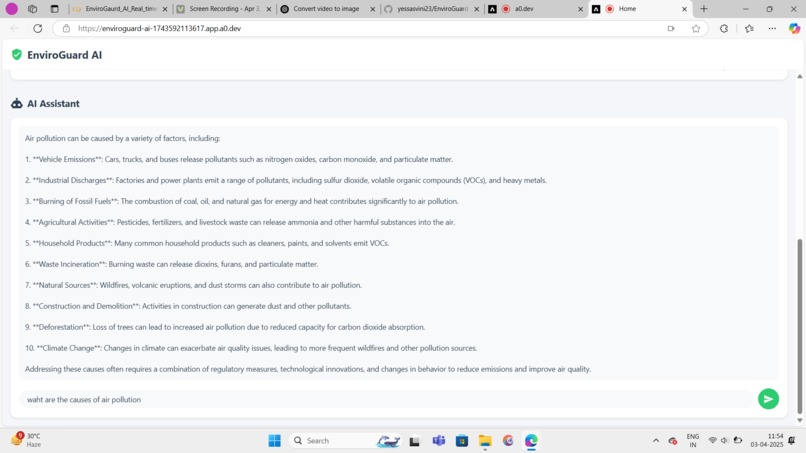
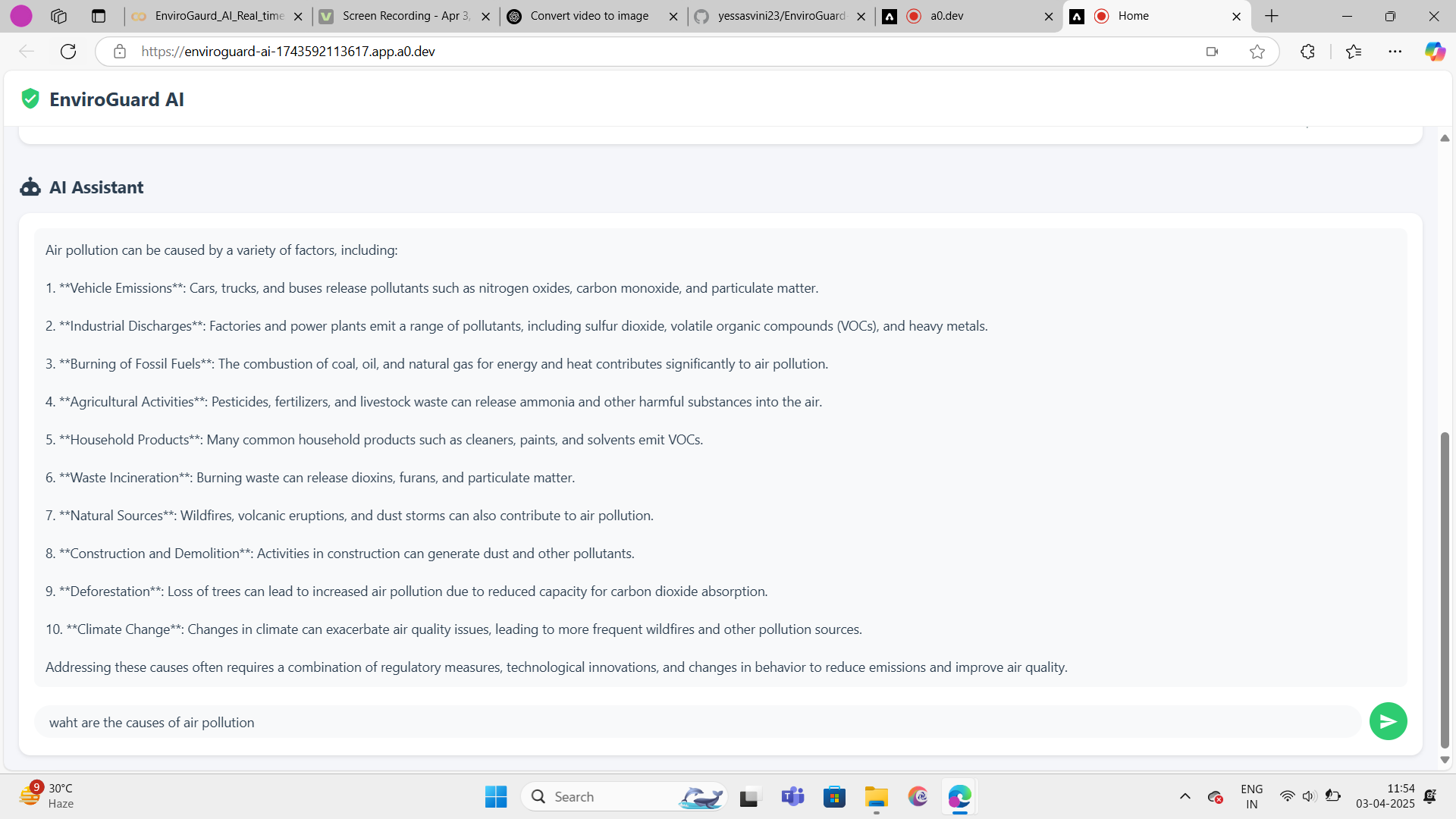
- 🗣️ Answers questions about the environment through AI-powered Q&A.
- 🔊 Provides voice alerts and actionable recommendations for hazard response.
- 🌡️ Integrates IoT sensors for real-time air quality and environmental data.
- 📊 Logs historical data for trend analysis and prevention strategies.
🛠️ How we built it
- Computer Vision & AI: We used OpenCV and Hugging Face models for hazard detection.
- LLM-Powered Q&A: Integrated LangChain with Gemini AI for environmental insights.
- Voice Interaction: Implemented gTTS and Whisper for real-time voice alerts and responses.
- Web Interface: Developed a Gradio-based UI for easy monitoring and interaction.
- IoT Integration: Connected air quality sensors via MQTT/REST APIs for real-time data fusion.
🚧 Challenges we ran into
- 🔥 Fine-tuning hazard detection: Training AI models to differentiate fire, smoke, and fog.
- 🎤 Optimizing voice interaction: Ensuring accurate speech-to-text conversion in noisy environments.
- 🌎 Data collection & accuracy: Finding high-quality environmental datasets for model training.
- ⚡ Real-time performance: Balancing speed vs. accuracy in AI inference for edge devices.
🏆 Accomplishments that we're proud of
- ✅ Built a fully functional prototype that detects hazards in real-time.
- ✅ Successfully integrated AI-powered Q&A for environmental insights.
- ✅ Designed a user-friendly web interface with multi-modal interaction.
- ✅ Established a foundation for IoT-enhanced monitoring.
📚 What we learned
- 📌 Optimizing computer vision models for real-time performance.
- 📌 Building scalable AI workflows using LangChain & Gemini AI.
- 📌 Importance of user experience in AI-powered monitoring solutions.
🏗️ Built with
| Technology | Purpose |
|---|---|
| Python | Core programming language |
| OpenCV | Real-time video processing |
| Hugging Face Transformers | Pre-trained AI models for hazard detection |
| LangChain | AI workflow orchestration |
| Gemini AI | Natural language Q&A |
| gTTS & Whisper | Text-to-speech & speech-to-text for voice interaction |
| Gradio | Web interface for user interaction |
| MQTT & REST APIs | IoT sensor integration for real-time environmental data |
| FastAPI/Flask | Backend for mobile-friendly API deployment |
| Jetson Nano/Raspberry Pi | Edge AI deployment for low-latency processing |
🚀 What's next for EnviroGuard AI
- 🔄 Expand hazard detection to include radiation, gas leaks, and flood monitoring.
- 🤖 Deploy on edge devices like Jetson Nano for low-latency AI processing.
- 📱 Develop a mobile app with push notifications for real-time alerts.
- 🌍 Integrate geospatial mapping for hazard visualization and tracking.
- 🏭 Collaborate with industries & smart cities for large-scale deployment.
EnviroGuard AI is just getting started – join us in building a safer, smarter planet! 🌎🔥🌿
Built With
- geminiai
- gradiobasedui
- gtts
- huggingfacemodel
- iot
- langchain
- opencv
- whisper


Log in or sign up for Devpost to join the conversation.