-
-
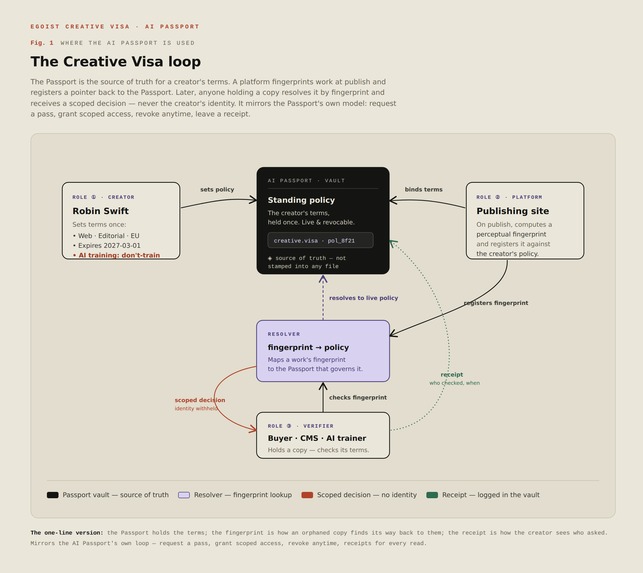
VISA loop for creatives.
-
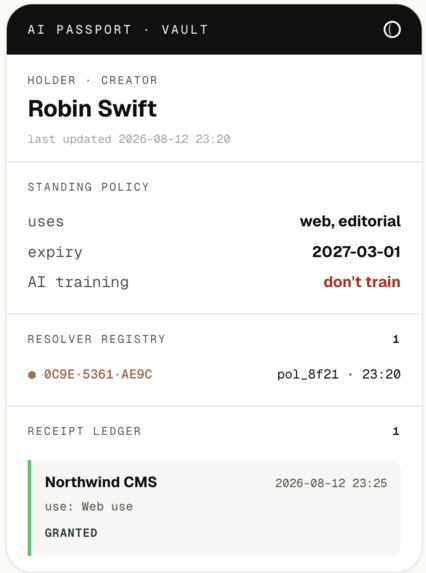
Passport Ledger
-
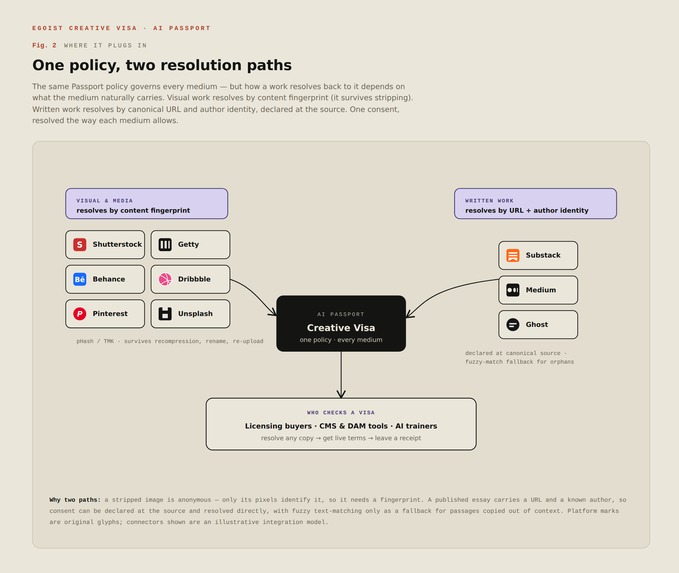
VISA integrations
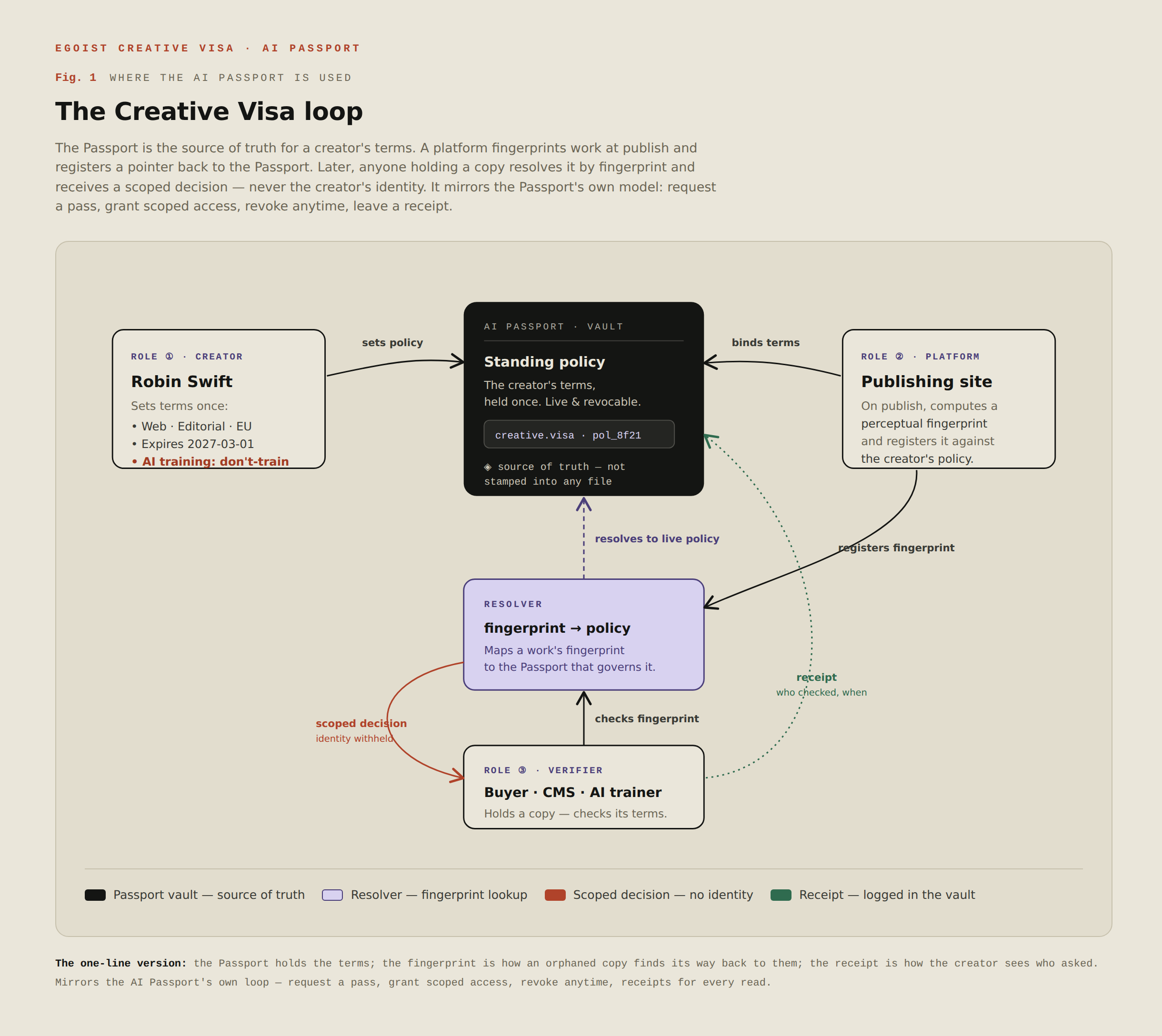
Team name : Darkrai
Track : Creative
Lane: Build
Summary
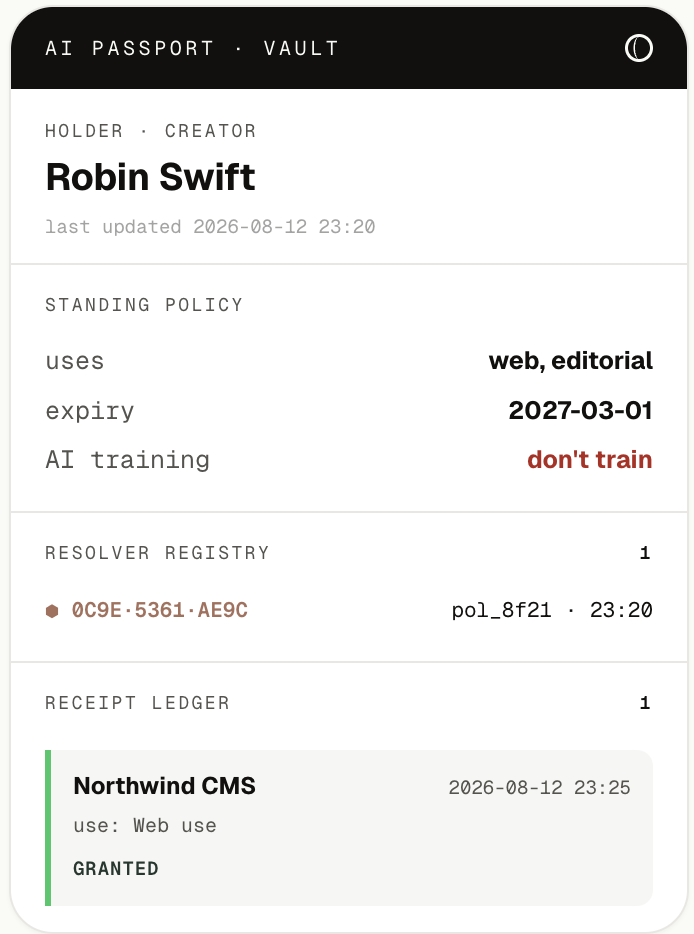
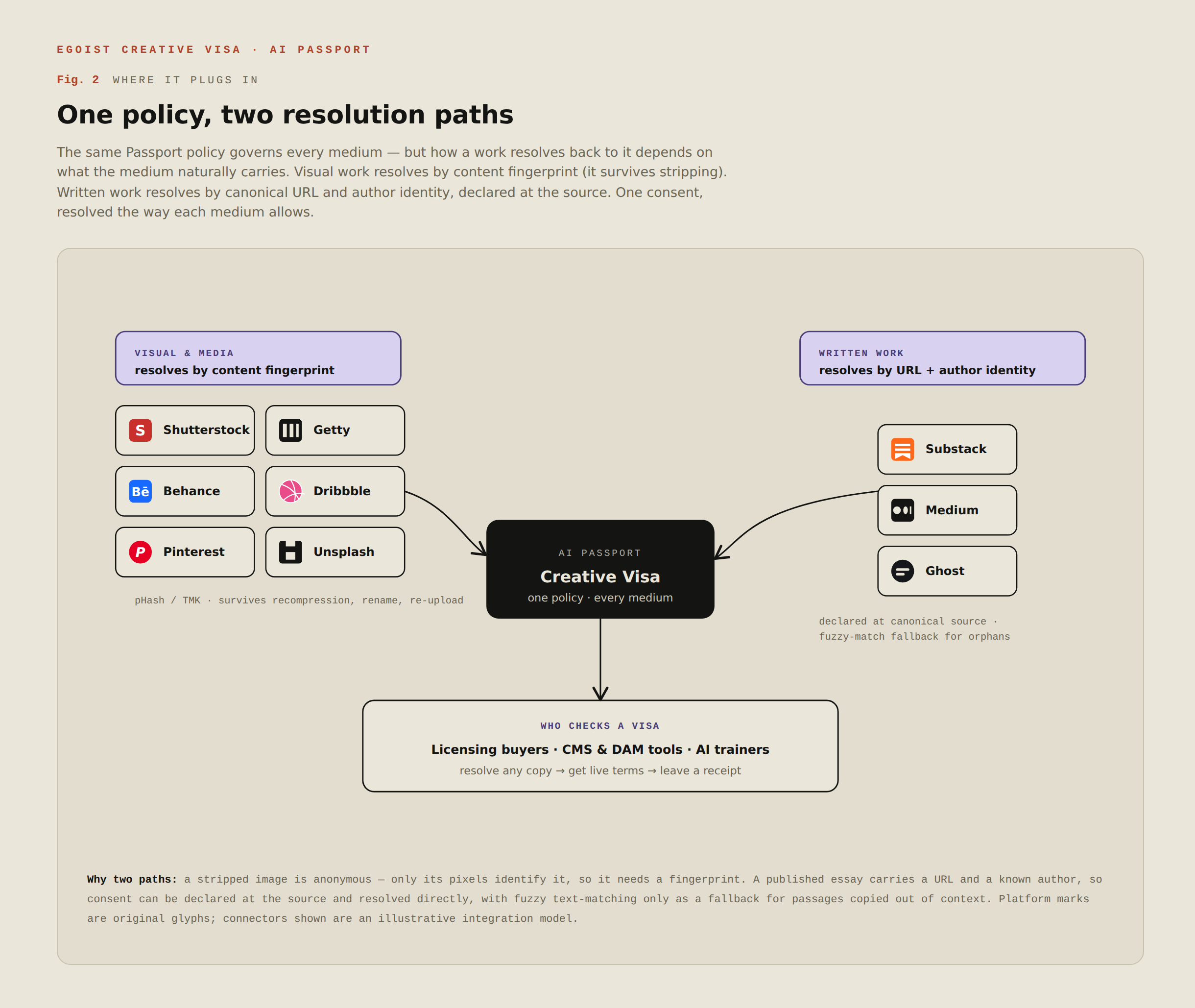
Egoist Creative Visa is a native permission layer for the AI Passport that gives creative work a scoped, expiring, revocable licence that travels with it. A creator sets their terms once in their Passport Vault (licensing scope, expiry, whether AI training is permitted). Any connected platform (Shutterstock, Behance, Substack, Medium) inherits the user's permissions from their Passport.
When they publish something on a visual/media platform, the platform computes a content fingerprint and registers it against the creator's standing policy. Later, anyone holding a copy (AI trainer, licensing buyer, or a DAM) can resolve that copy via it's fingerprint and receive it's current terms.
The verifier learns the decision. Neither learns more than they need to.
Problem
Whether creators should have a legal right to set terms on their work is a hotly contested topic right now. With They can set terms regarding who may license it, for what purpose, for how long, and whether it may train AI models. But every existing mechanism binds those terms to the wrong thing, and breaks at the same moment: when the work leaves home.
Robots.txt and ai.txt bind consent to a domain, bypassed the instant content is re-hosted or swept into a bulk dataset like Common Crawl. C2PA binds it to file metadata which is stripped on effectively every social upload, and C2PA confirmed in January 2026 that Content Credentials carry no "do-not-train" signal at all. Opt-out registries are keyed to the original URL, so a recompressed or renamed copy no longer matches.
Paywalling trades readership for protection, leaks anyway, and the leaked copy is the most detached from the author's wishes. Each mechanism's consent signal is host-bound; it dies when the work travels.
Active federal class action lawsuits allege that AI labs have harvested creator content for training. A famous example is the YouTube-creator suits against Apple, Nvidia, Meta, ByteDance, and Snap which are centred on the Panda-70M dataset, an academic-origin index of ~70 million clips passed between companies and re-fetched for training.
Creators' written work is equally exposed: authors' class actions, the NYT v. OpenAI suit, and a $1.5B training-data settlement have all turned on this gap. DeviantArt was named as a defendant in Andersen v. Stability AI for training on its own hosted content and then scrambled to build a "do not train" toggle in response, demonstrating that platforms build these flags under pressure, but each one is a separate island bound to that platform, solving nothing once content is copied off.
Detection today is broken for exactly the people who need it most. A creator only learns their work was trained on if they are famous enough to make the model regurgitate it verbatim. for example -> how the NYT discovered its paywalled articles in training data or sophisticated enough to run a membership-inference attack. An independent photographer or writer on Substack gets neither. Consent and proof must travel with the work.
While companies often state that their models were trained through licensed material, synthetic data and publicly available web data gathered through “responsible web crawling", it is difficult to fully ascertain the truthfulness of this statement.
The gap between broad disclosures and creator-specific consent is becoming a recurring issue across the AI industry, and Egoist VISA attempts to solve this exact problem by giving creators a revokable way to embed consent guidelines into an image's fingerprint.
The user or group affected
Primary: Any user whose work circulates online and can be scraped for licensing and AI training - photographers, illustrators, filmmakers, musicians, and writers who publish freely by choice.
Secondary: compliant licensing buyer or AI lab which gain a checkable, auditable way to confirm consent before using content in their ad-campaigns, editorials or as part of their training data.
How AI Passport is used
The creator's licensing and consent terms live in their AI Passport vault as a first-class, standing permission. The same portable, user-owned context the Passport is built to hold maps precisely onto the Passport's own permissioned loop.
A connected platform (Shutterstock, Behance, Getty as the issuer of licences to buyers) fingerprints the creator's work at publish and registers fingerprint → creator's live policy. A verifier whether a licensing buyer, a CMS, a DAM or an AI trainer requests one scoped field (creative.visa) with a declared purpose and duration. The Passport evaluates its standing policy and returns only the decision plus any licence terms. Every check is logged in the creator's Passport receipt ledger for inspection.
Egoist Creative Visa contributes the one missing primitive that makes this work for creative media that has been copied away from its source: a resolver that takes an anonymous, stripped file and, via content fingerprint, determines which Passport to ask, so the Passport can govern the work even when the file arrives carrying nothing that points back to it. The fingerprint is the key; the Passport is the lock; the receipt is what the creator sees.
For visual work (images, video), the resolver uses a perceptual hash (DCT pHash) computed from the content signal which is robust to recompression, renaming, and re-upload.
For written work (Substack, Medium), consent is declared at the canonical source through a direct platform integration: the creator's Passport policy propagates to their publication. For example, medium has a specific feature that can be toggled --> Minimise third-party training (ask all AI companies not to train on your stories, even if it means they may no longer directly credit your work and send readers to it).
What context, permission, proof, or access is involved
The context carried is a single scoped permission i.e, the creator's Creative Visa with the following fields: allowed uses (web, print, editorial, commercial, broadcast), expiry date, and AI-training stance (allowed / if-licensed / don't-train).
Who controls access
The passport user controls access of their consent. They can set the standing policy in their passport, which will act as the source of truth that evaluates every request against that policy.
Verifiers cannot enumerate a creator's works, read their identity, or query freely without a declared purpose. Lookups are one file at a time, purpose-bound, and rate-limited.
The resolver stores only one-way perceptual fingerprints mapped to unlinkable per-work references never the content, never a stable creator identifier that would let anyone browse their catalog. No party, including the resolver operator, can enumerate or harvest a creator's body of work. The resolver can be operated by the Passport service as a trusted intermediary.
What can be revoked or changed
Fields such as attribution requirements and AI training consent . The answer always comes from the Passport in real time, not from a cached tag on a file. The creator can flip these settings and the very next lookup reflects the new state everywhere, with no need to find or update the scattered copies
For the enterprise case: a brand's one-year web licence lapses, and the next time a CMS or DAM resolves that asset's fingerprint, it learns the licence has expired before publishing, not after a demand letter.
Risks or misuse concerns
Evidentiary, not preventive
No system bound to freely-copyable content can physically stop a bad-faith lab from training. Egoist Creative Visa does two real things instead: it serves the compliant majority who now want to prove lawful use, and for those who don't check, it produces a signed, portable receipt that consent was expressed and was available.
Fingerprint robustness and collisions.
The perceptual fingerprint is a recall mechanism, not the authority. DCT pHash is robust to benign transforms (recompression, resize, reformat) and meaningfully resistant to structural collisions; it is not adversarially unbeatable, and two perceptually-similar images can still share a hash.
Mitigations: matches within threshold trigger a confirmation step (richer secondary fingerprint or cryptographic hash for exact-copy confirmation).
Complementary to, not competitive with, DAMs.
Enterprise DAMs (Bynder, Brandfolder, Aprimo) govern assets inside their walls; they are blind to assets that have been downloaded, shared with agencies, re-uploaded. Egoist Creative Visa is the layer they plug into for portable, content-resolved status on assets outside any single system. It does not reduce licence fees; it reduces compliance risk on the escaped-asset and provenance-unknown cases where DAMs are structurally blind and where the expensive violations occur.
Built With
- ai
- passport
- phash

Log in or sign up for Devpost to join the conversation.