-
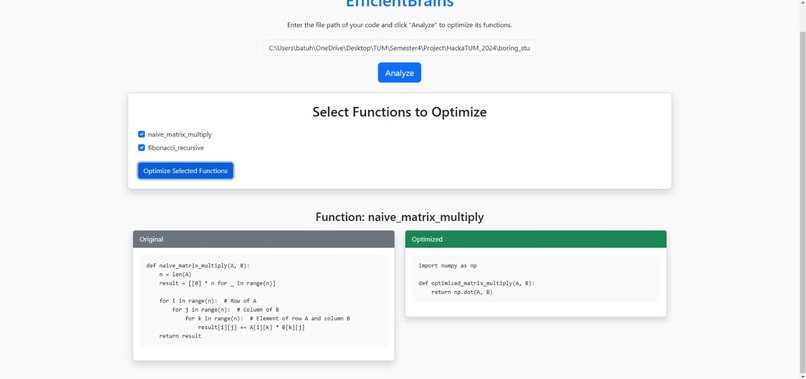
EfficientBrains on work!
Inspiration
The idea for CEB was born out of our own frustrations as developers. While working on complex projects, we realized how difficult and time-consuming it is to identify inefficiencies scattered across functions in a codebase. What makes it worse is the interdependence of these functions—optimizing one doesn’t always mean the entire program improves.
We thought: What if there was a tool that could intelligently analyze every function in isolation, optimize it individually, and then refactor the program as a whole for improved efficiency? This tool would provide a bird’s-eye view of inefficiencies while also focusing on the smallest, most granular components of the code. That’s when the concept for CEB emerged—a next-generation code booster designed to systematically enhance code performance without relying on recursion.
What it does
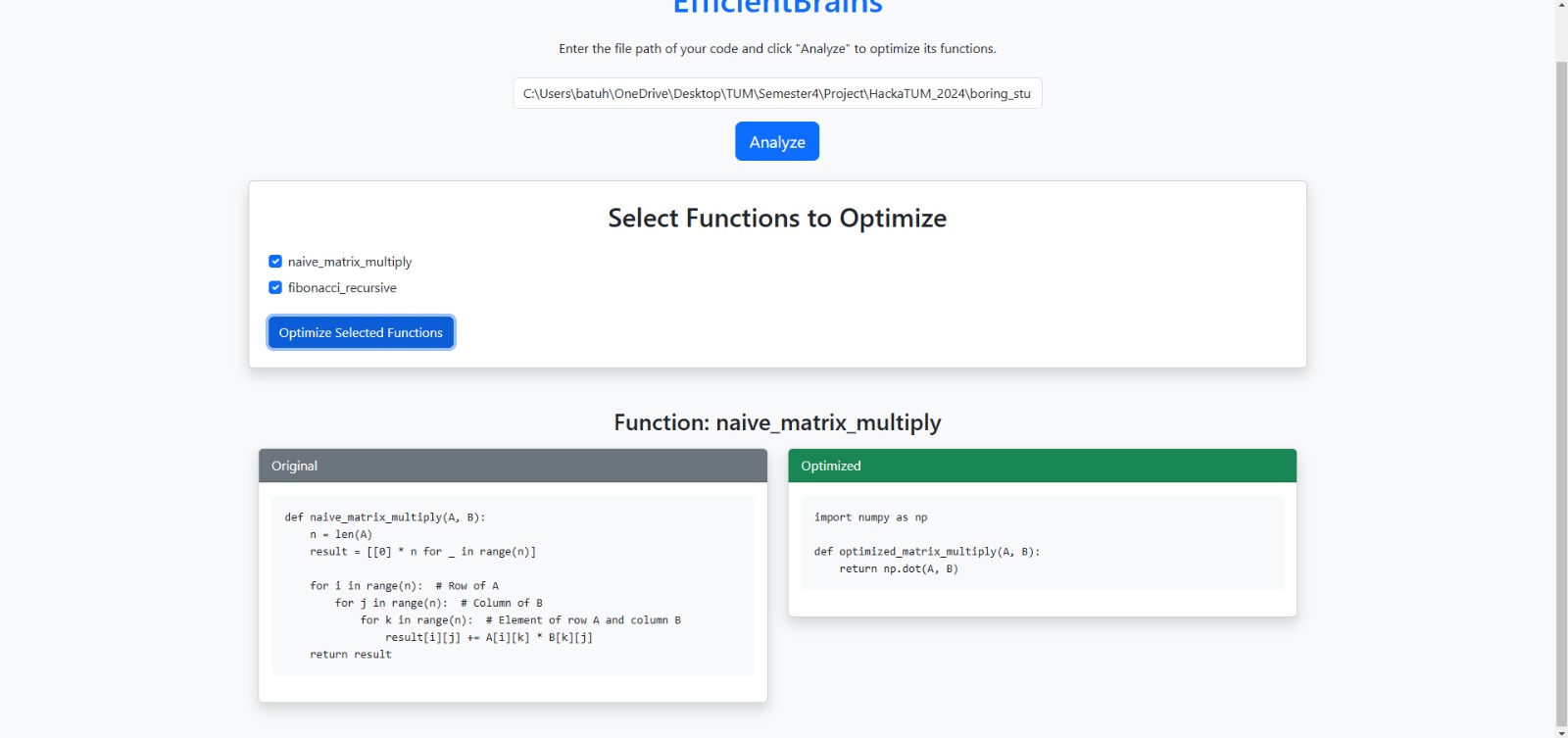
EfficientBrains is a function-level code optimization tool powered by advanced language models. It systematically analyzes a codebase, identifies inefficiencies in individual functions, and suggests targeted improvements. Here’s what it offers: • Function Isolation and Optimization: EfficientBrains extracts functions, optimizes them independently, and ensures they are reintegrated seamlessly into the codebase. • LLM-Powered Insights: Using a language model, it provides context-aware optimization, improving runtime performance, memory usage, and maintainability. • Program Integrity Validation: The tool ensures that the functionality of the program remains intact after optimization by running automated tests. • Time-Saving for Developers: By automating the tedious task of code optimization, EfficientBrains allows developers to focus on building features rather than fixing inefficiencies.
How we built it
Problem Analysis
• Understanding Inefficiencies: We studied inefficiencies in real-world codebases, identifying patterns in redundant logic, excessive memory usage, and inefficient algorithms. • Workflow Design: We designed a robust workflow that isolates functions, optimizes them, and reintegrates them into the codebase to ensure seamless improvements without breaking functionality.
Development Stack
• Frontend: Built using JavaScript to create an intuitive and responsive interface that allows developers to visualize and interact with optimization suggestions. • Backend: Powered by Flask (Python) to manage function extraction, LLM-based analysis, and reintegration. • AI Engine: Integrated with LangChain to leverage a cutting-edge language model for intelligent, context-aware code optimization. • Testing Framework: Automated testing implemented using Python libraries (like Pytest) ensures that the program’s functionality remains intact after optimization.
Iterative Testing
• Validation: We rigorously tested EfficientBrains on sample projects, monitoring improvements in execution time, memory usage, and code readability. • Refinements: Feedback from testing cycles was used to fine-tune the LLM’s optimization suggestions and improve reintegration accuracy.
This stack enabled us to build an efficient, flexible, and scalable tool while ensuring the codebase remains developer-friendly and maintainable.
Challenges we ran into
The usual stuff. It is never as easy as you imagine.
Accomplishments that we're proud of
    •.     Unique Idea: It is never implemented before!
• Functional Prototype: Delivering a working prototype of EfficientBrains that can analyze and optimize real codebases within the hackathon duration was a significant achievement.
• Meaningful Optimizations: The tool consistently improved runtime efficiency and reduced code complexity in our test cases.
• User-Friendly Interface: Creating an intuitive frontend for developers to interact with optimization results was a major milestone.
What we learned
• The Power of AI in Code Analysis: We gained a deeper understanding of how language models can analyze, understand, and optimize code.
• Collaborative Problem-Solving: Building EfficientBrains highlighted the importance of teamwork, with each member contributing unique skills to overcome challenges.
• Balancing Performance and Usability: We learned how to prioritize both performance improvements and code maintainability, ensuring a practical solution for developers.
• Iterative Development: Testing and iterating quickly was key to refining the tool within the hackathon timeframe.
What's next for EfficientBrains
EfficientBrains is just the beginning of what we envision as a revolutionary tool for developers. Here’s what’s next: 1. Multi-Language Support: Expanding the tool to support additional programming languages, making it accessible to a broader audience. Right now only python :( 2. Real-Time IDE Integration: Embedding EfficientBrains into popular IDEs like JetBrains! 3. Customizable Optimization Goals: Allowing developers to prioritize certain metrics like runtime speed, memory usage, or readability based on their project’s needs. 4. Machine Learning Enhancements: Leveraging feedback from users to continuously improve optimization algorithms. 5. Comprehensive Reporting: Providing detailed insights into the optimizations made, including performance benchmarks and refactoring summaries.
EfficientBrains is more than just a tool—it’s a vision to simplify and enhance the way developers write and optimize code. With this project, we’re paving the way for smarter, faster, and more efficient software development.
Built With
- flask
- javascript
- langchain
- openai
- python

Log in or sign up for Devpost to join the conversation.