-
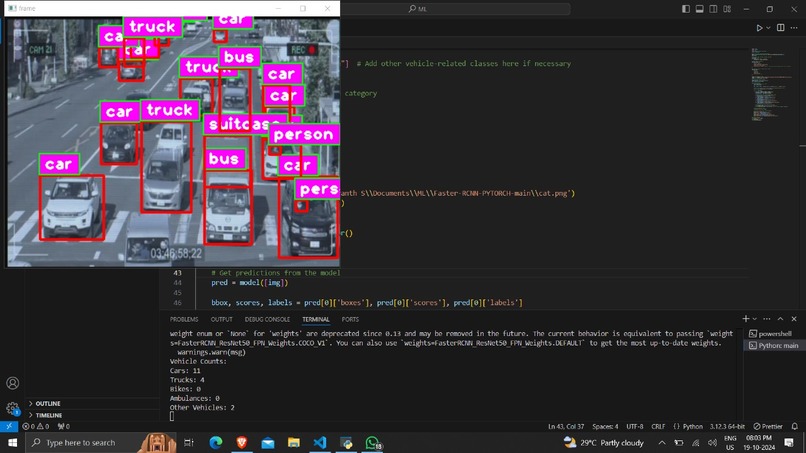
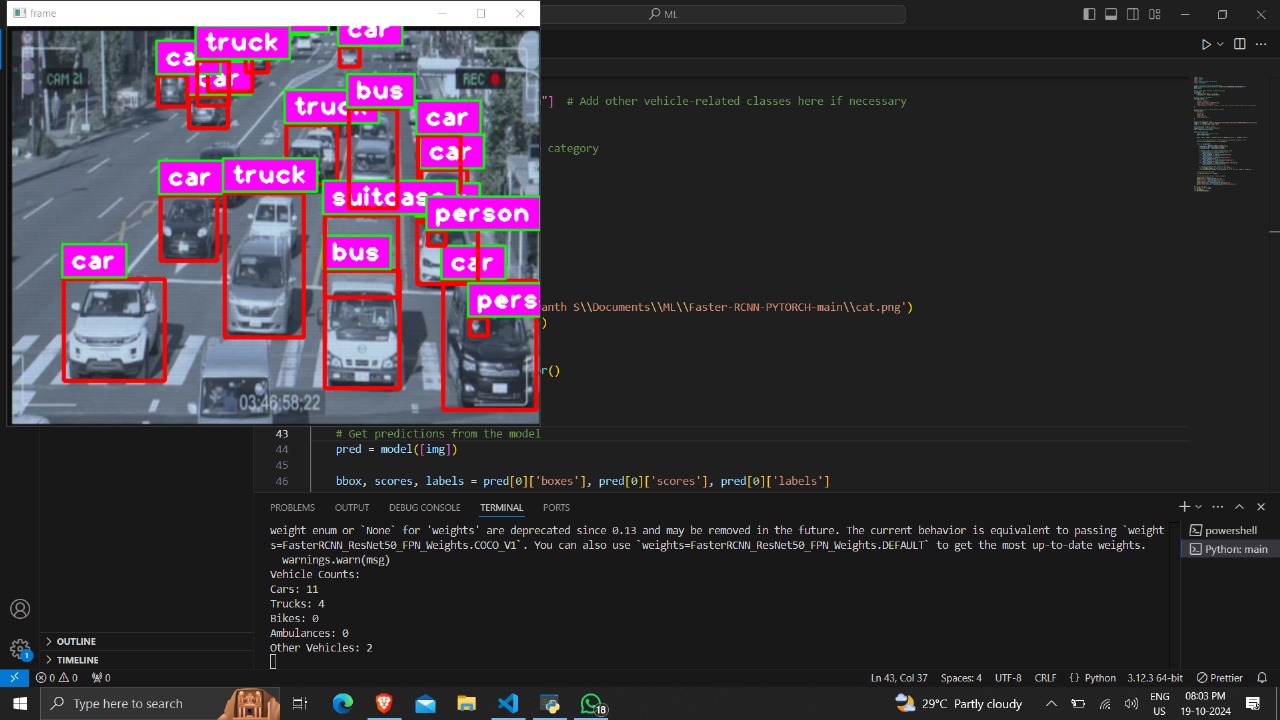
Working of object detection using Neural networking.
HOW DOES IT WORK:
- Vehicle Detection Using Faster R-CNN The goal here is to detect vehicles in real-time from CCTV footage. For that, we use a pre-trained Faster R-CNN model.
Pre-trained Model: Faster R-CNN is a state-of-the-art object detection model. We’ll use a model pre-trained on the COCO dataset, which already includes classes for vehicles such as cars, buses, and trucks. Using a pre-trained model allows us to skip the training process and directly use the model for detecting vehicles.
Loading and Using the Model:
We load the Faster R-CNN model in evaluation mode since we want it to perform inference (detection of vehicles) and not training. The input frames from the CCTV feed need to be transformed into a format the model can understand (a PyTorch tensor). The model processes the image and returns predictions, which include bounding boxes and the class of each detected object. Filtering Vehicle Classes:
The Faster R-CNN model detects multiple object classes, but we are only interested in vehicles (e.g., cars, buses, trucks). We extract the vehicle-related classes from the predictions. Counting the Vehicles:
Once we detect vehicles, we can count the number of vehicles in each frame to get a real-time estimate of traffic density. Video Processing:
The model processes each frame from the CCTV feed, detects vehicles, and overlays bounding boxes around them. This real-time processing allows us to continuously track the number of vehicles at the intersection.
- Traffic Signal Timing Using Linear Regression Once we have the number of vehicles from the detection step, we can proceed to adjust the traffic signal timing dynamically. This is where linear regression comes into play.
Data Collection:
The number of vehicles detected is one of the key inputs to the linear regression model. We can also consider other variables such as time of day, day of the week, historical traffic patterns, or even weather conditions, depending on the complexity of the model. The dependent variable (what we want to predict) is the signal timing, which refers to how long the light should stay green or red. Linear Regression Model:
Linear regression is a statistical method used to predict a dependent variable (signal timing) based on one or more independent variables (vehicle count, time, etc.). The model will take the input variables (like the number of vehicles) and compute the optimal signal duration based on a linear relationship learned from historical data. Training the Model:
We would use historical data to train the linear regression model. For example, we can collect data on traffic volume at different times of the day and the corresponding signal timings that worked well. The linear regression model learns how different input variables (like the vehicle count) affect the signal timing. Real-Time Prediction:
In real-time, after detecting the number of vehicles in each frame, we pass that number to the trained linear regression model, which predicts the optimal signal timing. For instance, if the detected vehicle count is high, the model might predict a longer green signal duration to allow more vehicles to pass through. Dynamic Signal Control:
Based on the predicted signal timing, the traffic signal controller adjusts the timing of the red/green lights dynamically. This ensures that traffic flow is optimized in real-time, reducing congestion during busy times and saving energy during periods of low traffic. Additional Considerations Optimization: Beyond linear regression, you could use more advanced machine learning models such as decision trees, random forests, or even reinforcement learning if you want more accurate and sophisticated control of traffic signals. Real-time Performance: The processing time of each frame and the model’s prediction speed must be optimized to ensure real-time performance, especially when dealing with live CCTV feeds. Integration: The model would need to be integrated with the traffic light control system to automatically adjust the timings based on predictions. Putting It All Together In the real-world application:
Vehicle Detection: Faster R-CNN continuously detects vehicles from the live CCTV feed. Vehicle Count Data: The detected number of vehicles is passed as input to the traffic signal timing model. Signal Timing Prediction: The linear regression model predicts the appropriate green/red light duration based on the current traffic load. Dynamic Signal Control: The traffic signals are adjusted in real-time based on these predictions, optimizing traffic flow.
Built With
- faster-rcnn
- flask
- postgresql
- python
- sklearn

Log in or sign up for Devpost to join the conversation.