-

Team
-
EEG
-
mental wellbeing chatbot

EEGcel
THE PROBLEMATIC ISSUE
The current healthcare system is rather overwhelmed, with increased imbalance in demand and supply of helathcare services. To decrease the burden on the system, the Singapore government has urged the public to only visit the hospital if they are seriously ill. Even former Covid restrictions, when compared to today, is heavily loosened, which further increased the daily cases of local Covid cases. From hereon, various social implications has arose:
1) Due to increase in cases and higher workload, the healthcare workers are facing burnout. They work a longer hours with increased doctor/nurse to patient ratio. Research has also shown that the younger doctors which are mentally affected by such issues, do not seek mental counselling with varying reasons 2) There may be people who are not so sick, yet rush to hospitals, increeasing the burden on the healthcare system, and at the same time, there are people who are very sick, yet avoid the hospitals due to two factors- fear of getting ill due to the increased density in the hospital, as well as being disincentivised by the drastically longer waiting and queuing times 3) Mental health problems which holds long term stigma, is increasingly problematic. The added effects from the quarantine, along with people's current avoidance of hospitals and polyclinics increases the risk of exacerbating any mental issues long term if nothing is being done.
We want people to be more responsible for their own well being, may it be mentally or physically. The more responsibility one takes, the lesser the likelihood for illness to set in. Therefore, we ambitiously envision a reduce in patient load, and an increase in general healthcare efficiency.
THE SOLUTION
With our vision, the team set out in a 2-prong approach: 1) Allowing self-responsibility for Physical Health 2) Allowing self-responsibility for Mental Health Each of these Prongs were then further developed into 2 steps: Diagnosis and Next Steps
THE APP
We made a functioning front-end and back-end, with completely self coded GUI from scratch to allow flexibility, and implementing numerous AI/API for different features.
Our App has the following features:
Physical health
1) Real time Medical Diagnosis from one of the best open and free symptom diagnosis in the world, WebMD with numerous awards for its AI classifier and predictive capabilities. The top illnesses we source aligns with real time update from WebMD's database, so that it will always be relevant.
2) Google maps tracker of nearest hospitals/clinics so they don't have to procrastinate if they feel really ill. Getting treatment in time is but the basics of being responsible to your own health in the long term!
Mental health
1) A mental health checkup formulated by Ivan Goldberg, MD, and credited by other doctors is implemented. It is used widely by different national health organisations; it may not be as comprehensive as those from professionals , but they indicate enough for a person to know if they should seek help.
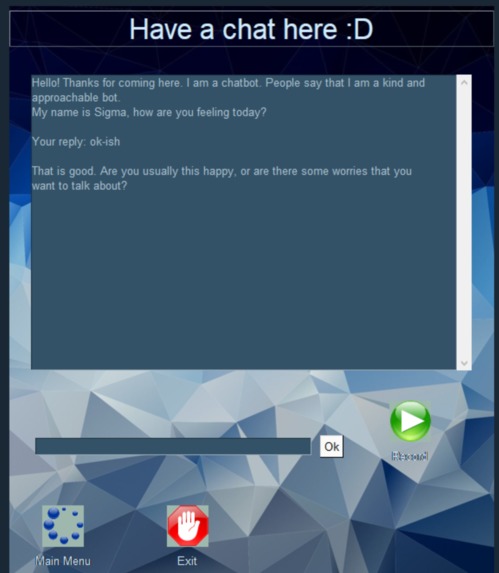
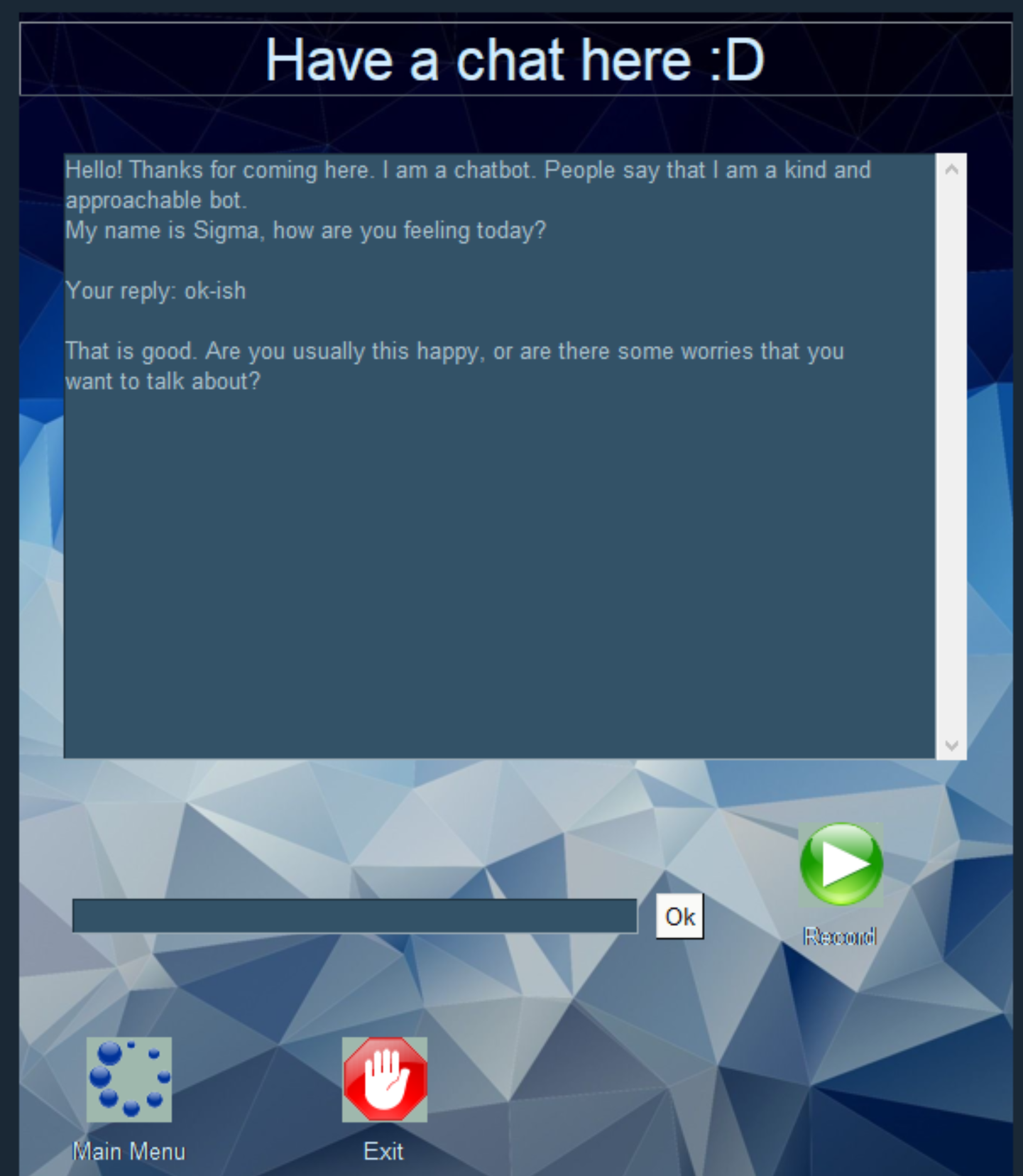
2.1) Implementing NLP and sentiment analysis to create a chatbot trained on data such that it can identify when someone is depressed. This chatbot serves as a companion to hopefully improve the mental health of people by having a secret partner to talk to.
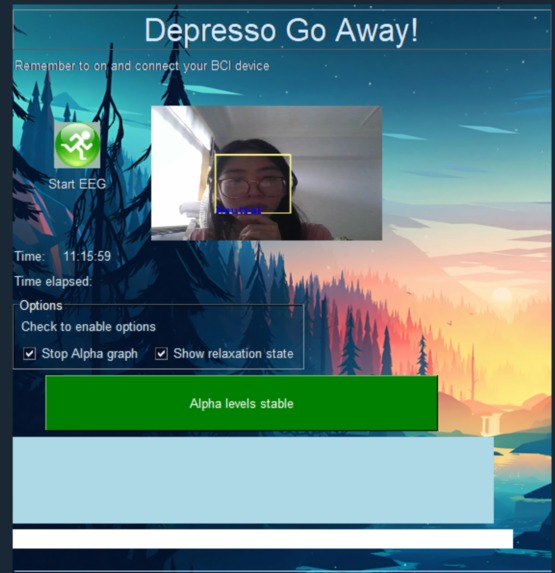
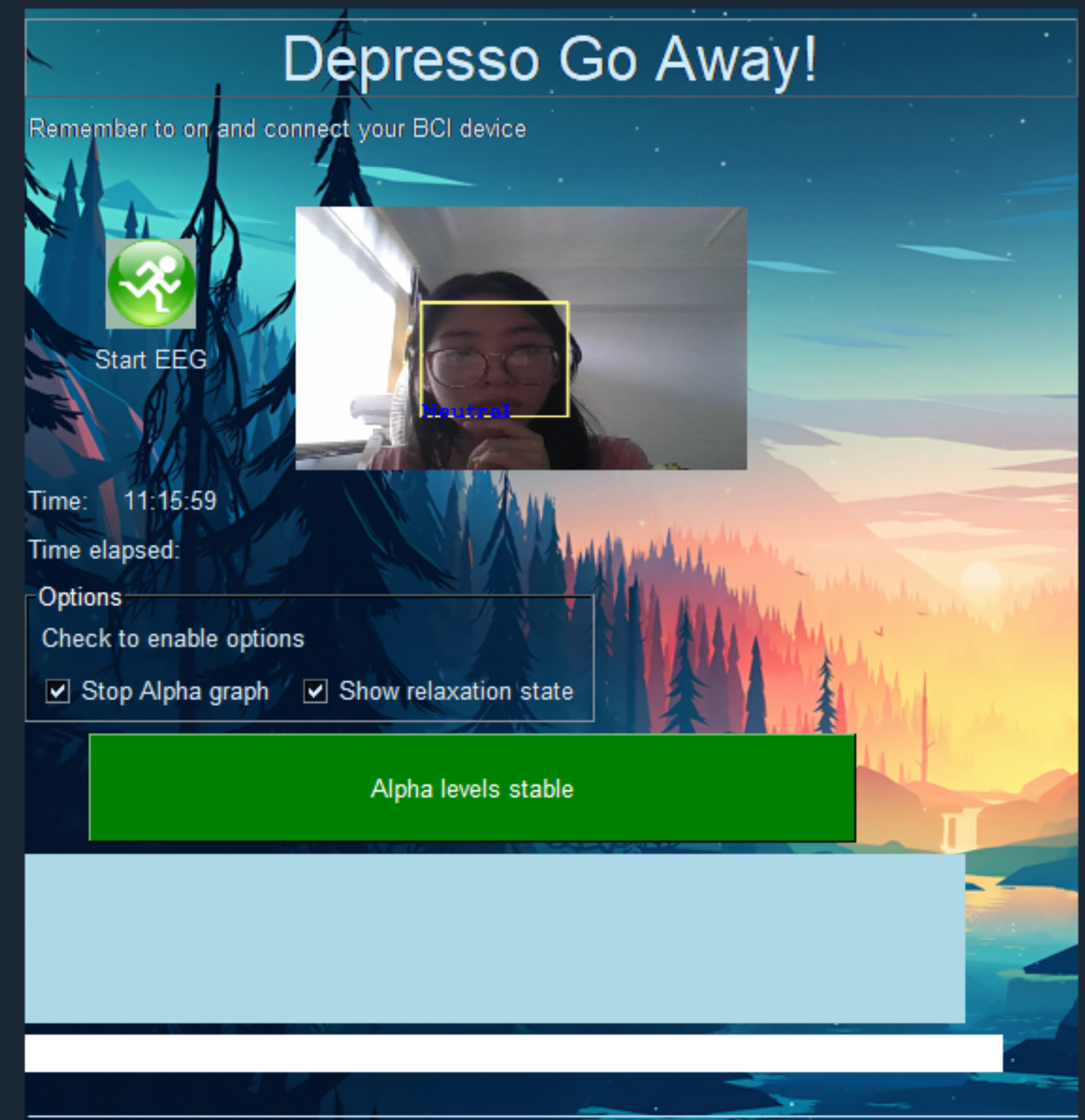
2.2) Other than giving a platform to release stress above, we made a meditative function to allow individuals to try to calm themselves. Research has shown for silent reflections/meditations to improve mental health, and one of the indicators were alpha brain waves. By using a MUSE2 device, the individual can use our app to see how relaxed they are. Higher Alpha brainwaves are also present in individuals with depression and anxiety, thus monitoring the alpha waves may be a good indicator of mental health improvement. Along with real time brain data, sentiment analysis and image recognition AI was used on this function such that the person can see if they are feeling neutral during the meditation(where having a neutral, relaxed face was desired).
HOW WAS IT MADE
First round was planning topic which was fast since there's only so much we can try. We thought of helping the doctors do major diagnosis before remembering we do not have much of the knowledge.
The second phase was distributing research. This was the most frustrating portion. 1 combed through papers, the other 2 combed through datasets. We had major difficulties finding good data. It was very painful. Initially we planned to use MUSE2 to also recognize emotions(instead of visually), but the place where there exist datasets, openneuro, had very problematic dataset issues that we threw away the idea and chose an alternative. Or we might never complete this hackathon in time. We might still be cleaning the data now...
The third phase was coding. Without showering, by only eating oven food or cup noodles, and not sleeping, we were rather agitated when something failed to compile. It was very painful. There were so many things to do and so little time. If we spent anytime sleeping or anything else, we'd probably miss the deadline.
Forth phase was compiling and debugging any last issues.
Last phase was writing a script and videoing, an honest pain in the apple. The PCs were running real slow due to using it without stop (and that its kinda old ngl). Alas, perseverance is key to a functioning app. Although the app is functioning, I feel that our brains might stop soon.
Currently, the three of us are undergrads in Singapore so we try to apply what we have learnt. The fuel allowing this app to prevail was in the end: SLEEP DEPRIVATION
ENLIGHTENMENT?
There was never enough time, there is so much more to add, but we'll be realistic... for now. Honestly, other than learning a lot about development, the true miracle was the amount of time one would have if there's no sleep. Alas, sleep is integral to having a healthy body. Is it ironic that we pushed an app to improve general health by ruining ours in the process... just some food for thought.
What's next for EEGcel
GUI changes, functions changes etc. Implement database for medical information.
SOME OF OUR RESEARCH LINKS:
https://openneuro.org/datasets/ds003004/versions/1.1.0 https://github.com/Aniruddha-Tapas/Predicting-Diseases-From-Symptoms https://github.com/sekharvth/symptom-disease https://github.com/KriAga/Health-Checker https://sph.nus.edu.sg/wp-content/uploads/2019/06/SSHSPH_Understanding-Hospital-Waiting-Times.pdf https://www.statista.com/statistics/874609/waiting-time-for-consultation-in-polyclinics-singapore/ http://ijer.skums.ac.ir/article_23155.html https://www.karger.com/Article/Fulltext/381950 https://openneuro.org/datasets/ds003751/versions/1.0.3 https://hms.harvard.edu/news/harvard-neuroscientist-meditation-not-only-reduces-stress-heres-how-changes-your-brain Hölzel, B. K., Carmody, J., Vangel, M., Congleton, C., Yerramsetti, S. M., Gard, T., & Lazar, S. W. (2011). Mindfulness practice leads to increases in regional brain gray matter density. Psychiatry research, 191(1), 36–43. https://doi.org/10.1016/j.pscychresns.2010.08.006 https://www.straitstimes.com/life/more-doctors-in-singapore-face-burnout-anxiety-amid-the-pandemic https://www.straitstimes.com/singapore/health/long-call-hours-teach-time-management-but-not-best-way-to-learn-medicine-say-junior-doctors https://screening.mhanational.org/ https://www.channelnewsasia.com/singapore/moh-new-covid-19-measures-ease-strain-healthcare-system-protocol-2-2513386 https://doi.org/10.7326/M20-1083 https://www.straitstimes.com/singapore/health/doctors-nurses-struggle-to-cope-as-covid-19-patients-flock-to-ae-depts-many-with-mild-symptoms https://www.straitstimes.com/singapore/health/healthcare-workers-strained-by-flu-season-omicron-resignations-and-insufficient-rest-union-president https://www.channelnewsasia.com/singapore/moh-new-covid-19-measures-ease-strain-healthcare-system-protocol-2-2513386
Built With
- ai
- bluemuse
- braincomputerinterface
- imagerecognition
- ktinker
- muse2
- natural-language-processing
- sentiment-analysis-online


Log in or sign up for Devpost to join the conversation.