-
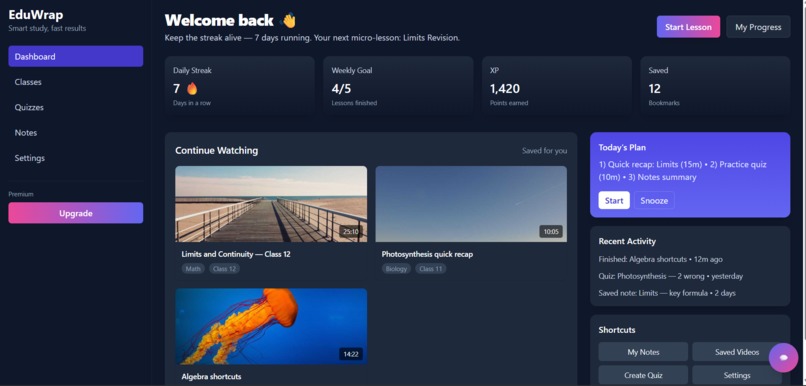
Our frontend as of now
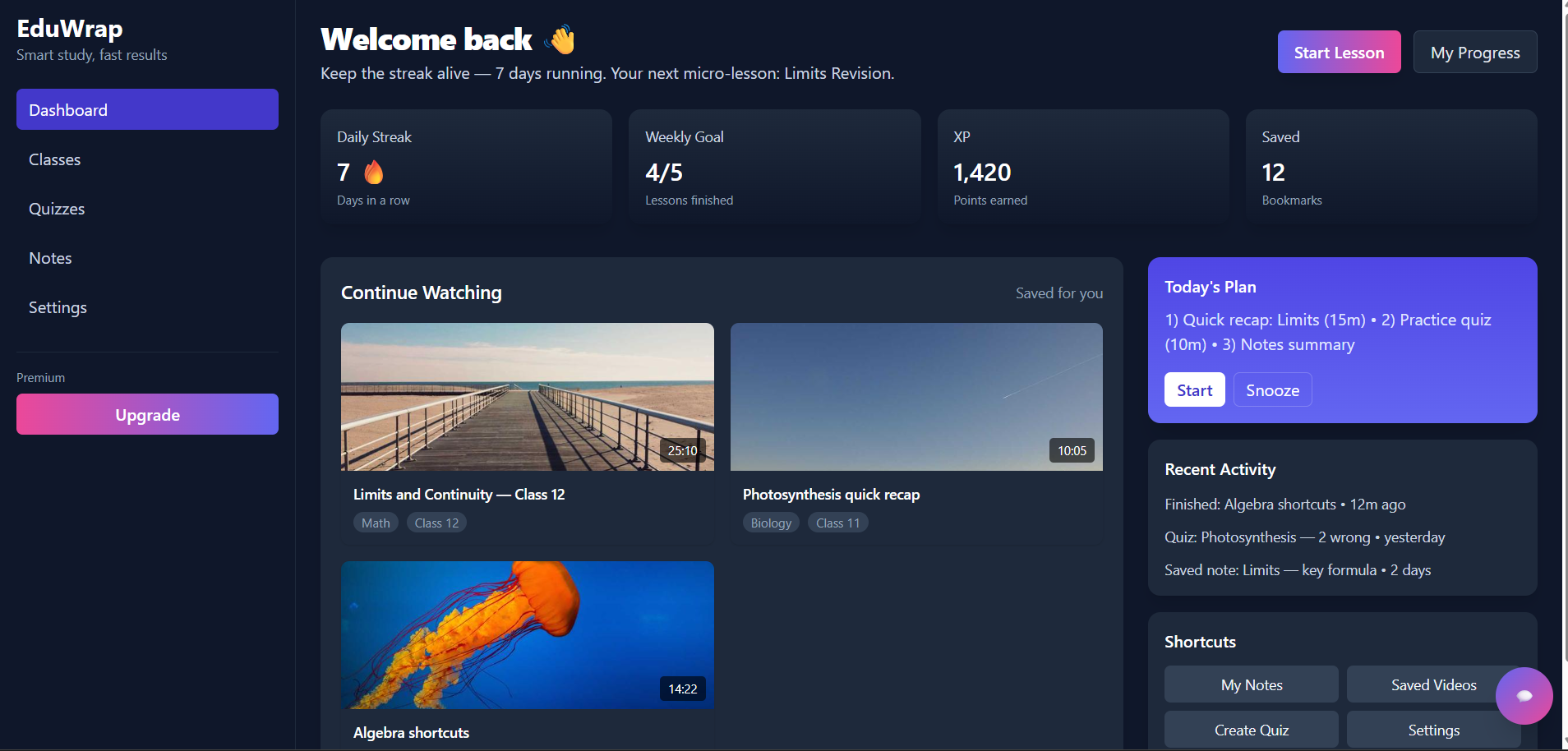
Inspiration
Students today rely on textbooks, PDFs, and handwritten notes, but these formats are passive, time-consuming, and often boring. As engineering students ourselves, we’ve faced the same struggle: Long chapters, last-minute exam preparation, difficult subjects with no visual or audio support, and the lack of personalized learning.
We wanted to build something that turns static study material into an interactive learning experience — videos, podcasts, summaries, quizzes, and a chatbot — all generated automatically. This vision inspired EduWrap, an AI-powered learning engine that transforms any educational PDF into multi-modal, engaging content.
What it does
Converts PDFs into Multiple Learning Formats EduWrap allows students to upload any educational PDF and automatically generates: Educational video lesson scripts Podcast-style audio scripts Concise chapter summaries Topic-wise quizzes A chapter-specific AI tutor This provides students with flexible learning options based on their preferred study style.
AI-Generated Video Lessons EduWrap transforms each section of a chapter into clear, student-friendly video scripts that mirror modern educational explanations.
AI-Generated Podcasts Each chapter is also converted into an audio-based narration that students can listen to while revising or multitasking.
Smart Summaries The system produces short, focused summaries that highlight key concepts, making them ideal for quick revision.
Automatic Quiz Generator EduWrap generates multiple types of questions, including: Multiple-choice questions Conceptual questions Application-based questions This helps students test their understanding immediately.
AI Tutor Chatbot A built-in AI tutor allows students to ask questions like: "Explain this concept" "Give me an example" "Create practice questions" It acts as a personalized tutor for every chapter.
Preloaded Learning Library The platform includes ready-to-use NCERT content for Grades 9–12, enabling instant learning even without uploading a PDF.
How we built it
Backend FastAPI for building lightweight, asynchronous API endpoints pdfplumber for reliable PDF text extraction BARC for structured LLM workflows and multi-step content generation Groq API to generate summaries, video scripts, podcasts, quizzes, and chatbot responses with high-speed inference CrewAI for agent-based reasoning and pipeline automation Pydantic for schema validation Uvicorn as the ASGI server Qdrant for RAG
AI and Content Generation LLM models served via Groq for fast text generation Text-to-speech tools to convert script outputs into audio podcast content Chunking utilities to process long PDFs into context-aware segments
Frontend React + Vite for a fast and responsive user interface Tailwind CSS for consistent and utility-driven design Axios for API communication React Router for managing navigation across the platform
Challenges we ran into
Chunking and Sequence Management Long PDFs exceed LLM context windows. We experimented with optimal chunk size=1500–2500 tokens plus overlap to preserve meaning. Getting this right took multiple iterations.
BARC Integration BARC has a very specific agent structure. We struggled with: Task definitions Agent role separation Pipeline orchestration Error handling Eventually, we designed a reusable pipeline.
Video & Podcast Consistency Ensuring: Voice tone consistency Script continuity Section-wise flow was tricky when content was generated in parts.
We solved it using metadata + subarray tracking.
- FastAPI Bugs & CORS Issues Common issues we fought through: Random 422 errors File streaming issues Dev environment mixing WSL/Windows Tailwind not loading Vite hot reload port conflicts
Each fix taught us more about real-world full-stack debugging.
- Time Constraints Building a multi-modal AI product in limited time meant managing: Feature prioritization Architecture simplification Efficient teamwork Minimizing technical debt
But this pressure made our work sharper.
Accomplishments that we're proud of
Successfully built a complete end-to-end AI learning system that can convert any PDF into videos, podcasts, summaries, quizzes, and a personalized tutor. Achieved consistent content quality across all generated formats, despite varying chapter lengths and structures. Designed a clean, minimal, and highly responsive UI that makes the platform easy for students to use. Integrated multiple AI modules (summarization, video scripting, TTS, quiz generation, chatbot) into a unified, seamless workflow. Optimized the system for speed using Groq’s fast LLM inference, making the platform feel almost real-time. Created a preloaded learning library with NCERT content for Classes 9–12, offering instant usage without uploads. Managed to build and refine all major features within strict time constraints, demonstrating effective teamwork and rapid problem-solving.
What we learned
How to design and organize a multi-modal AI learning product that handles large, unstructured academic content. The importance of clean chunking, content flow, and structure when working with long PDFs and educational material. How to use FastAPI, BARC, CrewAI, and Groq models together to create structured pipelines for reliable output. The significance of creating simple, student-focused interfaces that reduce cognitive load. How to work efficiently as a team, break features into modular tasks, and integrate them step by step. Problem-solving in real-world scenarios involving time pressure, unclear outputs, and shifting priorities. The balance between speed, quality, and user experience while building AI-powered applications.
What's next for EduWrap
Introducing fully AI-generated videos using a 3D virtual teacher that delivers lessons with animations, gestures, and visual explanations. Adding automated video creation with dynamic slides, diagrams, and chapter visualizations. Implementing concept maps and interactive diagrams for improved visual learning of complex topics. Launching a mobile app to enable on-the-go revision and offline access to podcast-style content. Integrating student performance tracking and personalized learning paths based on quiz results and study patterns. Expanding the learning library beyond NCERT to include higher education, competitive exam syllabi, and university-level resources. Adding collaborative study features such as shared notes, peer discussions, and group revision rooms. Introducing multi-language support to make EduWrap accessible to learners across diverse regions. Improving generation speed and scalability by deploying optimized cloud infrastructure and content caching.

Log in or sign up for Devpost to join the conversation.