-
-
-
-
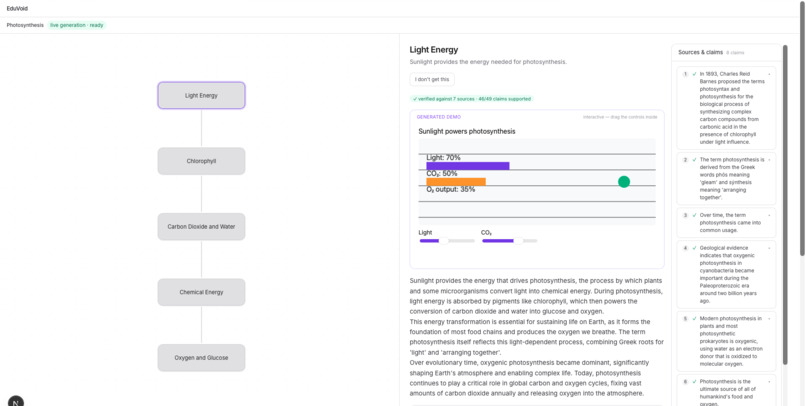
Photosythesis example
-
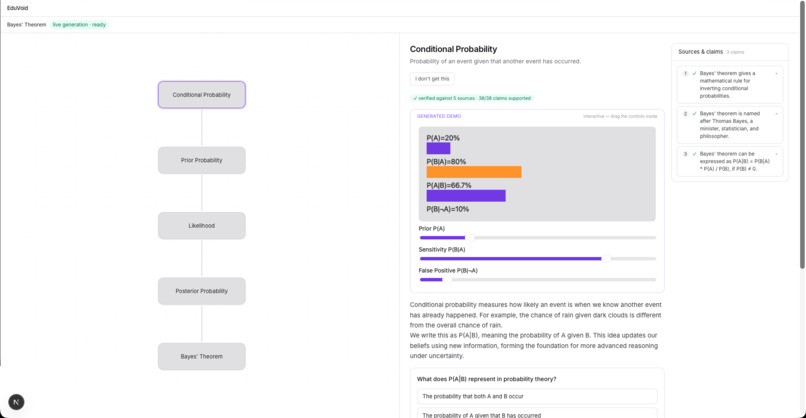
Bayes' Theorem example
Inspiration
Ask an AI chatbot to explain a topic and you get a good answer in ten seconds. Read it, close the tab, and try to explain it to a friend the next morning. It is gone. The answer was not wrong, but reading an answer is not the same as learning one.
Worse, you cannot tell which sentences were load-bearing. A study guide that confidently states something subtly false costs a student real marks, and the student has no way to check it.
Two failures, then: it doesn't stick, and you can't check it.
EduVoid is built against both. Instead of an answer in a chat window, you get a small interactive app for the topic: a map of what you need to know first, simulations you predict before you're allowed to run, and explanations where every statement is clickable down to the exact passage it came from, or is dropped before you see it. Miss a quiz question and the app does not repeat itself. It rebuilds that concept as a simulation you can manipulate, and tells you why.
Built for ForgeHacks 2026, AI + Education.
What it does
You type one question: "What do you want to learn?" No level picker, no style form, no settings.
Then agents search the web, rank sources by authority, extract claims with passage-level citations, cross-check them, plan the topic's prerequisite graph, and stream a learning app into your browser:
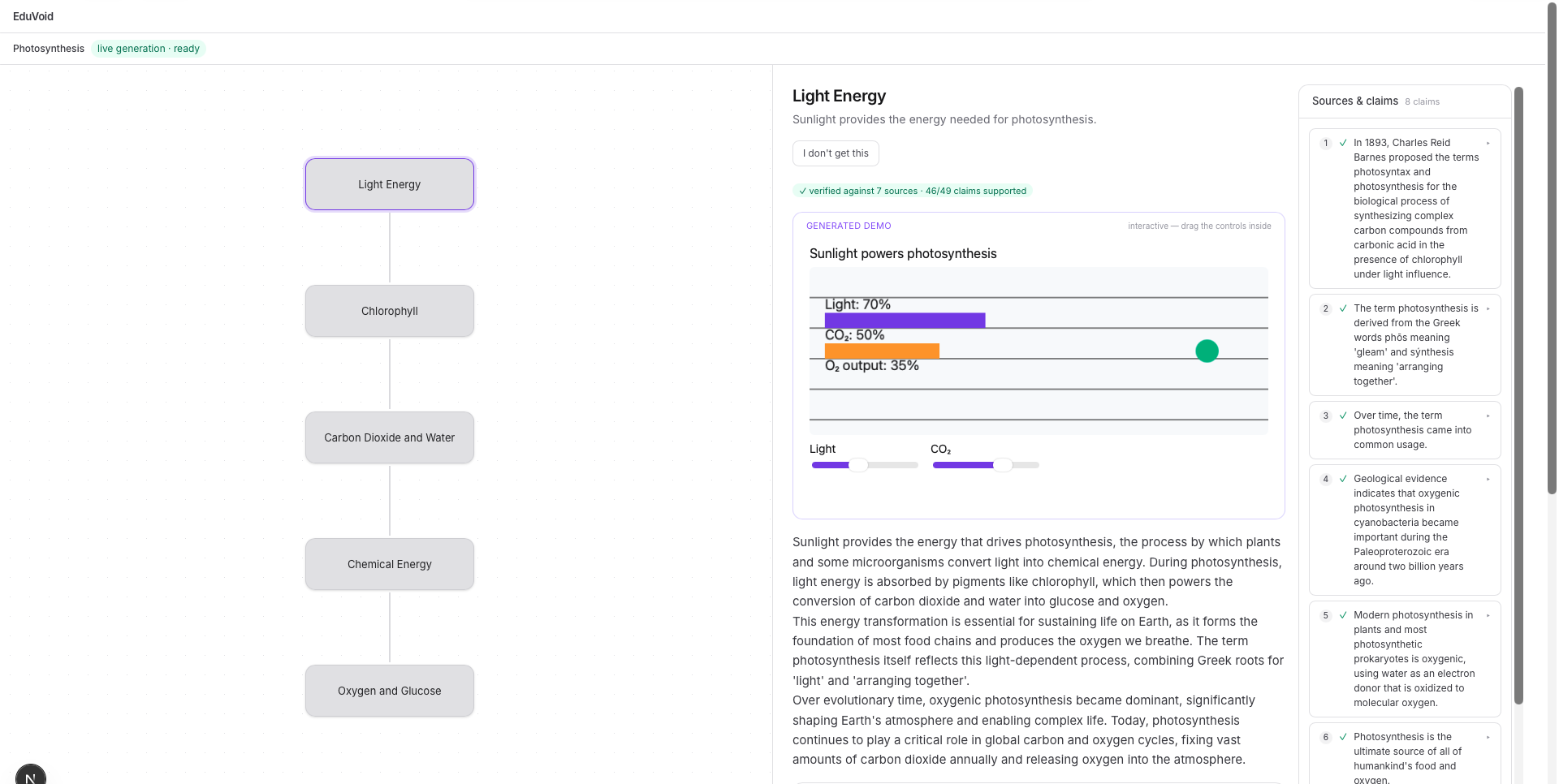
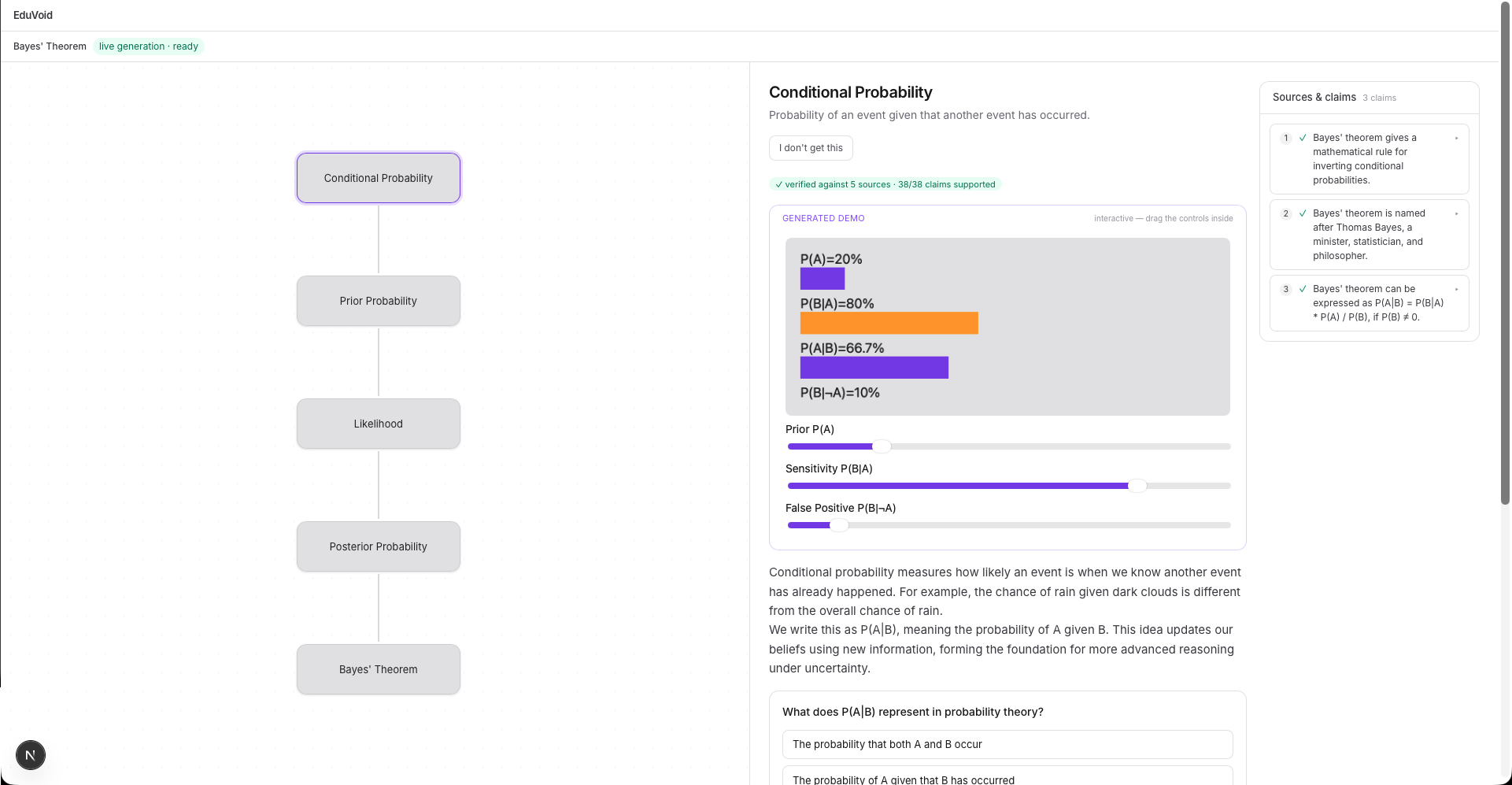
- A live mastery mindmap. Nodes are concepts, edges are prerequisites, and node colour is your mastery. It renders as a skeleton before any prose exists, so the structure of the topic and your gaps in it are visible at the same time.
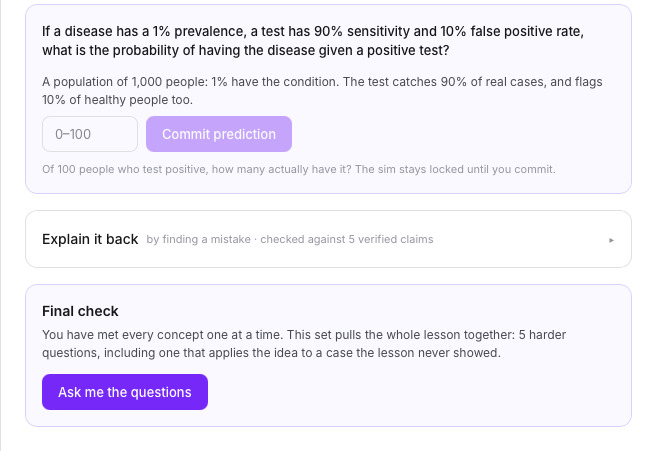
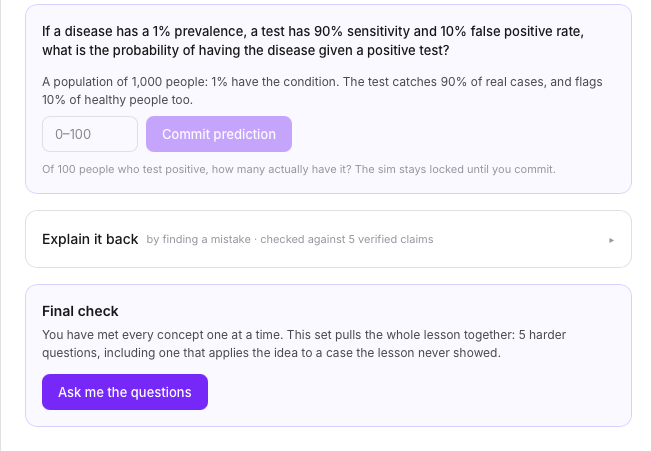
- Predict-then-reveal simulations. You commit to a prediction before anything runs, then unlock an explore lab. For example, in a population growth sim you set birth and death rates, predict the curve, and then watch it play out. Changing one parameter shows the cause directly, which is more memorable than a paragraph describing it.
- Cited everything. Every explanatory sentence carries a marker that opens the claim, the passage text, and the source link with its authority label. Sources that disagree are shown as "sources disagree" rather than averaged into confident mush. Claims the verifier could not support are removed, and the agent-activity panel shows how many it threw away.
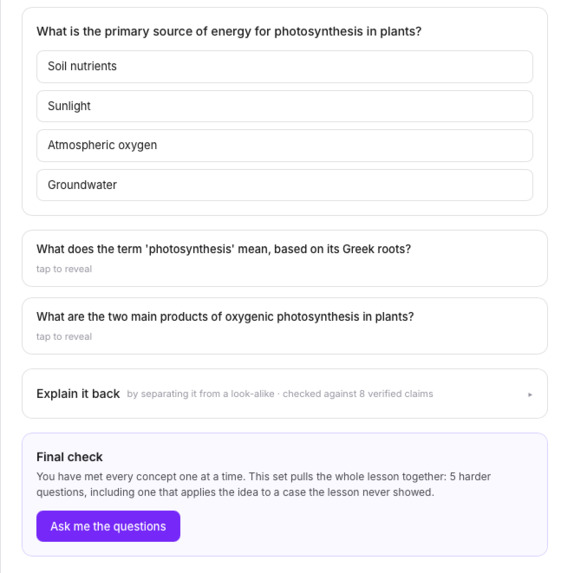
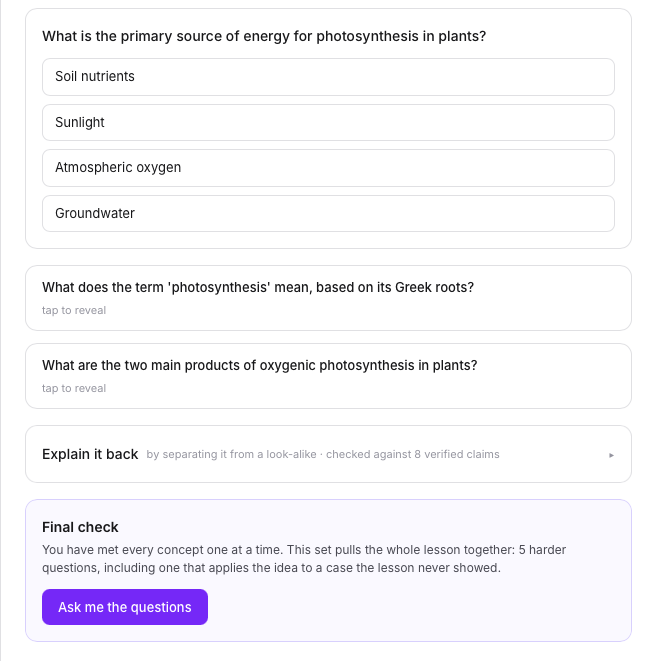
- An adaptive loop you can see. Miss a quiz question and that concept is regenerated in a different modality: a simulation instead of prose, a worked example instead of a definition. The panel is rebuilt with new content, the node recolours, and a one-line reason appears: "You missed X, so here it is as a simulation."
- Explain-back. Write the concept in your own words and the grader compares your text against that concept's verified claims, then names the claim you left out. The task rotates per concept (teach a beginner, give your own example, separate it from a look-alike), so seven concepts in a row never ask you the same thing.
Any topic works.
How I built it
Next.js (App Router) + TypeScript, deployed on Vercel. No accounts, no database. All learning state (mastery, modality history, attempts) lives in localStorage and survives reloads.
The pipeline is the product:
topic → SOURCE → PLAN → GENERATE (lazy, per concept) → VERIFY → RENDER (streamed) → ADAPT
                                                        ↑                          │
                                                        +------ quiz / explain-back +
- SOURCE: Tavily search (top 8, using the provider's own content extraction rather than scraping HTML), then authority ranking, then text sliced into passages with stable IDs. Each source's atomic claims are extracted in parallel.
- VERIFY: two layers, and the first has no LLM in it. A deterministic check drops any claim citing a passage that does not exist. Then the model judges each surviving claim only against the text of the passages it cites, returning
supported | unsupported | contradicted. Flagged claims never ground generated content. - GENERATE: one call per concept, filling a fixed library of typed components (explainer, sim, quiz, flashcards). The agents never write free-form app code. The one exception is a single generated canvas demo per run, executed inside
<iframe sandbox="allow-scripts">with adefault-src 'none'CSP, no network, no parent-DOM access, a render timeout, and an automatic fallback to a hand-built sim. - ADAPT: deterministic mastery rules over quiz and explain-back results. No Bayesian knowledge tracing; the rules are readable and testable.
Models and APIs: NVIDIA NIM (nvidia/nemotron-3-super-120b-a12b) behind a provider-agnostic complete() with role-based routing (planner / generator / verifier / grader), Tavily for search, and zod for every schema. Every model call is schema-validated, retried twice with the validation error fed back, and degrades to a visible state instead of crashing.
Numbers from this build: 10/10 planted factual errors caught by the verifier, 10/10 valid JSON against the real schemas, 5.1 s median model latency. The model spike that picked the model is documented in DECISIONS.md, including the two candidates that failed. 217 tests across 27 files pass via npm run check. There are per-IP rate limits on every route that spends money, keys are server-side only, and a deterministic safety check refuses harmful topics before any provider call.
Challenges I ran into
1. The model was failing structurally, not intellectually. Claim extraction stalled completely. Every call returned 3–4 KB of reasoning prose truncated at the token limit, with no JSON anywhere, reproducibly. Byte-inspecting the raw responses found two separate causes: the model was spending its whole completion budget on the thinking channel for structured prompts, and it emitted single-backslash LaTeX inside JSON strings, an escape error no amount of retrying can repair. The fixes were a transport-level enable_thinking: false for schema calls and a sanitizeEscapes pass in JSON extraction that repairs invalid escapes while leaving valid JSON byte-identical. Effect: claim extraction on the demo topic went from 0 claims to 61.
2. Latency, and the counter-intuitive half of it. Two stages, pulled in opposite directions, both measured:
- Claims extraction: made parallel. One long call became per-source extraction with bounded concurrency. Live bench: median 139.9 s → 38.2 s, a 3.67× speedup, with comparable claim yields.
- Concept generation: made strictly serial. This one surprised us. Generating every concept in parallel made the lesson arrive out of order and raced the provider. The app now keeps one generation request in flight at a time, in plan order, so the lesson fills in the same order the mindmap shows it. Opening a concept jumps the queue, and the interrupted concept comes back later, still in order.
The structural win underneath both: the setup stream stops after sources → skeleton → claims → verified, and concepts generate on demand. The mindmap skeleton lands in 13–24 s on unseen topics, and each concept in 2–8 s, instead of one long request that shows nothing until it is entirely done.
3. Making trust real instead of decorative. A "verified" badge that doesn't remove anything is marketing. So the verifier is allowed to delete content. Claims go through a deterministic passage-ID check before any model sees them, then passage-scoped entailment, and unsupported claims never reach the screen. We measured it by planting 10 factual errors that each contradict their own cited passage: 10/10 caught. We also state the limit plainly: this checks entailment, not truth. A source that is wrong but internally consistent will pass.
4. Not faking interactivity. An early version put a "commit to your prediction" gate on concepts with nothing to predict, and paired a probability sim with topics where it made no sense. Now a sim ships only when a hand-built template genuinely fits that concept's own text. The check is deterministic, with no model and no randomness, and a prediction prompt is something the generator must justify, not a default. A topic that doesn't fit gets explanations, quizzes and flashcards instead of a slider we can't defend. The sim templates are hand-built, so the underlying logic is ours, not the model's.
5. Two things we chose not to ship, and why. The level-diagnostic step was cut because it adds a second screen to a one-question home, so the app plans every lesson at beginner level instead. And an unseen-topics test found that a vague one-word topic can ground on a real passage about a different sense of the word. The verifier is correct here; the passage really does support the sentence. The right fix is a claim-to-concept relevance gate, which is a new ranking mechanism rather than a patch, so it is documented in README.md as a known boundary instead of being rushed in at the end.
Accomplishments that I'm proud of
- Verification that removes content, not just labels it. 10/10 on planted errors, with the citation chain clickable from a sentence you're reading to the passage it came from and out to the source.
- The deterministic simulation labs. They run pure, deterministic maths in the browser with no model call and no network, so they cannot fail on stage. The most convincing parts of the app are also the least likely to break.
- An adaptive loop that visibly isn't cosmetic. The concept you missed comes back in a genuinely different form, and the app tells you why.
- Honest failure paths everywhere. Rate limits return a friendly wait time. Failed concepts show a retry, not a spinner. The demo-safe cached run appears only when a live request fails, only for the focus topic, and is labelled "cached run" in the UI. Nothing cached is presented as live, and no lesson content is hard-coded.
- 217 tests green behind a single
npm run checkgate, all built in the hackathon window.
What I learned
- Verifying generated content changes what you can build, not just how safe it is. Once claims are passage-scoped, "delete the unsupported ones" becomes a normal design move, and the app can show the learner what it refused to teach.
- The expensive failures were structural, not factual. The model's knowledge was fine. Its output budget, JSON escaping and latency profile were the real problems, and every one was found by instrumenting the transport, not by re-prompting.
- More parallel isn't automatically faster for the learner. Parallel claim extraction bought 3.67×. Parallel concept generation bought a jumbled lesson and raced the provider. Serial, ordered generation matched what the learner actually sees. Measure the stage, not the instinct.
- The most valuable thing in the demo is the one with no model in it. The simulation labs are deterministic code, and they're what makes people lean in.
What's next for EduVoid
Next, we're adding AI chat that works at the sentence level. You'll be able to select any sentence in a lesson and ask about it directly, with answers grounded in that passage, so the conversation stays inside the evidence instead of drifting into general knowledge.
We also want you to bring your own sources: PDFs, lecture notes, course materials. Instead of learning from general web search, the pipeline verifies claims against the texts you're actually being examined on.
And two things this build already points at: a claim-to-concept relevance gate, so vague one-word topics get asked to clarify rather than grounded thinly, and real participant data. The external 10-item pre/post instrument already ships in data/eval/ for anyone to run by hand.
Built With
- localstorage
- next.js
- nvidia-nim
- react
- react-flow
- tailwind
- tavily
- typescript
- vercel
- zod


Log in or sign up for Devpost to join the conversation.