Inspiration
Students today learn from multiple sources—lecture videos, textbooks, PDFs, and presentation slides—but their learning experience is often fragmented. They may spend hours searching for the right explanation, while generic AI chatbots can provide answers that are not connected to their actual course material or understanding.
We wanted to build something different: an AI study companion that understands the student's learning material first, then teaches the student based on it.
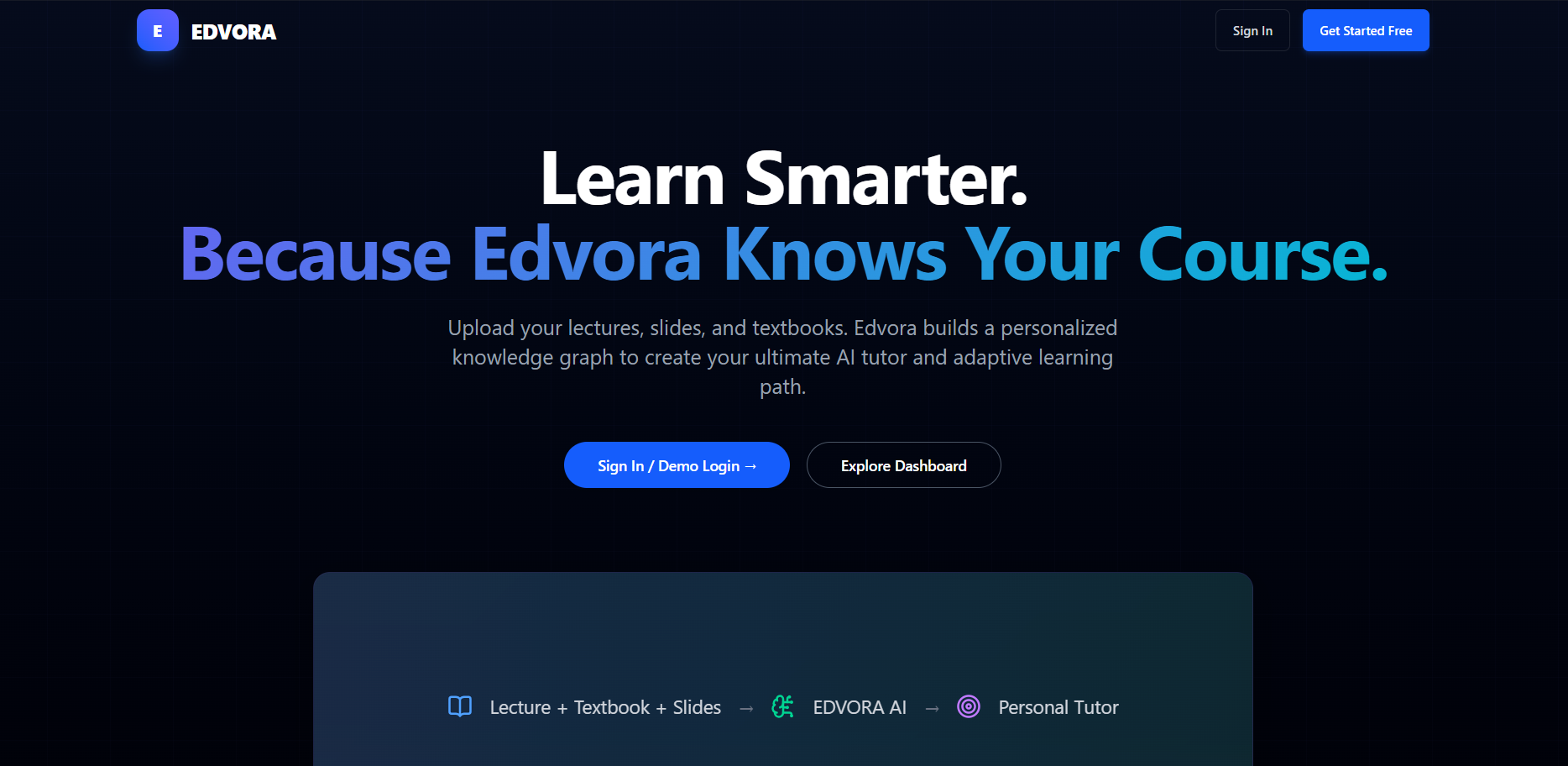
This inspired us to build Edvora, a personalized multimodal learning companion that brings lecture videos, textbooks, and slides into one intelligent learning environment. Instead of simply answering questions, Edvora aims to understand what the student is learning, where the information came from, and which concepts the student needs to improve.
Our goal was simple:
Don't just give students answers. Help them understand what they are learning.
What it does
Edvora transforms scattered learning resources into an interactive, personalized study environment.
Students can provide learning materials such as lecture videos, textbooks, and slide decks. Edvora processes these resources and organizes the information into topics, subtopics, concepts, and prerequisites.
Its core capabilities include:
- Multimodal Knowledge Base — Understands information from text, slides, videos, images, diagrams, and figures.
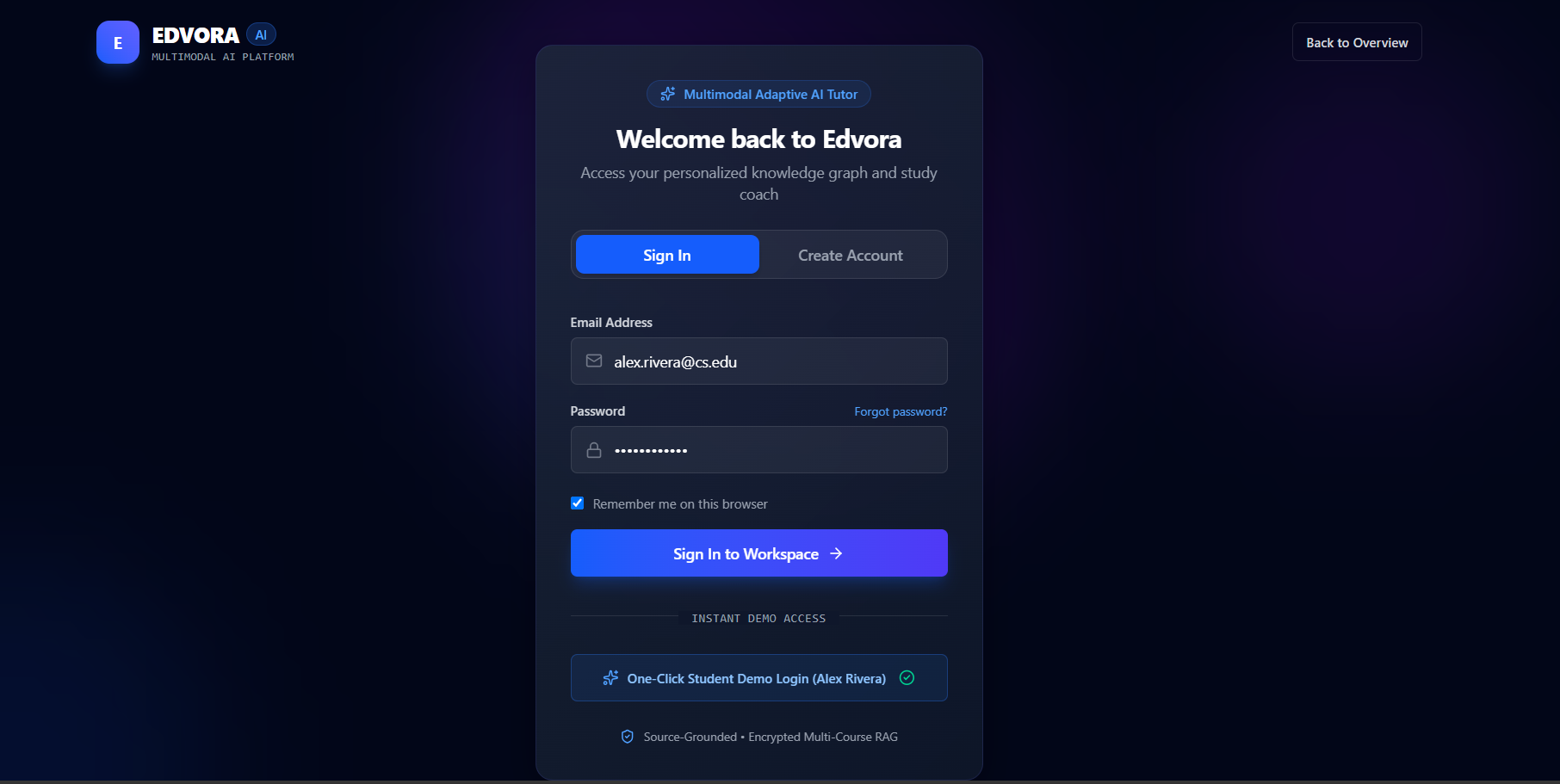
- Source-Grounded AI Tutor — Answers student questions using the uploaded course material and provides references to the relevant page, slide, or video timestamp.
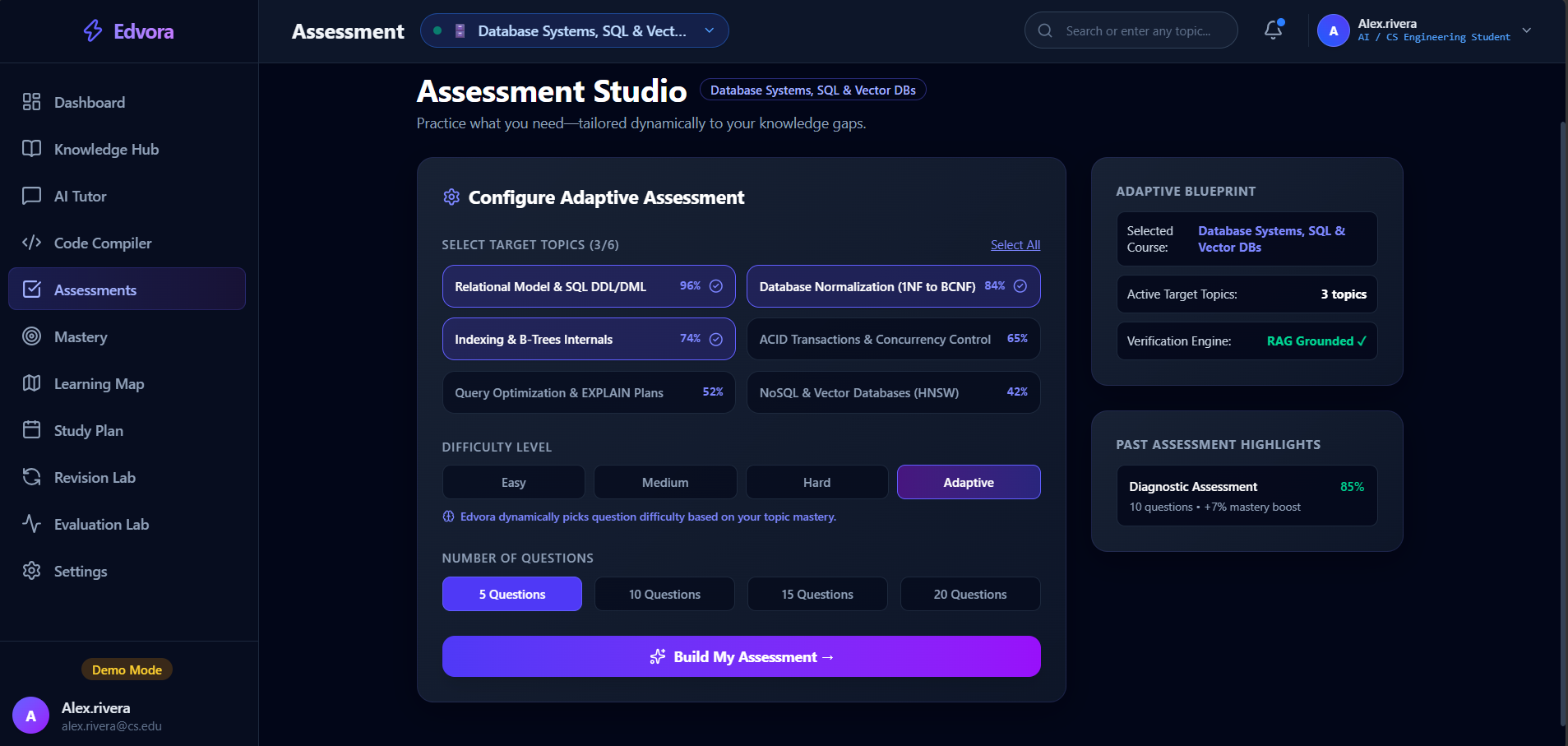
- Adaptive Assessments — Generates MCQs, short-answer questions, and numerical problems based on the student's selected topic and difficulty level.
- Personalized Feedback — Explains answers and identifies topics where the student is struggling.
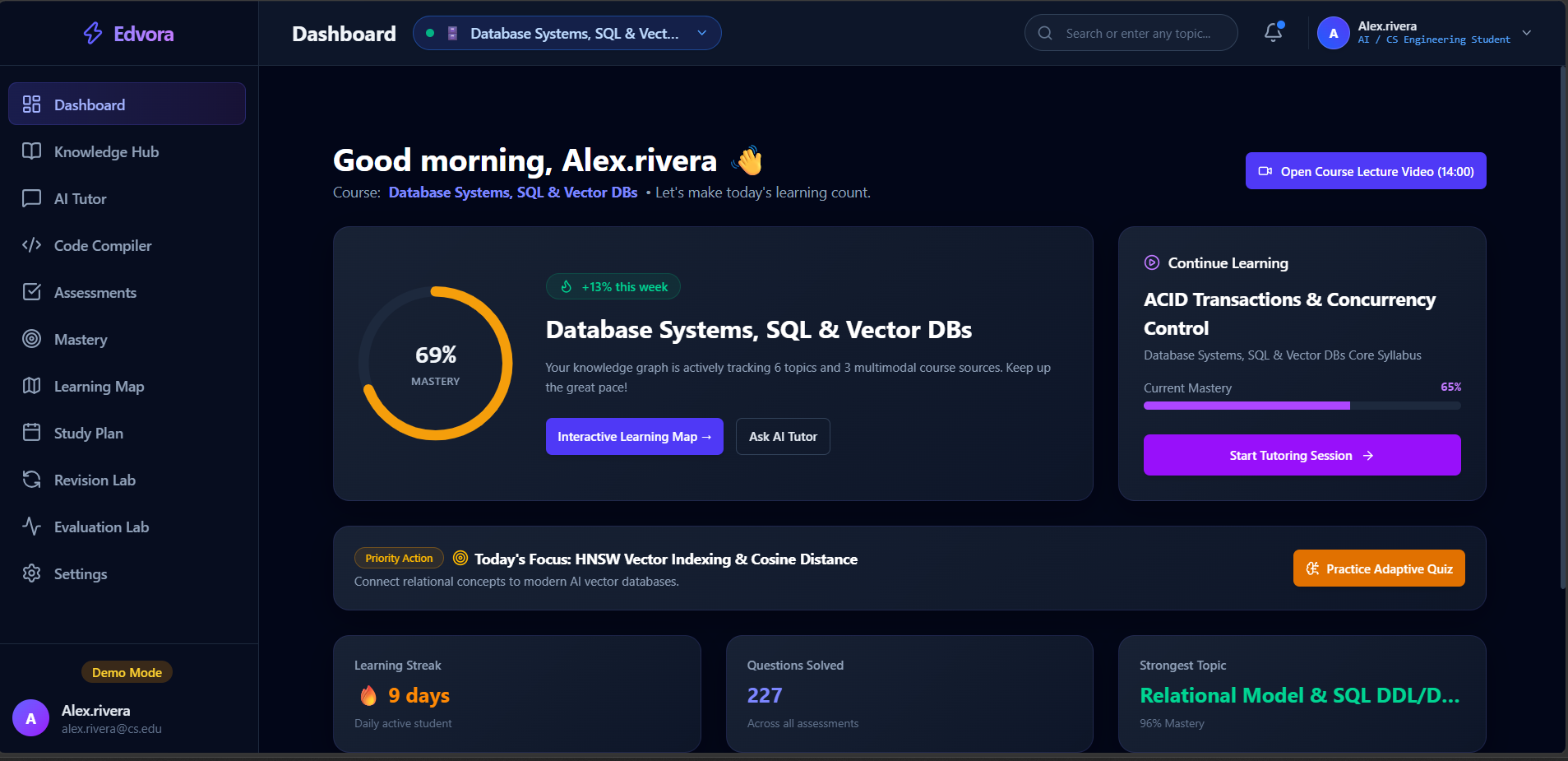
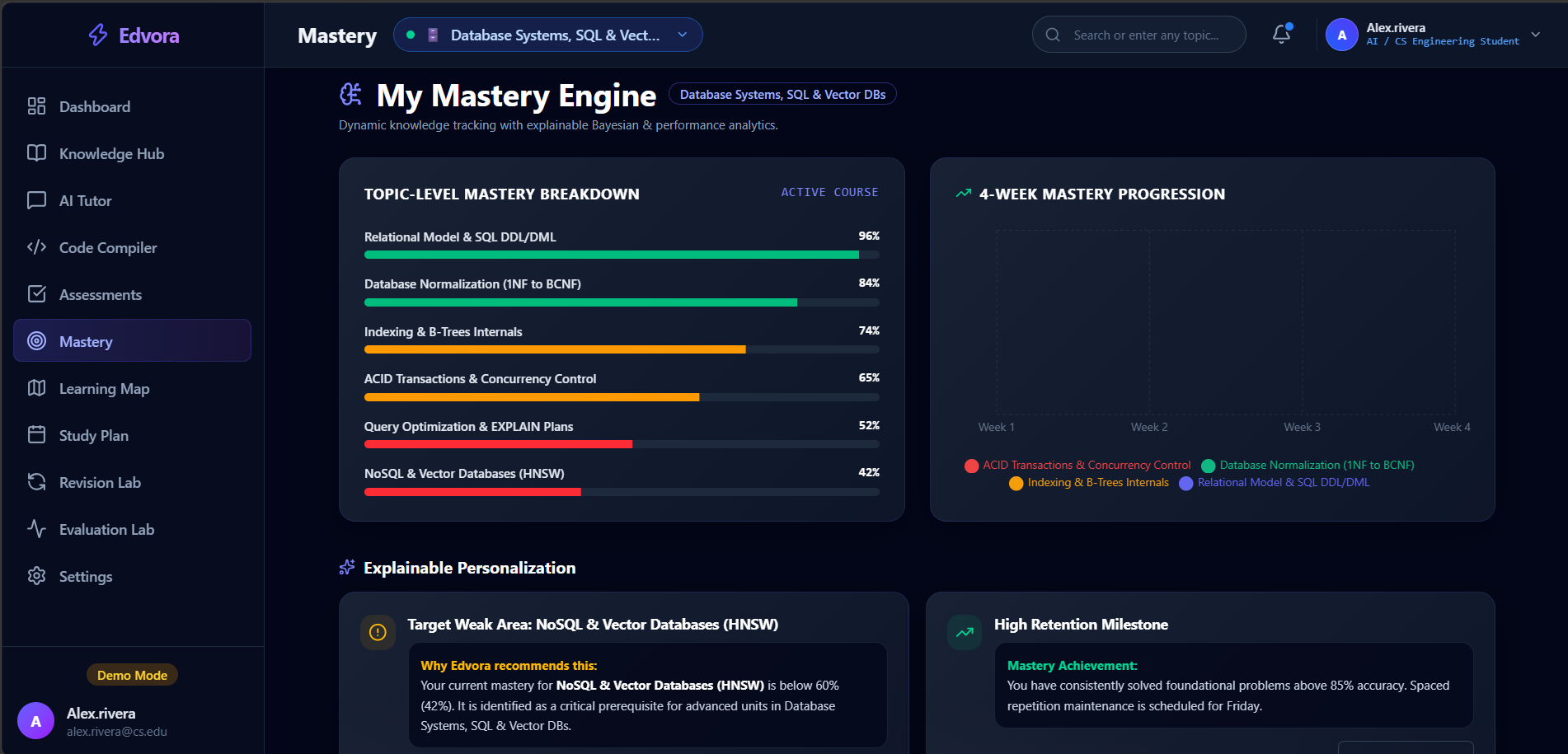
- Learner Model — Maintains topic-wise mastery and adapts future learning and assessments according to the student's performance.
- Weak Topic Detection — Identifies concepts that require additional revision.
- Trustworthy Responses — If the uploaded material does not contain enough information to answer a question, Edvora can flag or decline unsupported claims rather than presenting uncertain information as fact.
This makes Edvora more than a chatbot—it acts as a personal learning companion that evolves with the student.
How we built it
We designed Edvora as a multimodal AI pipeline.
First, learning resources are ingested from different formats. Textbooks and slides are processed for their textual content, while lecture videos can be processed into meaningful textual segments with their corresponding timestamps. Images, diagrams, and figures are also considered as part of the learning context.
The extracted information is then organized into a structured knowledge base containing:
Source → Topic → Concept → Prerequisite → Content
Each piece of knowledge retains its original source location so that generated responses can be traced back to the material.
For question answering, Edvora uses a retrieval-augmented generation approach. Instead of relying only on the language model's general knowledge, relevant content is retrieved from the student's uploaded material before generating an answer.
For assessments, questions are generated with metadata such as:
- Topic
- Difficulty
- Source location
- Question type
- Correct answer
After every assessment, the student's performance is used to update their topic-level learning state. This allows Edvora to gradually understand which concepts the student has mastered and which concepts require more attention.
We also designed the system around an important principle:
The AI should be grounded in the student's material, not blindly confident.
Challenges we ran into
One of our biggest challenges was bringing together different types of educational content into a single learning pipeline.
A textbook page, a presentation slide, a diagram, and a lecture video communicate information in very different ways. Preserving the relationship between extracted information and its original source was therefore important for reliable citations.
Another challenge was preventing hallucinations. A fluent AI response is not necessarily a correct response. We therefore focused on source grounding and the ability to distinguish between information supported by the uploaded material and information that is outside its scope.
Generating useful assessments was another challenge. Questions should not only be grammatically correct—they should test the intended concept, have an appropriate difficulty level, contain a reliable answer key, and avoid unnecessary repetition.
Finally, personalization required us to think beyond a simple question-answer system. The system needs to continuously learn from student interactions and assessments so that future questions and recommendations become more relevant.
Accomplishments that we're proud of
We are proud of building Edvora around trustworthy and personalized learning rather than generic AI conversations.
Our key accomplishments include:
- Creating a unified concept for learning from multiple educational modalities.
- Designing a source-grounded tutoring workflow with traceable learning content.
- Connecting assessment results with topic-level learner understanding.
- Designing an adaptive assessment pipeline instead of a static question generator.
- Making explainability and source references a core part of the learning experience.
- Designing the system so that personalization can improve as more student interaction data becomes available.
Most importantly, Edvora combines multimodal understanding, grounded generation, assessment, and personalization into a single learning workflow.
What we learned
Building Edvora taught us that an effective educational AI system is not just about using a powerful language model.
We learned that retrieval quality, source attribution, question quality, learner modeling, and evaluation are equally important.
We also learned that personalization cannot be achieved by simply asking an AI to "teach the student." The system needs evidence about the student's performance and a mechanism to update its understanding of the student's mastery over time.
Another important lesson was that knowing when not to answer is part of building trustworthy AI. When the source material does not support a claim, the system should communicate that limitation rather than confidently inventing an answer.
What's next for Edvora
We envision Edvora becoming a complete AI-powered learning ecosystem.
Our next steps include:
- Building richer visual course maps showing topics and prerequisites.
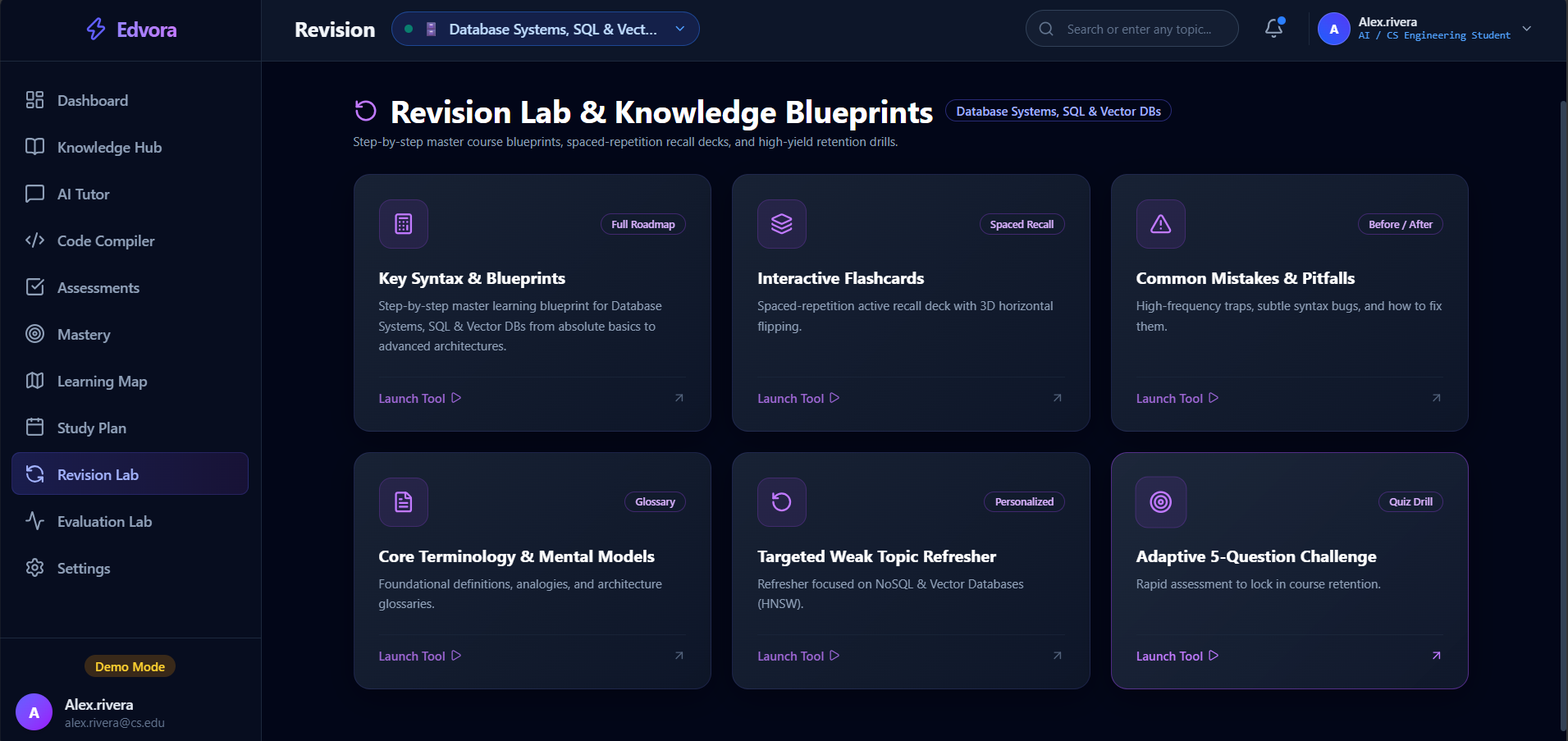
- Generating personalized flashcards and revision material for weak topics.
- Creating intelligent study schedules based on mastery and exam deadlines.
- Supporting multilingual and Indian-language learning.
- Adding voice-based tutoring for more natural learning interactions.
- Improving learner modeling with stronger mastery-estimation techniques.
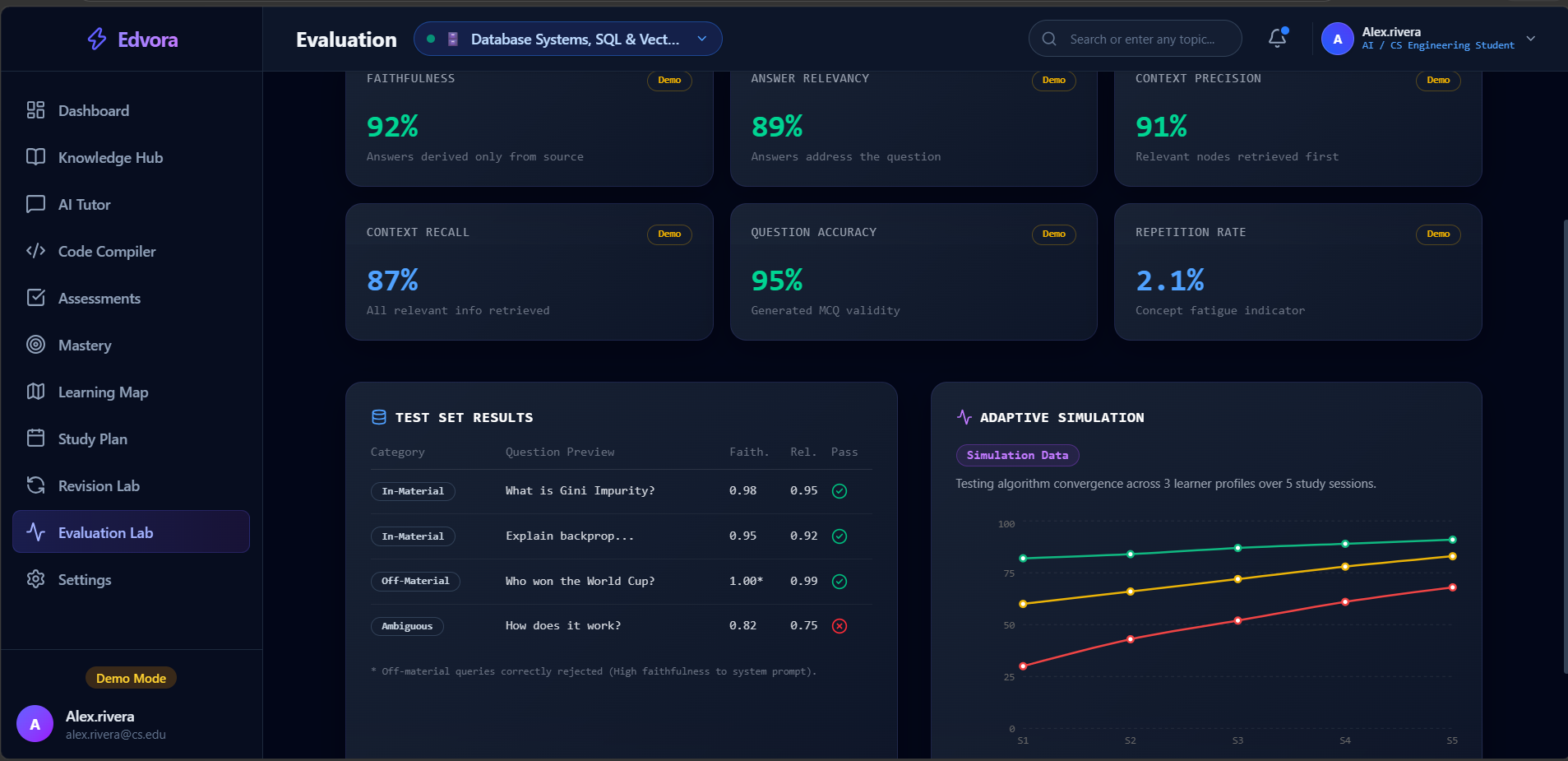
- Expanding evaluation using metrics for faithfulness, answer relevancy, context precision, and context recall.
- Running longer simulated student sessions to measure whether Edvora actually improves learning outcomes.
Our long-term vision is to make Edvora a learning companion that doesn't just know the course material—it knows how the student learns.
Edvora — Learn from your material. Understand your gaps. Grow with every question.
Built With
- ai
- careerbulider
- chatbot
- e-learning
- edtech
- generativeai
- javascript
- machine-learning
- personalizedlearning
- python
- react

Log in or sign up for Devpost to join the conversation.