-
-

Icon.img
-
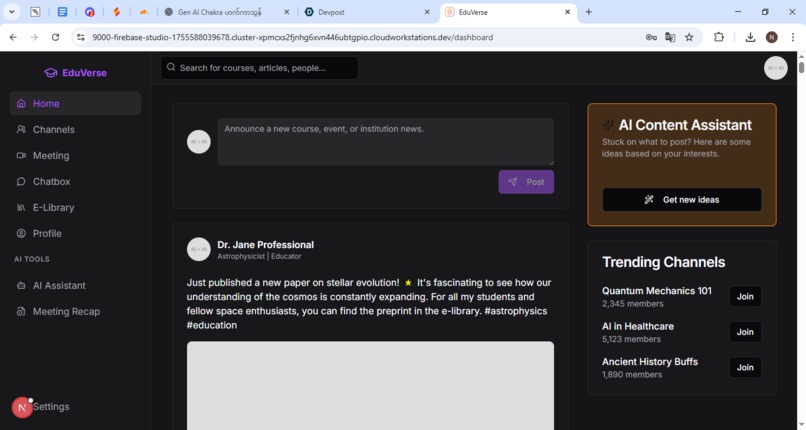
Hone.page
-
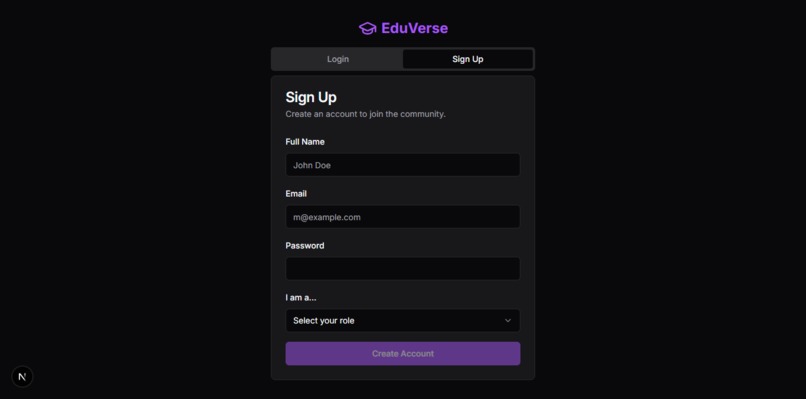
Create an Account
-
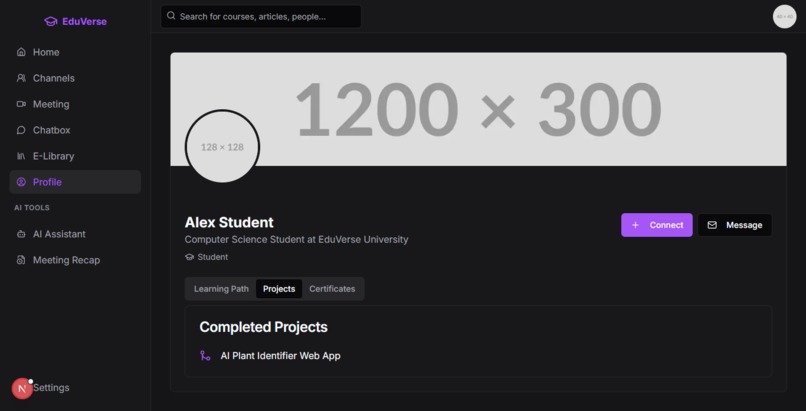
Profile
-
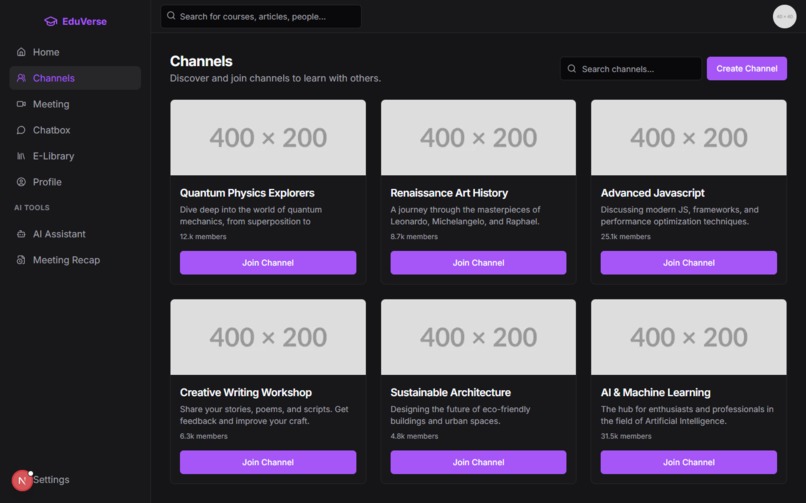
Channels.page
-
Meeting.page
-
Chat.page
-
MeetingRecap.page
-
E-Library.page

EduVerse: The Future of Collaborative Learning
Inspiration
Education is supposed to be about curiosity, collaboration, and growth, yet the current digital learning experience often feels disjointed and inefficient. Students have to navigate between learning management systems for coursework, social platforms for communication, messaging apps for group projects, and third-party tools for live classes. Teachers and professors face a similar struggle: creating engaging communities across fragmented platforms that don’t talk to each other. Institutions are forced to patchwork together solutions that are neither scalable nor inspiring. This frustration gave rise to EduVerse — an AI-powered collaborative learning platform that unifies the fragmented educational experience into one ecosystem. The inspiration was rooted in a desire to reduce friction, empower learners and educators, and reimagine digital education not as a series of disconnected tasks but as a living, breathing community where knowledge is created, shared, and celebrated. The vision was to blend the best aspects of social media, learning management, and AI assistance into a single, intuitive platform that actually supports lifelong learning instead of obstructing it.
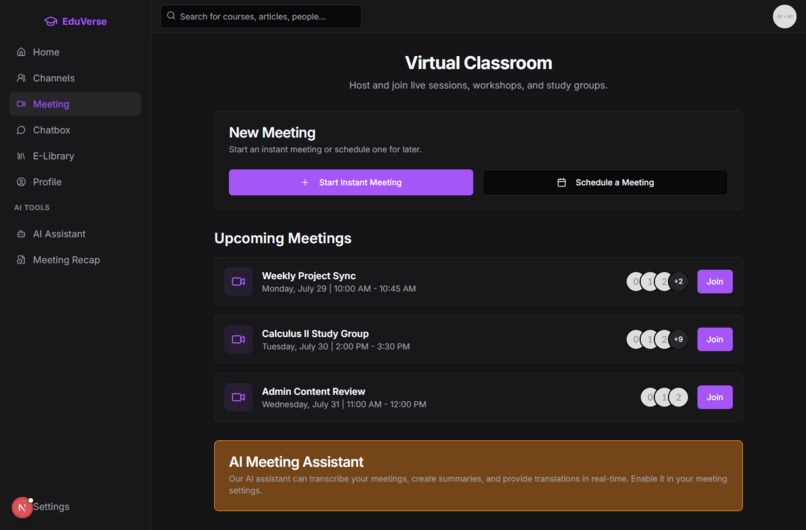
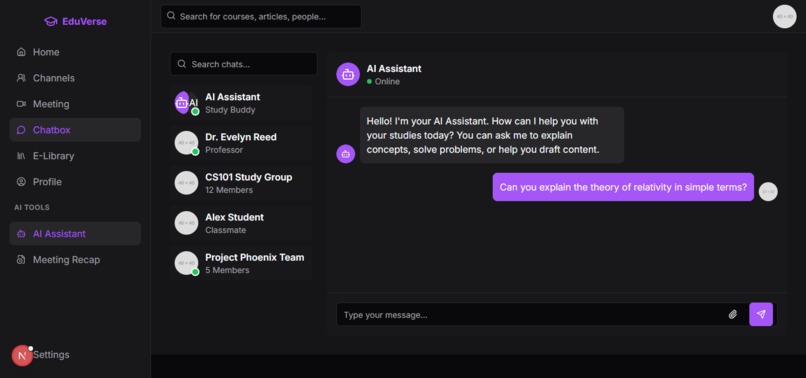
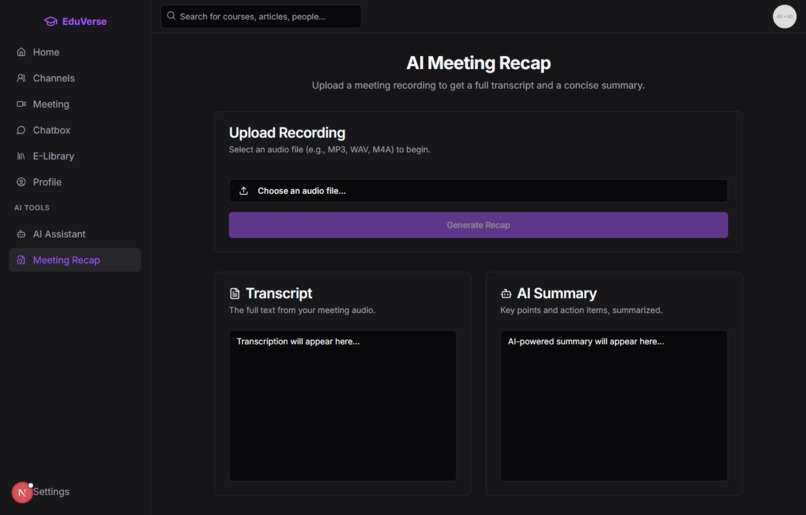
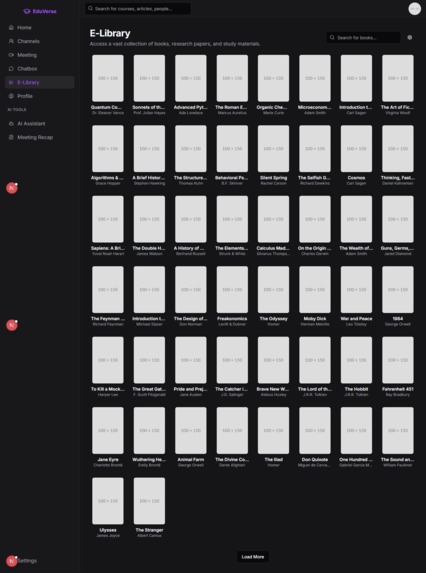
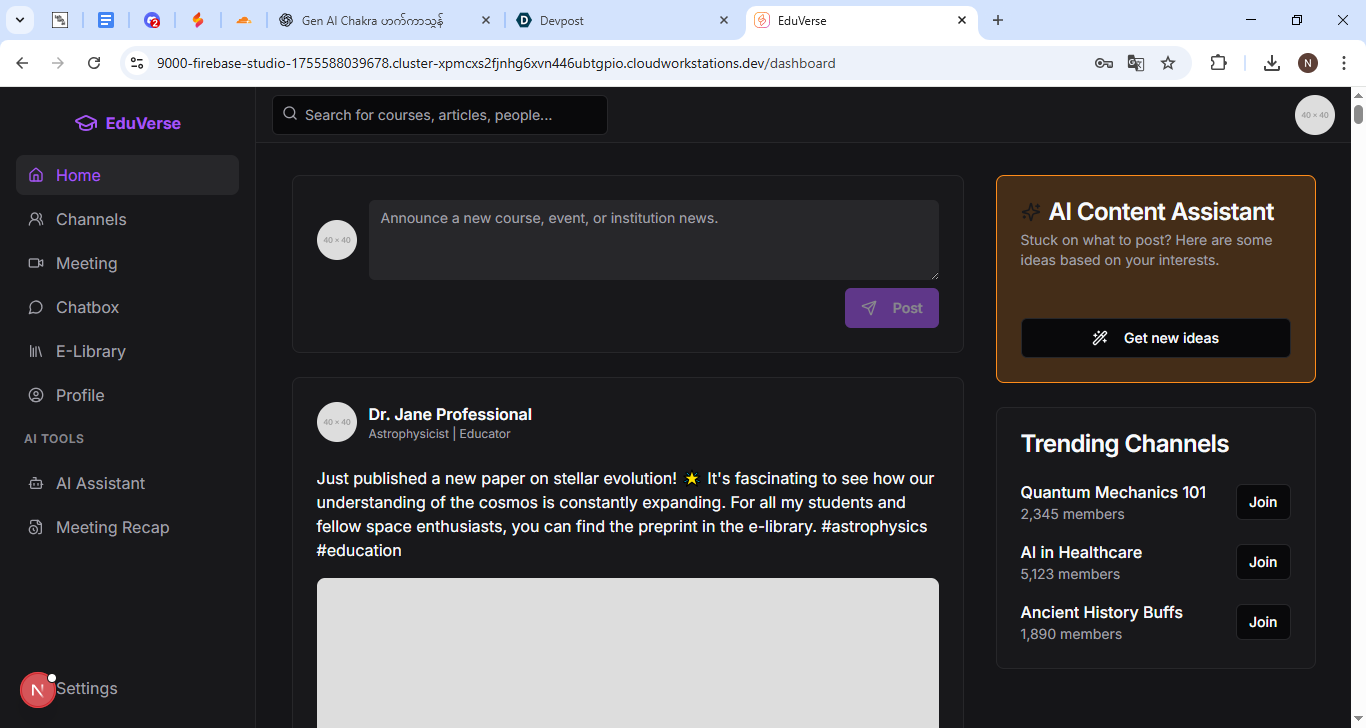
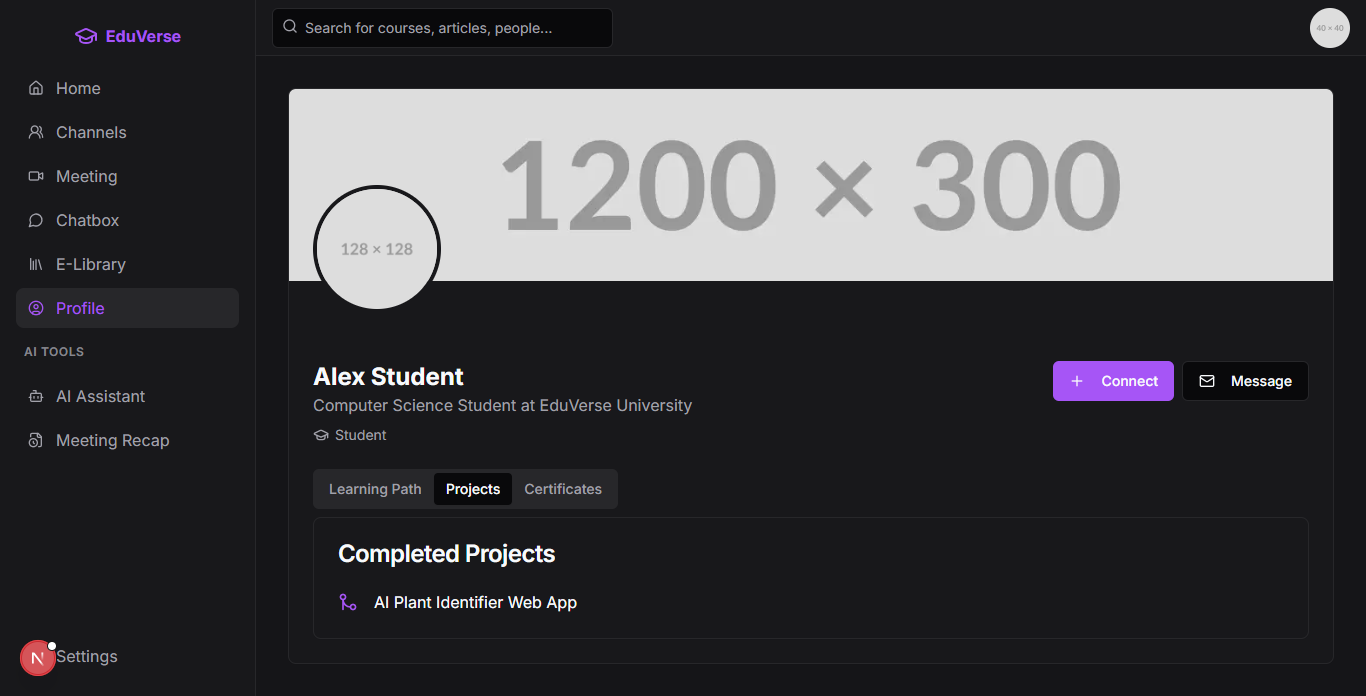
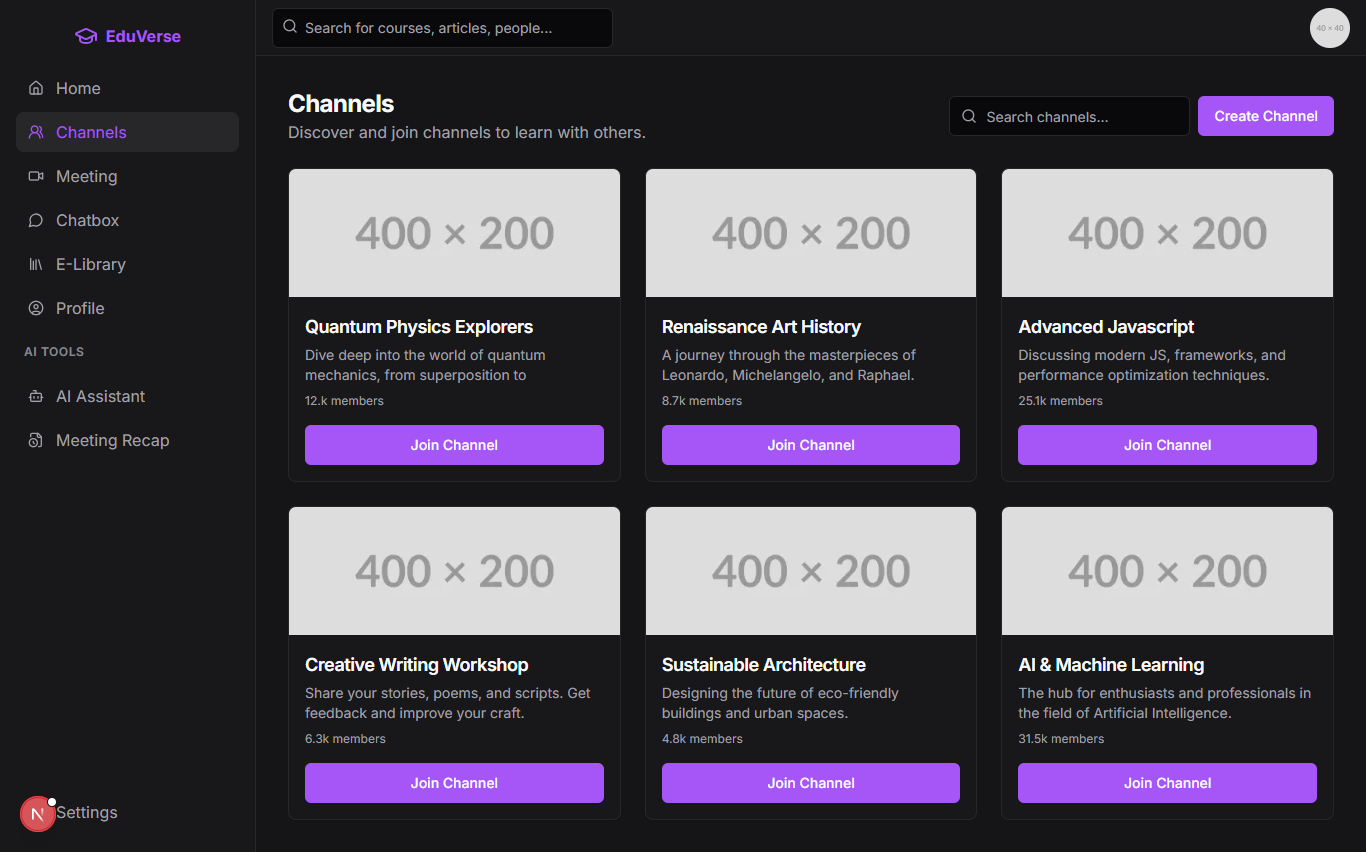
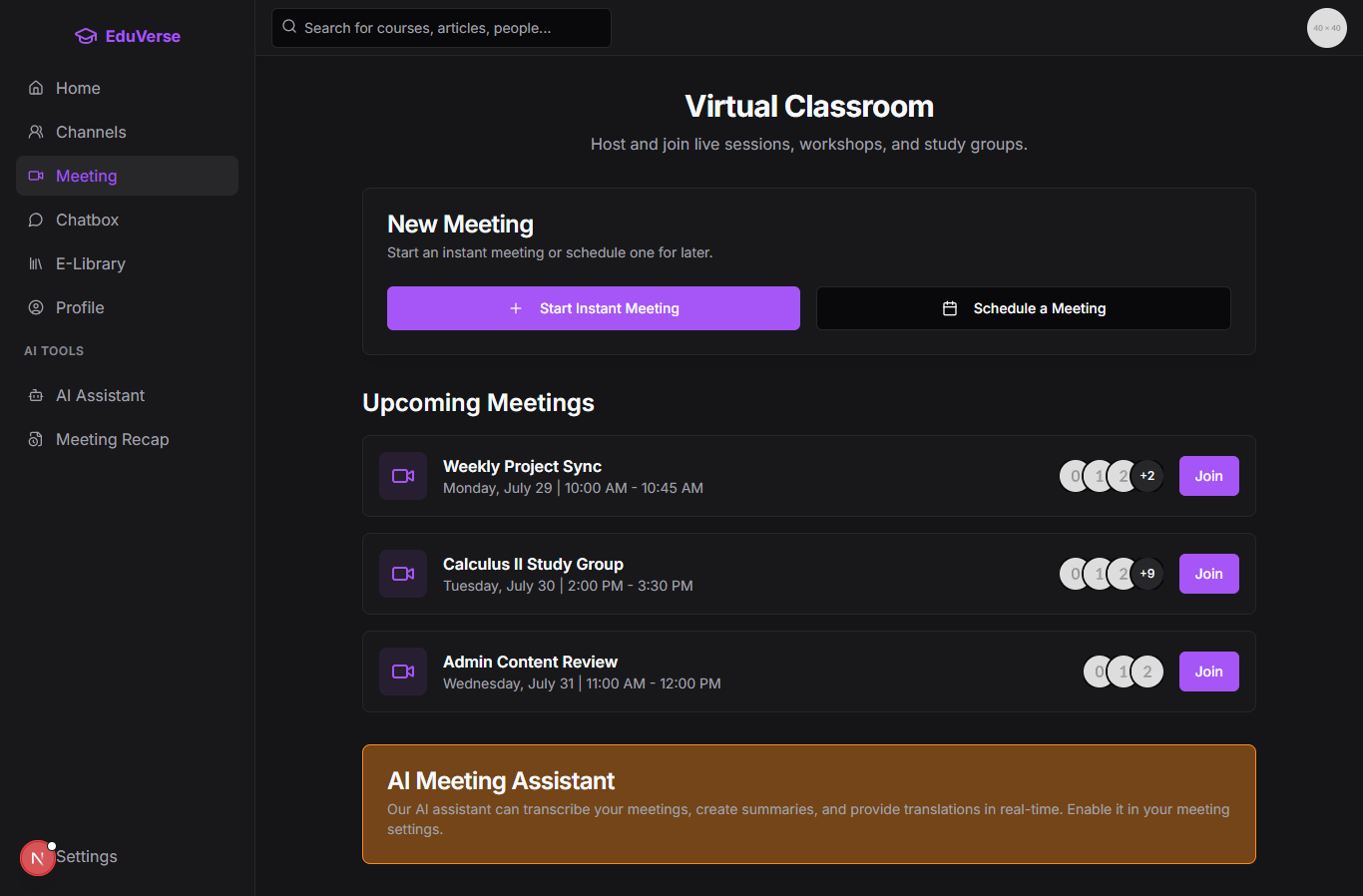
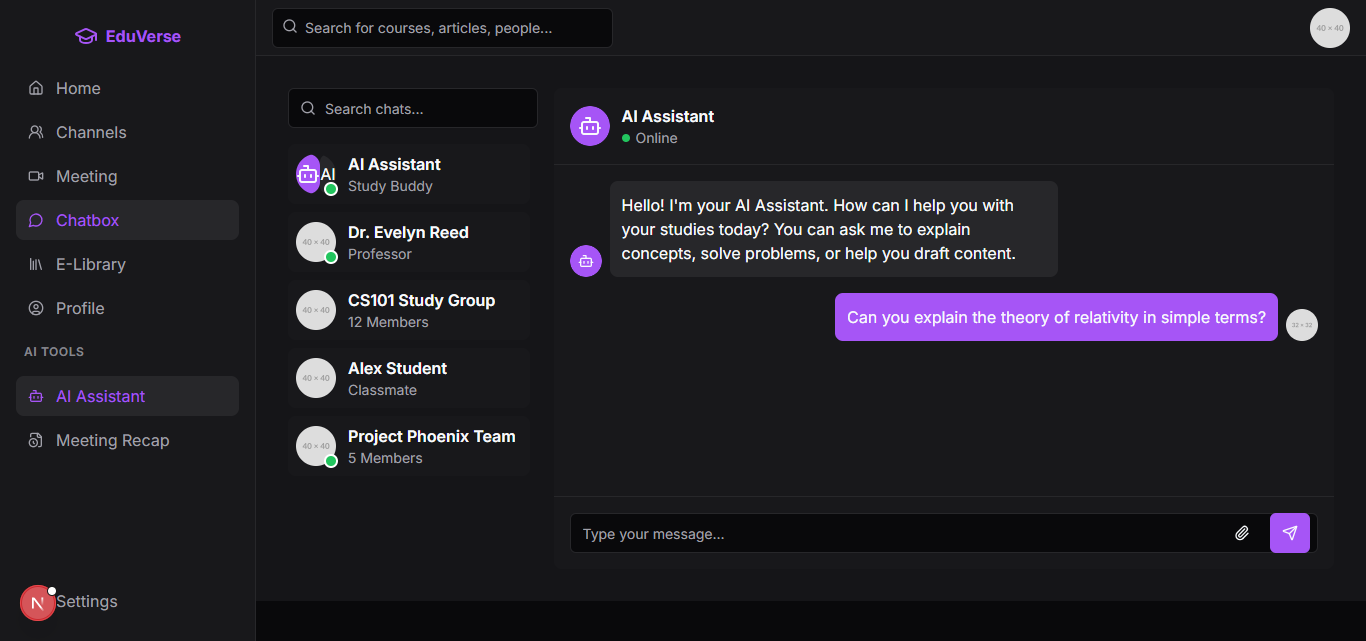
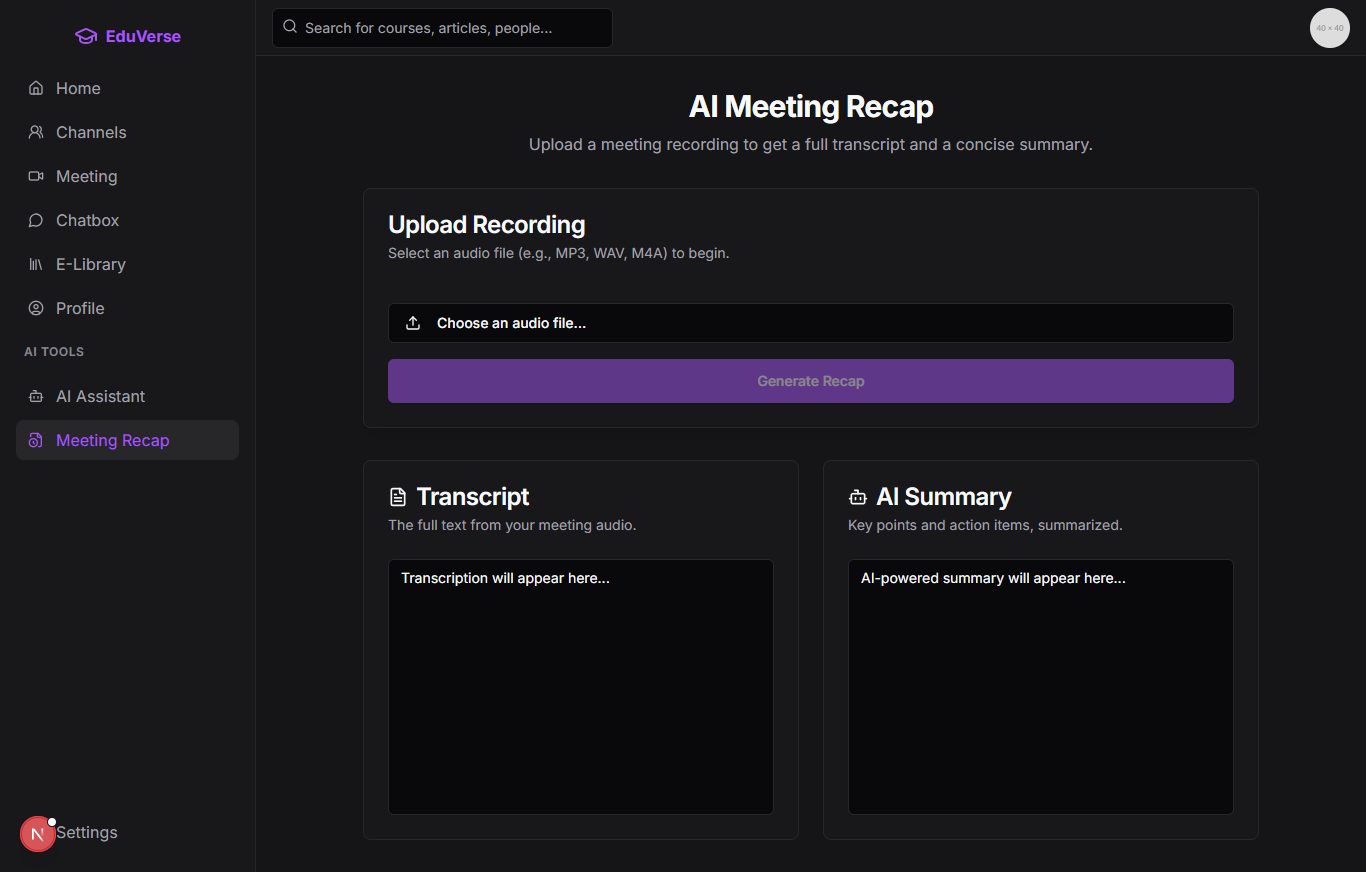
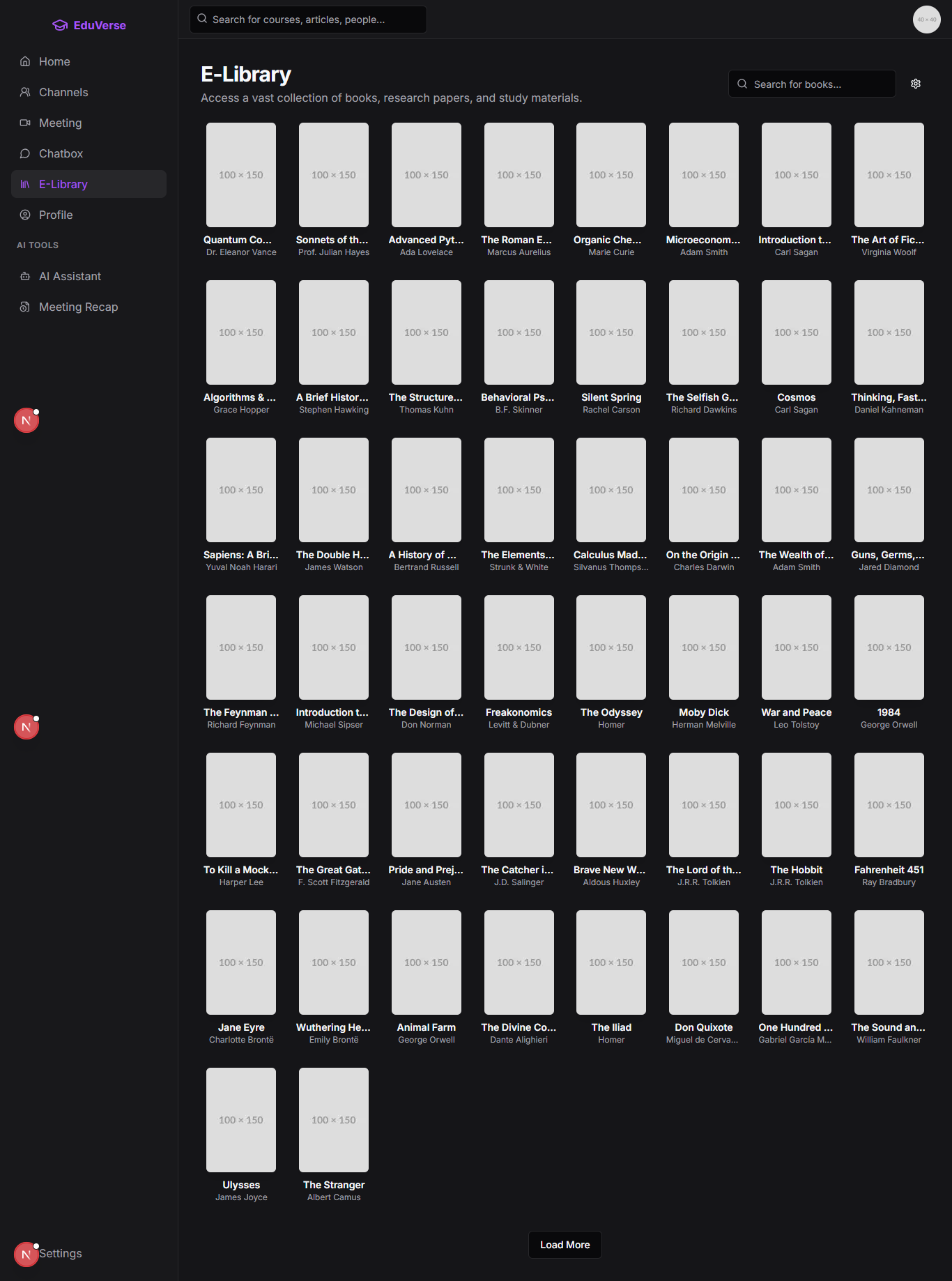
EduVerse was born from the idea that online education should not feel like a patchwork of disconnected platforms but rather like a seamless digital campus where students, teachers, and knowledge flow together naturally, and that inspiration drove us to create a system that merges learning management, communication, and AI assistance into one place; the platform functions as an integrated hub where instructors can share video lectures, text notes, and resources while students interact in real time through group chats and embedded live classrooms powered by WebRTC and Socket. IO, ensuring low-latency streaming and smooth communication, and what makes EduVerse stand out is the presence of an AI Tutor connected via the OpenAI API that provides learners with instant feedback, explanations, and tailored guidance based on their study history, which transforms static lessons into interactive journeys, while under the hood the system is built with Node. js and Express on the backend for scalability, MongoDB for flexible content storage, and React on the frontend with Tailwind CSS for a clean and adaptive interface that feels modern across desktops and mobile devices, with JWT tokens managing secure authentication so that student data, chats, and profiles remain protected; the user journey begins at the Home Page, a dashboard that organizes courses, upcoming meetings, and quick access to essential tools, and then flows naturally into Channels where instructors publish structured lessons in formats that blend videos, notes, and interactive discussions much like academic social feeds, while the Meeting feature allows scheduled or instant live classes with screen sharing and collaborative tools so that learning feels both synchronous and engaging, complemented by Chats that support both group conversations and direct teacher-student messaging, building a sense of community; for deeper study the Library stores lecture recordings, shared documents, and curated resources so that knowledge remains accessible long after a session ends, and the Profile system empowers students and teachers to present academic progress, skills, and experiences much like a professional network, while Settings ensure full customization of notifications, privacy controls, and interface preferences; one of the most forward-looking tools is the AI Meeting Recap, where our AI listens to live classes and automatically produces concise summaries, highlights, and action points, giving both students and instructors a reliable reference of what was covered without manual note-taking, and although building such a feature-rich environment brought challenges like synchronizing AI with live teaching, designing a clutter-free interface, and keeping performance stable across devices, the result is a working prototype that unifies multiple tools into a single ecosystem, demonstrating our ability to blend technical execution with user-focused design, and in achieving this we are proud of creating an intuitive UI that feels as professional as it is accessible, of embedding video and chat without reliance on external apps, and of shaping AI into a responsive tutor and meeting assistant rather than a generic chatbot, all of which taught us how vital simplicity, iteration, and prompt engineering are in making advanced technologies serve education effectively, so EduVerse today stands not only as a project built on code but as a vision of how future learning spaces can empower students globally.
The current biggest problem in online education—the fragmented 'patchwork' situation of disparate tools across various sectors—is solved here. By integrating LMS, video conferencing, chat, and cloud storage into a single place, it is easy to use and prevents distraction.
The integration of AI not just as a simple chatbot but for both purposes is highly commendable. ·AI Tutor: Because it can look at the student's record and provide adaptive guidance, it can deliver the benefits of a personalized education system. ·AI Meeting Recap: This feature is an excellent idea. It can automatically solve problems in real life, such as missing what the teacher says while taking notes or difficulty remembering.
Building the entire system is extremely difficult. Integrating everything together smoothly is more challenging than building each feature separately. Because real-time video, chat, and AI processing must be performed simultaneously, server load and bandwidth need to be carefully managed. Maintaining such a feature-rich platform is costly. A sustainable business model, such as a subscription model or institutional licensing, will be necessary.
Established platforms like Microsoft Teams, Google Classroom, and Zoom are also integrating AI features into their ecosystems. To compete with them, it will be necessary to clearly articulate why EduVerse is better.
EduVerse is an excellent idea that deeply understands the problems of online education and can solve them by fully integrating modern technologies. The vision of a 'digital campus' is quite clear and attractive.
However, in a practical context, it would be an immensely complex and resource-intensive project. Success would require solid technical execution, user experience design, and a long-term business model. The current prototype is an excellent starting point for this.
What it does
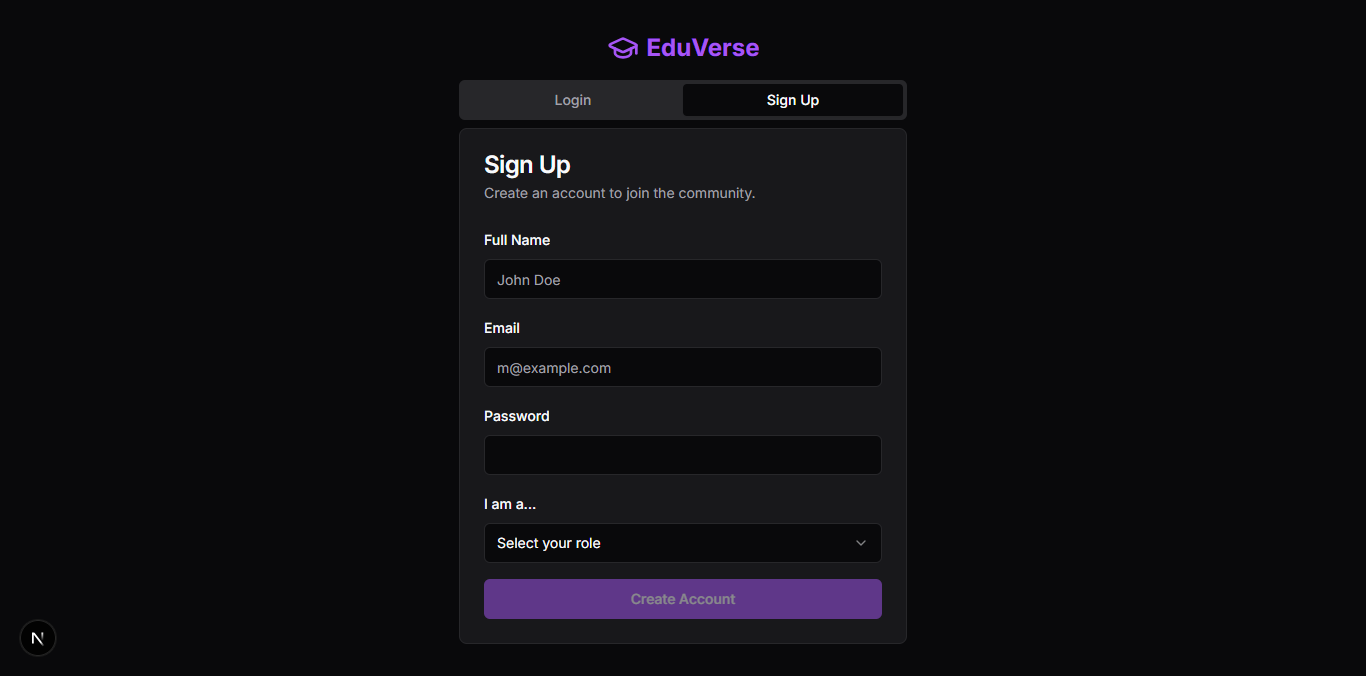
EduVerse provides a next-generation platform designed to support students, educators, and institutions in one integrated ecosystem. It offers role-based experiences so that each user type receives the tools most relevant to their goals: students gain personal study support and a portfolio to showcase projects, educators receive publishing tools and channels to mentor learners, and institutions can manage communities and resources at scale. The AI chatbot functions as a personal study buddy, capable of explaining complex concepts, assisting with assignments, and guiding users through their learning journey. The AI content assistant helps overcome the challenge of writer’s block by generating context-specific post ideas to stimulate engagement and discussions. Virtual classrooms and meeting recap features allow for live collaboration, transcription, and summarization so that learning persists beyond the live moment. A comprehensive e-library ensures access to diverse educational materials, while dynamic profiles evolve into living resumes that highlight learning milestones, certifications, publications, and community contributions. Collectively, EduVerse transforms the way people approach education by consolidating everything into a vibrant, intelligent, and supportive platform.
How we built it
EduVerse was engineered using a modern and scalable technology stack that balances usability, performance, and AI integration. The frontend is built with Next.js and React in TypeScript, ensuring type safety, reusability, and maintainability across the entire project. For design, shadcn/ui and Tailwind CSS were employed to create a clean, responsive, and accessible user interface, optimized for all device sizes. At the heart of EduVerse lies its AI functionality, orchestrated through Google’s Genkit framework, which manages AI flows such as answering study questions, suggesting content, transcribing meetings, and generating summaries. The platform was initially prototyped using React hooks and simulated state management through localStorage to demonstrate role-based customization, with planned migration toward Firebase Authentication and Firestore for persistence. Modular architecture and reusable components ensure scalability as more features are added, while adherence to accessibility and responsive design principles guarantees inclusivity. By combining cutting-edge AI, intuitive design, and scalable architecture, EduVerse was crafted as a proof-of-concept for the future of digital learning.
Challenges we ran into
Developing EduVerse presented several complex challenges that shaped the evolution of the project. One of the most difficult aspects was designing role-based experiences for students, professionals, and admins without overwhelming users with unnecessary features. Without a dedicated backend during the hackathon phase, simulating authentication and permissions had to be solved using localStorage, which limited real-world reliability. Another major challenge was integrating AI functionality seamlessly into the user interface so that it enhanced, rather than disrupted, the learning process. We also struggled with creating a responsive layout that transitioned smoothly between desktop, tablet, and mobile devices while retaining feature parity. Time management was also a key challenge: building an ambitious platform that merges AI, education, and social features in just over a week required prioritization, compromise, and countless iterations. Despite these difficulties, each obstacle pushed the team to think creatively, test solutions rapidly, and ultimately deliver a working prototype that demonstrates EduVerse’s potential.
Accomplishments that we're proud of
Despite the challenges, EduVerse achieved milestones that we are deeply proud of. The platform integrates multiple AI-powered features that function cohesively, including the AI study assistant, the AI content suggestion tool, and the meeting transcription and summarization pipeline. Another accomplishment was implementing a role-based architecture that tailors the platform’s experience for each user type, demonstrating the vision of a community where students, educators, and institutions coexist harmoniously. We successfully designed a dynamic profile system that evolves as users progress in their learning journey, turning static accounts into living academic portfolios. The clean, consistent design system built with Tailwind CSS and shadcn/ui ensures accessibility and scalability, which is critical for long-term adoption. Most importantly, the prototype proves that it is possible to unify social networking, education, and AI into a single platform without losing focus or usability. These accomplishments highlight EduVerse’s potential to grow into a transformative tool for global learning communities.
What we learned
Building EduVerse during the hackathon was a journey filled with technical and conceptual lessons. We learned how to effectively integrate Genkit AI flows into a modern frontend and create structured prompts that drive meaningful AI outputs. We discovered the importance of role-based design in educational platforms, ensuring that students, teachers, and administrators feel supported by customized experiences. Through trial and error, we realized how crucial responsive and accessible design is in creating an inclusive product that works across devices and geographies. On the technical side, we learned about state management trade-offs, balancing local simulation during prototyping against the need for persistent, scalable backend solutions in production. On a human level, we learned that AI is not meant to replace teachers or learners but to augment them, freeing time for higher-order thinking and creativity. Most importantly, the hackathon reinforced that building meaningful technology requires empathy, listening to the needs of different user roles, and designing with simplicity in mind.
What’s next for EduVerse
The journey of EduVerse has only just begun, and the roadmap ahead is ambitious yet achievable. In the short term, we plan to replace the simulated role system with a full backend built on Firebase Authentication and Firestore to enable secure user accounts, real-time collaboration, and persistent data storage. Real-time chat and WebRTC-powered classrooms will bring live, interactive teaching into the platform, while an advanced AI meeting assistant will offer real-time transcription, translation, and intelligent note-taking. In the long term, we envision expanding EduVerse into a full-fledged course creation and management system where educators can design curricula, assign quizzes, and issue certifications. Gamification elements such as badges, achievements, and learning milestones will encourage motivation and consistency among students. Monetization pathways for institutions and professionals will support sustainability, and integrations with third-party tools like Google Calendar and GitHub will enrich user experience. Ultimately, EduVerse will grow from a prototype into a global ecosystem that empowers learning as a lifelong, collaborative, and joyful journey.
Built With
- css
- firebase
- javascript
- next.js
- postcss
- tailwindcss
- typescript

Log in or sign up for Devpost to join the conversation.