-
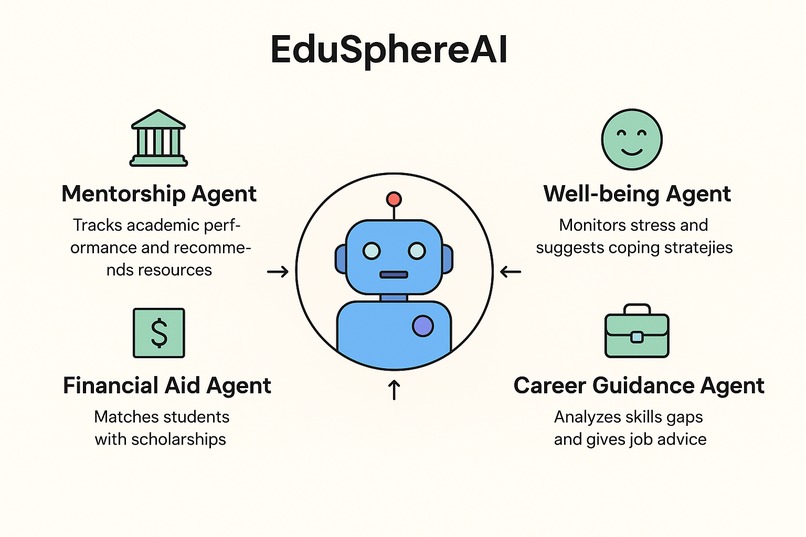
EduSphereAI – Smarter support, brighter futures.

Inspiration
We noticed that students often struggle because their support systems are fragmented — academic guidance, mental health support, financial aid, and career advice usually come from different sources and don’t communicate with each other. This inspired us to design EduSphereAI, an AI-powered platform where all these aspects are unified through intelligent LLM-based agents. Our goal was to create a system that could provide students with holistic support, reducing stress and improving academic and career outcomes.
What it does
EduSphereAI brings together four AI agents: Mentorship Agent – Tracks learning performance, detects weak subjects, and recommends resources. Well-being Agent – Monitors stress indicators and inactivity, providing coping strategies or nudges. Financial Aid Agent – Matches students with scholarships and financial aid opportunities. Career Guidance Agent – Analyzes skill gaps, recommends internships, and gives resume feedback. Together, these agents collaborate so that if a student struggles in one area (like finances), the system can automatically connect them to support in another (like mental health or career advice).
How we built it
We started by collecting datasets that included student performance metrics, mental health surveys, scholarship records, and job skills data. To fill in the gaps and ensure coverage across all domains, we also generated structured data that combined these aspects into unified student profiles. This dataset was then prepared for training by creating prompt–response examples that reflected real student scenarios. Using both OpenAI fine-tuning and Hugging Face’s LoRA-based training, we adapted pre-trained language models into four specialized agents. Finally, we established an inter-agent communication flow, enabling the Mentorship, Well-being, Financial Aid, and Career Guidance agents to share information and provide a more complete understanding of student needs.
Challenges we ran into
Integrating fragmented data sources into one consistent dataset. Handling technical issues like TensorFlow/Keras dependency errors during Hugging Face fine-tuning. Designing prompts that helped agents reason contextually across multiple domains. Managing limited compute resources for training large models.
Accomplishments that we're proud of
Successfully creating a multi-agent framework powered by LLMs. Generating a unified dataset that represents academic, emotional, financial, and career factors. Fine-tuning a base model to provide personalized, context-aware advice. Designing a scalable framework that can be adapted beyond education, into fields like healthcare or corporate training.
What we learned
How to structure multi-agent communication with LLMs as mediators. The importance of prompt engineering and data formatting for fine-tuning. Practical use of LoRA and OpenAI fine-tuning pipelines. That building impactful AI requires balancing technical and human-centered design.
What's next for EduSphereAI
Real-world student data integration for more accurate recommendations. A web and mobile interface with chatbot-style interaction. Voice-based support for accessibility. Extending the system to handle peer collaboration and group learning insights. Exploring deployment in other domains like employee training and mental health apps.
Built With
- csv
- google-colab
- hugging-face-transformers
- jsonl
- jupyter-notebooks
- llm
- lora
- numpy
- openai-api
- pandas
- peft
- python
- pytorch
- scikit-learn

Log in or sign up for Devpost to join the conversation.