-
-
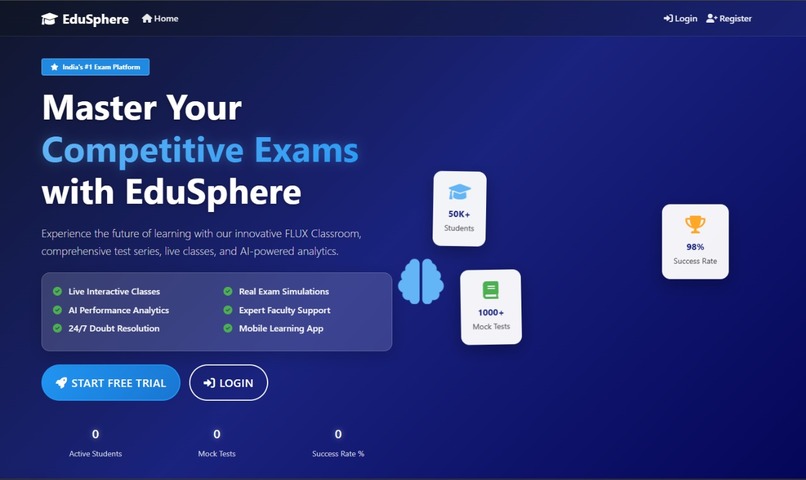
EduSphere-Website
-

Logo
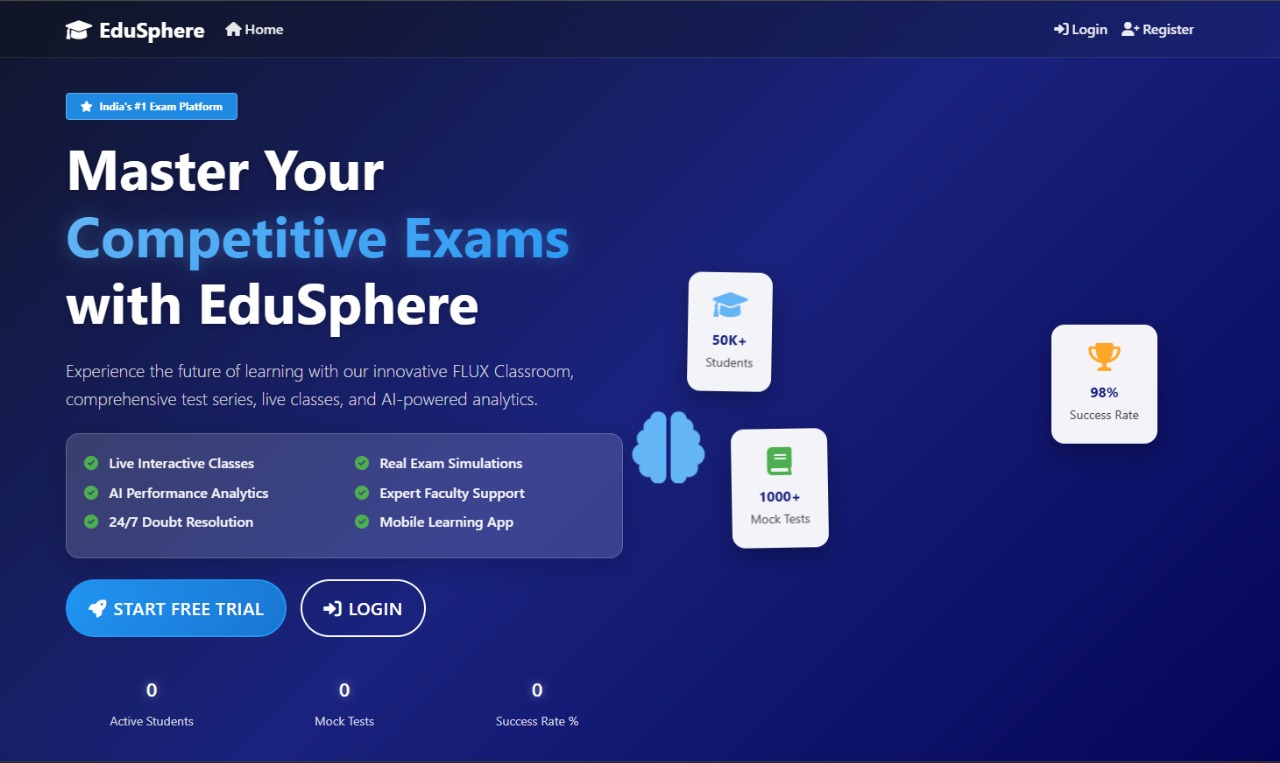

Inspiration
Our project vision served as our core inspiration: to create an all-in-one educational ecosystem that combines traditional learning methods with cutting-edge AI technology. We wanted to provide a single, cohesive platform for competitive exam preparation that offers truly personalized learning experiences and comprehensive tools for students, faculty, and administrators alike, moving beyond fragmented single-purpose apps.
What it does
EduSphere is a sophisticated, full-stack educational platform with three distinct, permission-controlled roles:
For Students: It provides a personalized dashboard, enrollment in 70+ courses (JEE, NEET, UPSC, etc.), a comprehensive Test Series with realistic exam simulation, and access to live virtual classes. The two standout features are the FLUX Classroom for real-time interactive polls and quizzes, and an AI Study Assistant (powered by Google Gemini) for 24/7 academic help.
For Faculty: It's a complete teaching cockpit. Faculty can create and manage their own FLUX sessions, build custom quizzes, host live classes with an interactive whiteboard, manage assignments and grades, and track detailed student performance analytics.
For Administrators: It offers a complete system-wide oversight, including user management (activating accounts), course catalog creation, platform-wide analytics, and database management.
How we built it
We built EduSphere as a monolithic full-stack application.
Backend: The core is built with Python Flask 2.3.3. We used Flask-Login with Werkzeug hashing for secure authentication and role-based access control. The database is SQLite, managed through a comprehensive relational schema with over 20 tables. The AI Study Assistant is integrated using the Google Gemini AI (gemini-2.0-flash) model via its API, with secure key management using
python-dotenv.Frontend: The UI is built with HTML5, CSS3, and JavaScript (ES6+) and is fully responsive using Bootstrap 5.1.3. We used Chart.js for all analytics dashboards, DataTables for advanced table management in the admin panels, and Font Awesome 6 for iconography.
Real-time Features: The "FLUX" live classroom's real-time updates (like live polls and leaderboards) are powered by a JavaScript polling mechanism that fetches new data from the server every 2 seconds.
Challenges we ran into
The project report highlights several technical achievements that were solutions to significant challenges:
Simulating Real-Time Interaction: A major challenge was building the FLUX interactive classroom. Instead of WebSockets, we had to engineer a robust, efficient, and scalable JavaScript-based polling system to provide a live-feel experience with instant feedback, leaderboards, and teacher controls, all while managing server load.
Complex Database Architecture: Designing a database to support three different user roles and interconnected features (courses, enrollments, multiple test/quiz systems, live sessions) was a significant challenge. We had to create a comprehensive relational schema with over 20 tables, ensuring data integrity and query efficiency.
Secure, Multi-Role Authentication: Implementing a secure system that not only authenticates users but also strictly enforces permissions across students, faculty, and admins was critical. This required careful implementation of role-based access control (RBAC) at every endpoint to prevent unauthorized access.
Role-Aware AI Integration: Integrating the AI assistant was more complex than a simple chatbot. We had to engineer it to provide role-based responses, meaning the AI's answers and capabilities change depending on whether a student, faculty, or admin is interacting with it.
Accomplishments that we're proud of
We are incredibly proud of successfully building a complete, end-to-end platform with such a wide scope. Our key accomplishments are:
The FLUX Interactive Classroom: This is our most innovative feature. It's a real-time polling and quiz system with session codes, live leaderboards, and full faculty control, creating a truly engaging learning environment.
The Comprehensive Test Engine: We built a full-fledged test simulation system that supports multiple exam types (JEE, NEET, etc.), timers, negative marking, and advanced post-test performance analytics with visual charts.
The AI-Powered Learning Assistant: We successfully integrated a state-of-the-art AI model to provide 24/7, role-aware, educational-focused assistance, complete with a persistent conversation history for each user.
The Robust Multi-role Architecture: We built a single application that seamlessly serves three different user types with completely distinct interfaces, features, and permissions, all from a unified codebase and database.
What we learned
This project was a massive learning experience in full-stack development and system design. We learned:
- How to build a large-scale, production-ready Flask application (over 3,000 lines of backend code) from scratch.
- How to design a complex, normalized relational database schema to serve as the backbone for a multifunction platform.
- Advanced front-end techniques for creating dynamic, data-driven user interfaces using JavaScript, Chart.js, and AJAX-style polling.
- How to securely implement a robust authentication and authorization system for multiple user roles.
- The practicalities of integrating and managing third-party AI APIs in a secure and context-aware manner.
What's next for EduSphere
The platform is built to be scalable, and we have a clear roadmap for future enhancements.
Technical Improvements: Our first priority is to migrate the FLUX classroom from polling to WebSockets for true, instantaneous real-time communication. We also plan to build a React Native companion app for mobile users and migrate the database to PostgreSQL for production-level scaling.
Feature Expansions: We plan to integrate video conferencing directly into the "Live Classes" feature, implement machine learning for personalized learning recommendations (beyond the AI assistant), and add social learning features like peer-to-peer collaboration.
Platform Enhancements: We will add multi-language support to broaden our reach and implement two-factor authentication (2FA) for enhanced security.


Log in or sign up for Devpost to join the conversation.