-
-
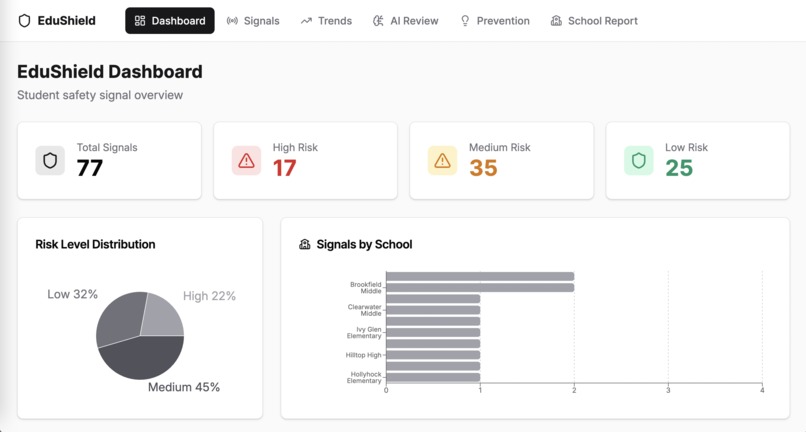
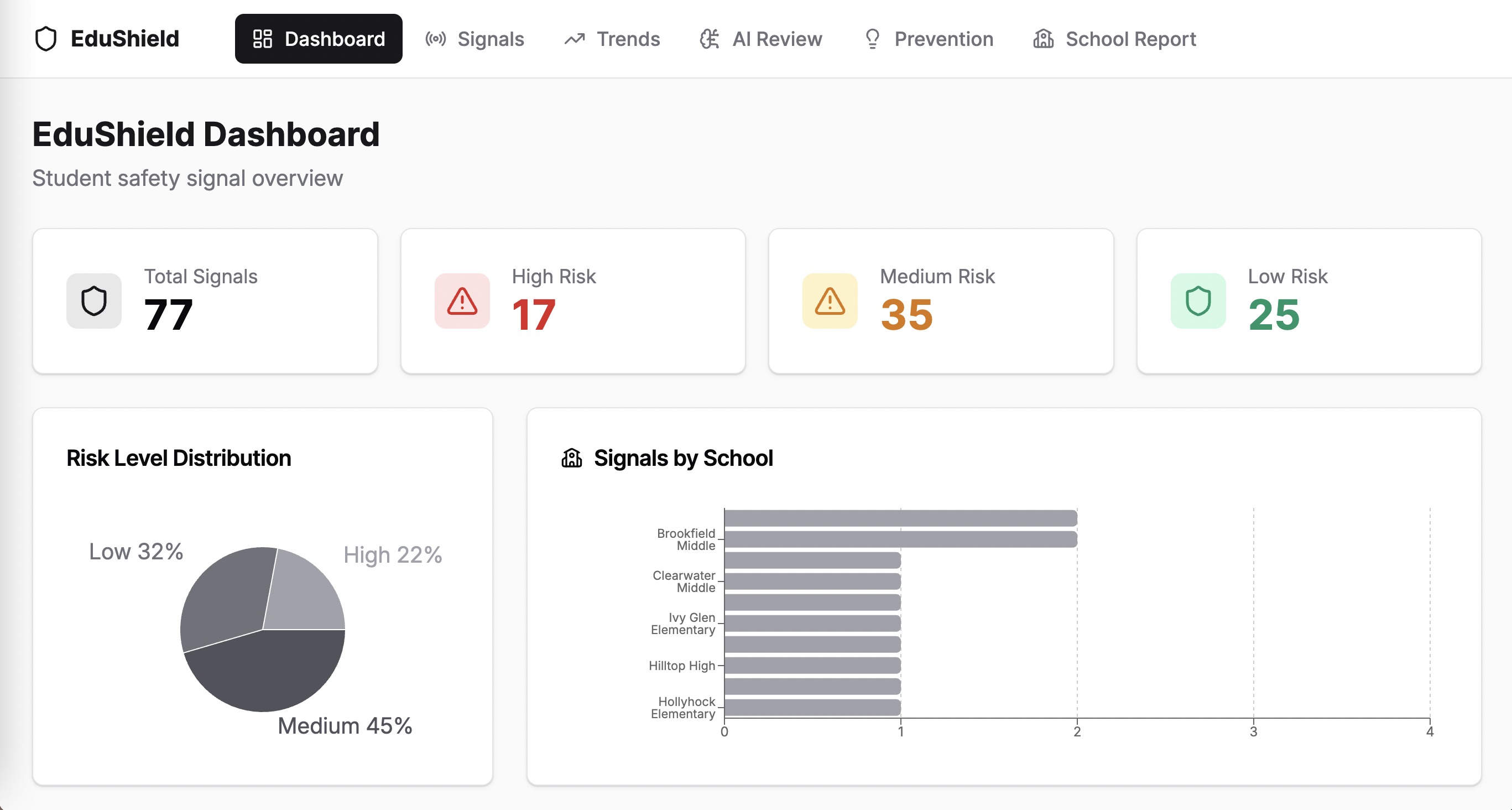
EduShield Dashboard
-
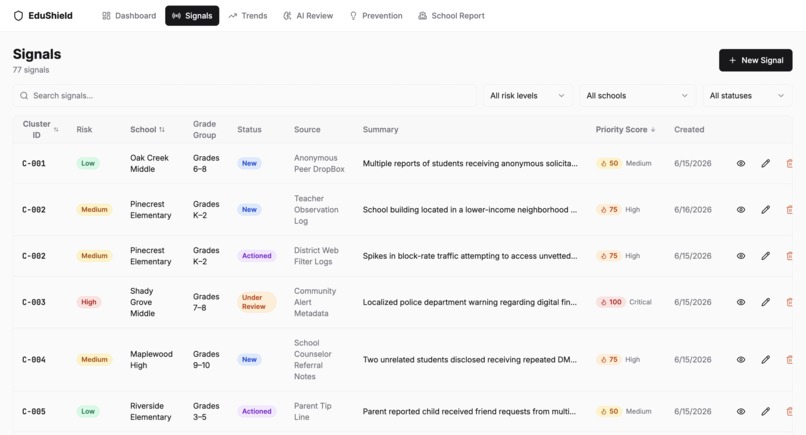
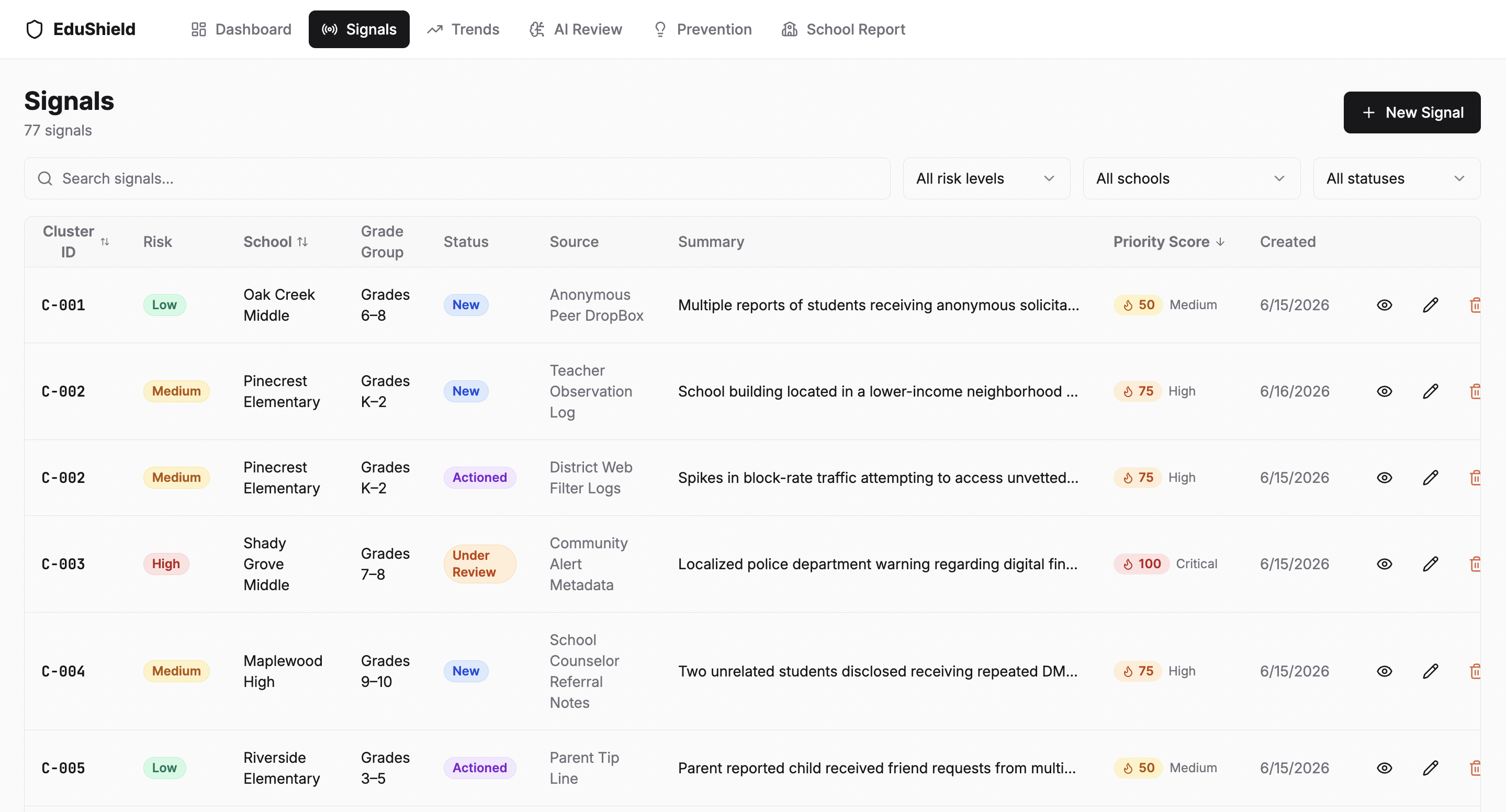
Signals (Alerts of Online Threats)
-
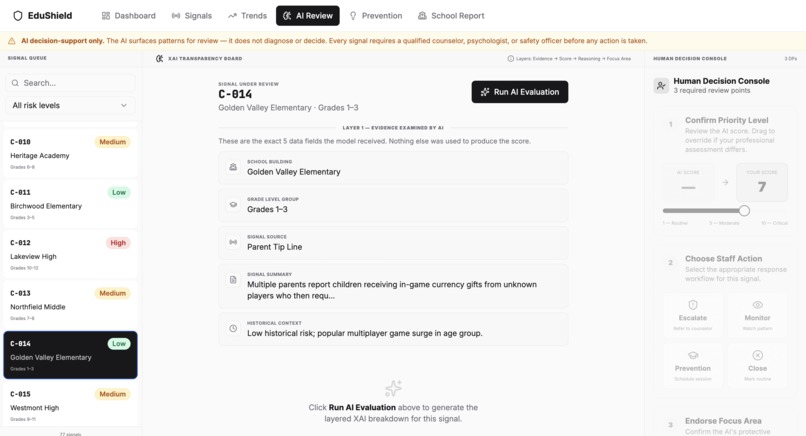
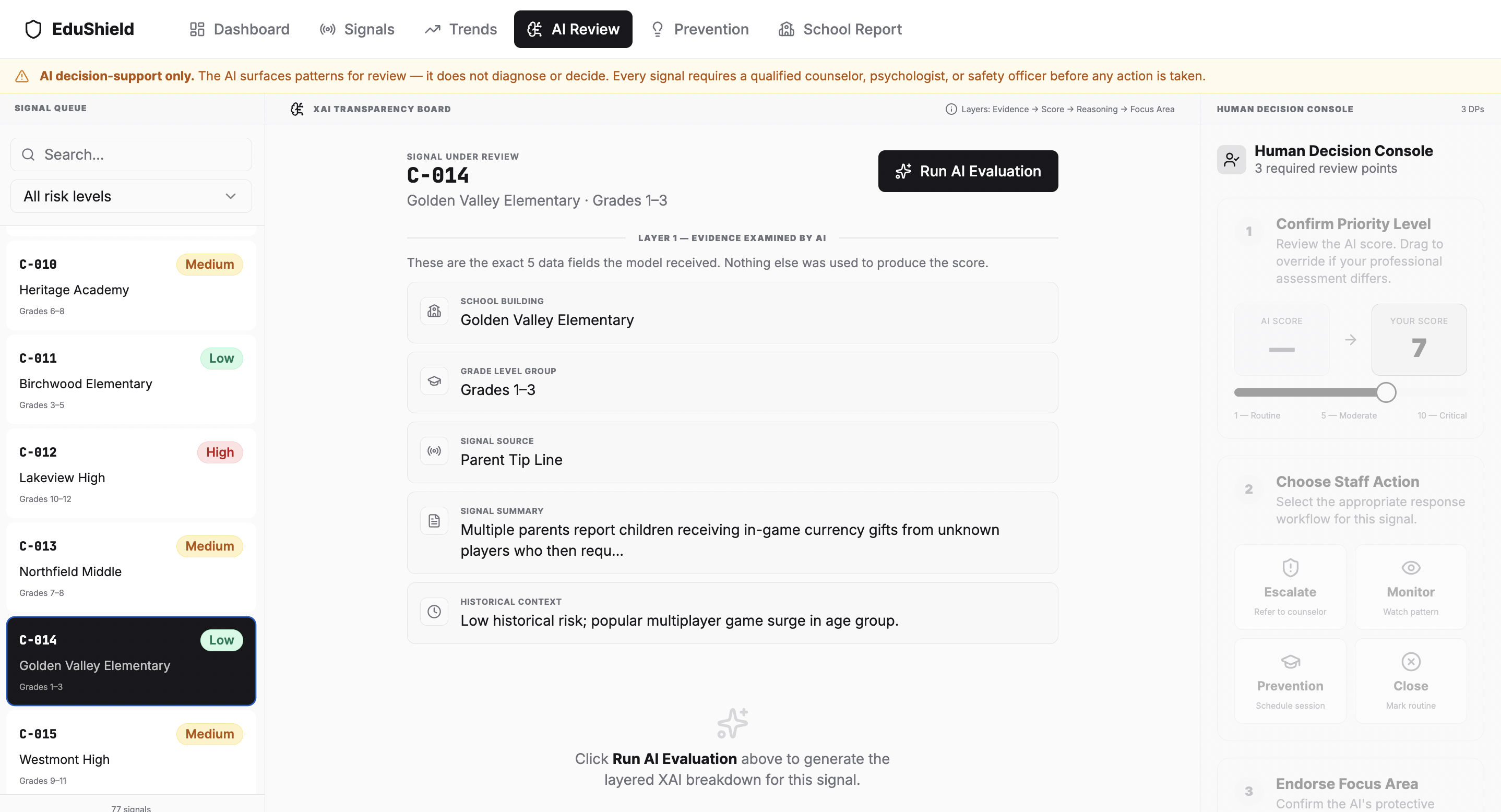
AI Review 1
-
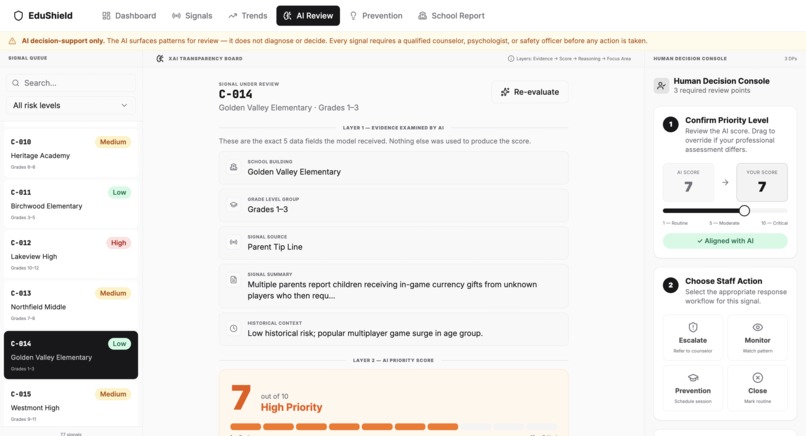
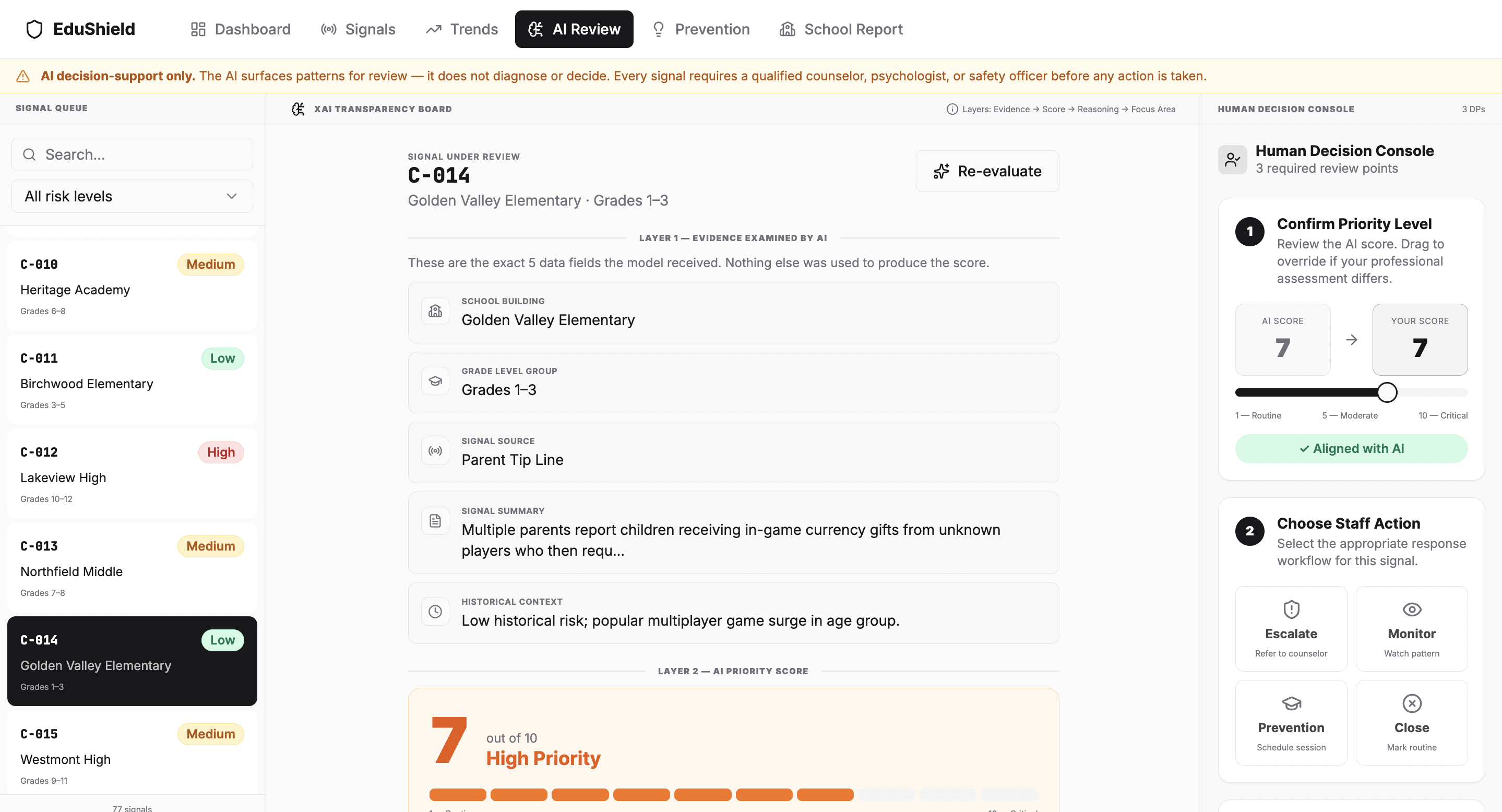
AI Review 2
-
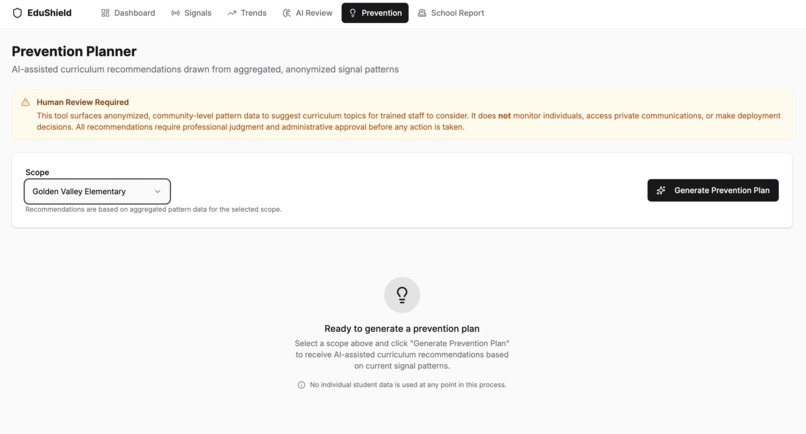
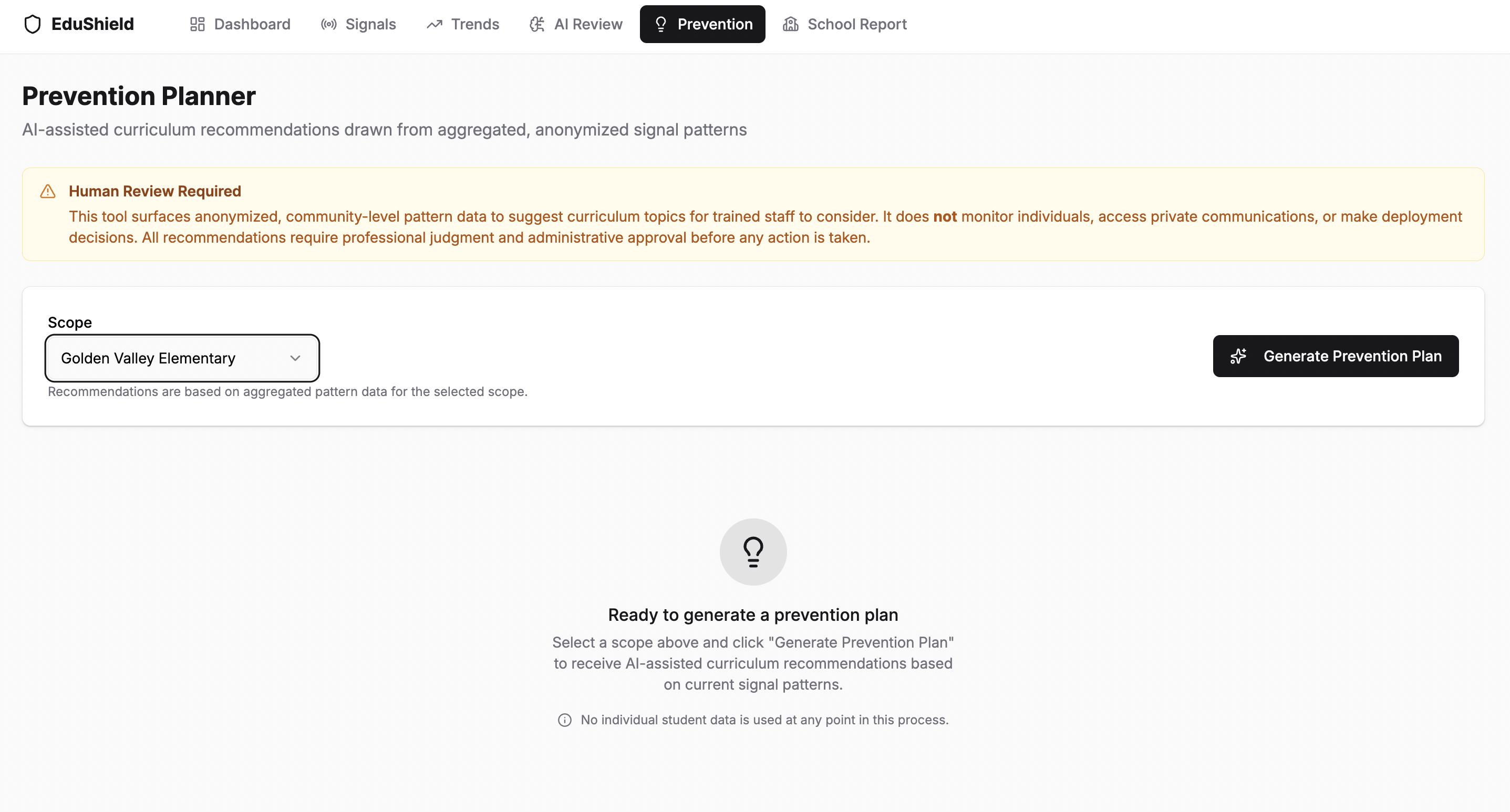
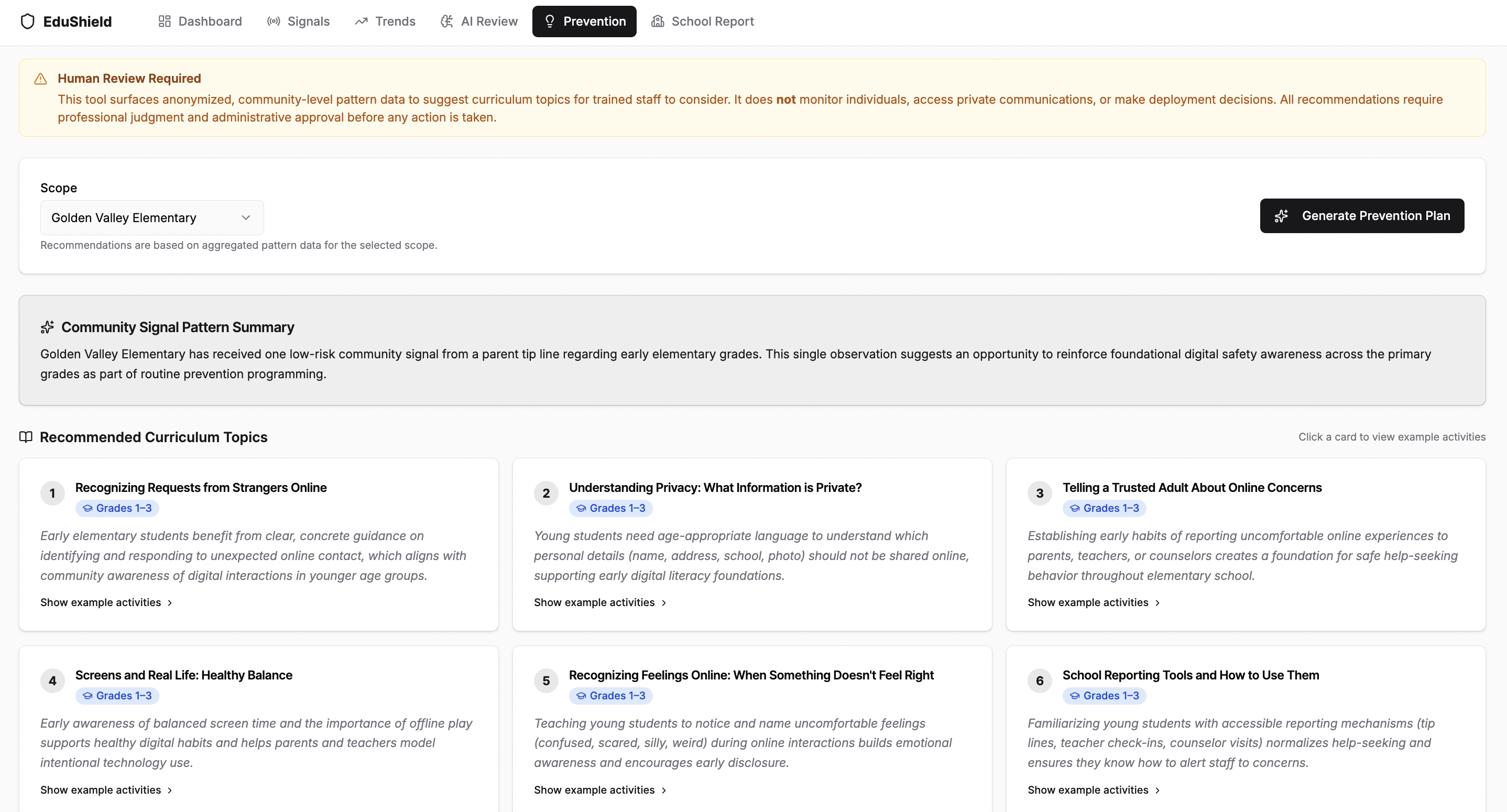
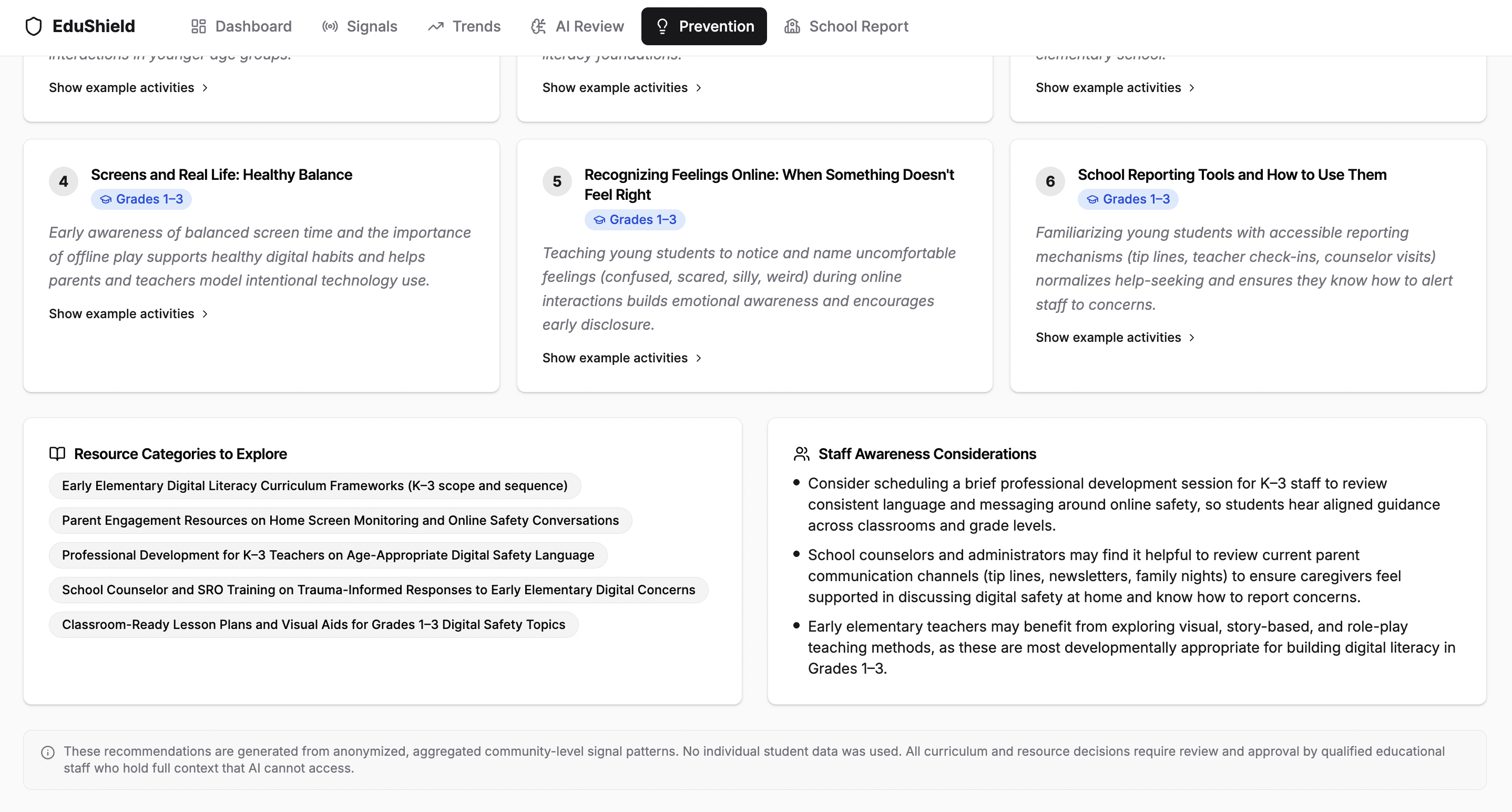
Prevention 1
-
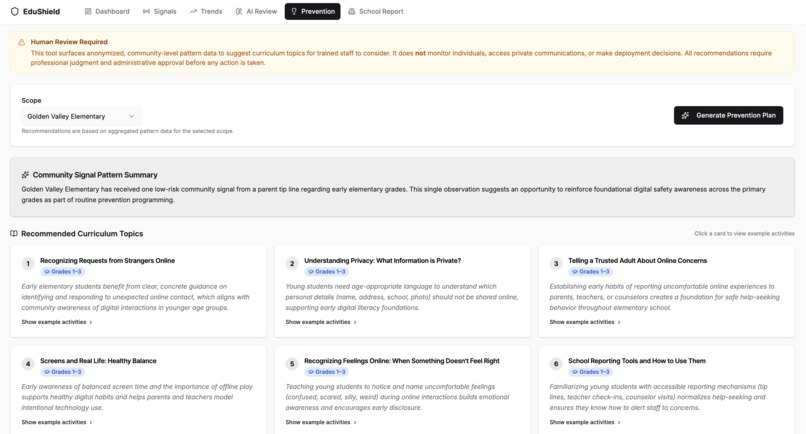
Prevention 2
-
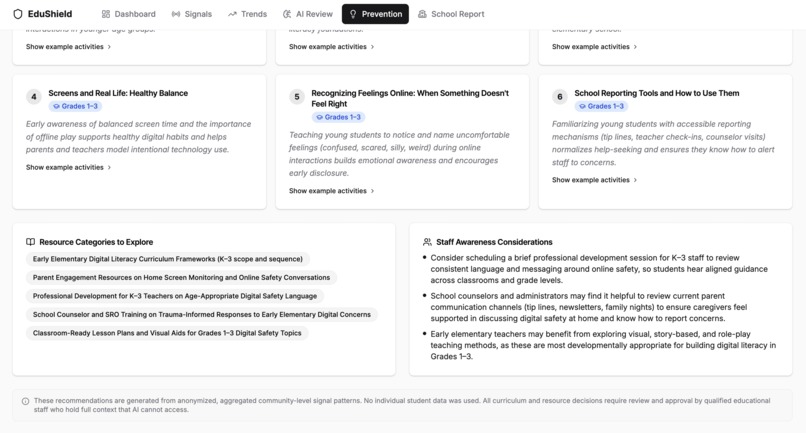
Prevention 3
-
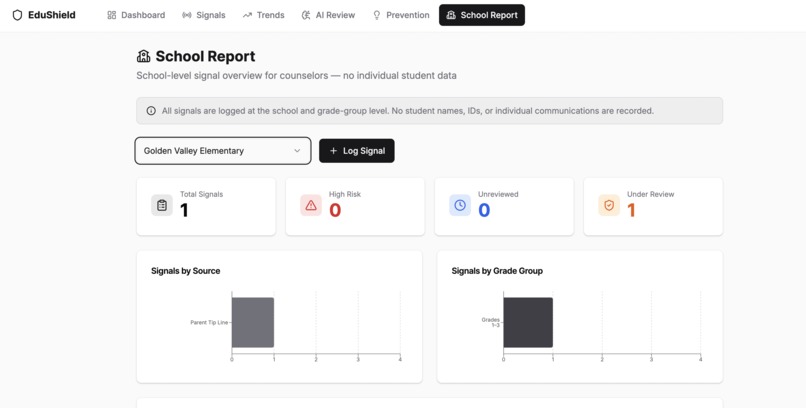
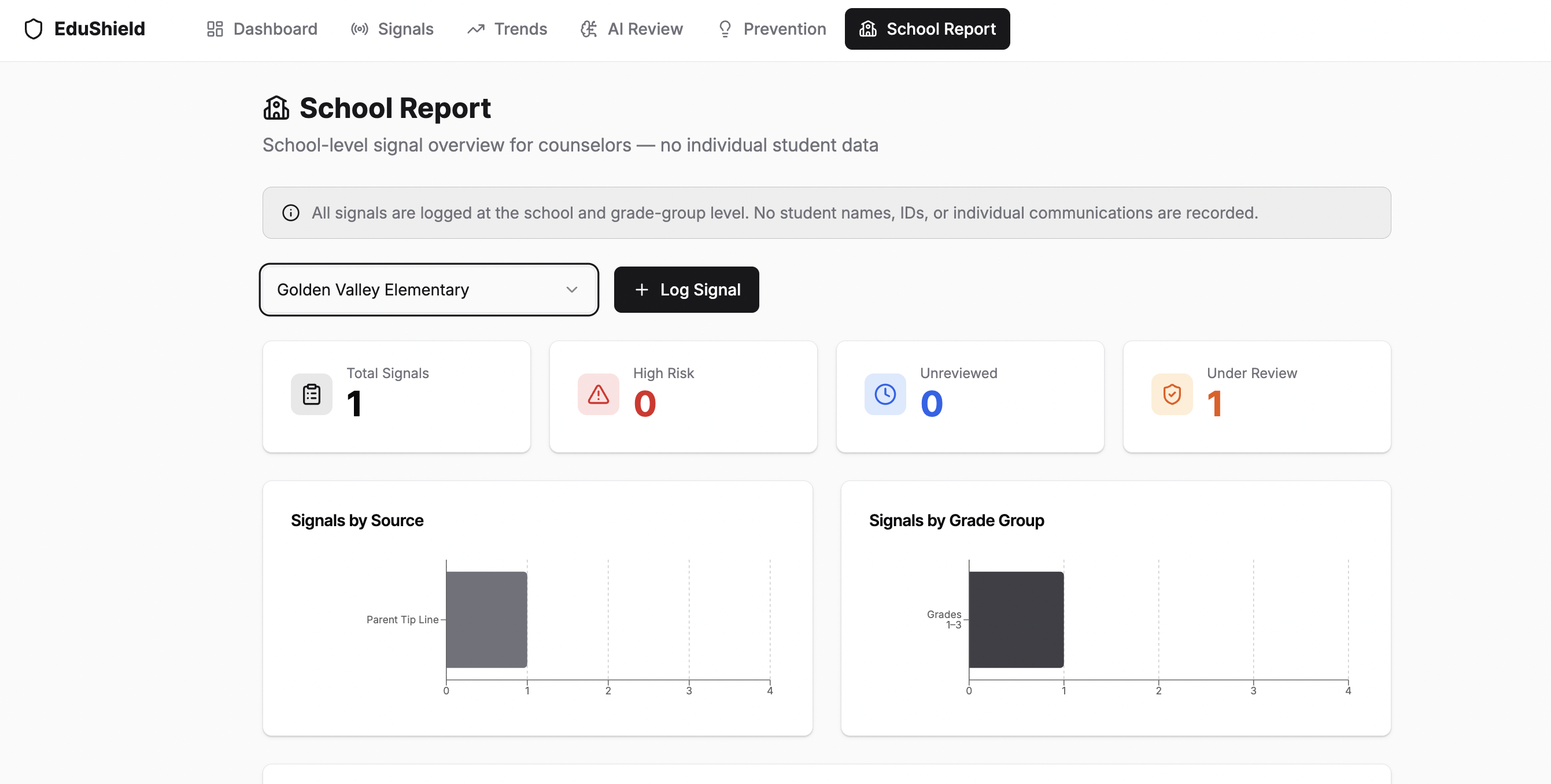
School Report
Inspiration
The inspiration for our Hackathon project was to help keep PreK-12 students safe in today’s digital world. Today, students from Pre-K through 12th grade spend much of their time online. They use school-issued devices to learn, connect, and express themselves online, while also managing the social, academic, and emotional experiences that happen in school each day. There are reports of peer-to-peer conflicts that begin in school, often culminating in online conflicts or bullying after school hours. There are frequent reports of students circumventing the guardrails that have been put in place to protect them from exposure to inappropriate material and/or online predators. There are online threats even when students play games with players they do not know. As a result, students are at high risk of online dangers, and teachers and administrators lack the means to detect those threats, analyze the risks, and take appropriate action.
What It Does
EduShield is a student safety platform used across the district that connects digital monitoring to the valuable insights of people such as counselors, parents, guardians and school resource officers. By combining web-filter alerts with real-world reports, EduShield helps schools quickly identify and respond to serious safety concerns on campus. Importantly, it keeps student information private and follows all (Family Educational Rights and Privacy Act) FERPA guidelines.
How We Built It
EduShield was designed to help districts quickly and effectively improve safety across schools. We focused on building a platform that can grow with district needs and is easy to set up, using up-to-date technology that works well together.
- The Technology Stack For the dashboard, we chose Retool because it allows us to create a fast and easy-to-use interface. This approach also makes it easy to grant different users the appropriate level of access based on their roles. We used a centralized PostgreSQL database to keep all district data secure and consistent. This setup ensures everyone is working from the same reliable information.
To test the system, we used Base44 to create realistic sample data for the whole district. This helped us organize information in a way that matches how schools actually work.
- The Multi-Channel Ingest Pipeline We developed a custom data pipeline that integrates information from various sources across the district. This system organizes and connects both digital and human-reported data to each student's profile.
Digital Signals (Automated): Web searches, student chat logs, and school device telemetry.
Offline Human Signals (Observational): Counselor/teacher logs, parent tip lines, anonymous student reporting boxes, and School Resource Officer (SRO) reports.
- The Core Correlation Logic: As soon as new information is added to the database, our risk engine gets to work. Instead of looking at each alert separately, the system checks for patterns across different types of data. For example, if a student's online activity matches what a counselor has noted, the platform updates the student's safety score immediately, allowing urgent situations to be addressed quickly.
Challenges We Ran Into
Incremental Development and Seamless Testing Developing the core application was efficient. We used an agile, step-by-step approach, working with Gemini to write code and then add it to Retool. By testing each part right after making changes, we found and fixed bugs early, which helped us keep the system stable from start to finish.
Mastering The Platform Flow Once we finished the architecture, we spent hours exploring and practicing with the platform to really understand how everything worked together. We focused on moving smoothly between the district analytics and the counselor reporting tab so our live demonstration would feel clear and natural.
The Time-Constraint Hurdle: Condensing the Narrative Our biggest challenge was fitting everything we built into a 4- to 5-minute presentation. We were proud of our work and wanted to highlight every feature, but it was tough to explain the backend database, the data pipeline, and the risk multiplier in such a short time. To solve this challenge, we used NotebookLM to turn our detailed technical notes into a clear, high-level summary. This helped us focus our pitch on EduShield’s main value and keep things simple for the judges.
Accomplishments That We're Proud Of:
Designing a Tangible Solution to a National Crisis Instead of creating a generic hackathon prototype, we focused on building a practical platform that addresses one of the most pressing challenges in PreK-12 education today. By moving from passive web monitoring to active, coordinated support, we aimed to develop a tool that could make a real difference for students.
Developing An Intelligent, Context-Aware Risk Model We are especially proud of our work on the Composite Risk Engine. Instead of relying on isolated keyword alerts that often lead to alert fatigue, we developed a system that recognizes patterns across different data types. Watching the platform identify and escalate a crisis when a student's online activity matches a counselor's report was a significant achievement for our team.
Architecting For District Scale Without Compromising Privacy We demonstrated that it is possible to support an entire school district while still protecting student privacy. Our system gives district leaders access to important, de-identified demographic information while keeping individual student details secure at the school level. This was a key accomplishment for our team.
Laying The Groundwork For Future Safety Nets We are proud that EduShield is a practical and scalable platform. Many PreK-12 districts are looking for ways to connect IT teams with campus mental health professionals. I believe our framework could be an important first step toward a real solution.
Thankful We are very thankful for our team. This was a truly collaborative process, and we supported one another throughout by leveraging our individual strengths. Working together allowed us to build on each person's expertise, contribute meaningful ideas, and create a stronger final product than any of us could have achieved alone.
What We Learned
Demystifying the Path from Technology to Real-World Impact Before this hackathon, our team had not tried, or even considered ourselves capable of, building a complex system to address a significant real-world challenge. We often assumed that advanced security platforms were only within reach for large corporations. Through this project, we discovered that with a clear vision, an organized database, and a focus on solving a specific problem, we can create tools that make a real difference. Now, we have moved beyond simply writing code to understanding how to design effective solutions.
Embracing AI As A Strategic Co-Developer This hackathon helped us understand what it means to work in today's developer environment. We found that using AI tools like Gemini goes beyond finding quick answers; it supports collaborative systems design. By dividing the EduShield platform into manageable parts, testing each database migration and API script step by step, and using tools like NotebookLM to improve our pitch, we learned how to speed up our development process while maintaining code quality and stability.
Student Safety Student safety is not solely an AI task or a human responsibility. It is a partnership. By combining automated digital intelligence with localized human empathy, we create a comprehensive safety net that monitors, prevents, and responds to crises in real time.
What's Next For EduShield
EduShield was designed to help districts quickly and effectively improve safety across schools. We focused on building a platform that can grow with district needs and is easy to set up, using up-to-date technology that works well together.
Built With
- base44
- gemini
- retool


Log in or sign up for Devpost to join the conversation.