Inspiration
There has been a multitude of school shootings within the past 3 years. Students run out of the classroom when they hear a fire alarm. Kids are confused when they hear a tornado warning. A clear problem is that under a massive amount of stress, students and teachers simply don’t know how to react sometimes. This can lead to catastrophic consequences. This course will run students through simulations of many types of dangers that can be posed at schools whether it be natural disasters, school shootings, or simple scientific guidelines. It will ensure that students and teachers master these safety concepts.
What it does
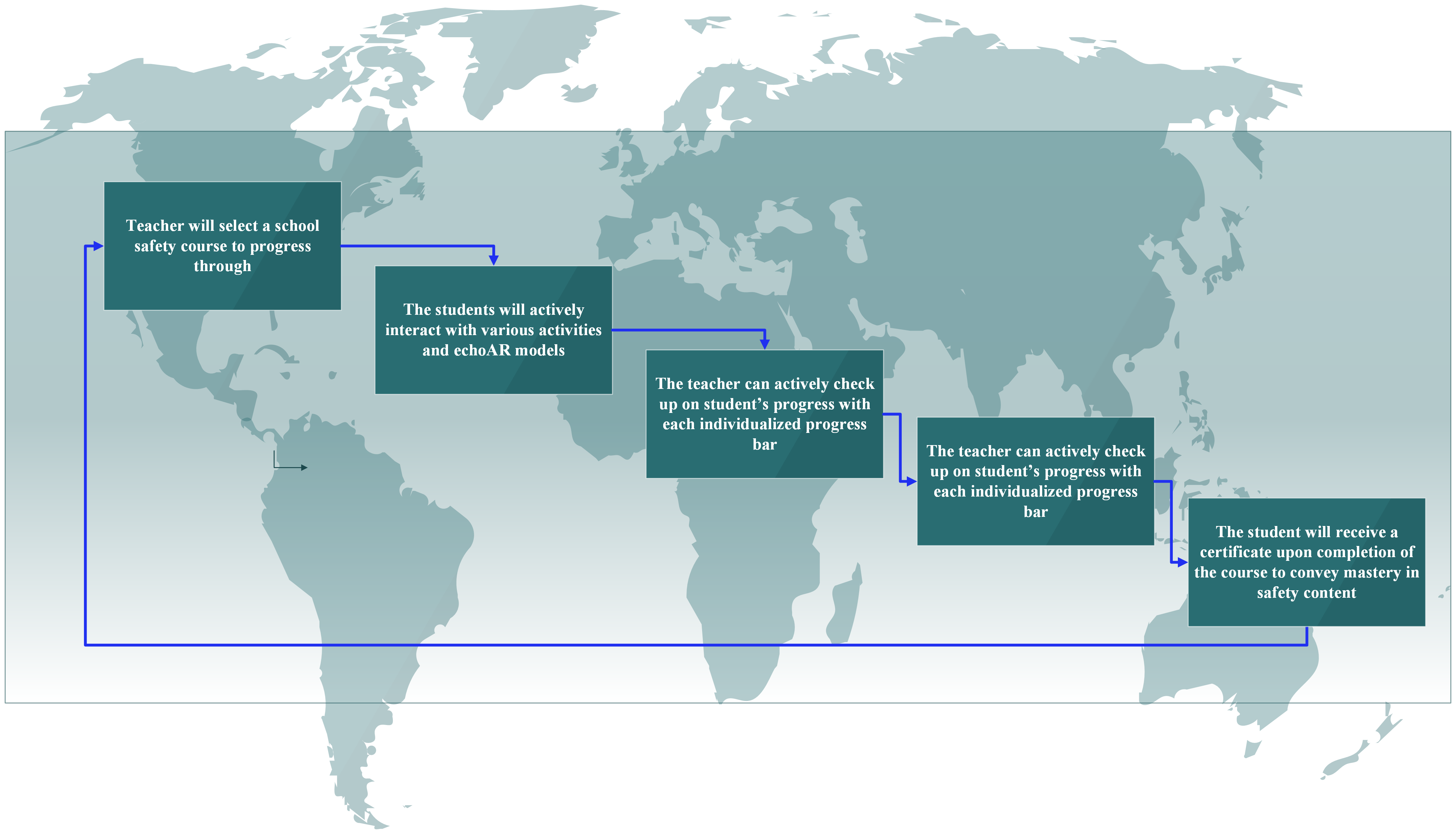
The webapp has a plethora of courses that students can take. The teachers of classes can check on each student's progress and make sure the student is logging in and getting work done. The exploration division of the webapp allows for students to go over the Flinn Scientific Safety Contract and teaches students the names of different pieces of lab equipment with interactive 3d augmented reality models. We believe that seeing an Erlenmeyer flask or graduated cylinder in person is a lot easier than trying to memorize it off of images. The exploration division also features an interactive map for students to view past incidents around the world, and a news feed featuring the latest articles on school and safety. Being able to apply what they’ve learned to the real word is integral to retaining this vital information For the courses, we currently have fire safety, how to react to a school shooting scenario, and what to do in case of a tornado, and lab safety All three have courses that go through what to do in those situations so students do not panic when these issues arise in real life.
How we built it
The webapp was designed in Angular, using the Node javascript extension. Multiple APIs, such as the Google Maps API were implemented. The biggest challenges while designing were getting a user login system, getting an interactive map, and linking to 3d models. To build the 3d models, the echoAR API was used. From here, live models were linked as buttons on the webapp. As for actual course information, research had to be conducted into fire safety, lab safety, tornado safety, and more. It did help that all of us are currently students, since we already know most of the safety procedures. Ultimately, the development of the webapp relied on Angular and countless APIs for the amazing features we have implemented. (Due to the NewsAPI key being a developer key, the newsfeed does not populate in the demo link, but a working version is shown in the demo video.)
Challenges we ran into
Finding accurate course information and lab safety rules took more time than expected since we realized that the best information is vital when making courses that can change a students decisions in a life or death situation.
Accomplishments that we're proud of
We believe that EduSafe is a significant step in the right direction. In times where safety is of the utmost priority and digital interaction is becoming more prevalent, this application’s courses and AR implementations can be very important for a lot of people. We are extremely proud of the fact that this idea can make a genuine change in schools all around the United States and the entire world. Every time we see some type of disaster on the news, it’s truly saddening to see how these kids suffer. Taking the necessary precautions will help reduce this problem.
What we learned
Throughout this hackathon experience, we were able to learn about cool tools and technologies to help support this application with all of its features. We learned how to effectively pitch an idea, by incorporating personal experiences and detailed flowcharts to explain our thinking. On the technical side, we explored the possibilities of AR, surprised by the intuitive and effective echoAR tool, which enabled us to better support the courses. Finally, the execution of the webapp was a super cool learning process. We learned how to incorporate a Google Maps API into our webapp to allow for user interaction on our case map.
What's next for EduSafe
EduSafe’s unique integration of course certification and augmented reality demonstration allows for an innovative way of content mastery. Besides just school safety courses, we can also use this same technology for workplace safety training, pilot and passenger helicopter safety training, as well as amusement park training. This can also be implemented in the health field, as it can show people who are looking to get into working out the proper steps for each machine.
Built With
- angular.js
- google-maps
- news-api
- paper-kit-2-boostrap-ui-kit


Log in or sign up for Devpost to join the conversation.