-
-
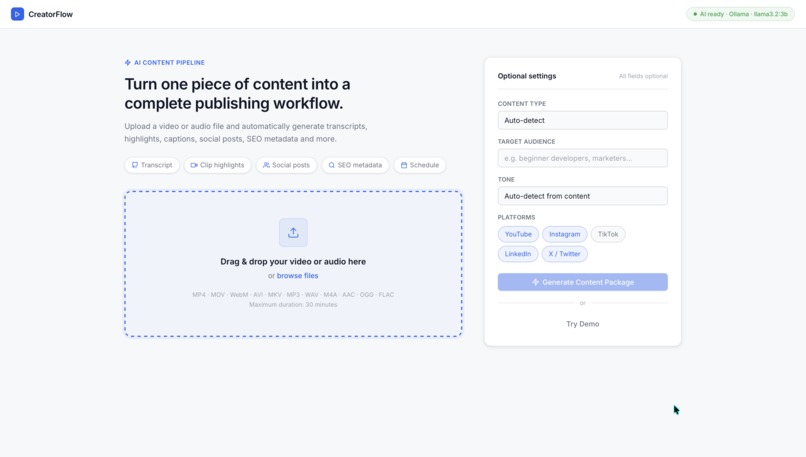
USER Uploadings
-
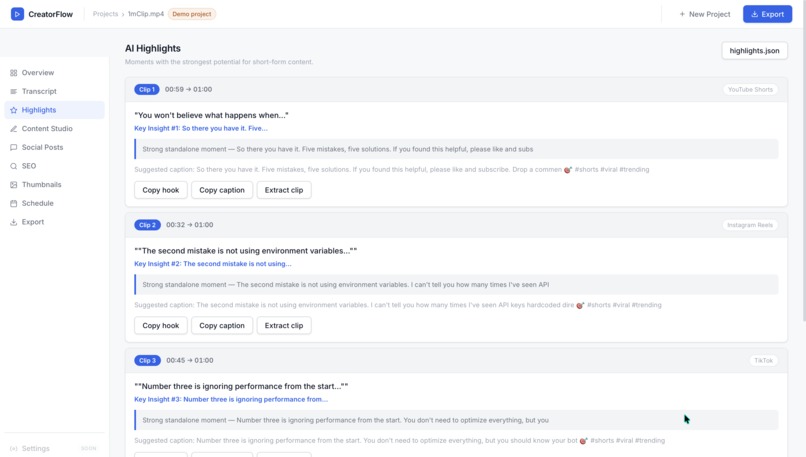
Contents extracted
-
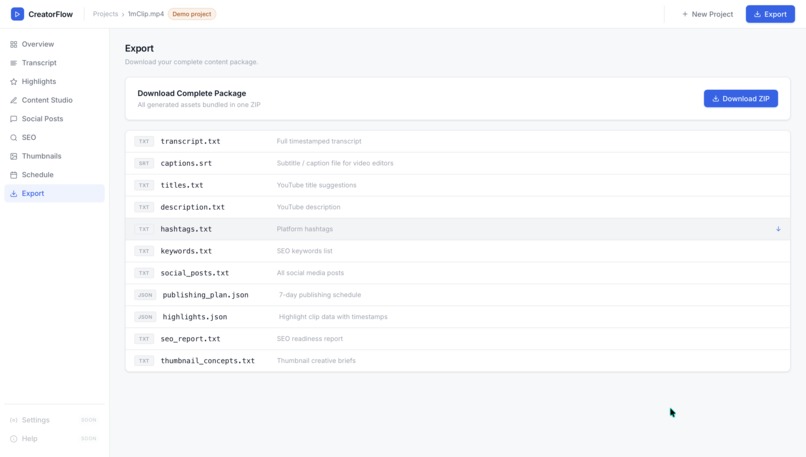
Exports
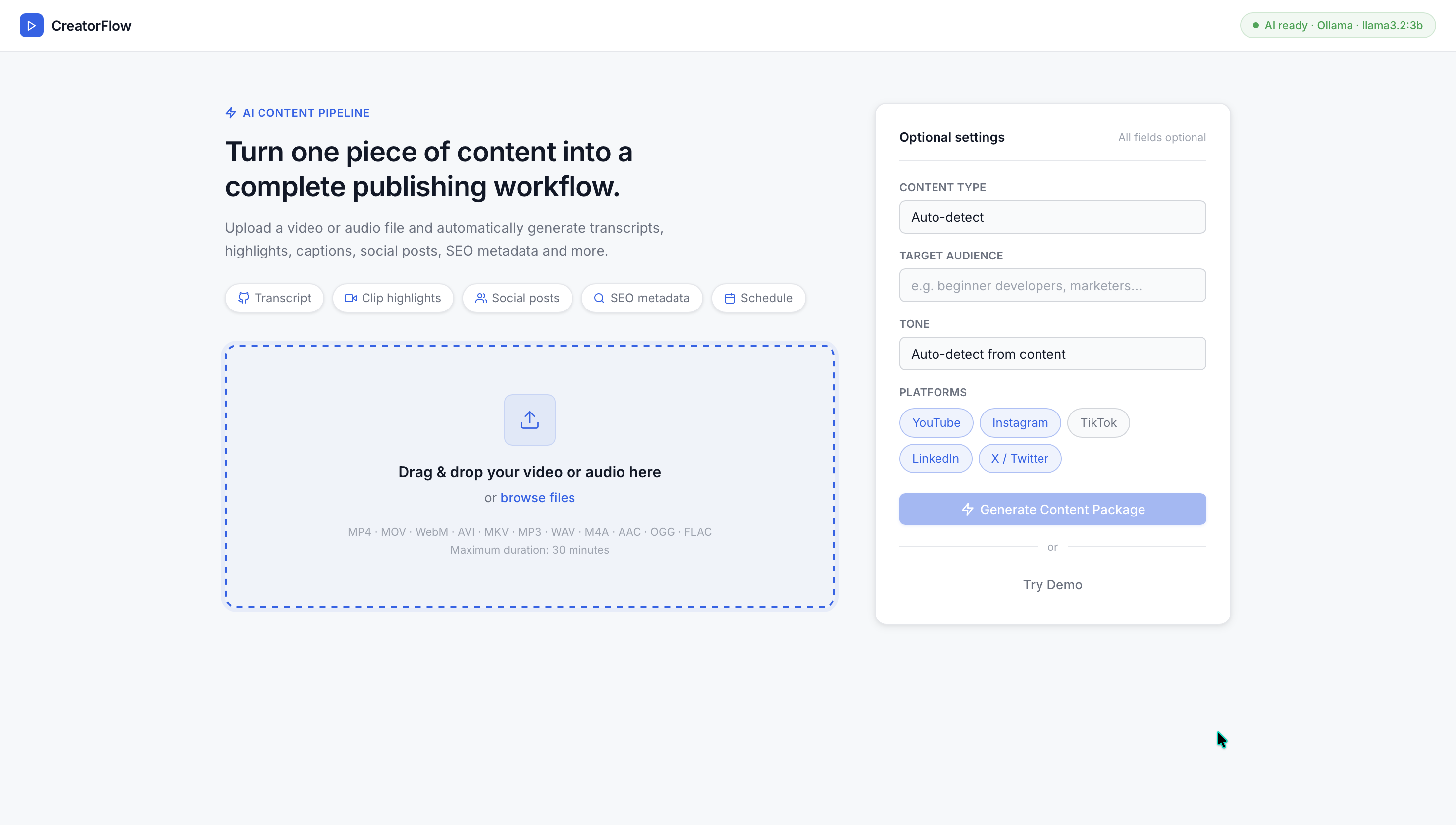
Inspiration
Creating content from long-form videos, podcasts, lectures, interviews, and recordings can be time-consuming. A single video may contain valuable information, but turning it into a transcript, summary, short clips, social media posts, titles, hashtags, and SEO-friendly content often requires multiple tools and significant manual effort.
We wanted to explore how AI could simplify this entire process by transforming one piece of long-form content into multiple useful formats from a single platform.
This led us to CreatorFlow AI, an AI-powered content repurposing platform designed to help users turn long-form media into structured, ready-to-use content.
What is CreatorFlow AI?
CreatorFlow AI is an AI-powered content repurposing platform that transforms uploaded video and audio into multiple forms of useful content.
A user can upload a video or audio file, and the platform can:
- Transcribe the content automatically.
- Generate summaries and key information.
- Create multiple title suggestions.
- Generate descriptions and keywords.
- Generate hashtags and tags.
- Create social media post suggestions.
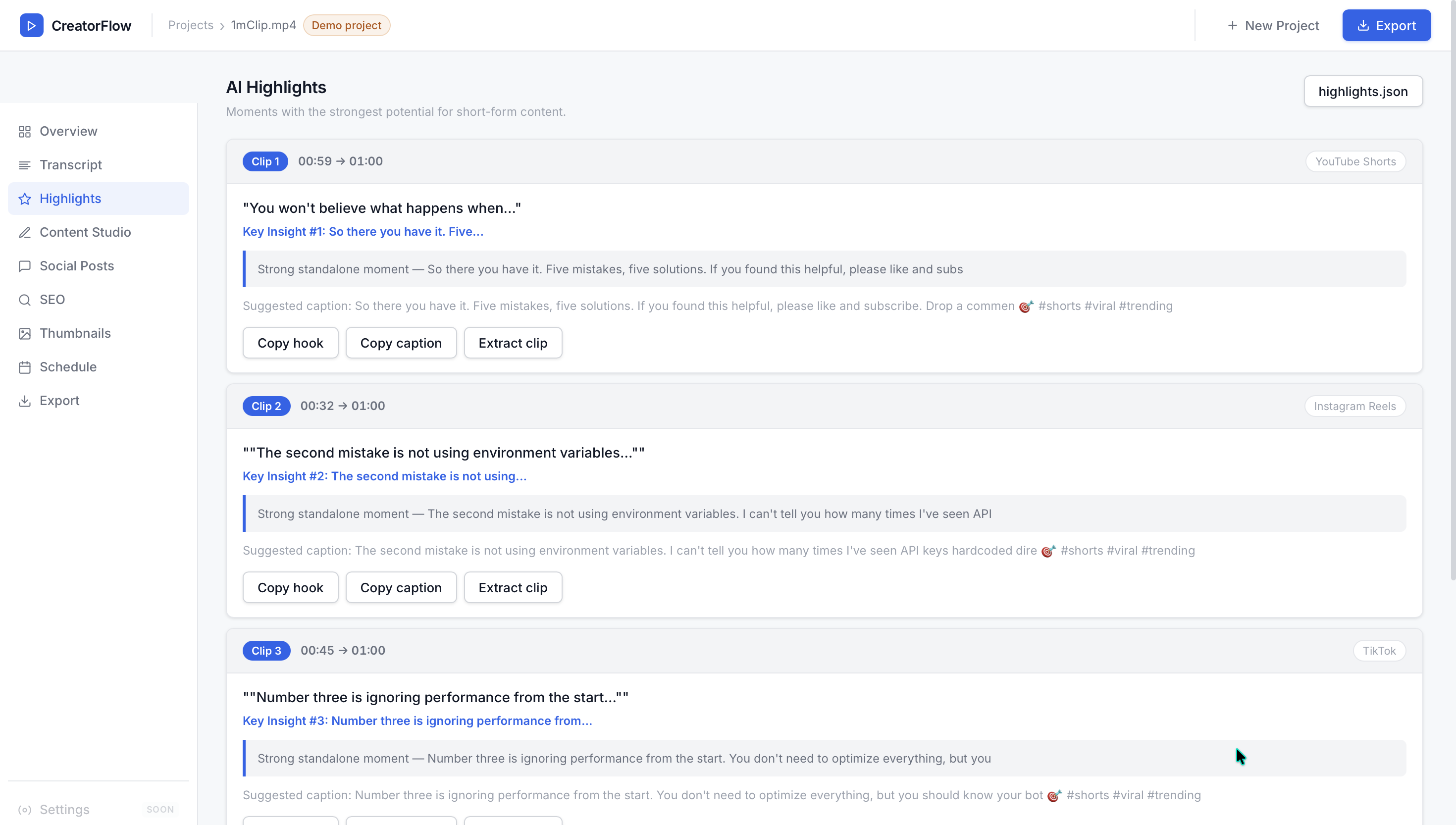
- Identify important sections of the content.
- Extract short video clips from selected highlights.
- Provide SEO-related insights.
- Organize content into different sections.
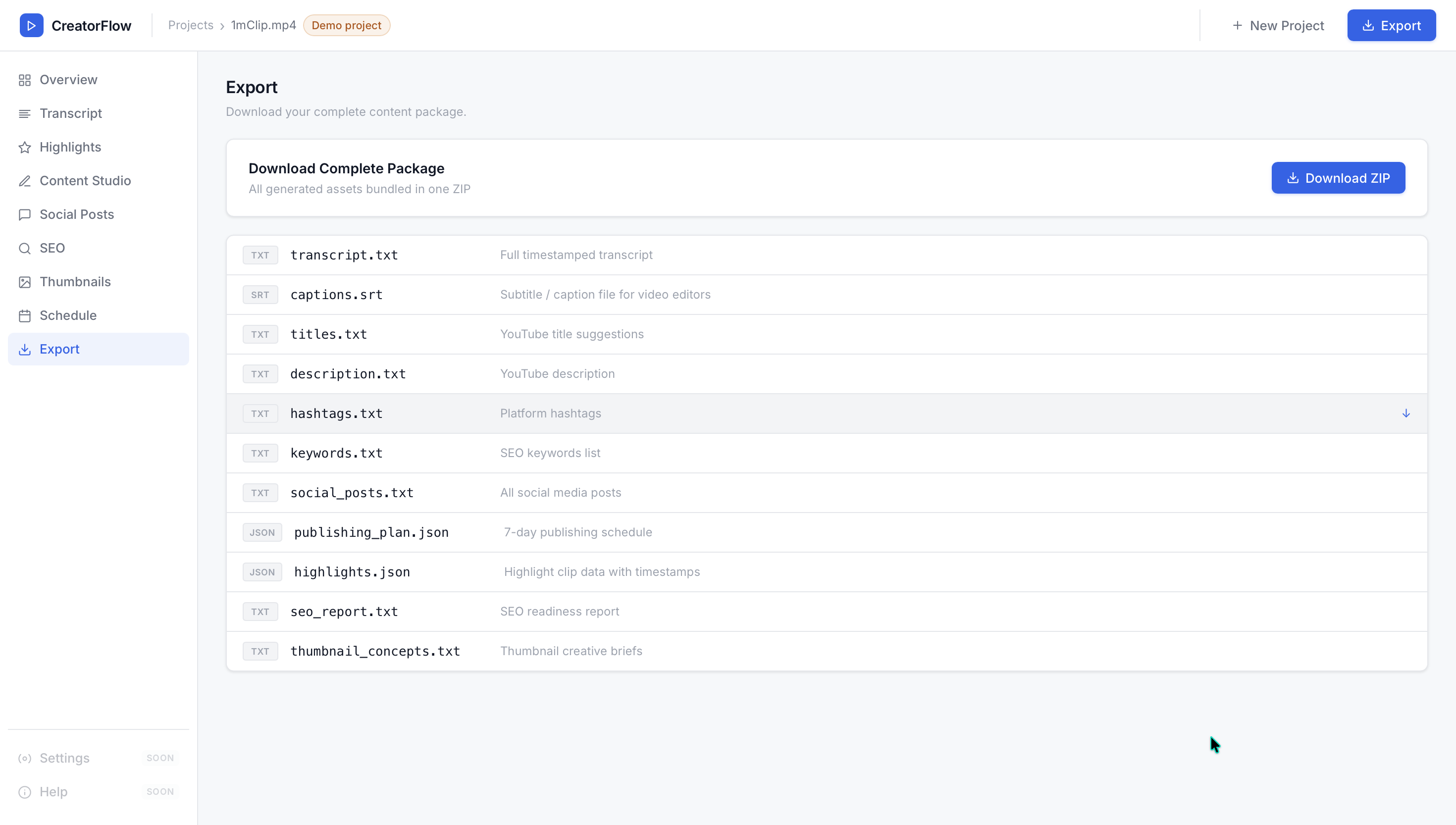
- Export the generated content and clips as a package.
The goal is to reduce the amount of repetitive manual work required to repurpose long-form content.
How It Works
The workflow is:
Upload Media → Audio Processing → AI Transcription → Content Understanding → Content Generation → Highlight Detection → Clip Extraction → Export
Once the media is uploaded, the system extracts and processes the audio before generating a timestamped transcript.
The transcript is then used as the source for generating different types of content.
The platform can produce:
- Full transcript
- Summary
- Titles
- Description
- Keywords
- Tags
- Hashtags
- Social media posts
- SEO insights
- Important content highlights
- Short video clips
- Exportable content package
This allows users to start with one long-form piece of content and create multiple derivative resources from it.
Technology
CreatorFlow AI combines several technologies:
- Python for backend processing.
- Flask for the web application backend.
- JavaScript, HTML, and CSS for the frontend.
- Whisper for speech-to-text transcription.
- Ollama with Llama 3.2 for local AI content generation.
- FFmpeg for audio/video processing and clip extraction.
- Natural Language Processing for understanding transcripts and generating structured content.
A major part of the project is the use of local AI models. Instead of depending entirely on paid cloud AI APIs, the current system can run transcription and language-model processing locally.
This makes the core AI workflow more accessible for experimentation and reduces API costs.
Target Users
CreatorFlow AI can benefit:
- Content creators
- YouTubers
- Educators
- Podcasters
- Students
- Researchers
- Marketing teams
- Small businesses
- Anyone working with long-form recorded content
It is particularly useful for users who regularly need to transform one long piece of content into multiple shorter formats.
Impact
CreatorFlow AI aims to reduce the repetitive work involved in content creation.
Instead of manually watching a long video, finding important sections, writing summaries, creating captions, preparing social posts, and extracting clips separately, users can begin with a single upload and process these tasks through one workflow.
The platform can help users:
Save time + Reduce repetitive work + Reuse existing content + Reach multiple audiences
For educators and knowledge creators, the same workflow can also help transform long lectures or presentations into summaries, important sections, and shorter educational resources.
Challenges
One of the biggest challenges was ensuring that generated content remained connected to the actual uploaded media.
Other challenges included:
- Processing different audio and video formats.
- Extracting audio reliably from uploaded videos.
- Generating accurate timestamped transcripts.
- Identifying meaningful sections of long-form content.
- Producing valid video clips from selected timestamps.
- Handling structured responses from an AI model.
- Keeping the frontend synchronized with backend processing.
- Running AI models locally with limited computing resources.
- Handling cases where an AI service is unavailable.
Another challenge was avoiding generic or unrelated AI-generated content. The system therefore uses the transcript as the main source for downstream content generation and validates timestamps before creating clips.
What We Are Proud Of
We are proud that CreatorFlow AI is more than a simple text-generation interface.
The project connects multiple stages into a complete pipeline:
Real Media → Real Transcript → AI Content → Real Highlights → Real Video Clips → Export
The system can process an actual uploaded media file, generate a timestamped transcript, identify sections of interest, and use those timestamps to extract playable video clips.
We are also proud of implementing the AI workflow using local Whisper and Ollama models, allowing the core processing to work without requiring paid AI API credits.
What We Learned
Building CreatorFlow AI taught us that creating an AI application involves much more than connecting an application to a language model.
AI output needs to be:
- Relevant to the original input.
- Structured correctly.
- Validated before being used.
- Connected to real application functionality.
- Presented in a way that users can understand and act on.
We learned about speech-to-text processing, local LLM integration, prompt engineering, video processing, timestamp handling, backend/frontend integration, and designing reliable AI pipelines.
Most importantly, we learned that the best AI applications focus on solving an entire user problem rather than simply generating AI text.
What's Next for CreatorFlow AI
There are several areas we would like to improve in future versions.
Better AI Models
Larger local models could improve transcription accuracy and the quality of generated content.
Smarter Highlight Detection
Future versions could use deeper semantic and engagement analysis to identify the most valuable or interesting sections of a video automatically.
More Content Formats
CreatorFlow AI could generate additional formats such as newsletters, blog posts, learning notes, podcast summaries, and presentation outlines.
Social Platform Integration
Future versions could integrate official platform APIs to allow users to publish generated content directly rather than only preparing and scheduling it.
AI-Generated Visuals
The platform could eventually generate actual thumbnails, captions, and supporting visual assets based on the content.
Personalization
Users could define their preferred writing style, audience, brand voice, and content strategy so that generated content better matches their needs.
Conclusion
CreatorFlow AI aims to turn one piece of long-form content into an entire collection of useful content through a single AI-powered workflow.
By combining speech recognition, local large language models, natural language processing, and video processing, CreatorFlow AI reduces the repetitive work involved in content repurposing.
The core idea is simple:
Upload once. Understand the content. Create more from it.
Built With
- ai
- css
- flask
- generative
- html
- javascript
- natural-language-processing
- ollama
- python


Log in or sign up for Devpost to join the conversation.