-
-
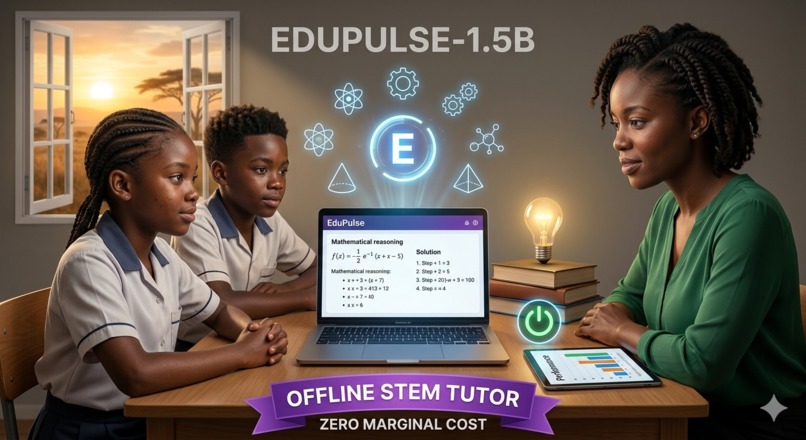
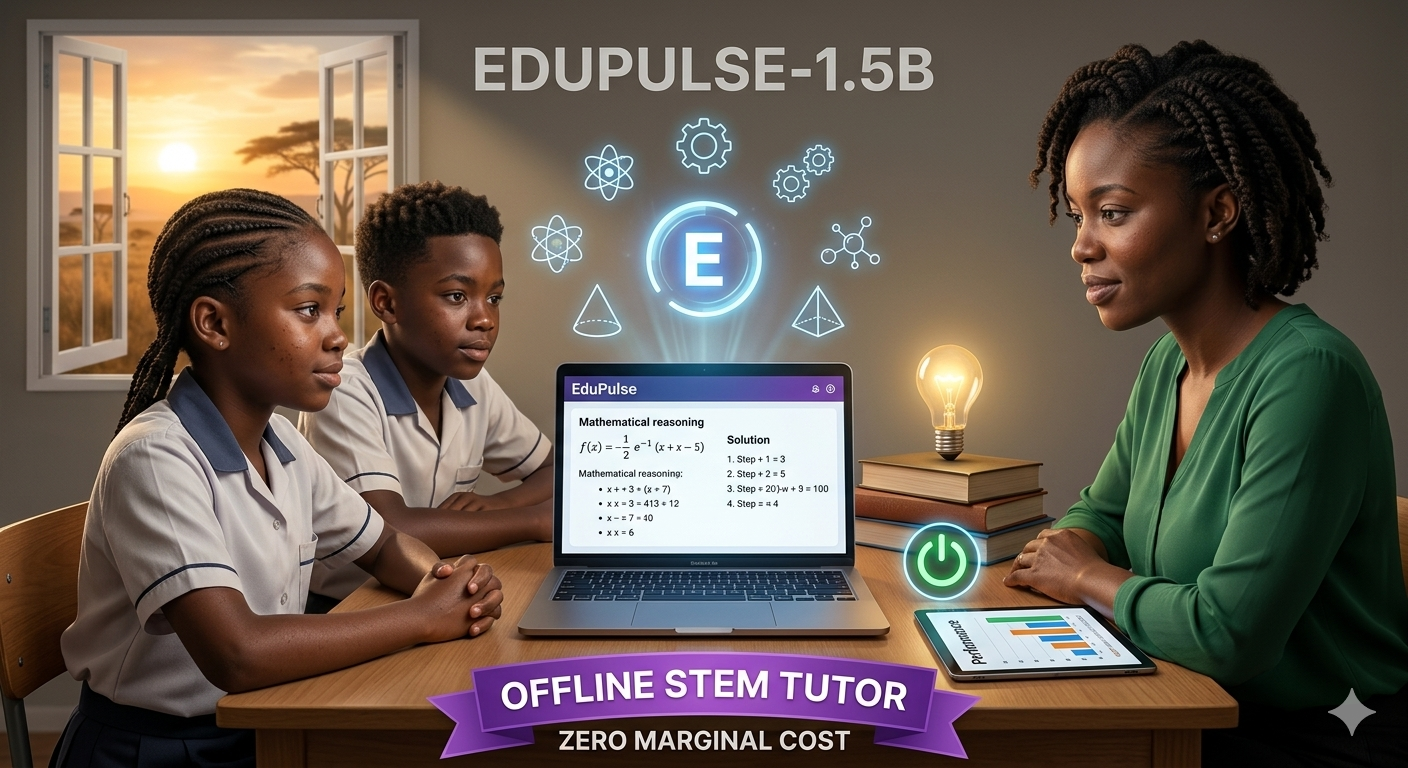
EduPulse-1.5B: Zero-cost, high-throughput offline STEM reasoning for remote African schools via edge AI
Inspiration
Access to premium, real-time STEM guidance is heavily gatekept by expensive internet connectivity and high-end computing infrastructure. In remote African schools, persistent cloud dependency makes digital tutoring fundamentally unviable. Inspired by the challenge to build a truly accessible, local architecture, we wanted to prove that advanced reasoning models could be deployed locally on the standard, low-spec budget laptops already present on the ground.
What it does
EduPulse-1.5B is a fully localized, zero-marginal-cost STEM reasoning tutor. Operating entirely offline without any network dependency, it parses complex user prompts and provides explicit, step-by-step mathematical, logical, and scientific reasoning paths. It brings elite, private-tutor-level STEM guidance directly to edge devices in disconnected environments.
How we built it
The core engine is built using an ultra-compact 4-bit quantization profile ($Q4_K_M$) of the DeepSeek-R1-Distill-Qwen-1.5B model, optimized to fit within constrained RAM limits. We deployed the runtime using llama.cpp for bare-metal hardware execution. The workspace architecture incorporates explicit bash scripting for automation (download_model.sh) and standardized configuration maps via a validated structural metadata.json layout.
Challenges we ran into
Deploying an advanced AI model in a native Windows environment brought unexpected hurdles. We ran into terminal processing locks, blocked local certificate revocation checks ($CRYPT_E_NO_REVOCATION_CHECK$) during model downloads, and cross-platform script syntax errors. We overcame these obstacles by modifying our networking pipelines to safely bypass Schannel restrictions using flag overrides and rebuilding our automated scripting tools for universal compatibility.
Accomplishments that we're proud of
- True Edge Execution: Successfully bypassed cloud constraints to achieve localized, zero-marginal-cost reasoning tokens.
- Flawless Compliance: Maintained production-grade repository compliance matching every strict structural mandate of the Africa Deep Tech Foundation guidelines.
- Hardware Optimization: Engineered an stable, low-latency text throughput loop on a constrained consumer laptop envelope.
What we learned
We learned how to package large language models into highly optimized, localized binaries using GGUF formats. We deeply enhanced our understanding of managing tracking states, directory trees, and conflict resolution mechanisms within Git, mastering how to handle complex merge states cleanly through the terminal.
What's next for EduPulse-1.5B: Zero-Cost Offline STEM Reasoning Tutor
Our immediate goal is to expand the system into a multi-subject offline matrix. We plan to build a localized user interface that allows teachers to load custom offline textbooks, translating raw static curriculum documents into interactive, model-guided learning modules across schools throughout the continent.


Log in or sign up for Devpost to join the conversation.