Inspiration
Most AI tutors are very good at answering questions. But answering a student's question is not necessarily the same as helping that student learn.
A student may ask:
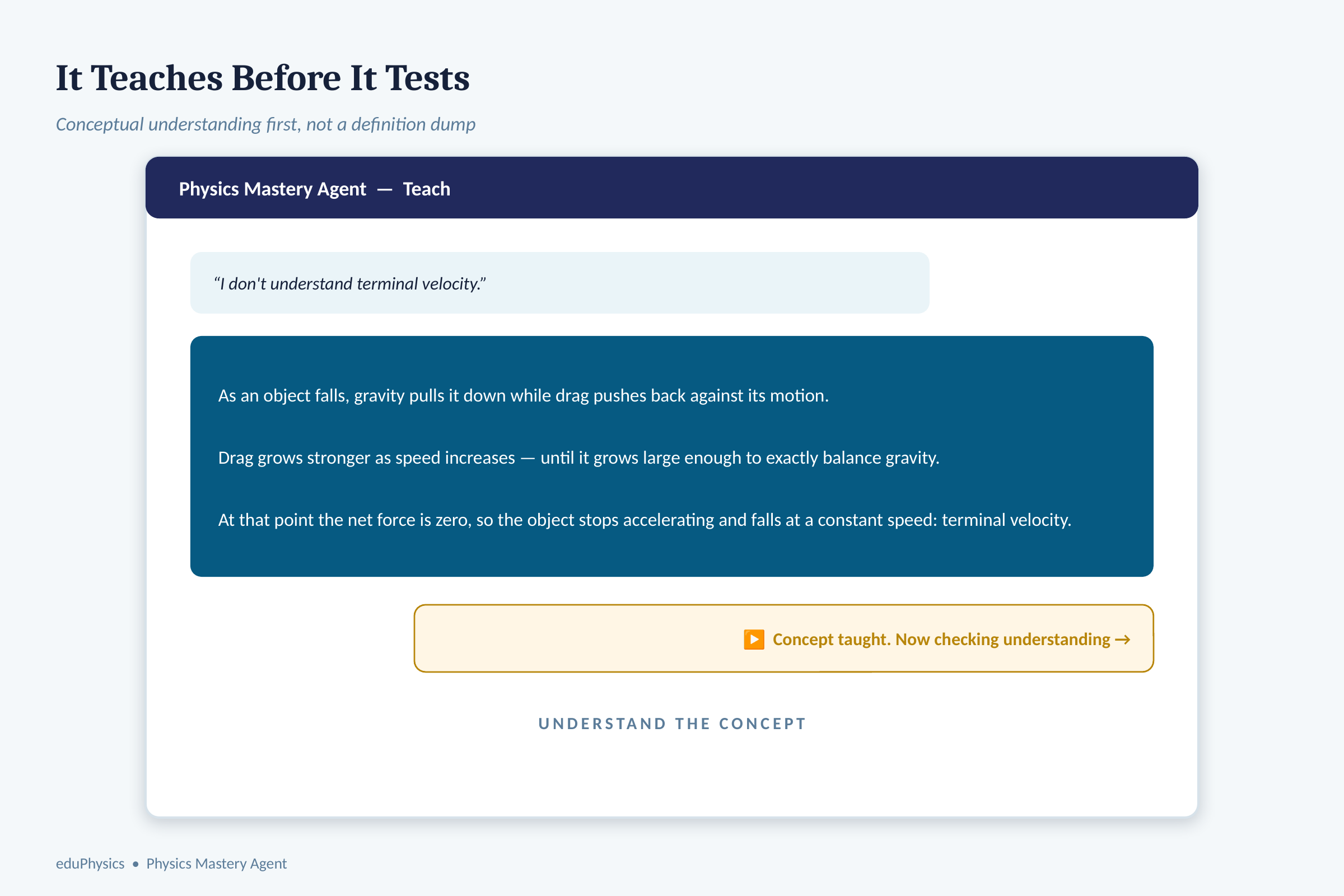
"I don't understand terminal velocity."
The real problem may not be terminal velocity at all. The student may have misunderstood viscosity, Stokes' law, force balance, or even the meaning of net force.
That observation inspired "eduPhysics Physics Mastery Agent".
We wanted to build an AI agent that does something fundamentally different from a conventional question-and-answer tutor:
"Instead of only answering what a student asks, the agent tries to discover what the student actually needs to learn next."
The vision is to combine Gemini-powered reasoning with the educational resources of the eduPhysics ecosystem to create an adaptive Physics learning companion that can diagnose misconceptions, select an appropriate teaching strategy, challenge the learner, evaluate reasoning, and continuously guide the student toward mastery.
What it does
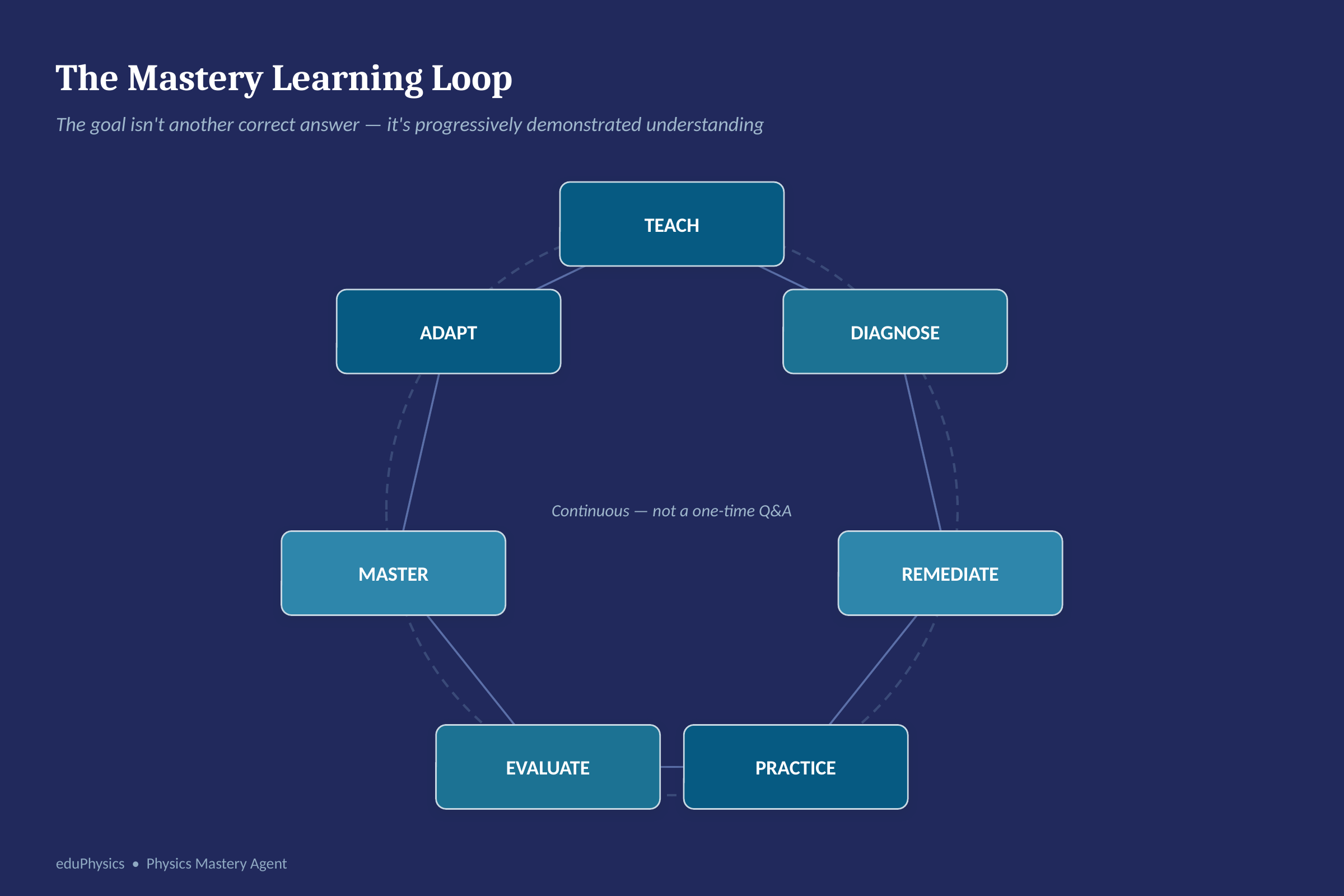
The eduPhysics Physics Mastery Agent is designed around an agentic learning loop:
"Diagnose → Retrieve → Explain → Challenge → Evaluate → Detect → Adapt → Re-test → Advance"
A student can begin with a simple statement such as:
"I don't understand terminal velocity."
Rather than immediately producing a long explanation, the agent can ask targeted diagnostic questions.
It attempts to determine whether the difficulty comes from:
- a conceptual misunderstanding,
- a missing prerequisite,
- incorrect use of a formula,
- mathematical reasoning,
- interpretation of forces,
- or an inability to connect the concept to a physical situation.
The agent can then retrieve relevant educational material, explain the concept at an appropriate level, generate a targeted challenge, and evaluate the student's response.
The most important part of the workflow is misconception detection.
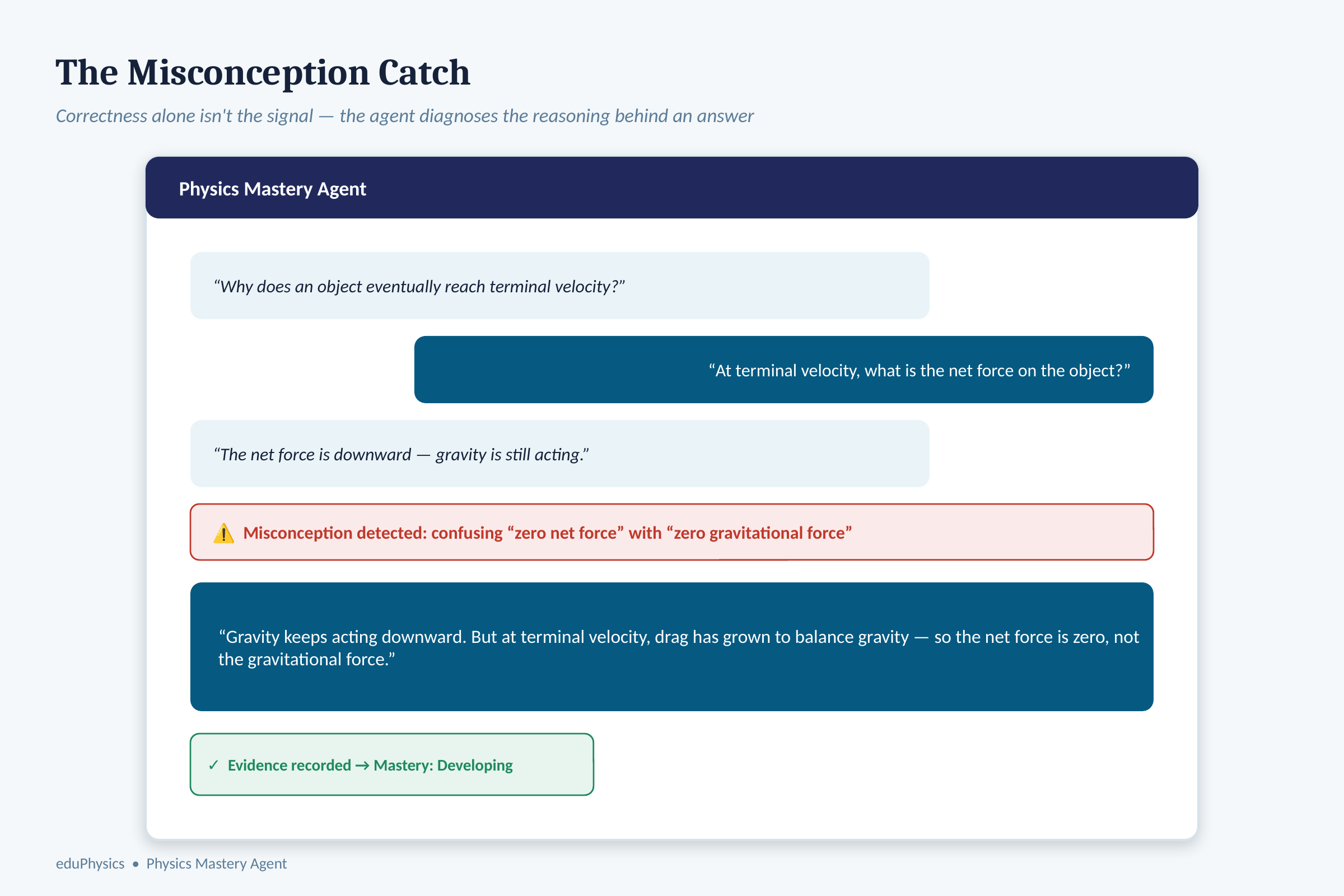
For example, if a student says:
"Gravity stops acting when terminal velocity is reached."
the agent should recognize that the student has confused "zero net force" with "zero gravitational force.
Instead of simply marking the answer wrong, the agent can identify the misconception, explain the force balance, and generate a new question specifically designed to test whether the misconception has been corrected.
The goal is to create a learning loop rather than a one-time answer.
How we built it
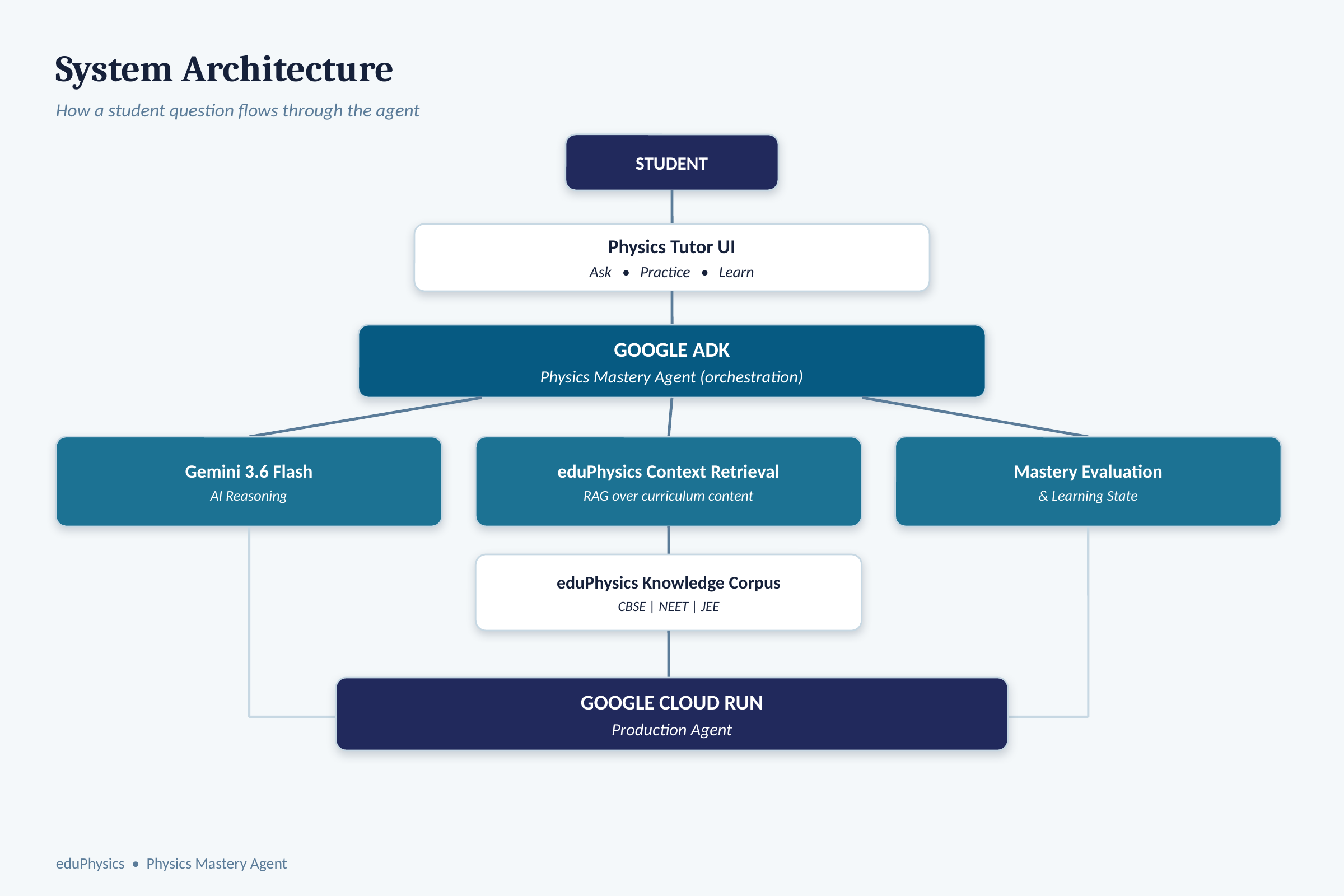
The project is being designed as an agentic AI system rather than a single chatbot prompt.
At the center is the "Physics Mastery Agent", which uses Gemini to reason about the student's current learning state and decide what action should happen next.
The agent is organized around several capabilities:
"Student diagnosis"
Identifying conceptual and prerequisite weaknesses."Physics knowledge retrieval" Finding relevant material from the eduPhysics learning ecosystem.
"Adaptive explanation"
Selecting an explanation appropriate to the student's demonstrated difficulty."Challenge generation" Creating targeted conceptual and numerical questions rather than random practice.
"Reasoning evaluation"
Looking beyond the final answer to examine the student's approach, equations, assumptions, units, and reasoning."Misconception detection"
Identifying the underlying reason for an incorrect response."Adaptive intervention" Deciding whether to explain again, simplify, go back to a prerequisite, provide another example, or increase difficulty.
"Mastery progression"
Determining when the student is ready to move to the next concept.
The architecture is intentionally designed so that the agent can make decisions about the "next learning action", rather than following a fixed sequence of questions.
The initial demonstration focuses on a Physics concept such as terminal velocity because it provides a particularly clear example of misconception-driven learning.
Challenges we ran into
One of the biggest challenges was defining what makes an educational AI system genuinely "agentic".
Simply connecting Gemini to a Physics question-answering interface would not be enough.
We therefore focused on the decision loop:
"What does the student know?" ↓ "What is the likely root misconception?" ↓ "What should the agent do next?" ↓ "Did the intervention work?" ↓ "What should happen after the student's next response?"
Another challenge is balancing helpful explanations with cognitive overload.
A Physics student does not always need more information. Sometimes the student needs one carefully selected question that exposes the missing concept.
A second challenge is preventing the system from confidently presenting an incorrect Physics explanation. This makes grounded retrieval and careful evaluation particularly important.
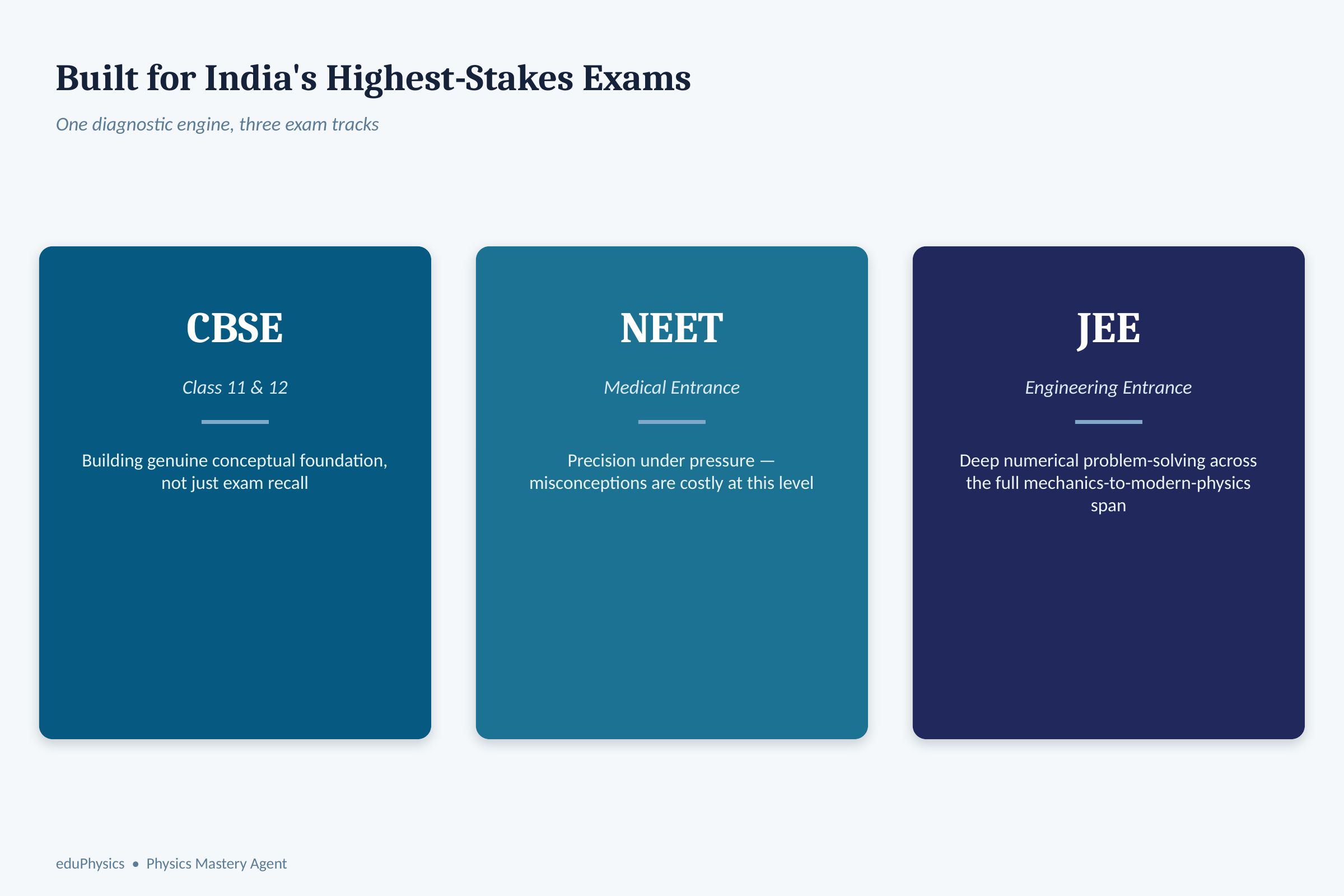
A third challenge is designing the system so that it can serve different learners—from a student learning a Class 11 concept for the first time to a student preparing for competitive examinations.
Accomplishments that we're proud of
We are building the project around a simple but powerful principle:
"The next best learning action should depend on the student's demonstrated understanding."
We are particularly proud of the misconception-repair workflow.
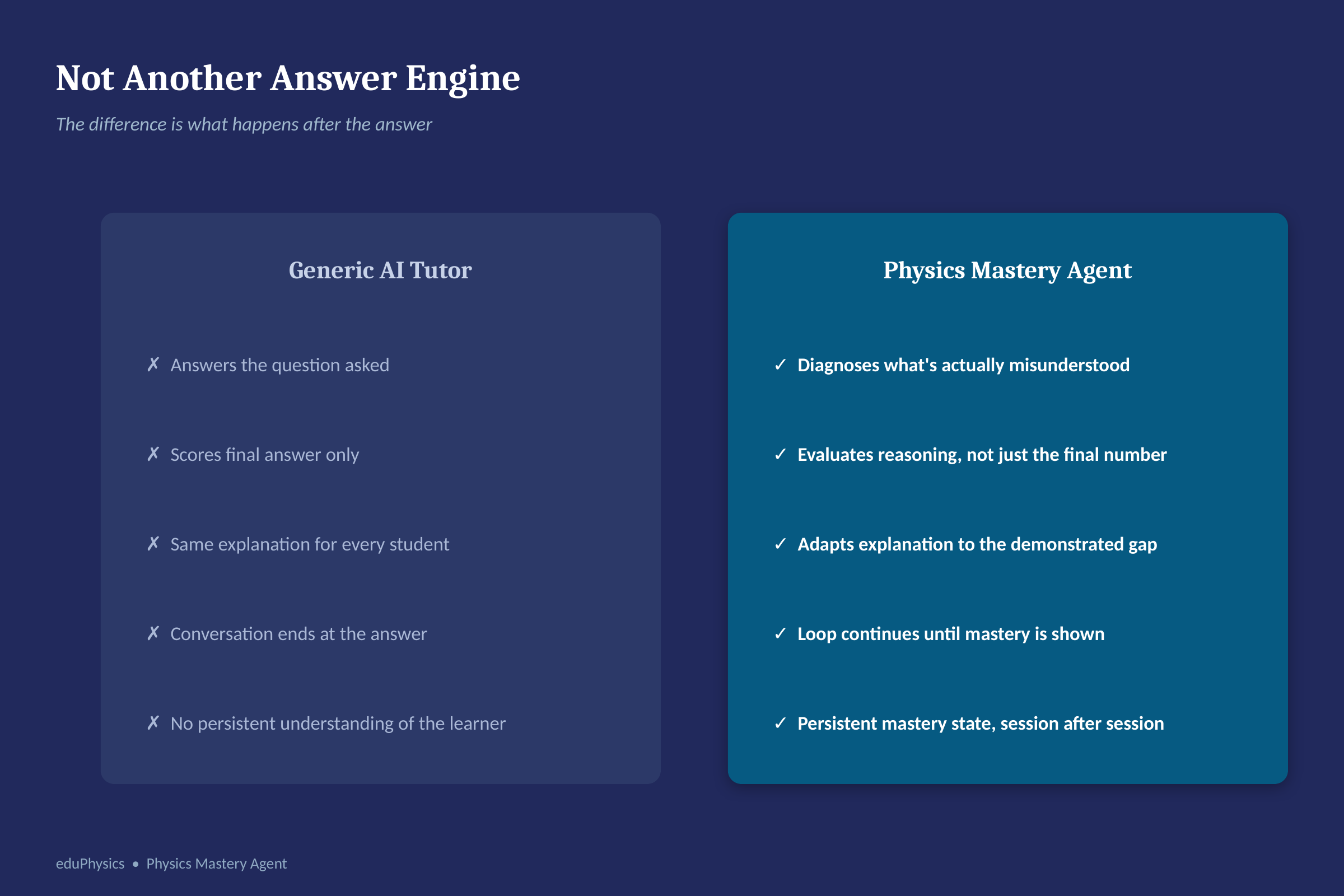
Instead of:
"Question → AI answer → End"
the system is designed to create:
"Question → Diagnosis → Targeted intervention → Student reasoning → Evaluation → Adaptation → Mastery"
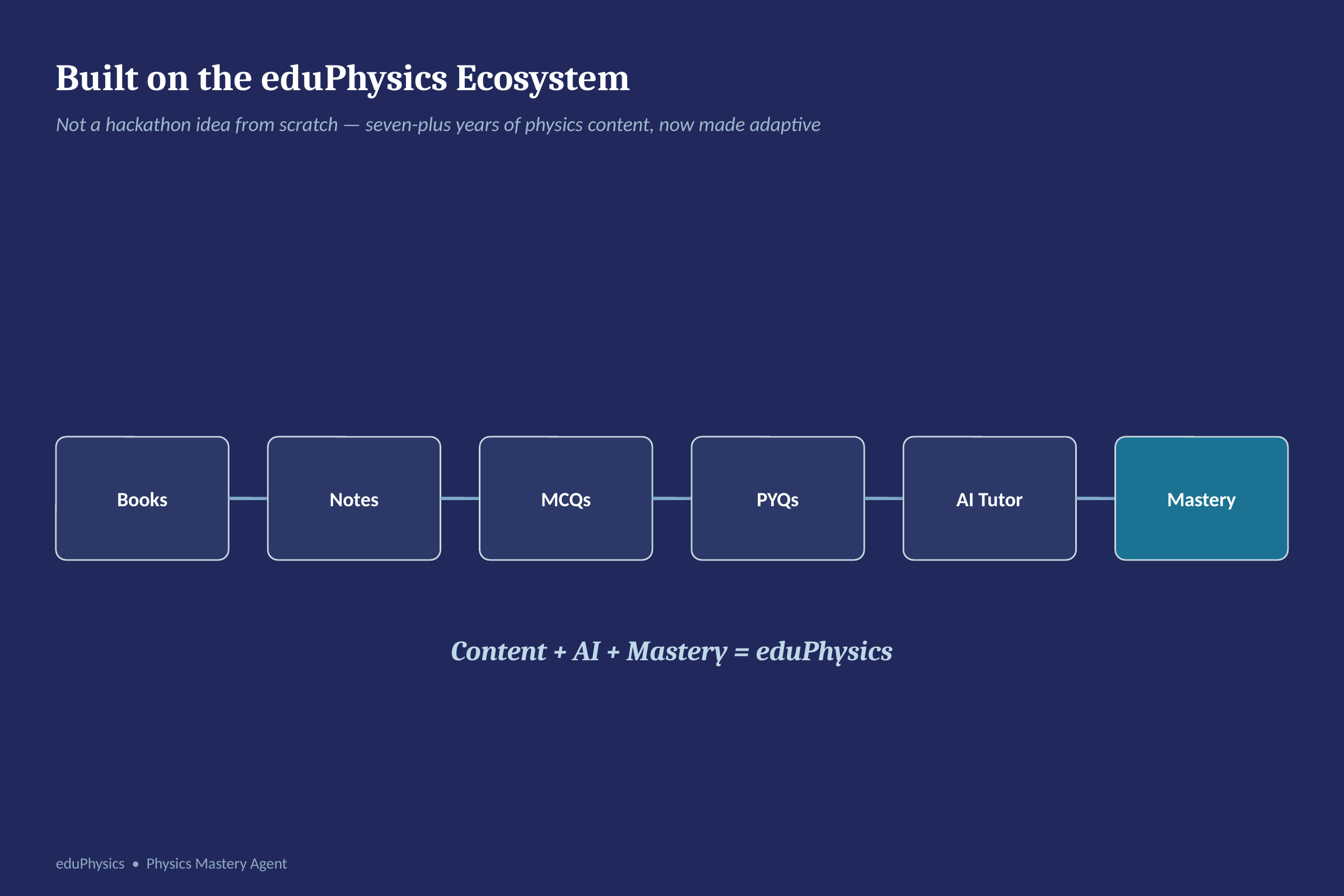
We are also proud of the opportunity to connect an agentic learning system with the broader eduPhysics ecosystem, including Physics learning resources, conceptual explanations, practice questions, previous-year questions, practical learning resources, and topic-based Master Hubs.
This creates the possibility of turning a large educational content library into an intelligent learning pathway rather than simply a collection of web pages.
What we learned
Building an educational agent taught us that "knowing the answer and knowing how to teach the answer are two different problems".
A strong educational agent must reason about the learner, not just the subject.
We also learned that agentic systems become more useful when their actions are explicit and measurable.
For Physics education, this means distinguishing between:
- knowing a formula,
- understanding a concept,
- applying a principle,
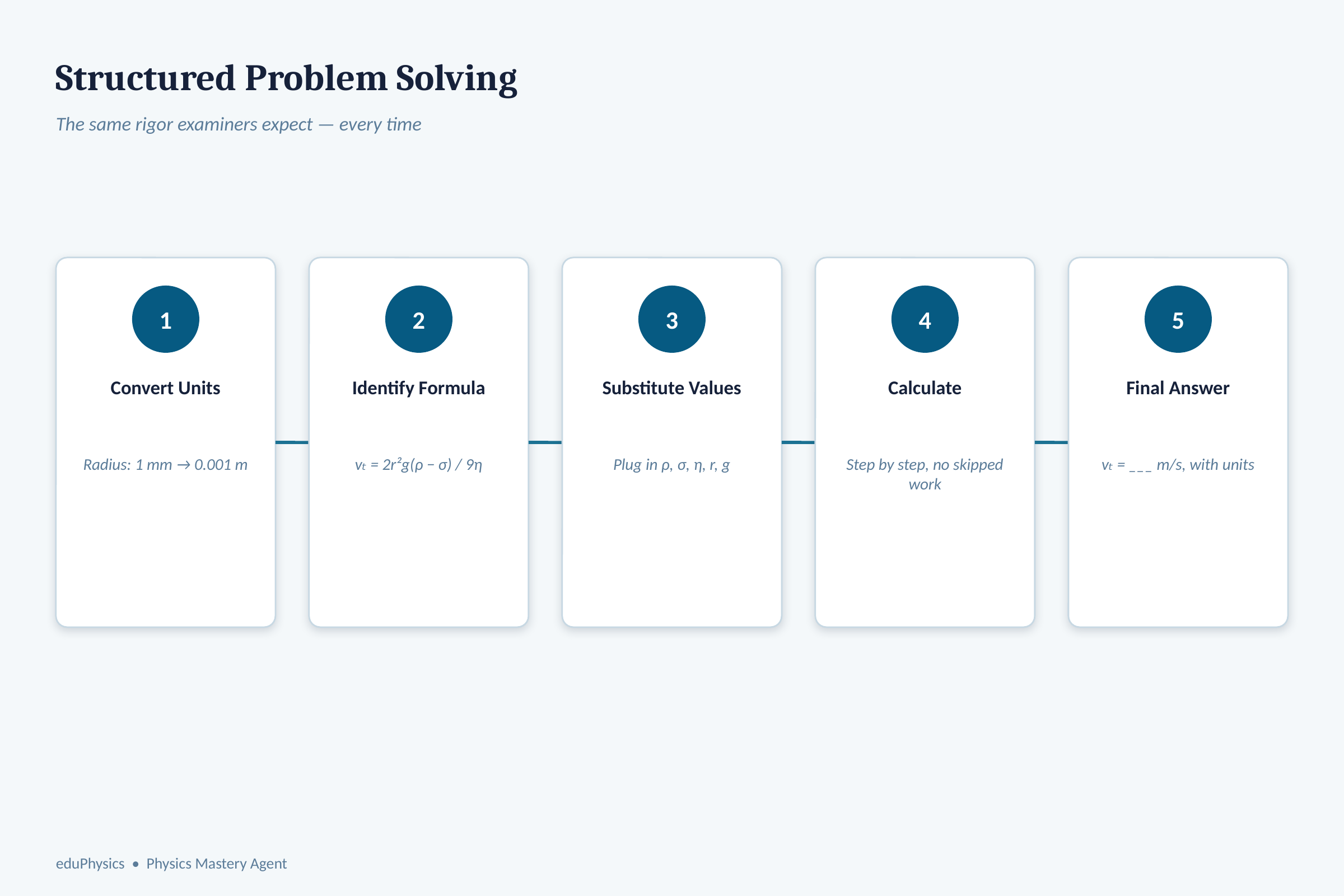
- solving a numerical problem,
- interpreting a physical situation,
- and explaining the reasoning.
We learned that a useful AI tutor should be willing to step backward.
If a student struggles with terminal velocity, the correct next step may be viscosity or force balance—not another terminal-velocity explanation.
That ability to navigate backward through prerequisites and forward toward mastery is central to our vision.
What's next for eduPhysics Physics Mastery Agent
Our next goal is to expand the agent from a focused demonstration into a broader Physics mastery system.
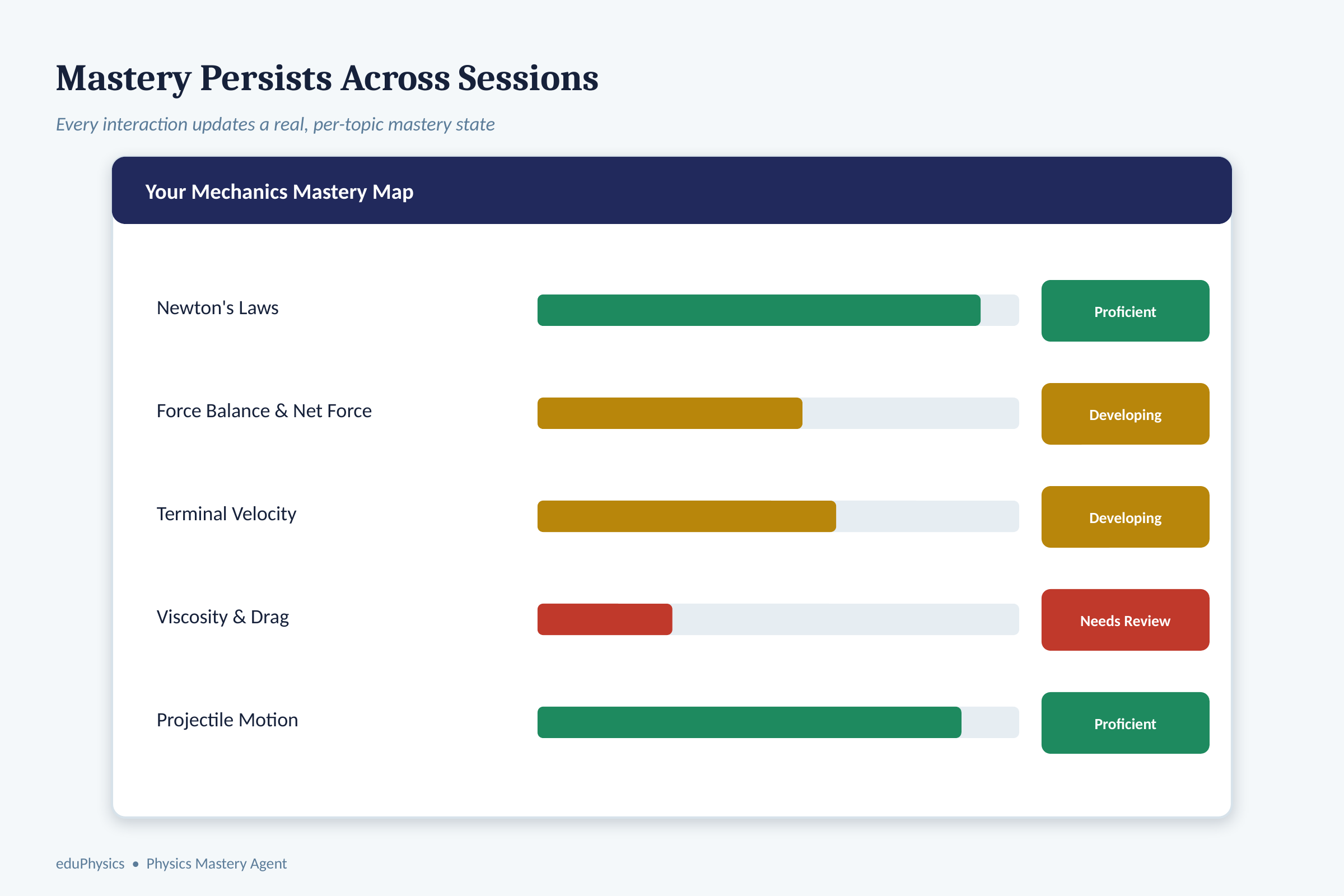
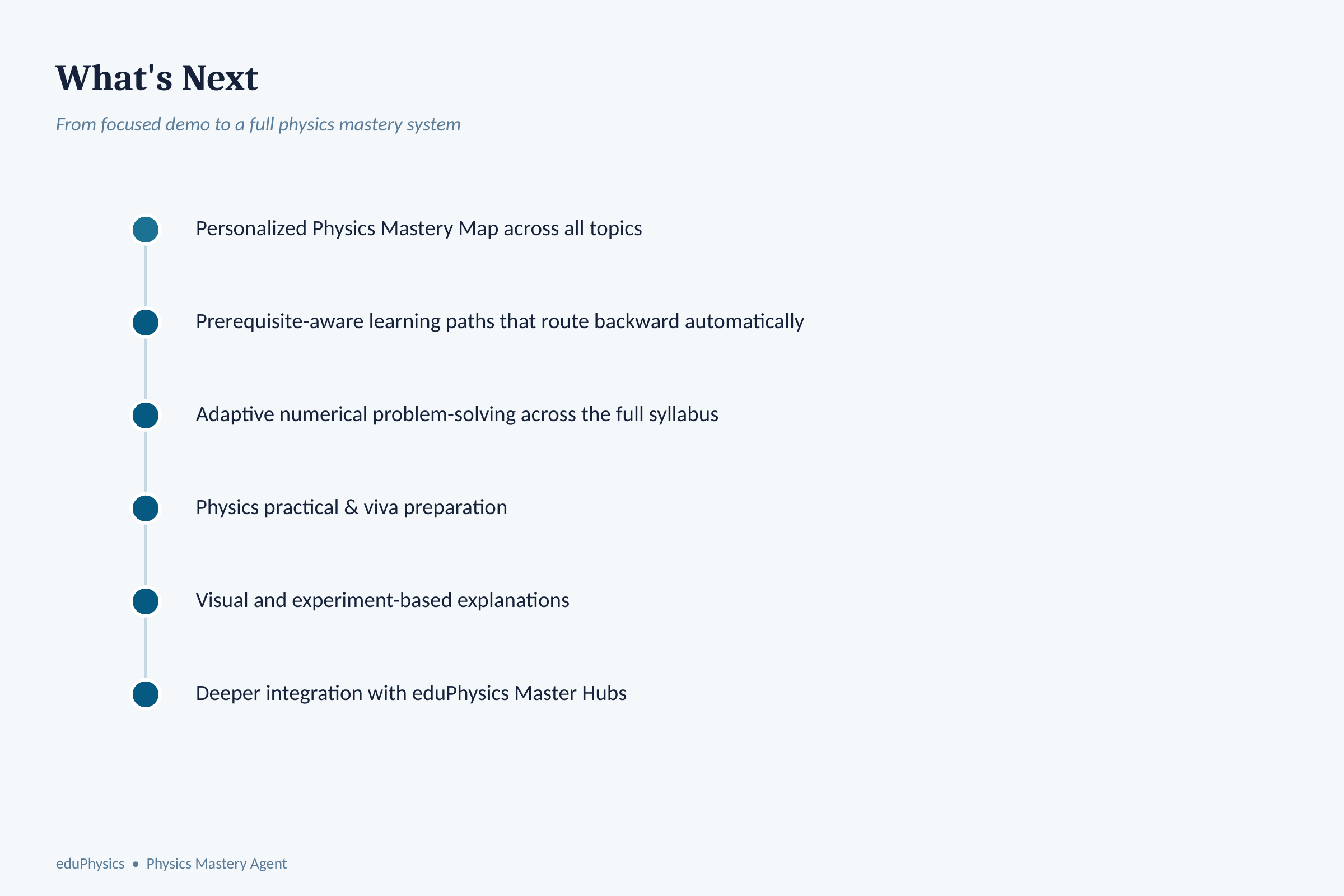
We envision a personalized "Physics Mastery Map" in which students can see their understanding across concepts and identify the areas that need attention.
Future capabilities include:
- prerequisite-aware learning paths,
- adaptive numerical problem solving,
- CBSE-focused preparation,
- NEET and JEE-oriented practice,
- Physics practical and viva preparation,
- visual and experiment-based explanations,
- personalized revision plans,
- misconception tracking,
- mastery-based progression,
- and deeper integration with the eduPhysics Master Hubs.
Ultimately, our goal is not to build another AI that simply answers Physics questions.
We want to build an agent that can continuously ask:
"What does this student understand, what are they missing, and what is the best thing I can do next to help them master Physics?"
“Instead of only answering what a student asks, the agent tries to discover what the student actually needs to learn next.”
That is the vision behind the "eduPhysics Physics Mastery Agent".


Log in or sign up for Devpost to join the conversation.