-
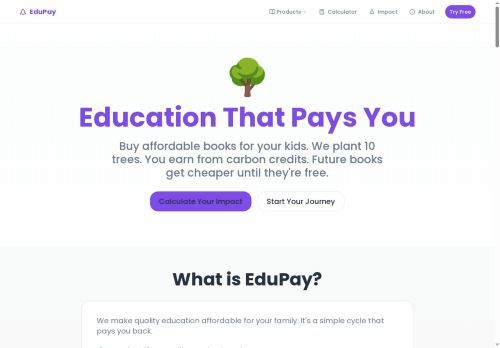
Edupay: Screengrab
Inspiration
Kenya has a 65% literacy rate and needs to plant 5 billion trees by 2032. We saw an opportunity to solve both challenges simultaneously. Quality educational books are out of reach for many families, while reforestation projects struggle with sustainable funding models. What if buying a book could plant trees, and those trees could eventually make education almost free? EduPay was born from this question, linking literacy, climate action, and financial empowerment into one self-sustaining cycle.
What it does
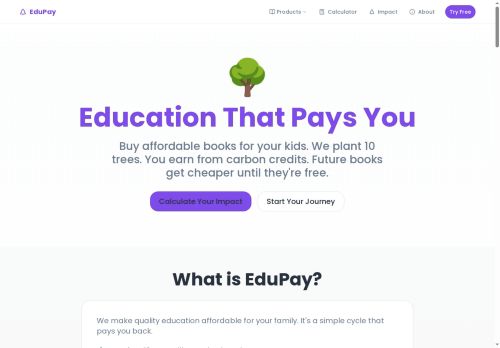
EduPay is a digital education platform that makes quality learning affordable for families in emerging markets while creating a measurable climate impact. How it works: Parents buy affordable digital soundbooks (foundational literacy content at $5-10) Each book purchase plants 10 verified tree seedlings in Kenya Trees grow and generate carbon credits over 20 years Families receive ongoing dividend shares from carbon credit sales Dividends can be redeemed to make future books cheaper or eventually free
The Loop: Education → Reforestation → Financial Returns → More Education We're creating a model where education funds conservation, and conservation funds more education. A truly sustainable cycle.
How we built it
As a non-technical founder with a 24-hour deadline, I orchestrated AI tools to execute my vision: Content Strategy: I designed a foundational literacy storybook with Kenyan-contextualized images to ensure cultural relevance. ChatGPT helped generate the narratives based on my specifications for age-appropriate vocabulary and local context. Audio Experience: I directed ElevenLabs to transform the text into high-quality audio soundbooks with natural-sounding narration, making them accessible for early readers and pre-literate children. Tested multiple voice options to find the right tone for young learners. Platform Architecture: I mapped out the user journey from landing page to interactive flashcards to the carbon calculator, then used Lovable to build it. When technical challenges arose (API integration, CSV formatting), I leveraged Lovable's chat to troubleshoot and iterate quickly. Impact Targeting: I researched Amazon Sustainability Data Initiative (ASDI) datasets to identify Kenya's highest-priority reforestation zones based on deforestation rates and climate vulnerability. This strategic approach ensures trees are planted where they'll have maximum impact, not randomly distributed. Viral Growth Loop: I designed the carbon credit calculator specifically for shareability. Each calculation generates personalized results showing:
Personal impact (trees planted, CO2 captured) Financial returns (dividend projections) Social proof messaging (shareable stats)
The calculator isn't just functional, it's engineered to be shared. When parents see "Your 10 trees will earn you $66-132," they naturally want to tell others. I built this viral mechanism intentionally, turning each user into an evangelist for both literacy and climate action.
Tech Stack: ChatGPT + Claude + ElevenLabs + Lovable + ASDI Climate Data
Challenges we ran into
Rate Limits: ChatGPT hit rate limits mid-build, forcing me to pivot and rely more heavily on Lovable's built-in assistance API Integration: As a non-technical founder, integrating ElevenLabs' text-to-speech API was daunting. Without Lovable's chat feature walking me through it step-by-step, I would have burned through API credits just debugging. CSV Conversion: Converting the PDF storybook into a structured CSV format for flashcards required multiple iterations to get the data structure right. Time Pressure: Building a functional prototype that demonstrates the full concept of education content, audio, and the carbon credit economics in 24 hours felt impossible at the start. Staying Focused: With so many features to build, I had to ruthlessly prioritize what would demonstrate the core value proposition.
Accomplishments that we're proud of
✅ Went from idea to working prototype in under 24 hours as a non-technical founder. ✅ Created localized educational content with Kenyan-specific imagery and context, not just generic materials. ✅ Built functional, interactive flashcards with audio narration that kids can actually learn with. ✅ Designed a sustainable economic model that links education, climate action, and financial empowerment. ✅ Demonstrated that AI tools democratize building; you don't need to code to create something meaningful. ✅ Addressed two UN SDGs simultaneously: Quality Education (SDG 4) and Climate Action (SDG 13)
What we learned
AI tools are incredible equalizers: Being non-technical is no longer a barrier to building functional products. The right stack (ChatGPT + ElevenLabs + Lovable) can take you from concept to prototype in hours. This would have been impossible without the generous credits from sponsors. Multi-AI workflows produce better results: Using ChatGPT for drafts and Claude for refinement created higher-quality content than relying on a single model. Context matters in education: Generic educational content doesn't resonate. Localizing the storybooks with Kenyan imagery and vocabulary made them immediately more relevant and engaging. The carbon credit model is powerful: Parents will be just excited about affordable books—they will be excited about earning from their education investment. That dual incentive is key. Hackathons force focus: The 24-hour constraint forced me to build an MVP that demonstrates core value, not get lost in features. Ship first, iterate later. Good dev tools are lifesavers: Lovable's chat feature saved this project. Having AI assistance built into the development platform is game-changing for non-technical builders.
What's next for Edupay
Immediate (Next 3 months):
Partner with verified reforestation projects in Kenya to establish tree-planting infrastructure. Pilot with 5 schools to test the model and gather feedback. Expand the soundbook library to 3 titles: a bibble sound book and a money concepts one.
Short-term (6-12 months):
Build a relationship with global carbon credit marketplaces. Build the carbon credit tracking dashboard so families can see their trees growing and credits accumulating. Launch the dividend redemption system so families can use their earnings to buy more books. Expand to other subjects beyond foundational literacy (math, science, English). Partner with schools and community learning centers for distribution.
Long-term (1-3 years):
Scale across East Africa (Tanzania, Uganda, Rwanda). Introduce the borrowing mechanism, and families can access books now, using future carbon credit earnings as collateral. Build a B2B model for schools in which corporations sponsor book purchases for CSR, earning verified carbon credits in return. Create a marketplace where families can trade/gift their carbon dividends within the platform.
Ultimate Vision: Make education self-funding for low-income families across Africa. Every book purchased today plants trees that fund tomorrow's learning, breaking the cycle of educational poverty through climate action.
Built With
- amazon-web-services
- asdi
- chatgpt
- elevenlabs
- lovable
- opendata

