-
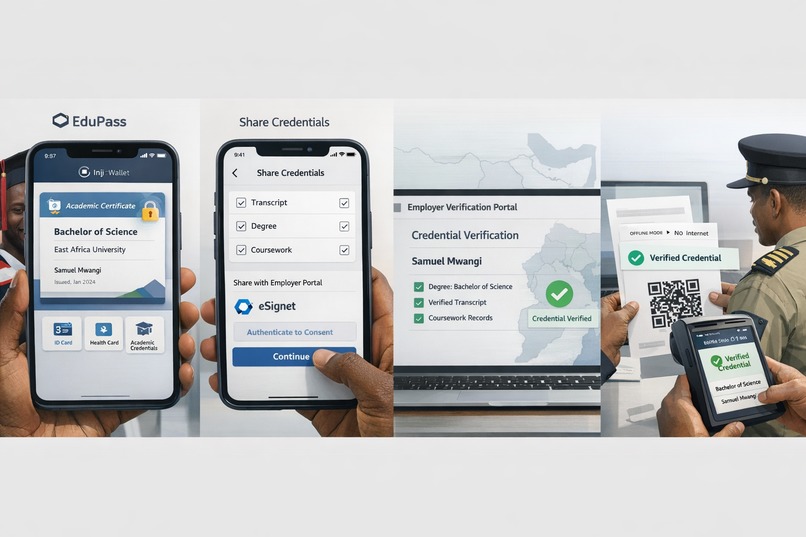
Visual prototype
Inspiration
This idea comes directly from our own experience. We're students from different African countries who came to study in Rwanda, and we've seen firsthand how lengthy the verification process can be when it relies on the speed of educational institutions back home. What should take days stretches into months, and we've watched this same challenge affect not just us, but other students around us and even graduates trying to secure jobs.
When you're waiting for transcripts to be verified across borders, every delay has real consequences - missed deadlines, lost opportunities, mounting uncertainty. We realized that if Digital ID can streamline access to banking and government services, there's no reason it can't help students own and share their academic credentials more efficiently.
What it does
EduPass transforms academic credentials into something students actually own and control. The system works through a straightforward but powerful process.
When a student graduates, their university creates a verifiable credential that's cryptographically linked to their Digital ID rather than simply issuing a paper certificate. This creates a digital seal that cannot be forged or tampered with.
Students store these credentials securely in their Inji wallet. When applying for opportunities abroad, they authenticate themselves using eSignet and consent to share exactly what's needed - whether that's a transcript, degree certificate, or specific coursework details. The receiving institution can verify authenticity in seconds rather than months, eliminating courier fees, notary requirements, and extended waiting periods.
For students from conflict-affected regions who cannot return home to retrieve physical documents, this approach is particularly valuable. Their credentials travel with them, securely stored and always accessible when opportunities arise.
How we built it
While we're still in the concept phase, our technical architecture is well-grounded. We're building on MOSIP's existing infrastructure rather than starting from scratch, which means we're leveraging systems that have already been deployed and tested across Africa, including in Rwanda. Our planned technology stack includes PostgreSQL for data management, Spring Boot for backend services, React Native and React for the user interface, and full integration with the MOSIP ecosystem. Specifically, we'll use the MOSIP Sandbox for identity management, implement W3C Verifiable Credentials standards for academic records, utilize the Inji wallet for credential storage, and integrate eSignet for authentication and consent management.
We recognize that consistent internet access isn't always available across East Africa, so we're building in QR code verification capabilities. This means credentials can be verified even in remote areas or at border crossings where connectivity may be limited or unavailable.
Challenges we ran into
One challenge was ensuring accessibility for students without smartphones or reliable internet. We addressed this by designing offline verification through QR codes, similar to MOSIP-based vaccination certificates. This means credentials can be verified at border crossings or in remote areas even without connectivity, and paper-based QR codes can serve students without personal devices.
Balancing technical sophistication with user simplicity required careful design thinking. We tackled this by mapping out each stakeholder's journey - students accessing their credentials, university registrars issuing them, employers and institutions verifying them. By starting with the user experience first and building the technical architecture to support those flows, we ensured the system remains intuitive despite its underlying complexity.
We also considered the trust and adoption question carefully. Universities and governments would need confidence in the system before widespread implementation. Our approach here is strategic: by building on MOSIP, which is already deployed in Rwanda and recognized regionally, we're leveraging existing institutional trust rather than asking stakeholders to believe in an entirely new platform. Starting with a pilot between established institutions like CMU-Africa and the University of Rwanda allows us to demonstrate reliability before scaling.
Accomplishments that we're proud of
We managed to design something that addresses a massive regional problem without requiring everyone to start from scratch. By building on MOSIP, we're leveraging infrastructure that's already being deployed across Africa.
We're especially proud that our solution puts students in control. It's not just digitizing the old system - it's fundamentally changing who owns the data. In the current system, you're at the mercy of institutions. With EduPass, you hold your own credentials. And it also works for refugees.
What we learned
Digital ID is creating layers of trust. Once we have that trusted identity foundation, we can build so many things on top of it. We also learned that regional solutions require regional thinking. You can't just copy-paste what works in Europe or North America. East Africa has unique challenges - connectivity issues, cross-border complexities, diverse education systems - and solutions need to be designed with those realities in mind.
What's next for EduPass First step: pilot between CMU-Africa and University of Rwanda. Get it working in a controlled environment, iron out the bugs, gather feedback. Then we want to expand across the East African Community - Kenya, Uganda, Tanzania, Burundi. Partner with IUCEA to get university buy-in across the region.
Long term, we see this extending beyond higher education. Professional certifications, vocational training, even secondary school records. Any credential that people need to prove across borders. We're also excited about building that automated equivalency engine we mentioned. Once we have verified credentials flowing through the system, we can start using AI to map qualifications across different education frameworks. A Kenyan Bachelor's degree is worth what in Rwandan credits? The system could answer that instantly.
Built With
- mosip
- postgresql
- react
- react-native
- springboot
- w3c

Log in or sign up for Devpost to join the conversation.