-
-
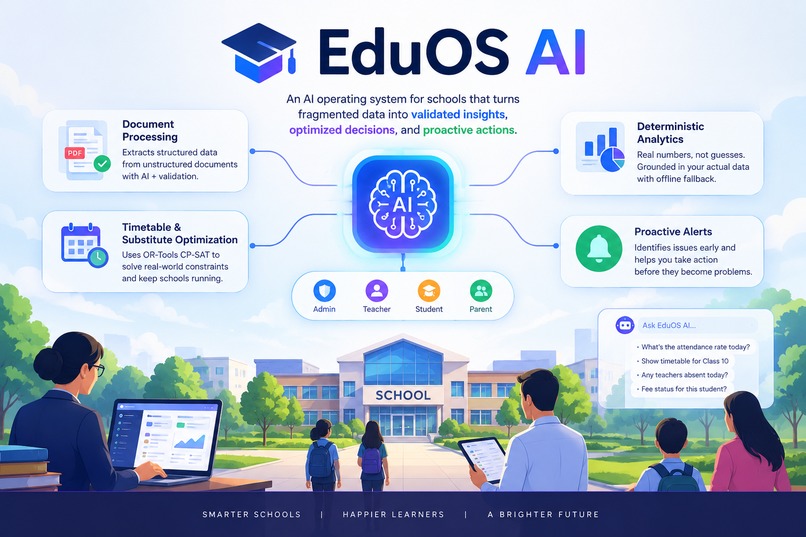
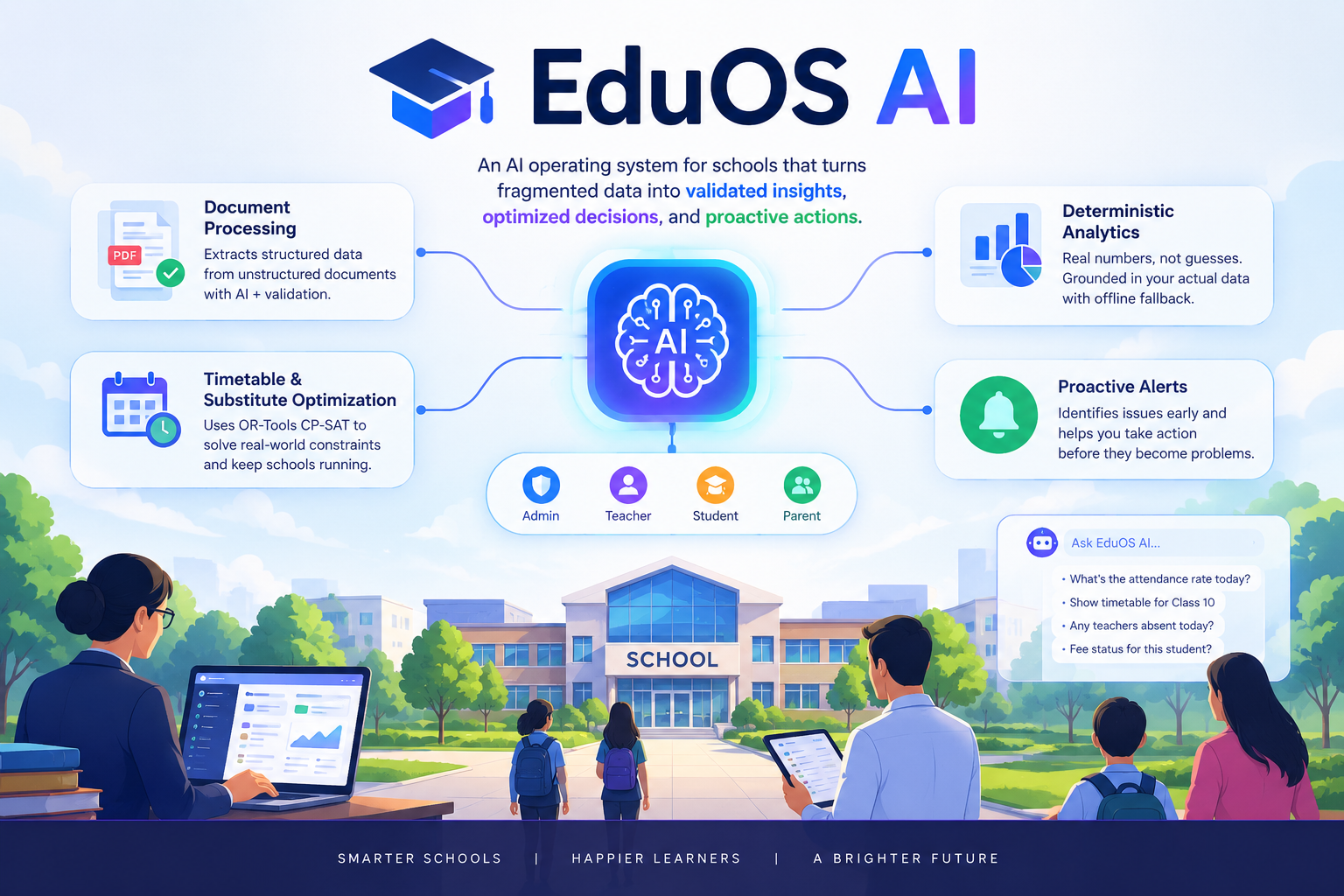
Thumbnail
-
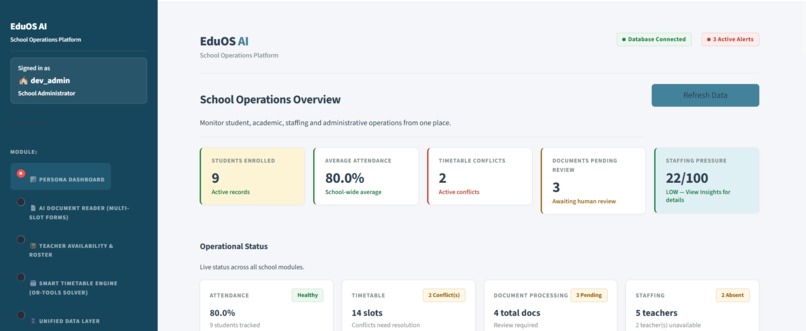
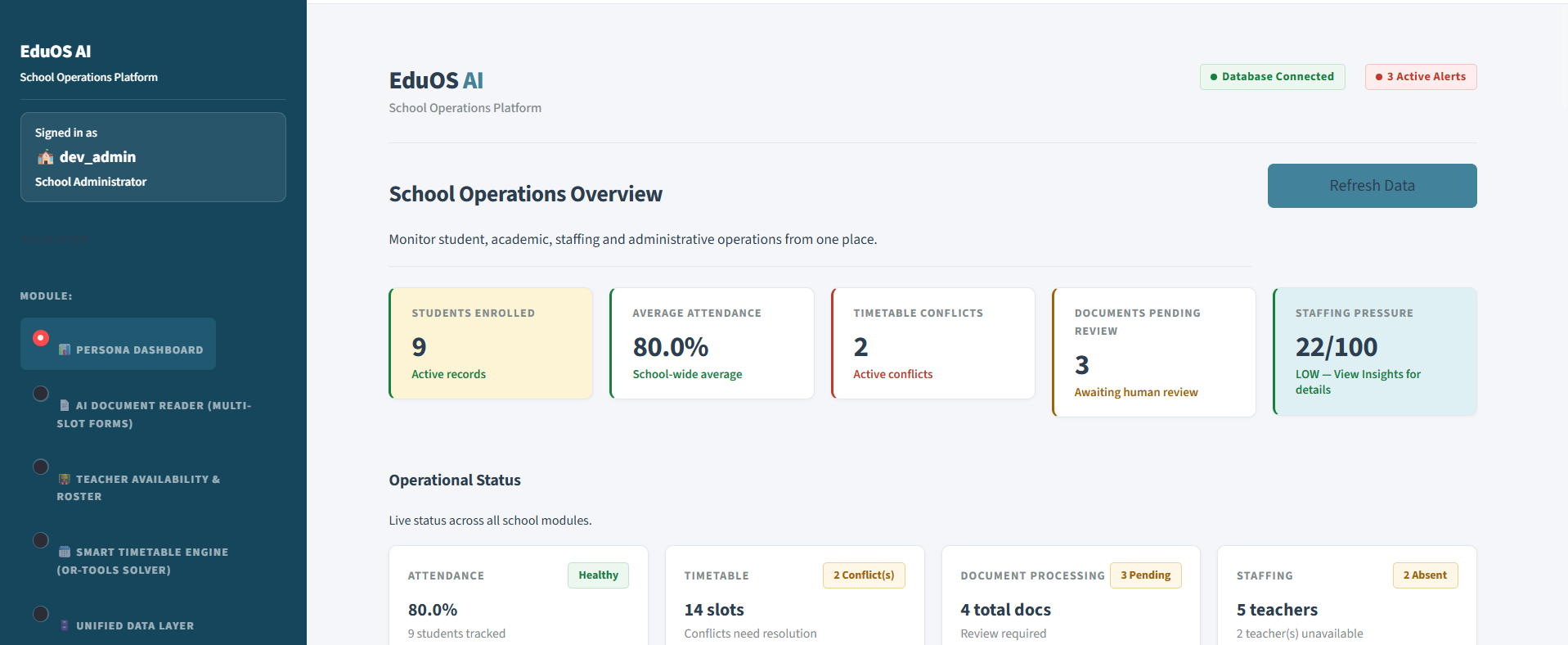
The "wow" screen 1) One operational view for the entire school.
-
Part 2
-
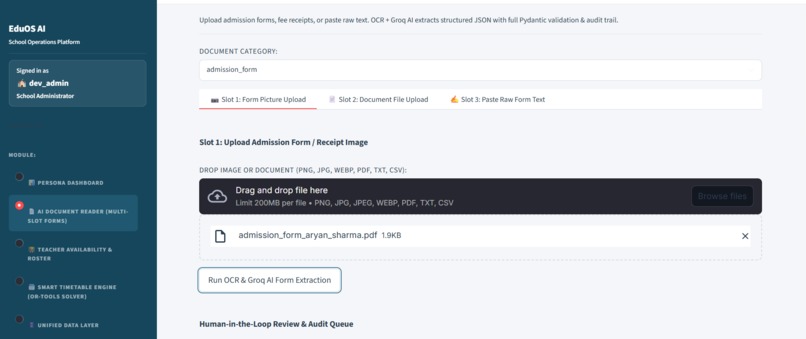
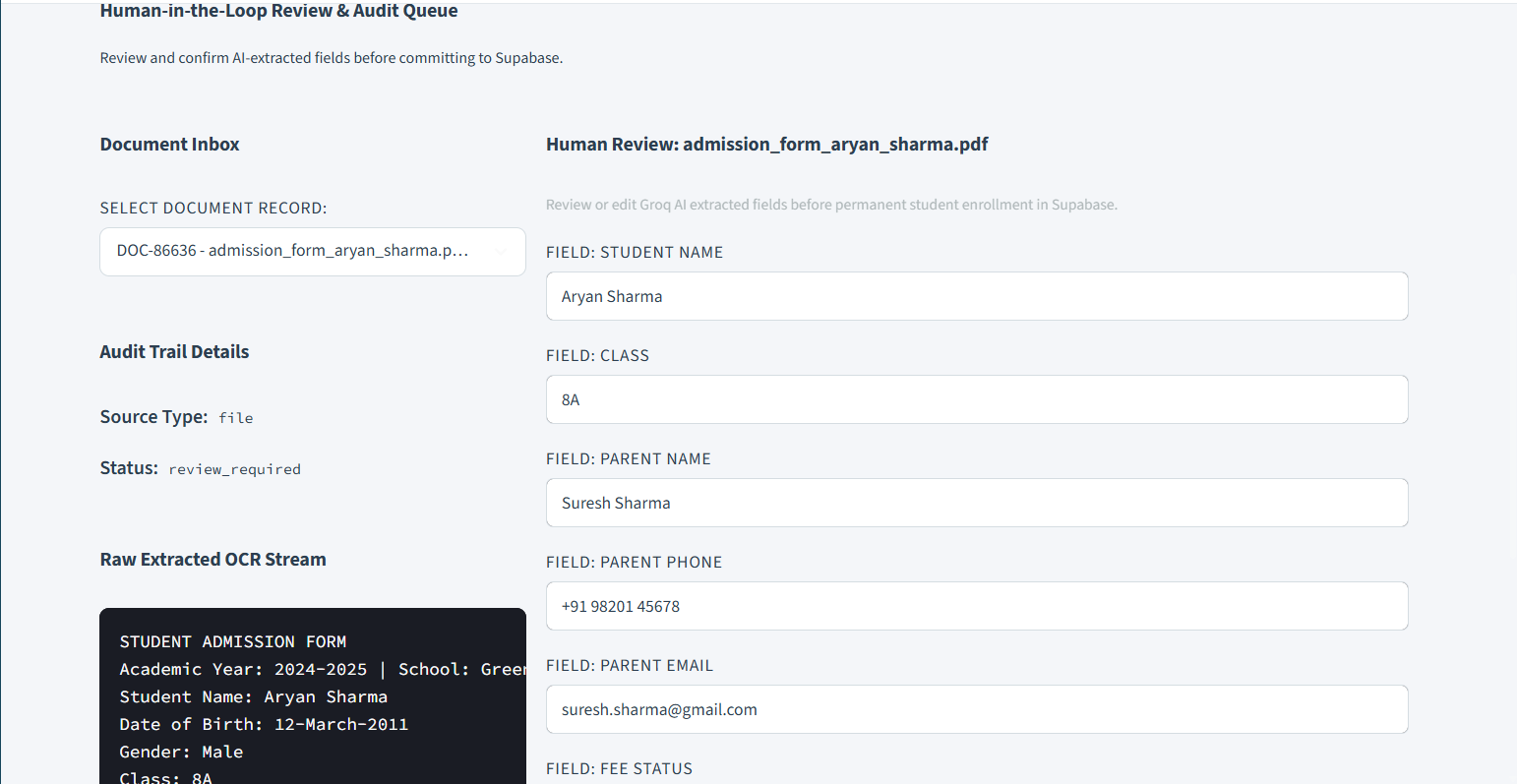
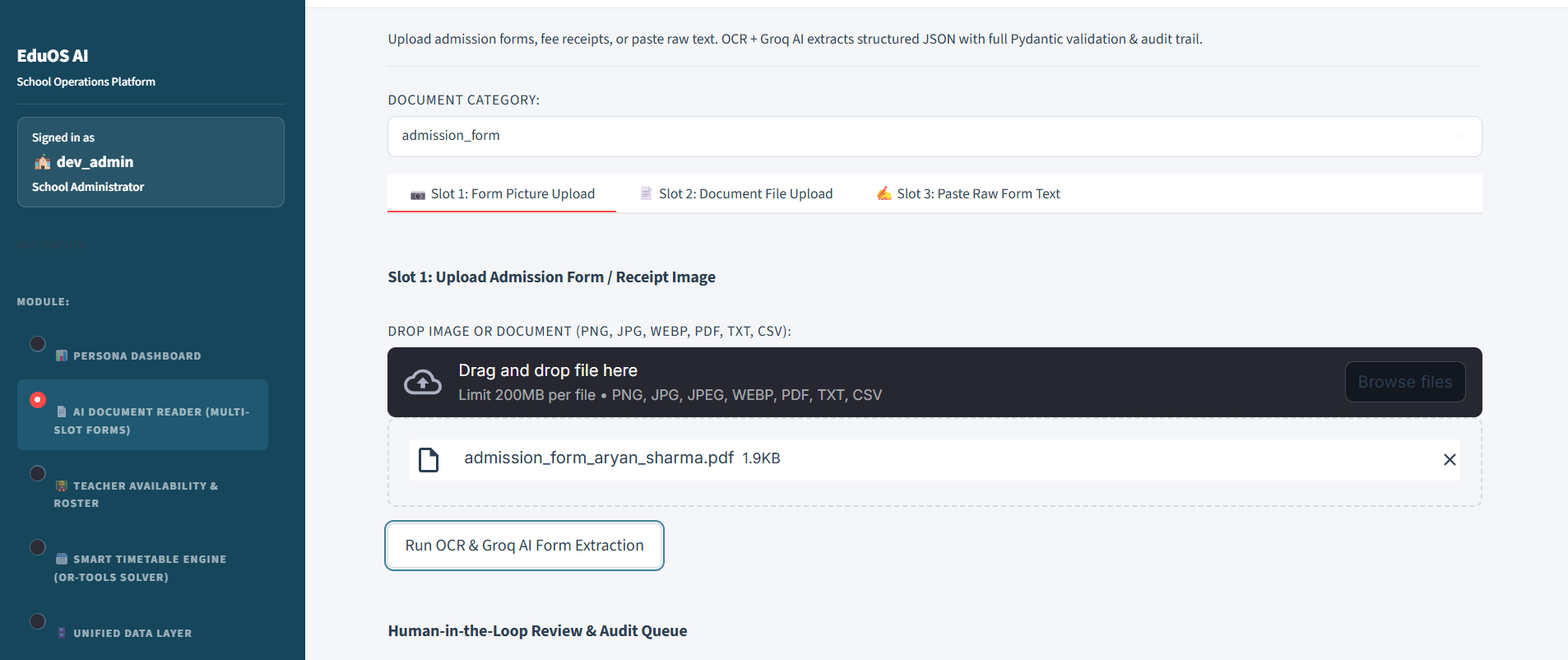
AI Document Reader 2) Turn unstructured school documents into validated records.
-
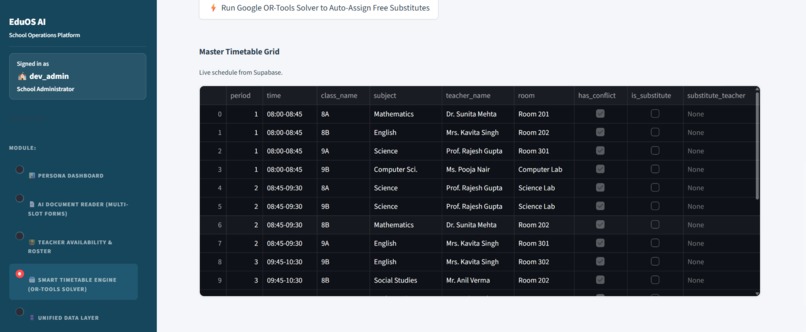
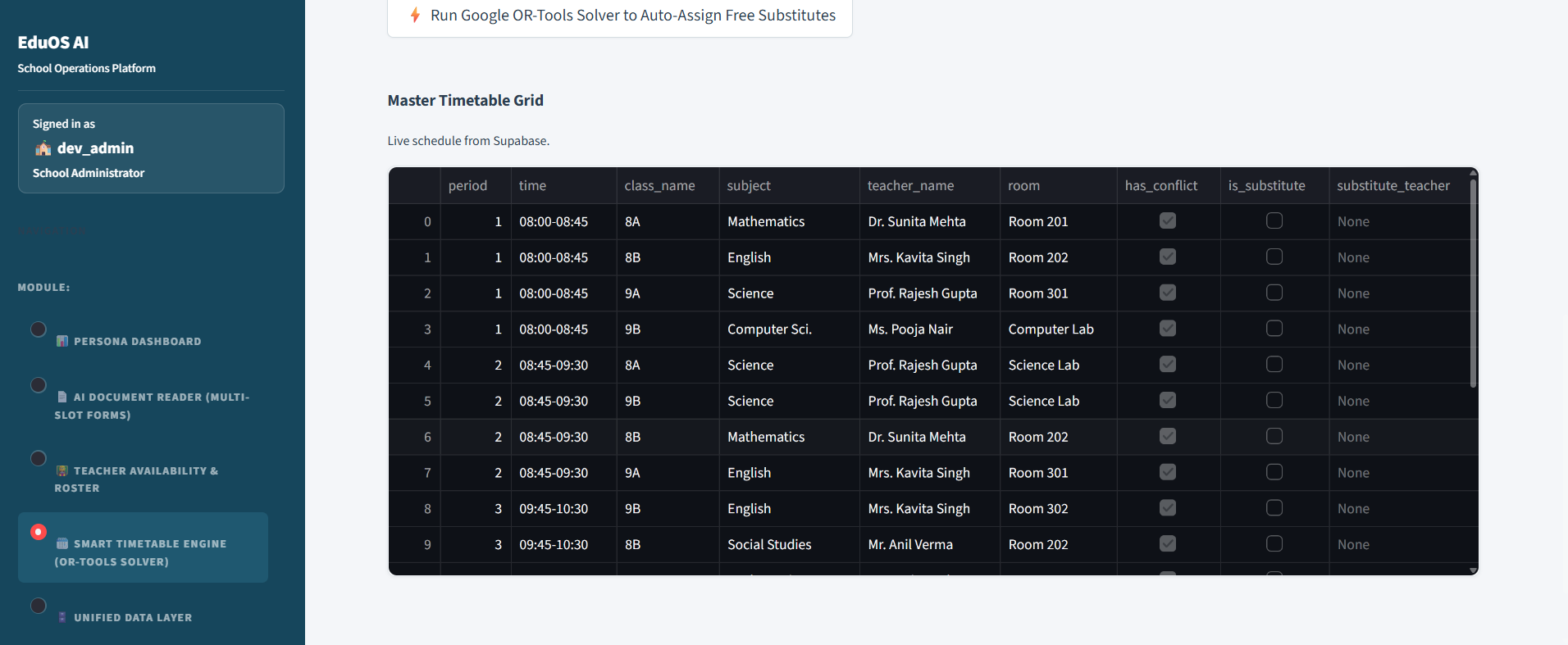
Timetable Solver 3) OR-Tools finds a conflict-free substitute assignment instead of guessing one.
-
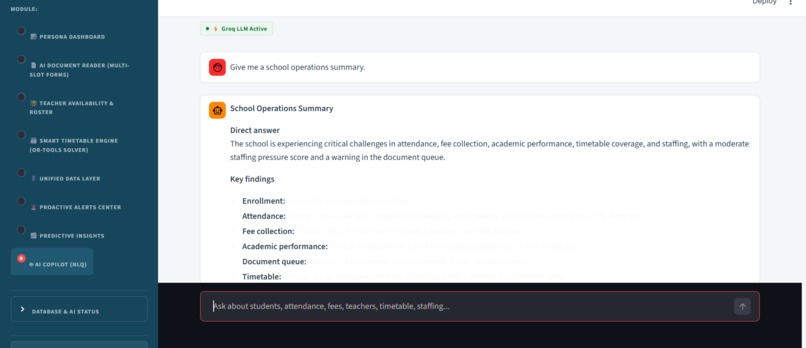
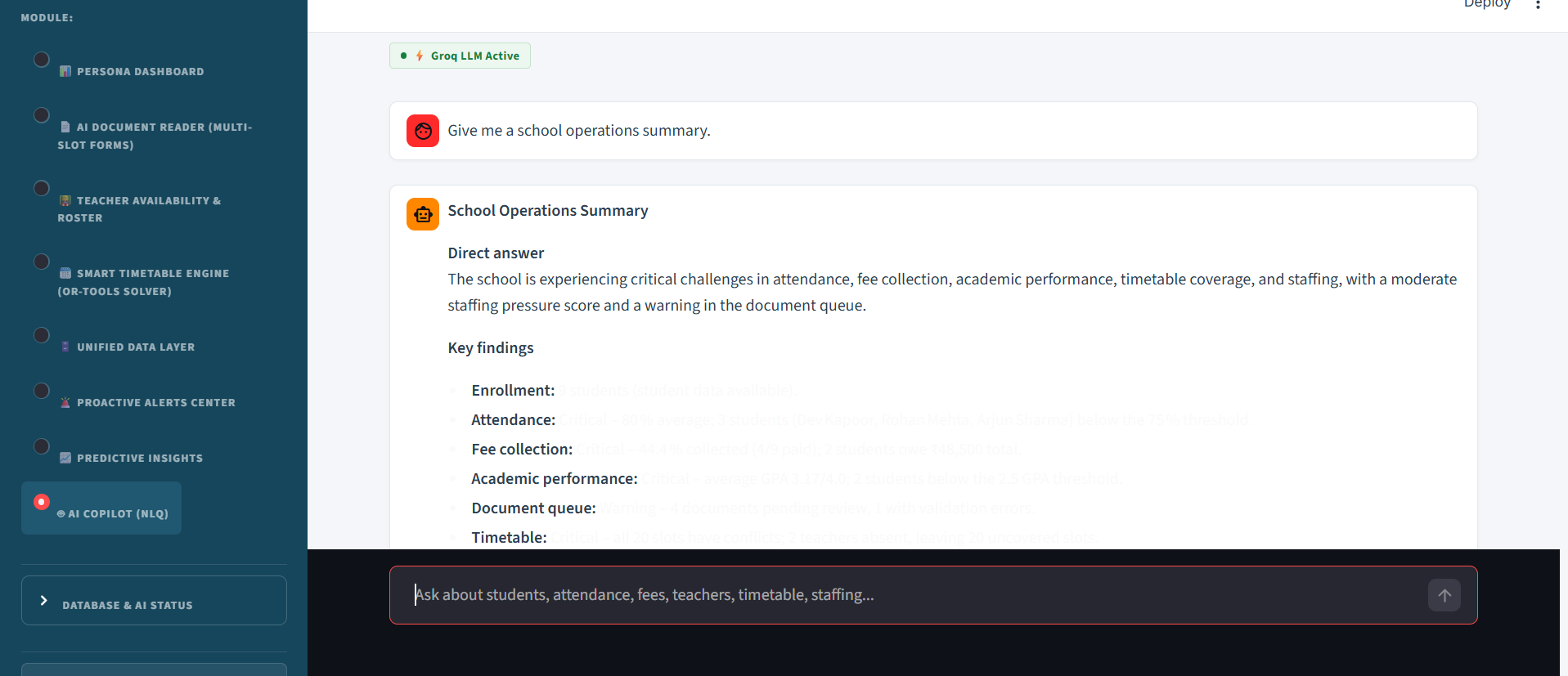
AI Copilot 4) Ask questions about live school data in natural language.
-
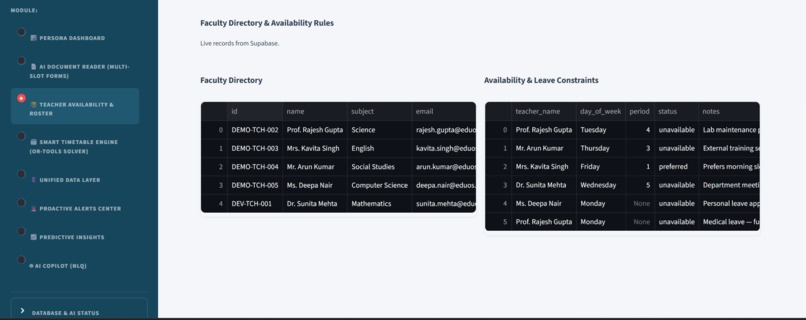
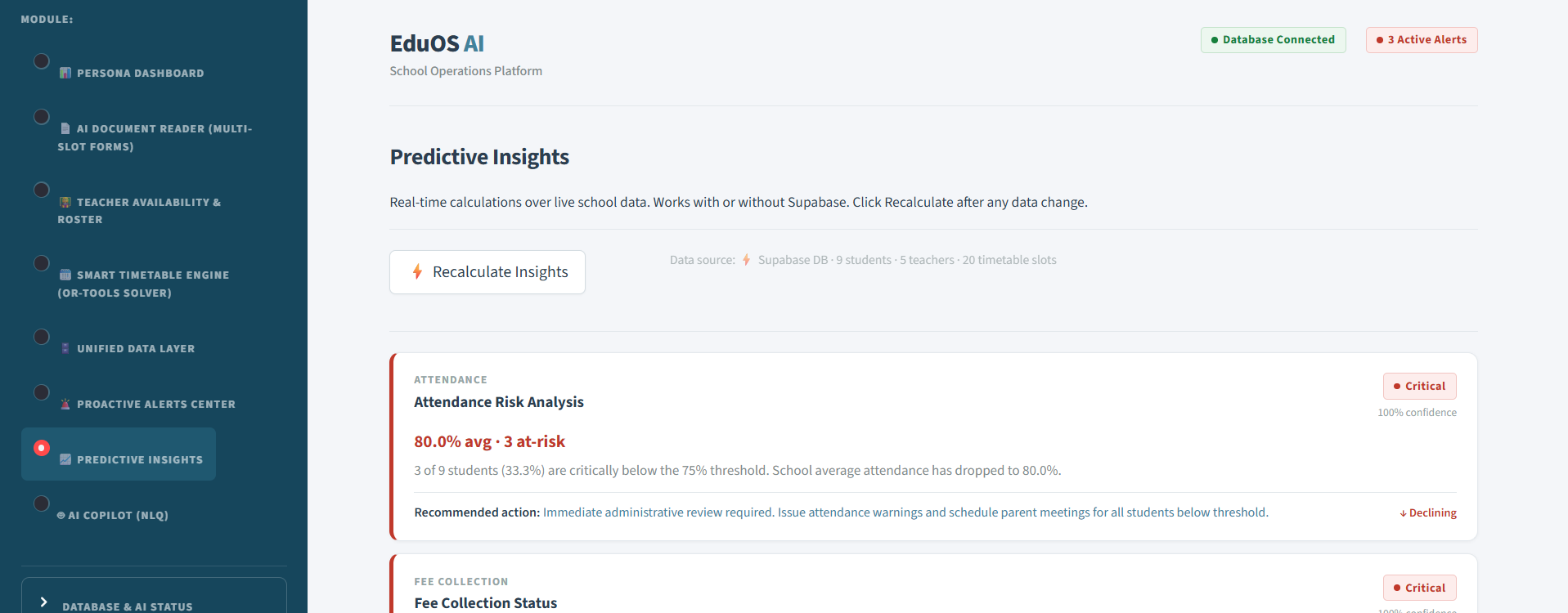
Analytics / Staffing 5) Deterministic analytics turn school data into actionable signals.
-
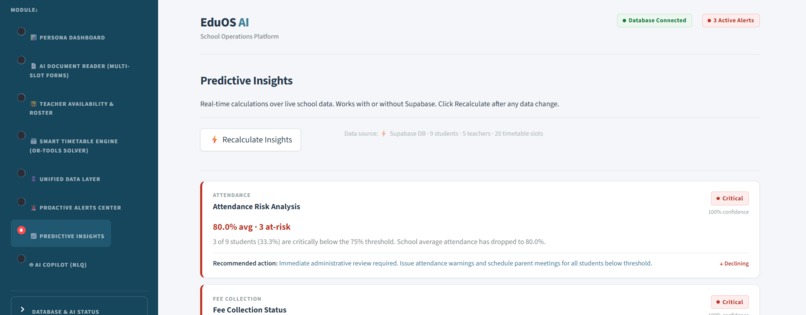
Proactive Alerts 6) Detect problems before they become operational failures.
💡 Inspiration
Schools generate a huge amount of information every day: student records, attendance, fee data, teacher availability, timetables, documents, and administrative updates. The problem is that this information is often fragmented across spreadsheets, PDFs, paper forms, and disconnected systems.
We wanted to build something beyond another educational chatbot.
Our idea was to create an AI operating system for schools — a system that could understand school data, reason over operational constraints, identify problems early, and help people take action.
That led to EduOS AI.
Instead of asking an LLM to simply generate answers, EduOS AI combines AI with deterministic analytics and mathematical optimization. The goal is:
Fragmented data → validated information → intelligent decisions → proactive action.
🎯 What EduOS AI Does
EduOS AI brings several everyday school operations into one intelligent platform.
1. AI Document Intelligence
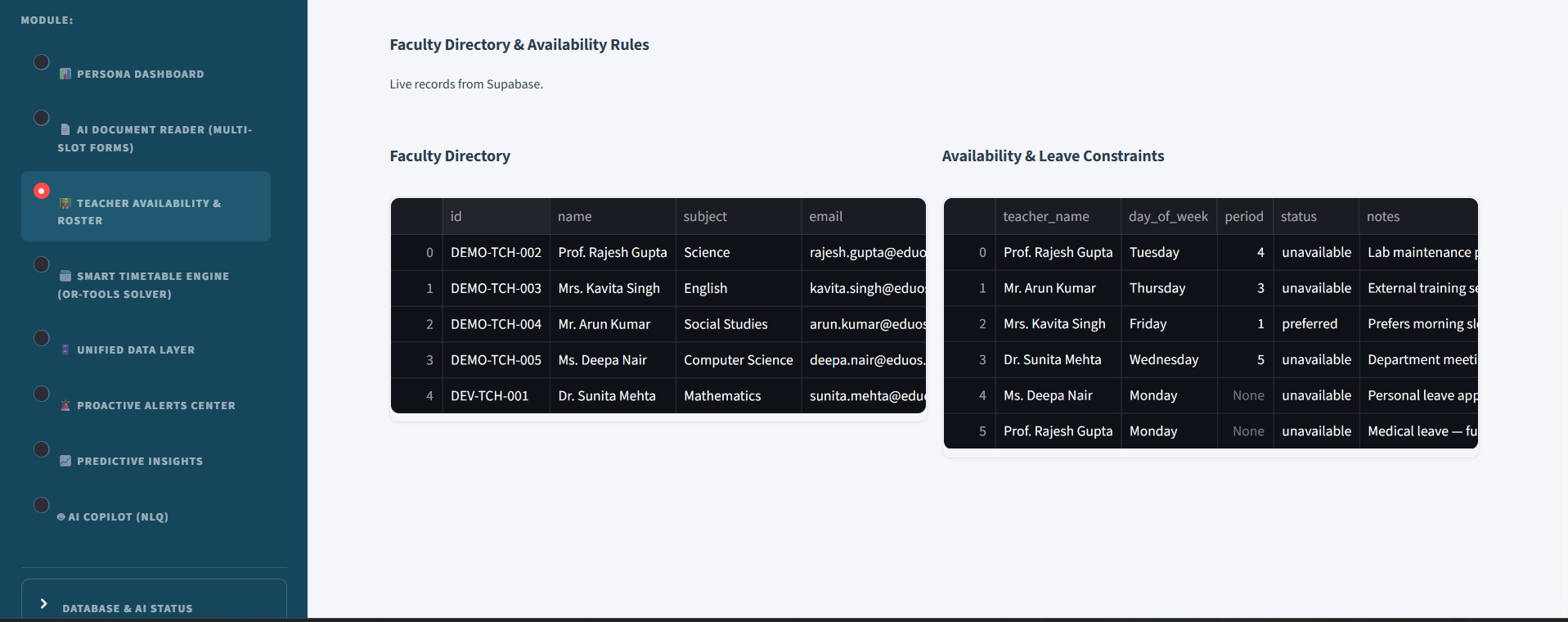
Schools still deal with large amounts of semi-structured information such as admission forms, fee receipts, and teacher rosters.
EduOS AI accepts information from documents, images, files, or text and uses Groq's Llama 3.3 70B to extract structured information.
But we don't directly trust the LLM output.
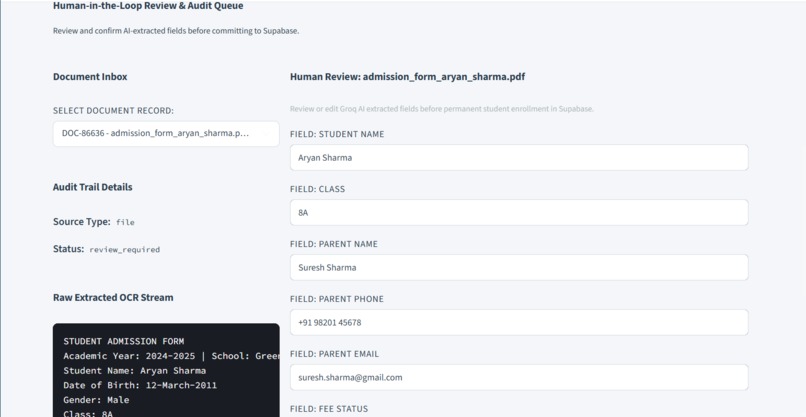
The extracted data goes through Pydantic schema validation and JSON repair, followed by a human-in-the-loop review step before important records are committed to the database.
This creates a safer pipeline:
Document → LLM extraction → validation → human review → database
2. Intelligent Timetable & Substitute Optimization
One of the most difficult operational problems in schools is what happens when a teacher becomes unavailable.
A simple AI chatbot can suggest a teacher, but it does not necessarily understand all the constraints involved.
EduOS AI models timetable generation and substitute assignment as a constraint satisfaction problem using Google OR-Tools CP-SAT.
The solver considers constraints such as:
- Teacher availability
- Class-section conflicts
- Room conflicts
- Existing timetable assignments
- Substitute availability
When a teacher is marked absent, the system can recompute substitute assignments while preserving unaffected timetable slots.
This was one of the biggest technical challenges of the project because the problem isn't just about generating text — it requires finding a valid solution within multiple constraints.
📊 Deterministic Analytics Instead of AI Guessing
Another design decision we made was to avoid using the LLM as the source of truth for numerical information.
Attendance risk, fee patterns, and staffing pressure are calculated by deterministic engines operating on the underlying school data.
For example, EduOS AI calculates a staffing pressure score using four operational signals:
- Teacher unavailability
- Uncovered timetable slots
- Teacher overload
- Substitute dependency
The resulting metrics can then be explained through the AI Copilot.
This gives us an important separation:
The data engines calculate. The AI explains.
That makes the system more grounded and reduces the risk of an LLM inventing institutional numbers.
🤖 Grounded AI Copilot
We wanted school administrators to interact with their data naturally instead of navigating through multiple dashboards.
EduOS AI therefore includes a natural-language Copilot.
Instead of searching manually, an administrator can ask questions such as:
"Which students are below the attendance threshold?"
or
"Are there any teacher staffing shortages?"
The Copilot routes numerical questions to the deterministic analytics and staffing engines rather than asking the LLM to invent an answer.
It also includes intent classification and a deterministic fallback for cases where the LLM is unavailable.
🔔 From Reactive to Proactive
Traditional school management systems often require someone to notice a problem first.
EduOS AI tries to reverse this model.
The platform monitors conditions such as:
- Attendance drops
- Unpaid fees
- Timetable conflicts
- Staffing shortages
and generates role-aware alerts.
This changes the interaction from:
"Something went wrong. Find it."
to:
"Something needs attention. Here is what happened."
🏗️ How We Built It
The architecture is divided into several layers:
                 SCHOOL DATA
                      │
       ┌──────────────┴──────────────┐
       │                             │
 Documents / Forms              School Records
       │                             │
       ▼                             ▼
 Groq Llama 3.3 70B          Supabase PostgreSQL
       │                             │
       ▼                             │
 Pydantic Validation                 │
       │                             │
       └──────────────┬──────────────┘
                      │
          ┌───────────┴───────────┐
          │                       │
   OR-Tools CP-SAT       Deterministic Engines
          │                       │
          ▼                       ▼
 Timetable/Substitutes      Analytics & Risk
          │                       │
          └───────────┬───────────┘
                      │
                      ▼
               Grounded AI Copilot
                      │
          ┌───────────┼───────────┐
          ▼           ▼           ▼
        Admin      Teacher      Student/Parent
The application uses Streamlit for the interface, Supabase/PostgreSQL for persistent data, Groq/Llama 3.3 70B for AI workloads, Google OR-Tools for optimization, Pydantic for validation, and JWT/bcrypt-based role authentication.
🧩 What We Learned
The biggest lesson was that building a useful AI application is not simply about adding an LLM.
We learned that different problems require different kinds of intelligence.
- LLMs are useful for understanding unstructured information and natural-language interaction.
- Validation systems are necessary when AI output becomes real data.
- Optimization algorithms are better suited to hard scheduling constraints.
- Deterministic analytics are important when numerical accuracy matters.
- Human review is valuable when automated extraction can affect real records.
The project helped us understand how these components can work together instead of trying to make one AI model responsible for everything.
⚙️ Challenges
Challenge 1 — Making LLM output reliable
LLMs naturally produce flexible responses, while databases require structured information.
We solved this by enforcing schemas, validating extracted fields, repairing malformed JSON, and adding a human review stage.
Challenge 2 — Timetable optimization
Scheduling becomes complicated very quickly when teachers, rooms, sections, and availability interact.
We addressed this by converting the problem into a constraint-solving model using OR-Tools CP-SAT instead of attempting to solve it through prompting.
Challenge 3 — Preventing hallucinated analytics
We did not want an AI model to answer questions about attendance, fees, or staffing by guessing.
Instead, the analytics engines calculate the underlying values and the Copilot uses those results when responding.
Challenge 4 — Building for different users
A school does not have a single user.
An administrator needs operational insights, a teacher needs attendance and timetable tools, a student needs their academic information, and a parent needs visibility into their child's progress.
EduOS AI therefore provides separate experiences for Admin, Teacher, Student, and Parent roles.
🚀 What's Next
EduOS AI is currently a working prototype, but the architecture is designed to grow.
Our next steps include:
- Parent notifications through WhatsApp/SMS
- A React Native mobile application
- Multi-school / multi-tenant support
- Physical attendance hardware integration
- More intelligent early-warning systems
The long-term vision is to make EduOS AI a genuine operational intelligence layer for educational institutions rather than another standalone school-management dashboard.
🌟 Why EduOS AI Is Different
Most educational AI applications focus on helping a student learn.
EduOS AI focuses on helping an entire school operate intelligently.
It combines:
AI understanding + validated data + mathematical optimization + deterministic analytics + proactive alerts
into one system.
EduOS AI doesn't just answer questions about a school. It helps the school understand what is happening, why it is happening, and what action can be taken next.
Built With
- 3
- ai
- analytics
- artificial
- automation
- cp-sat
- data
- edtech
- generative
- groq
- intelligence
- llama
- llm
- ocr
- or-tools
- postgresql
- pydantic
- python
- rbac
- streamlit
- supabase

Log in or sign up for Devpost to join the conversation.