-
-
showcase of eduoasis
Inspiration
Our main inspiration is Inside Out. Riley's memories live on islands, and when she stops caring about them they crumble and fall away. That's exactly what happens when we study: we cram, then forget it all a week later, and nobody tells us what we're forgetting or when to review it. So in EduOasis every topic becomes a Kata (in martial arts, a kata is a form you practise until it lives in your memory). Your Kata stays green while you remember it and dries up as you forget. The TIME theme isn't a label. It's the core mechanic.
Most of our team is neurodivergent, and lecture slides are walls of text that don't answer back. Two other ideas shaped how it feels. Iron Man 3, where Tony Stark solves a mystery inside a fully interactive 3D world, and The Matrix, where Neo learns with a mentor who answers instantly. And Bruno Simon's portfolio, which turns a CV into a world you drive around, showed us that learning can be explored instead of read.
What it does
- Upload your slides or notes → get a game world. Gemini reads every page, numbers every fact and designs a world around them: picture-story intro slides, then action games chosen to fit the content (a survival Showdown for who-did-what, a Mario-style Timeline Run for anything with an order, a drag-and-drop Squad Board for groups, an Inspect room for evaluating evidence). This isn't a quiz with a skin on it.
- It predicts your forgetting. A half-life memory model tracks each Kata. Skip a few days and it visibly dries up, and Pip, your AI companion, tells you what to review and when. Pip answers questions using only your own notes, and cites where each fact came from.
- It learns how you learn. Every answer streams into Tiger Data. SQL predicts where your scores are heading, and a multi-armed bandit picks the game type that teaches you best. That pick goes straight into Gemini when it builds your next world. No two students get the same game, because no two brains learn the same way.
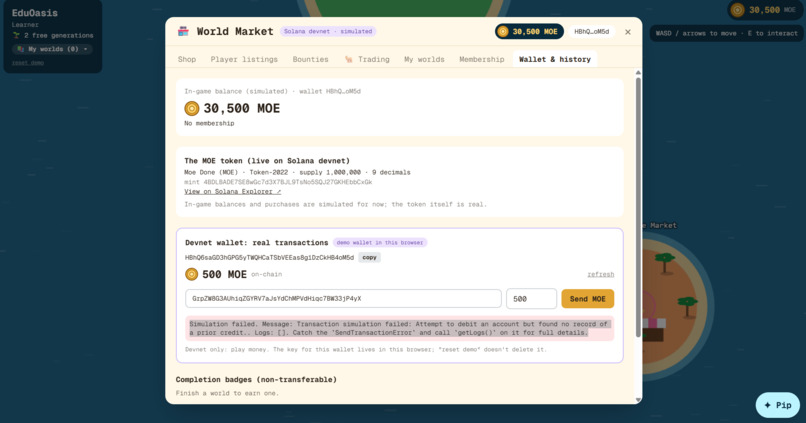
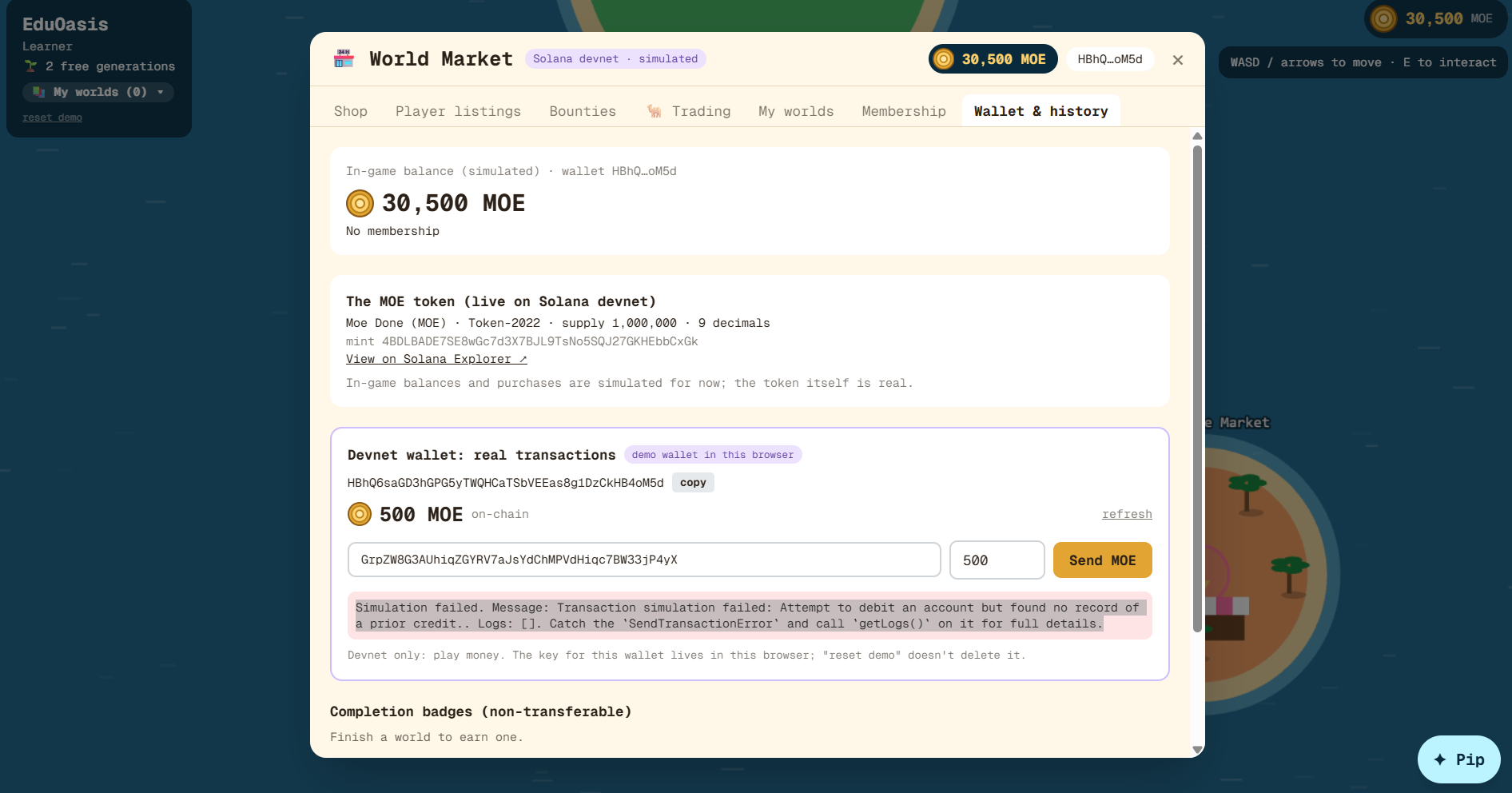
- A learning economy on Solana. MOE is our own token, a real SPL Token-2022 mint on Solana devnet.
- Earn by learning: finish a Kata and you earn MOE scaled by your score. Nothing below 60%, and each Kata pays out only 10 times, so it can't be farmed. Your reward reflects learning you've proved, not time spent clicking.
- Own a real wallet: every player gets a Solana wallet in their browser, and their private key never leaves the device. New players get a starter pack of 30,000 MOE plus a little SOL for fees from our treasury.
- Send MOE peer-to-peer, on-chain: students send MOE to each other wallet-to-wallet. Each transfer is signed by the sender, confirmed on devnet, and comes with a Solana Explorer link anyone can check. The in-gam
- Spend it in a student-made marketplace: buy other students' worlds in the World Market. Each world carries a SHA-256 fingerprint of its file, checked on purchase, so you know it hasn't been tampered with, on resale. There are also bounty pools on hard topics, amembership pass, and a cosmetics shop to personalise your Katas.
- A first step into 3D (in testing). A "3D Memory Crystalse Fiber: look around floating crystals and click each one tojudge a claim, with the same scoring, MOE rewards and data as every other Kata.
How we built it
- Frontend / game: Next.js 15 + React, with Phaser 3 for t All art is drawn in code, with no AI-generated images. The 3Dtest Kata uses three.js + React Three Fiber, and only loads when you open it.
- AI: Google Gemini in a 3-pass pipeline: (1) extract ever(2) design the games, with every element citing the facts itteaches, (3) code checks coverage and a patch pass fills any gaps, so nothing from your slides gets lost.
- Memory model: a simplified half-life regression (as in Dsince review ÷ half-life), with the half-life updated by youraccuracy each session.
- Tiger Data (TimescaleDB): every answer, game result and
learning_eventshypertable, and a continuous aggregate rollsgame results up per day. SQL predicts each learner's trend per Kata (regr_slope), and a UCB1 bandit picks the best game type per learner. That decision is sent to Gemini when it generates the next world, and Pip shata" panel. - Solana:
- Token: MOE is an SPL Token-2022 mint on devnet (
@pl-token). The treasury wallet is the mint authority, and itskey lives only in server environment variables. - Wallets: each browser generates its own keypair and ke server never sees a player's private key.
- Transfers: the server builds a transaction (create the receiver's token account if needed, then
transferChecked, then a memo), the player's browser signs it, and the server submits it and waits for conflance syncs from the on-chain balance after every send andreceive. - Fees: devnet fees are fractions of a cent. The treasurOL for wallets that have only ever received MOE, so they cansend it on.
- Market, NFTs and bounties: world ownership, SHA-256 fietion badges and bounty pools run through the same interface the on-chain calls will use. They're simulated in this build, and the token transfers are fully real.
- Token: MOE is an SPL Token-2022 mint on devnet (
- Deploy: Vercel, auto-deploying from GitHub.
Challenges we ran into
- Speed vs quality from the AI. Our first pipeline took 1–6 minutes per world on the free tier. Splitting it into three focused passes on a lighter model brought it to about 15 seconds, without losing coverage.
- "It's still just a quiz." Early worlds were word-sorting with a skin on. We rebuilt around action games where the mechanic itself carries the content.
- Making Solana feel invisible in a game. We had to get several things right without adding friction for students: who pays the fee, creating token accounts for first-time receivers, keeping keys in the browserce and chain balance in sync. One bug: wallets that had onlyreceived MOE had no SOL to send it on, so we added automatic fee top-ups.
- Designing learn-to-earn that can't be farmed: a pass mara cap per Kata.
- Connecting a serverless app to a time-series database: TLS, connection pooling, and creating the schema safely on first use.
- Adding 3D without breaking 2D: the 3D Kata lives on its les, loads only when opened, and falls back gracefully if adevice can't run WebGL.
- 25 hours, many branches. Merging parallel work (marketpletics) without breaking the core game took real discipline.
Accomplishments that we're proud of
- One set of slides becomes a playable world in about 15 seconds, and code-checked coverage means every fact gets taught.
- Our own token, MOE, moving for real between separate walletsnsfer verifiable on Explorer, inside a game where students earnit by learning.
- A platform that adapts from data: Tiger Data's predictions cer gets next.
- A forgetting curve you can see: the Inside Out idea turned into a working mechanic.
- Building something we'd genuinely use ourselves.
What we learned
- For neurodivergent learners, how content is delivered matters as much as what it is: short, visual, active, and never a wall of text.
- LLMs skip things unless you make them accountable. Numbering in code worked far better than prompting harder.
- Learning is a time series. Storing it that way made prediction and decisions simple SQL instead of a separate ML system.
- Putting a token on-chain is easy. Making it feel natural insalances) is the hard part. Solana's tiny fees and fastconfirmation are what make small payments between students practical.
What's next for EduOasis
- Fully on-chain ownership: each world minted as a Metaple56 fingerprint, with royalties enforced on-chain on resale, andsoulbound, timestamped completion badges as proof of learning.
- Escrowed player-to-player trading of worlds, MOE and cosram (the Trading tab is a preview today), plus bounty pools held in escrow on-chain.
- Real wallet support (Phantom and other Solana wallets),
- Creator rewards from measured learning: paying creators in MOE according to how much their worlds actually improve learners' results, using the data in Tiger Data.
- Full 3D worlds, building on the 3D Kata test: walk through a battlefield for history, or an interactive lab bench for science.
- Teacher and parent alerts when a learner's trend falls, and c and ADHD learners.
We're rebuilding studying for the 20% of students who never fi change the game, we will.**
Built With
- drei
- gemini
- github
- google-genai
- next.js
- node.js
- phaser.js
- postgresql
- react
- react-three-fiber
- solana
- solana-web3.js
- spl-token
- tailwindcss
- three.js
- tigerdata
- timescaledb
- token-2022
- typescript
- vercel


Log in or sign up for Devpost to join the conversation.