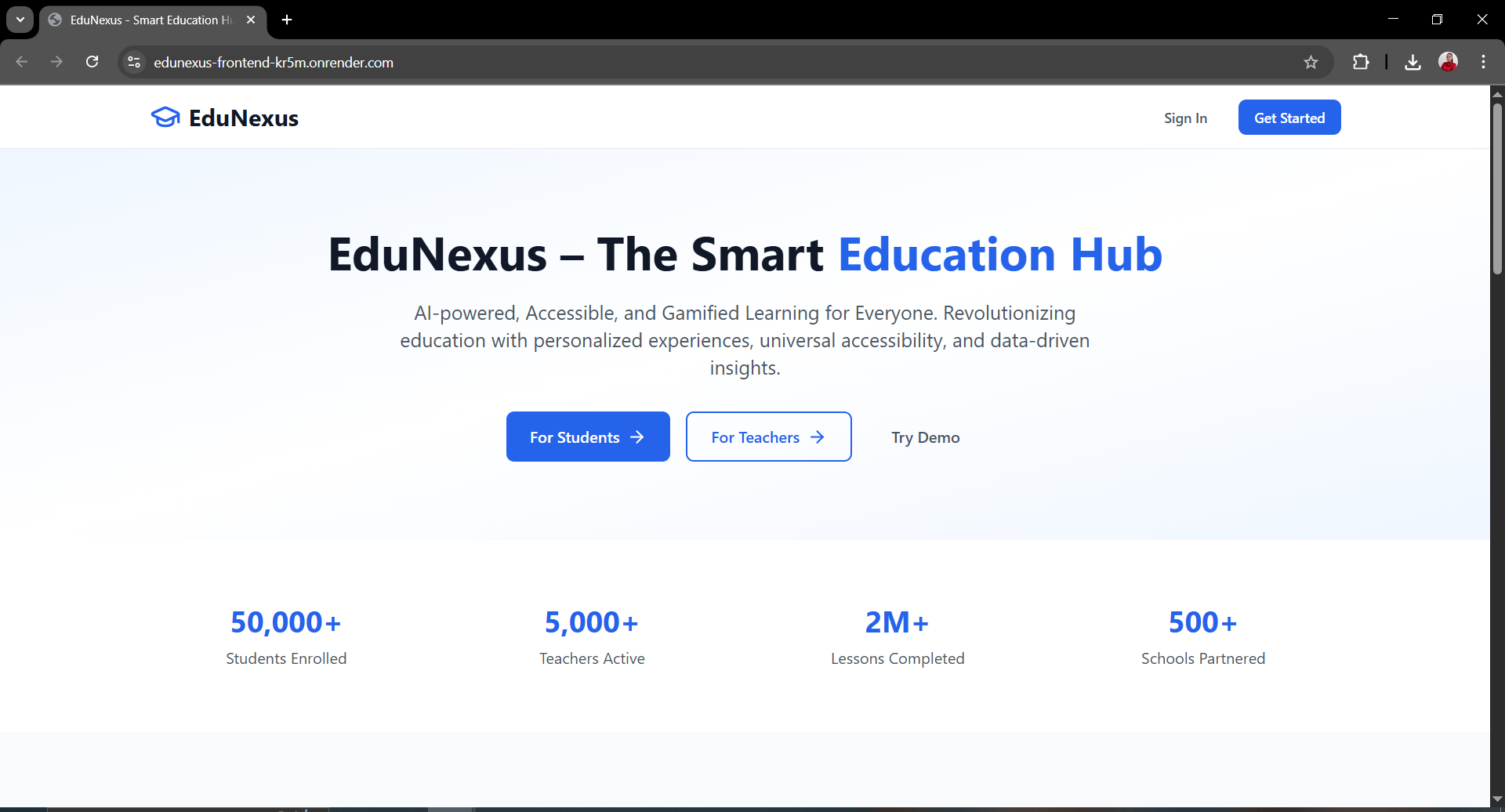
Inspiration 💡 EduNexus was inspired by the daily struggles of educators. The constant administrative burden—manual grading, repetitive lesson planning—takes valuable time away from meaningful student interaction. Our goal was to leverage AI to automate these tedious tasks, giving teachers the freedom to focus on what they do best: teaching and inspiring their students.
What it does 🚀 EduNexus is a comprehensive AI platform with two core functions:
AI Lesson Planner: This tool generates customized, detailed lesson plans in seconds based on a topic, grade level, and duration. It includes everything from learning objectives and activities to assessments and differentiation strategies, all powered by an advanced AI model.
AI Grading Tool: It streamlines the grading process by automatically scoring student submissions and providing personalized feedback. It can analyze text input against a specified rubric, saving teachers hours of work.
How we built it 💻 EduNexus is a full-stack application. The frontend is a single-page application built with React and TypeScript, using Tailwind CSS for a sleek, responsive design. The backend is a Python Flask server that acts as an API to handle all requests. The core intelligence comes from an integrated Large Language Model (LLM). We deployed the frontend on Netlify and the backend on Render, using environment variables to securely connect the two services.
Challenges we ran into 🚧 We faced several key challenges during development:
Deployment and Connectivity: A major hurdle was connecting our frontend and backend after deploying them to different services. We initially used hard-coded localhost URLs, which caused net::ERR_CONNECTION_REFUSED errors in production. We solved this by refactoring our code to use dynamic environment variables (import.meta.env.VITE_API_URL) to correctly point to the live API.
API Integration: Successfully integrating the AI model's API was complex. We had to ensure the request and response formats were correct and that the data was handled efficiently.
CORS Configuration: We had to spend significant time configuring the backend to handle CORS (Cross-Origin Resource Sharing) headers to allow the frontend to make requests from a different domain.
Accomplishments that we're proud of ✨ We are most proud of building a fully functional, end-to-end application that solves a real-world problem for educators. Creating a seamless user experience, from inputting a topic to generating a complete lesson plan, was a major accomplishment. We successfully navigated the complexities of full-stack deployment, which was a significant learning experience in itself.
What we learned 🧠 This project taught us invaluable lessons in full-stack development, including:
The importance of proper API design and handling.
The practicalities of web deployment and the necessity of using environment variables.
The fundamentals of prompt engineering to get reliable and high-quality outputs from an AI model.
Troubleshooting complex cross-origin errors and debugging a multi-part system.
What's next for EduNexus 📈 Our future plans for EduNexus include:
Developing a user authentication system to allow teachers to save and manage their lesson plans and graded assignments.
Adding a student portal for a more integrated feedback loop.
Expanding the AI's capabilities to include a quiz and test generator and a communication tool for sending feedback directly to students.
Built With
- python
- react
- tailwind-css
- typescript

Log in or sign up for Devpost to join the conversation.