-
-
demo
-
demo
About EduNexus AI
💡 Inspiration Students often struggle with learning materials scattered across textbooks, lecture videos, and presentations. Traditional AI chatbots may provide answers without reliable references or understanding a student's learning gaps. We were inspired to build EduNexus AI, a personalized AI study companion that makes learning more connected, trustworthy, and effective.
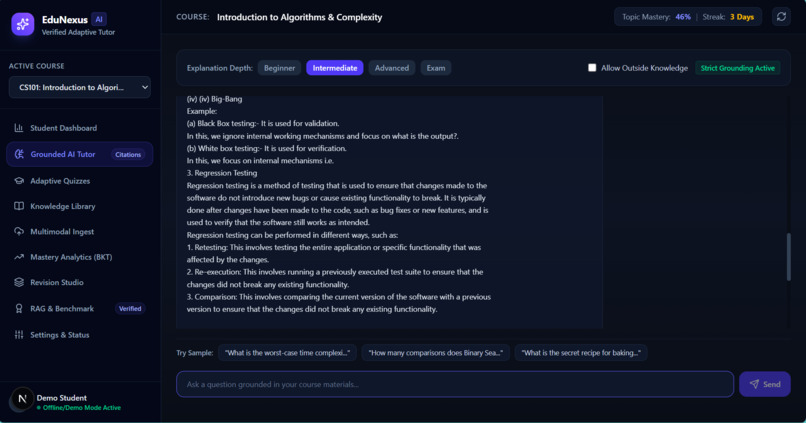
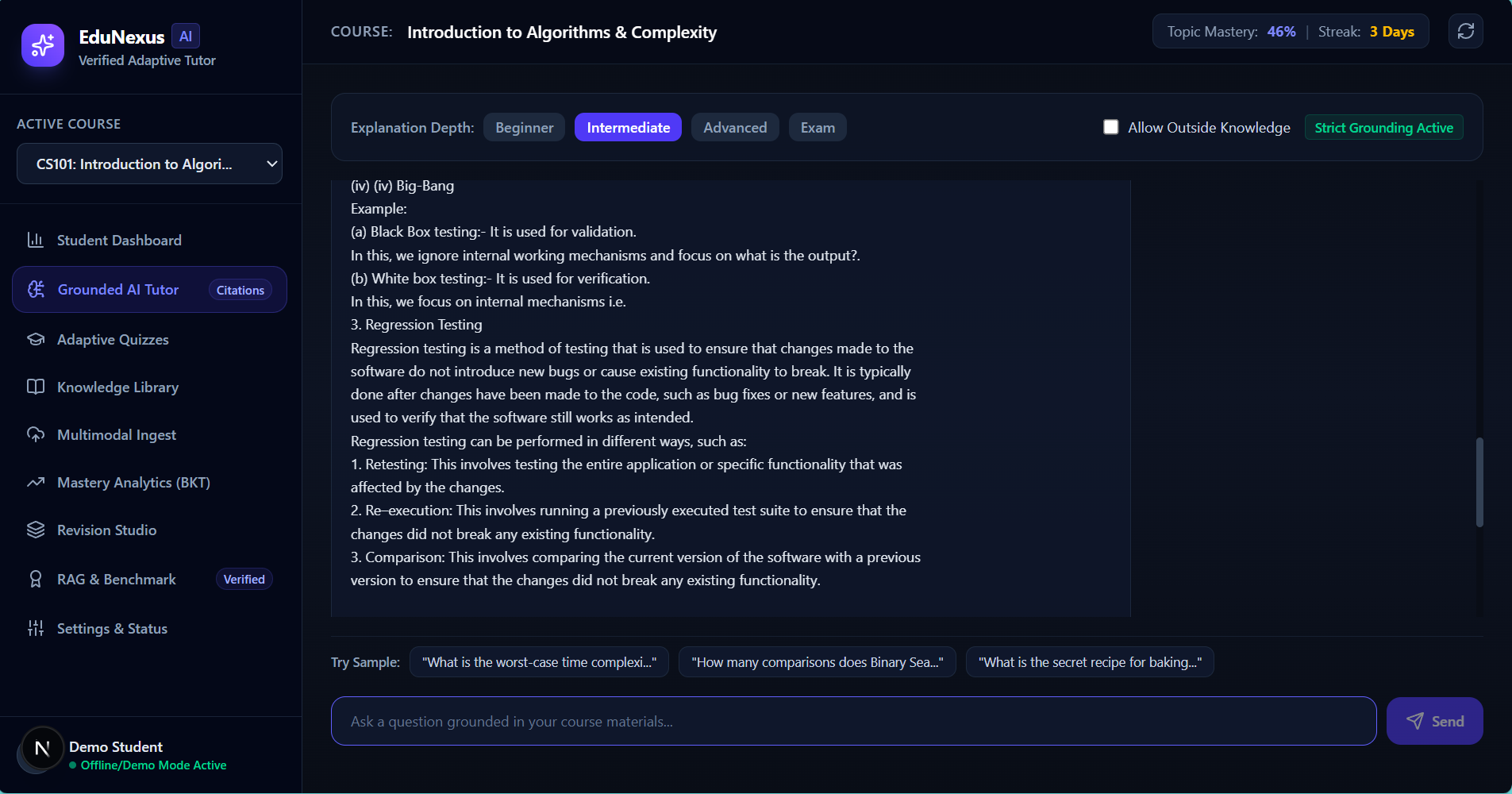
🚀 What It Does EduNexus AI transforms learning resources into an intelligent, personalized study experience. It extracts knowledge from PDFs, slides, and supported lecture content, allowing students to ask questions and receive answers grounded in their course materials with source citations.
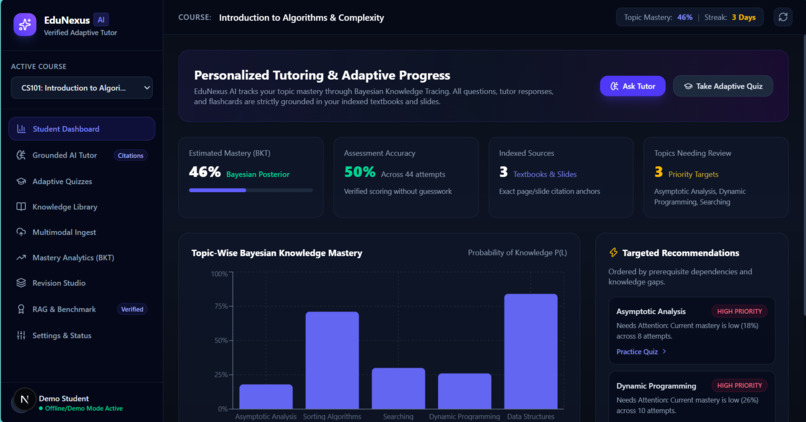
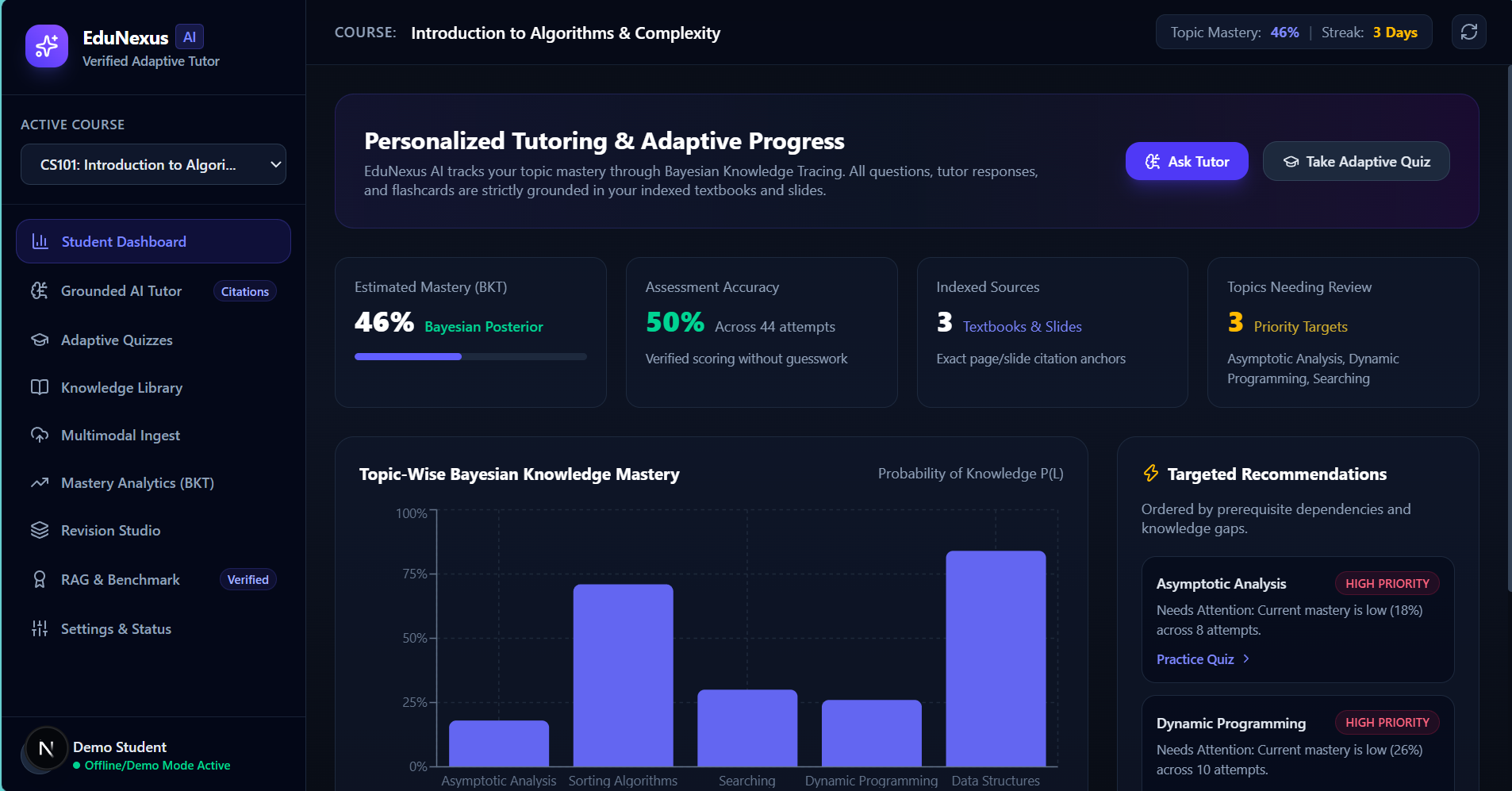
Its key features include: Multimodal Learning: Extracts information from documents, slides, diagrams, and supported video content. Source-Grounded AI Tutor: Provides explanations linked to relevant pages, slides, and timestamps while flagging unsupported questions. Adaptive Assessments: Generates quizzes and mock tests with validated answers, topic tags, and source references. Personalized Learning:Tracks topic-wise mastery, identifies weak areas, and recommends targeted practice. Smart Revision: Creates focused revision materials and study recommendations. Learning Analytics:Evaluates retrieval quality, answer faithfulness, and learning progress using measurable metrics.
🛠️ How We Built It We designed EduNexus AI using a modular full-stack architecture. The frontend provides an interactive student dashboard, while the backend manages document processing, knowledge retrieval, assessments, and learner progress.
Our approach combines PDF and presentation extraction, OCR for supported image-based content, semantic and keyword retrieval, and retrieval-augmented generation (RAG). Each extracted content unit retains its source metadata so the tutor can connect answers to their original locations.
An interpretable learner model estimates topic mastery from assessment performance and updates recommendations as students practice. We also designed an evaluation pipeline to measure retrieval performance, citation correctness, unsupported-query handling, question repetition, and simulated learner progress.
🧠 What We Learned Building EduNexus AI helped us understand that effective educational AI requires more than generating fluent answers. Reliable source attribution, accurate assessment generation, persistent learner modeling, and measurable evaluation are equally important.
We explored multimodal information extraction, RAG architecture, source metadata preservation, adaptive learning techniques, and full-stack integration. We also learned how to turn complex AI capabilities into a student-friendly experience.
⚡ Challenges We Faced One major challenge was preserving accurate page, slide, and timestamp references throughout document processing and retrieval. Another was ensuring that generated answers and assessment keys were supported by the actual learning materials.
We also considered how to handle questions outside the uploaded content, prevent repeated questions, estimate mastery without overstating confidence, and evaluate personalization fairly. Our approach prioritizes source validation, answer checking, transparent uncertainty, and reproducible testing.
🌟 What Makes EduNexus AI Different? EduNexus AI connects the entire learning journey—from scattered resources to grounded explanations, adaptive assessments, and targeted revision—in one workspace.
Instead of simply asking AI for answers, students can discover where the knowledge comes from, what they truly understand, and what they should learn next.
Our vision is to make trustworthy, personalized learning accessible to every student, helping them study with greater confidence, clarity, and purpose.
Built With
- adaptive-learning
- artificial-intelligence
- bayesian-knowledge-tracing
- data-analytics
- educational-technology
- faiss
- fastapi
- full-stack
- generative-ai
- knowledge-graph
- llm
- machine-learning
- multimodal-ai
- natural-language-processing
- next.js
- ocr
- personalized-tutoring
- python
- rag
- ragas
- react
- speech-to-text
- tailwind-css
- typescript
- vector-database

Log in or sign up for Devpost to join the conversation.