

Inspiration
Learning is most effective when it one is able to personally connect with it. In a world teeming with generic educational content, the challenge isn't just finding information—it's discovering it in a form that clicks with you. Whether it's through the lens of football terms for the sports enthusiast or analogies from the arts for the creative mind, EduHelp understands and adapts to the unique ways in which you learn best.
At its core, EduHelp is designed to transform the way we approach education, making it not only accessible but also deeply personalized. By analyzing your preferences and learning style, EduHelp tailors educational content to suit your individual needs, ensuring that complex concepts become clear and engaging, no matter how intricate they may seem.
What it does
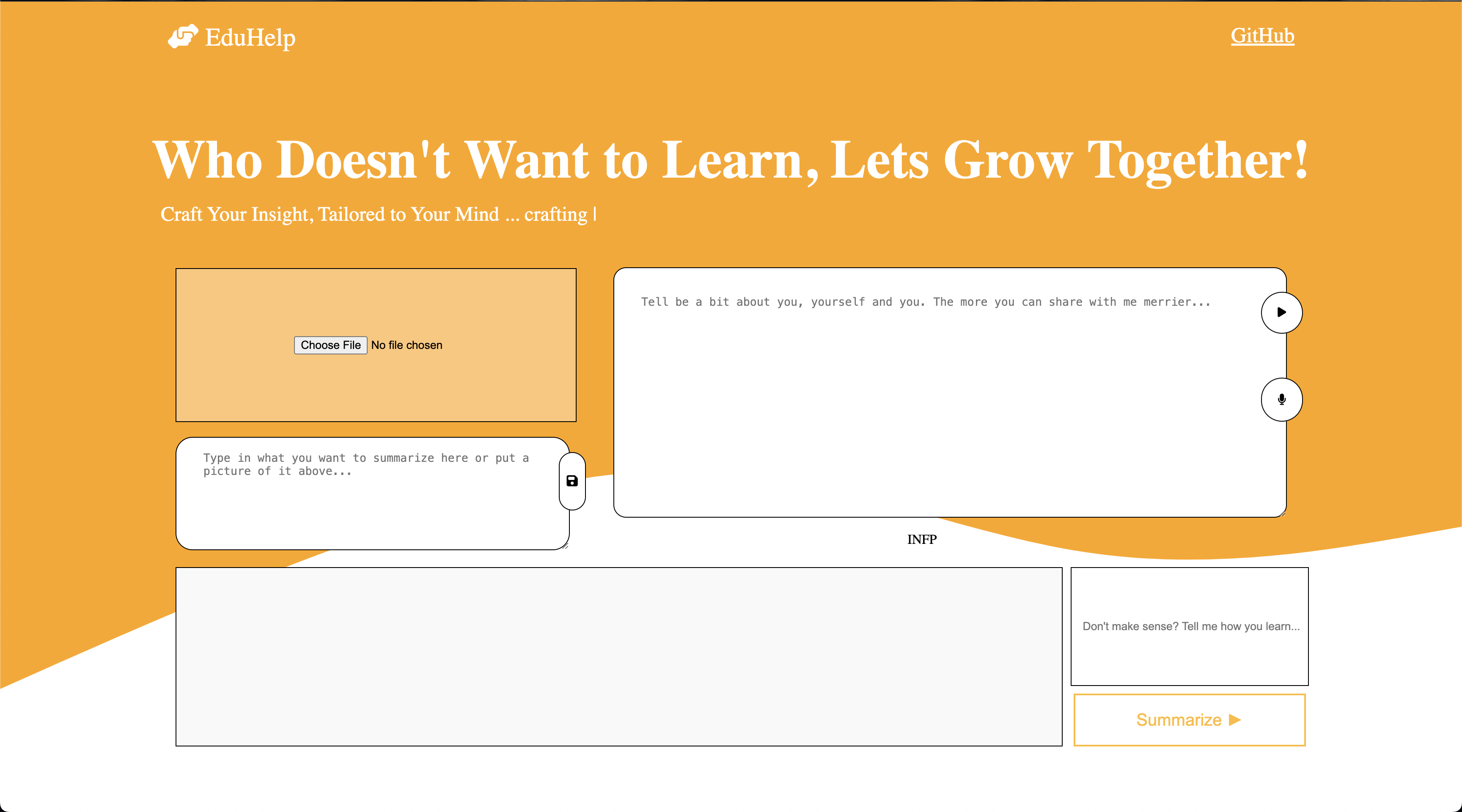
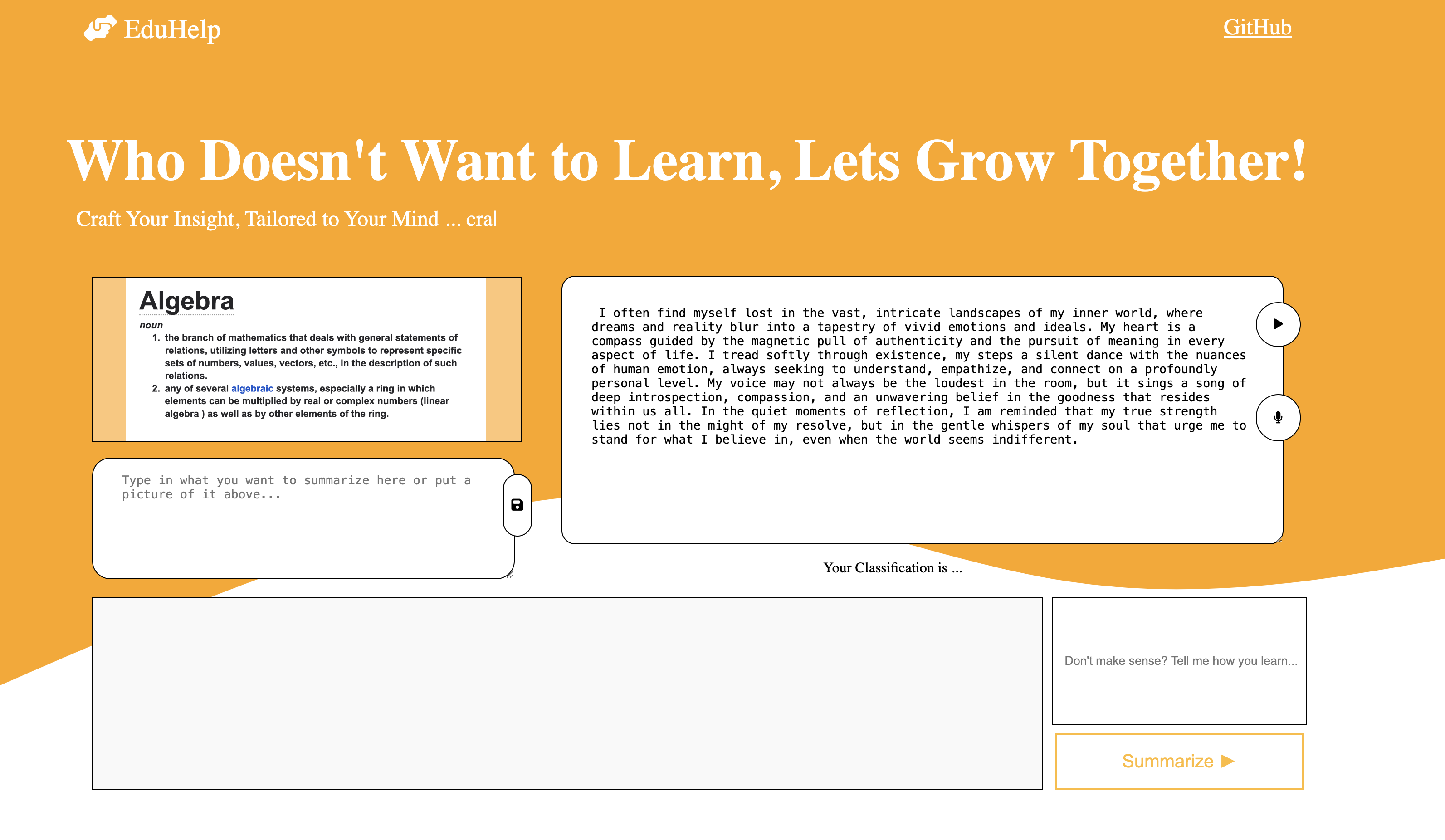
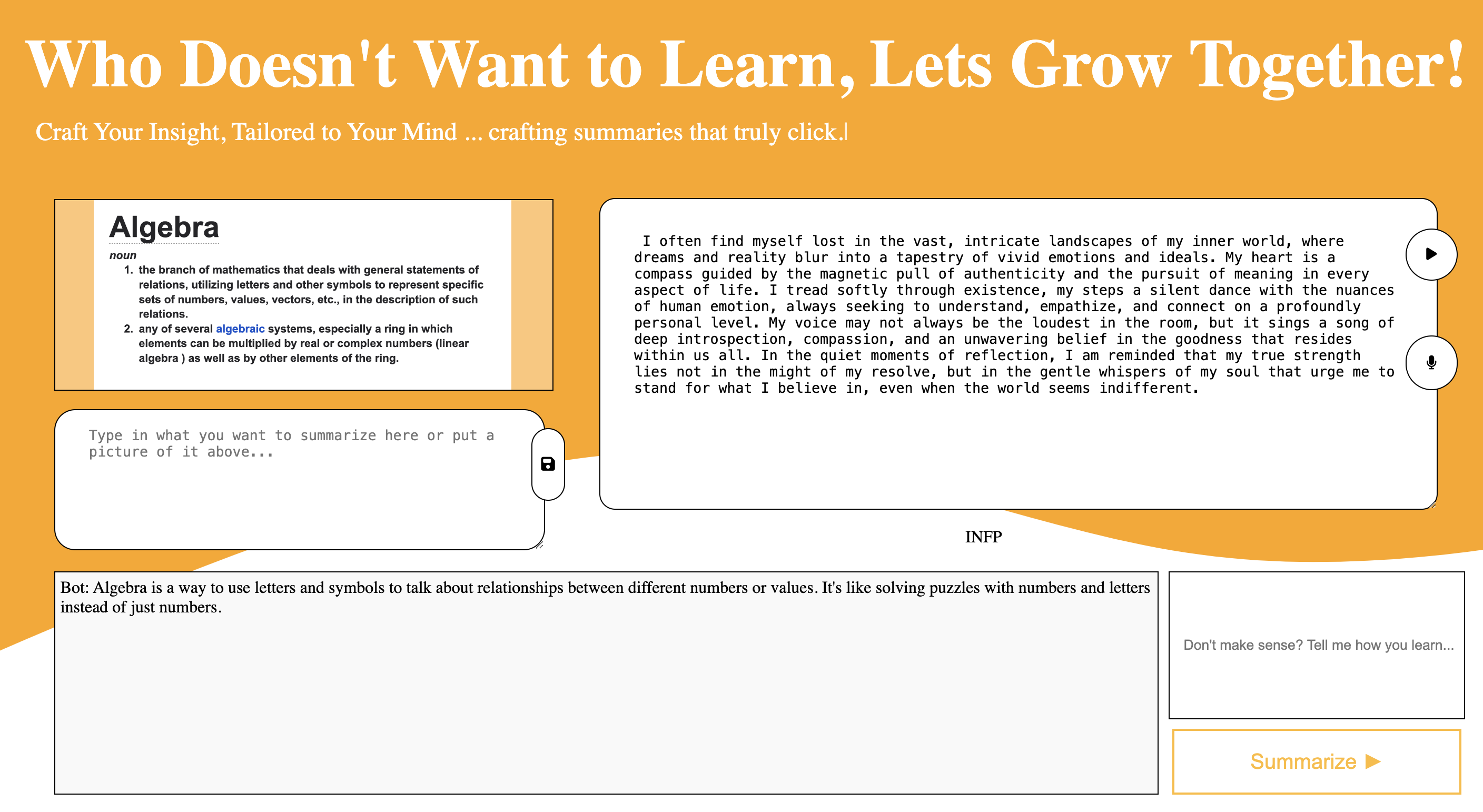
EduHelp changes the learning experience of pupils by tailoring educational content to their unique preferences and personalities of its users. At its heart, EduHelp is a platform that simplifies the journey toward understanding (complex) information. Users start by submitting a summary request of the topic they wish to learn about, along with sharing a small chunk about themselves.
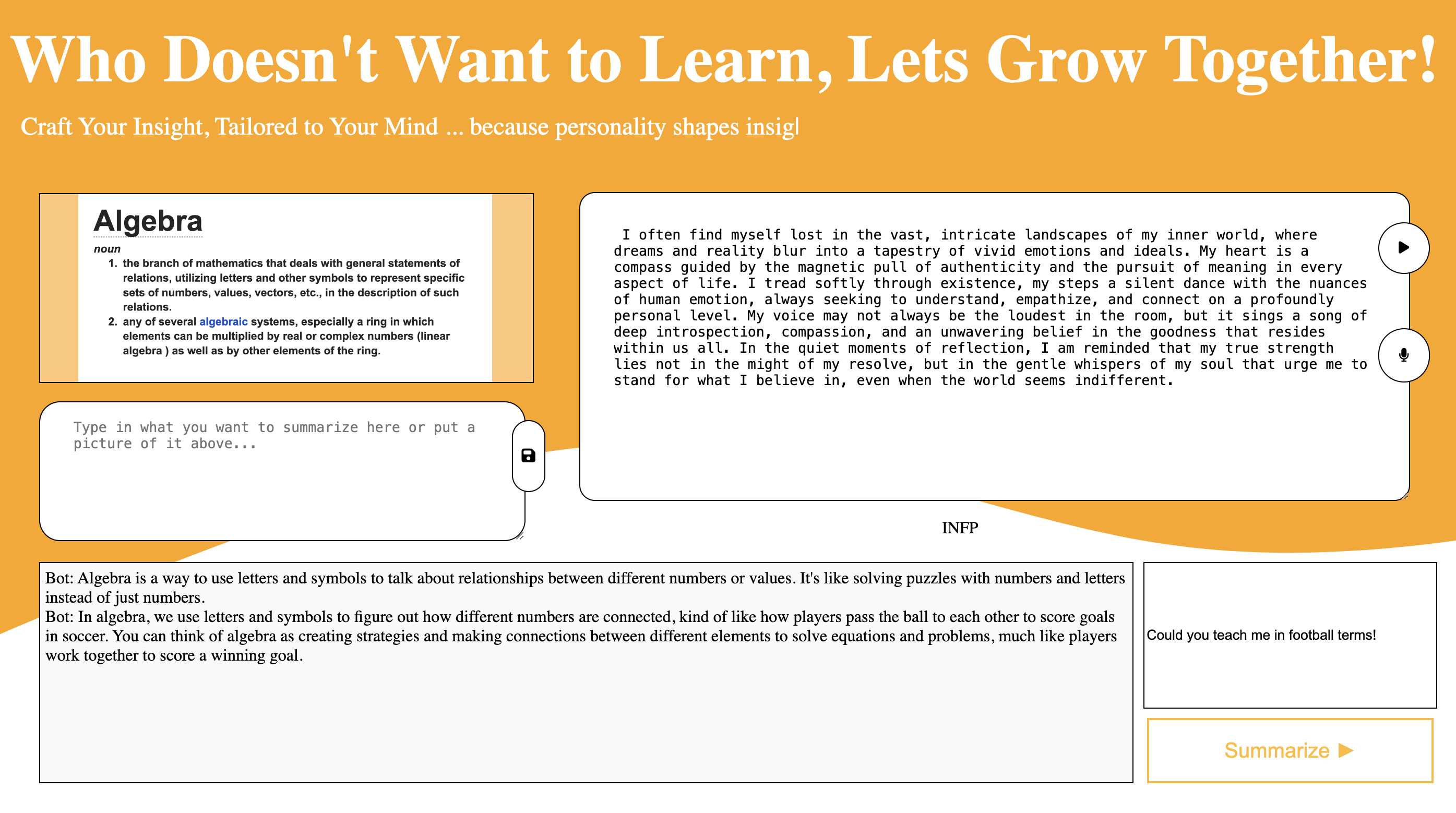
Utilizing a pipeline of a regression model and a fine-tuned neural network, EduHelp then analyzes the user's input to predict their learning type/personality. With this insight, the app customizes the educational material, ensuring that it aligns with the user's preferred learning style and interests. Whether the user thrives on detailed narratives, visual aids, or thematic analogies, EduHelp dynamically adjusts the content to make learning as effective and engaging as possible. Additionally also allowing the user to customize how they want the summary shaped based on any specific interests or unique learning preferences they have, such as wanting to understand quantum physics through football analogies
The app presents users with a personalized summary of their chosen topic, enriched with context and examples that resonate with their individual learning preferences. The app is also made to be as user friendly as possible, with options to take pictures, or speak your text inputs in, on-top of a minimalistic UI to gear people in.
Designed with both learners and educators in mind, EduHelp aims to bridge the gap between knowledge and comprehension, fostering a deeper connection with the material. By personalizing education, EduHelp empowers users to not only grasp but also retain information more effectively, opening doors to a world of knowledge crafted just for them.
How we built it
EduHelp is built with Node.js and Python, to make a dynamic web application. We leveraged Node.js for the server-side logic, handling HTTP requests and responses. For the complex NLP and machine learning tasks, we turned to Python, utilizing its robust libraries like numpy, sklearn, BeautifulSoup & Flair for text analysis and personality prediction. The interaction between Node.js and Python scripts was facilitated using the child_process module, ensuring seamless data exchange. This architecture allowed us to create a responsive, user-friendly interface while harnessing powerful Python algorithms for personalized learning experiences.
Challenges we ran into
Finding best ways to process the data, time constraints in finding the arguable best model, and generally struggling to fight a good prediction model. Last challenge was to get the server side working, unfortunately the classifier when online doesnt work(perhaps too slow), but works locally.
Accomplishments that we're proud of
Most proud of being able to execute the whole project, it address a real world issue that goes un-noticed in almost everyday lived and actively promotes change. Setting itself up as an alternative to drastic measures set up by institutions when students fall behind, which can be life changing in some cases. Noticed a similar study was done previously "https://medium.com/@bian0628/data-science-final-project-myers-briggs-prediction-ecfa203cef8", however, the data processing utilized resulted in an accuracies close to 75%, which was supprising but also faullty due to the data being skewed. Moving forward, I am hopeful of trying again, perhaps with more defined categorizations, and parameters and see what the results yielf!
Built With
- ajax
- beautiful-soup
- css
- express.js
- flair
- google-cloud
- job-lib
- matplotlib
- node.js
- numpy
- pandas
- python
- seaborne
- sklearn
- tesseract
- tqdm


Log in or sign up for Devpost to join the conversation.