-
-
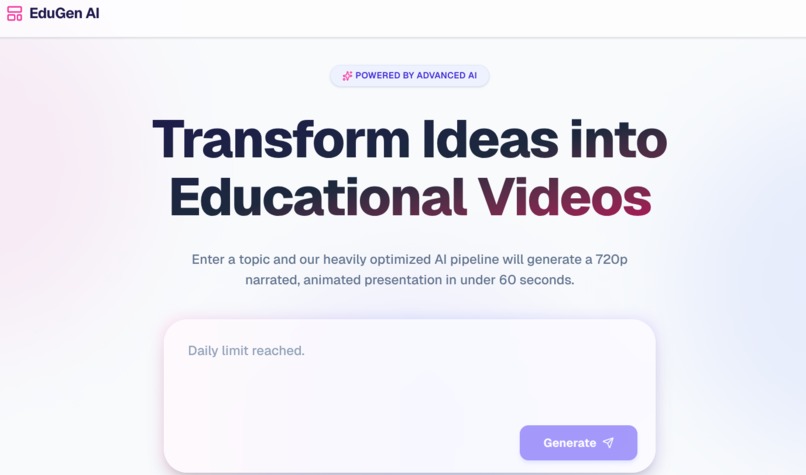
MeDo is lovely!
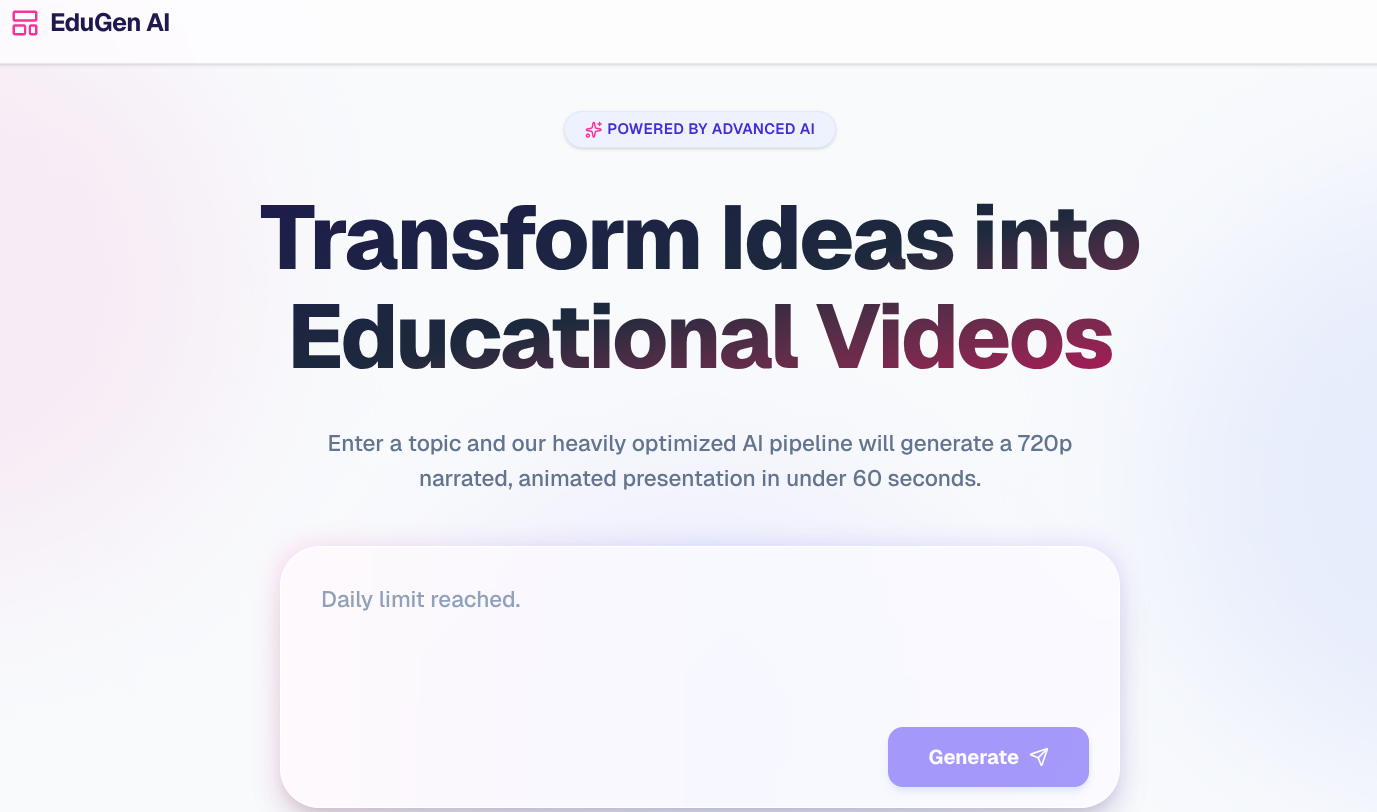
🚀 Edugen AI — Turning Ideas into Educational Videos
💡 Inspiration
The idea behind Edugen AI came from a simple frustration:
Creating educational videos is slow and costs real money.
Even for short explainers, you usually need:
- Scripting
- Designing slides
- Recording voiceovers
- Editing timelines
That process can take hours—or even days.
I wanted to explore a different question:
What if generating an educational video felt as simple as typing a topic?
🛠️ How I Built It
Edugen AI is designed as an end-to-end pipeline that converts a topic into a structured video.
At a high level, the system works like this:
- Input → Topic
- LLM generates structured script
- Scene segmentation + timing
- Visual generation (slides/frames)
- Text-to-speech narration
- Final video composition
You can think of it as:
$$ [ \text{Topic} \rightarrow \text{Script} \rightarrow \text{Scenes} \rightarrow \text{Narration} \rightarrow \text{Video} ] $$
The focus wasn’t just automation—but making the output feel coherent and watchable, not robotic.
🧠 What I Learned
Building Edugen AI taught me a few important things:
AI output needs structure Raw generation isn’t enough—you need constraints, formatting, and flow.
Latency matters more than you think Even a few extra seconds can break the “magic” feeling.
Perceived quality > technical complexity Smooth transitions and pacing matter more than fancy internals.
UX is everything If the experience isn’t simple, the product feels broken—even if it works.
⚔️ Challenges I Faced
1. Serverless Compute
Very often, the metrics showed spikes in GPU usage. Fix:
- Parallelised workflow
- Strict limits.
- Optimisation in pipelines.
2. Timing & Synchronization: MeDo HELP!
This was one of the hardest parts and MeDo helped me settle this by: Matching:
- Voiceover
- Visuals
- Scene transitions
…was harder than expected.
Fix:
- Approximate duration modeling
- Scene-level alignment logic
3. Making It Feel “Alive”
Most AI-generated content feels static.
I wanted:
- Motion
- Flow
- Visual rhythm
Fix:
- Introduced animation logic
- Focused on pacing over complexity
4. Speed vs Quality Tradeoff
MeDo Helped me with this as well. $$ [ \text{Better Quality} \uparrow \Rightarrow \text{Latency} \uparrow ] $$
Balancing this was critical.
Goal:
- Keep generation fast
- Without making output feel cheap
🔥 What It Does Today
Edugen AI can:
- Take a topic
- Generate a structured explanation
- Convert it into a narrated video
- Deliver it in less than a minute.
Still early—but already surprisingly usable.
🧠 Final Thought
Edugen AI isn’t just about speed.
It’s about removing friction from explaining ideas.
Because when creating content becomes effortless, more people can focus on what actually matters:
the idea itself
Built With
- chromium
- css3
- groq-cloud
- html5
- javascript
- medo
- modal
- nextjs
- react
- supabase

Log in or sign up for Devpost to join the conversation.