Inspiration
Photomath, Duolingo, Coursera… educational technology has come a long way in the 21st century. However, we came to the realization that not everyone in the world can actually access and benefit from these amazing tools.
This led us to research educational inequity, an issue that is prevalent across the world. Often, schools in disadvantaged, low-income, and remote communities do not have access to the same educational resources that their counterparts in high-income urban areas do. According to the United Nations, this is because government funding is funneled towards the latter due to political pressures. Consequently, the quality of education in the aforementioned vulnerable communities is much lower.
We designed EduEquity Systems to fight these inequities by centralizing resource distribution and making it socially transparent.
What it does
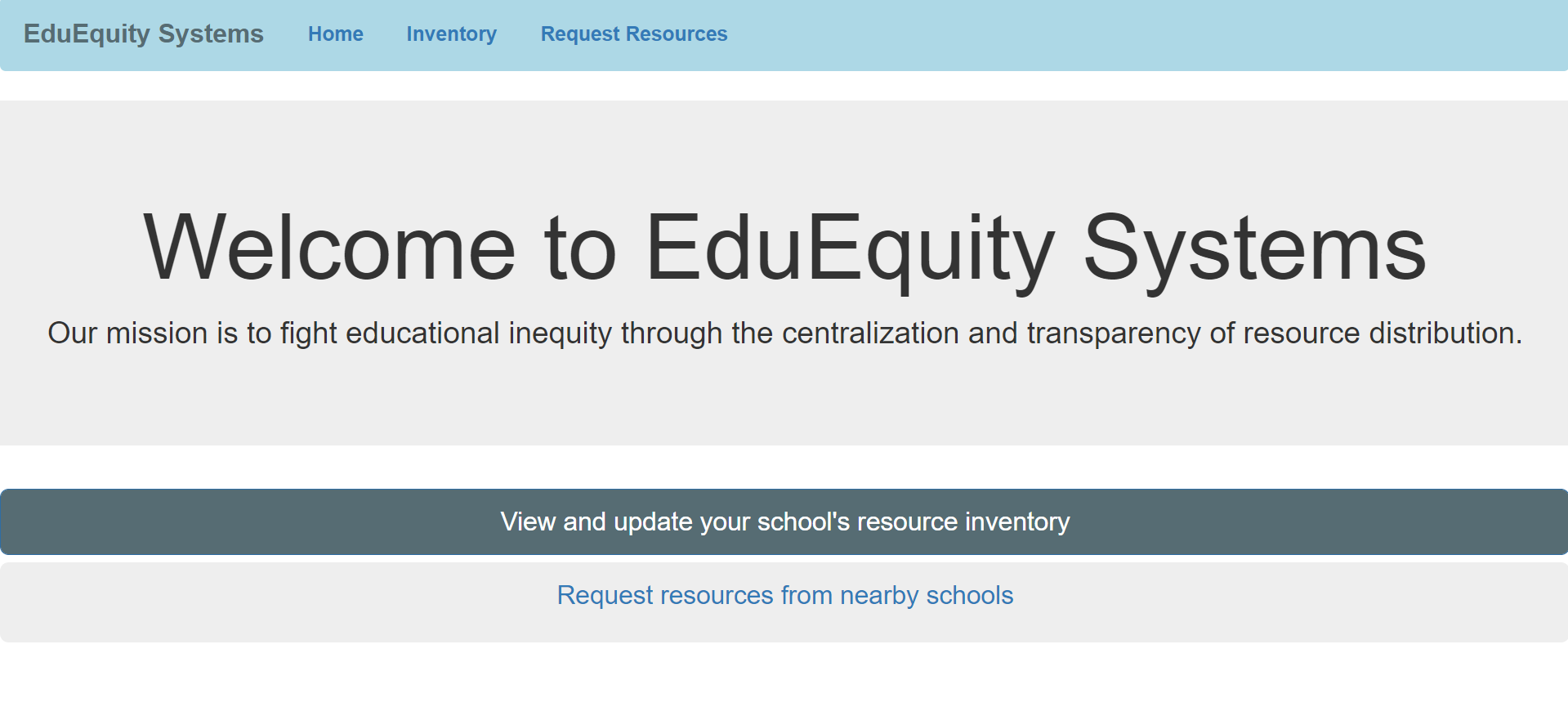
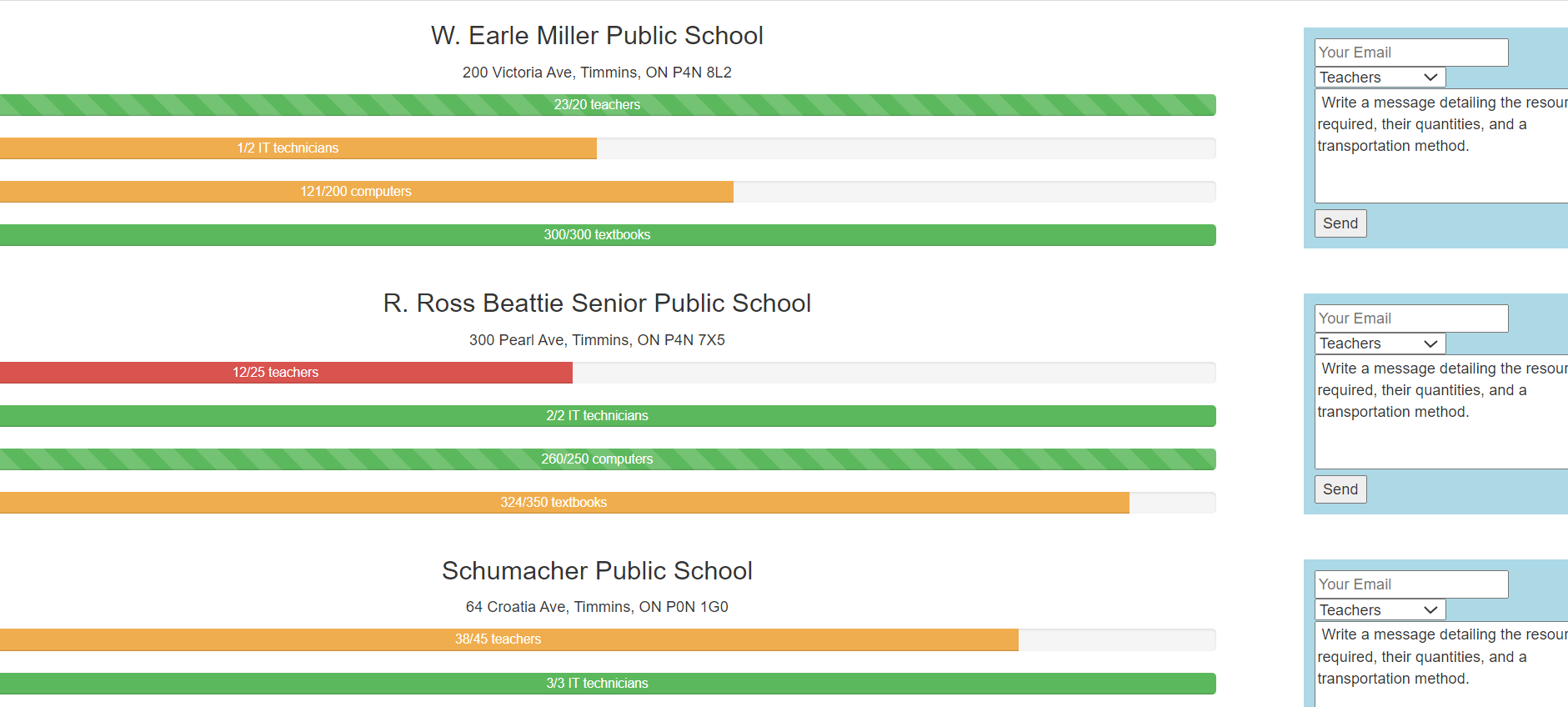
EduEquity Systems allows schools to keep track of shortages and surpluses in their resources, both human (ex. teachers and IT technicians) and physical (ex. computers and textbooks). It centralizes every school’s inventory onto one platform, allowing governments and school boards to monitor resource deficits while also allowing the schools themselves to exchange resources with those in geographic proximity. This ultimately promotes a culture of equity. Since EduEquity Systems makes resource distribution transparent to the public, all levels of educational institutions are socially obligated to be accountable for the resources they have, to share them when possible, and to make use of funding responsibly.
How we built it
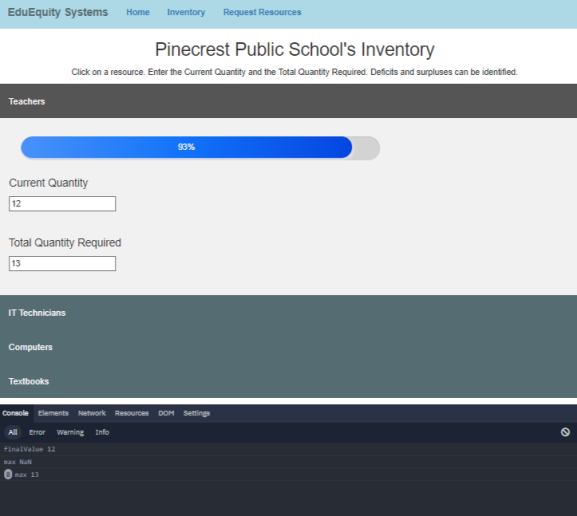
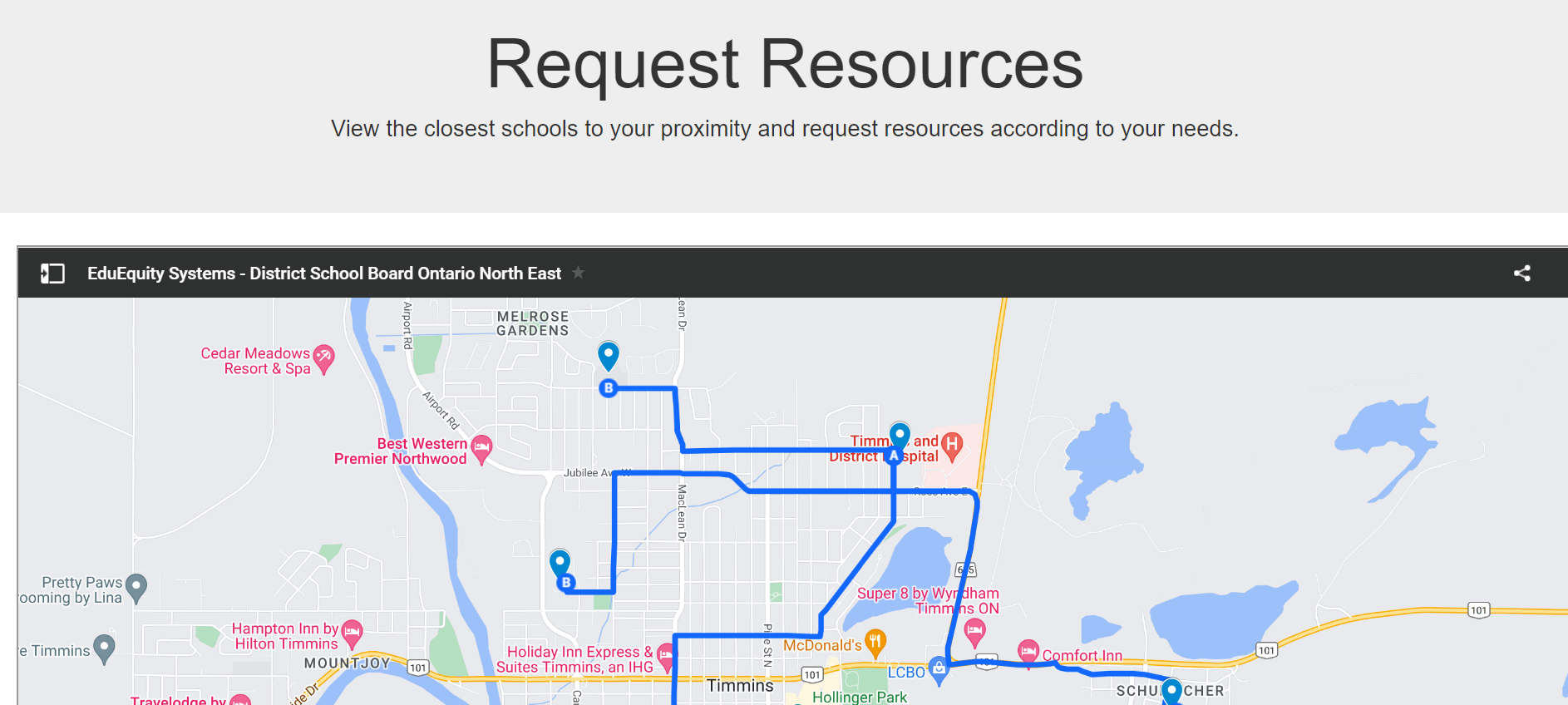
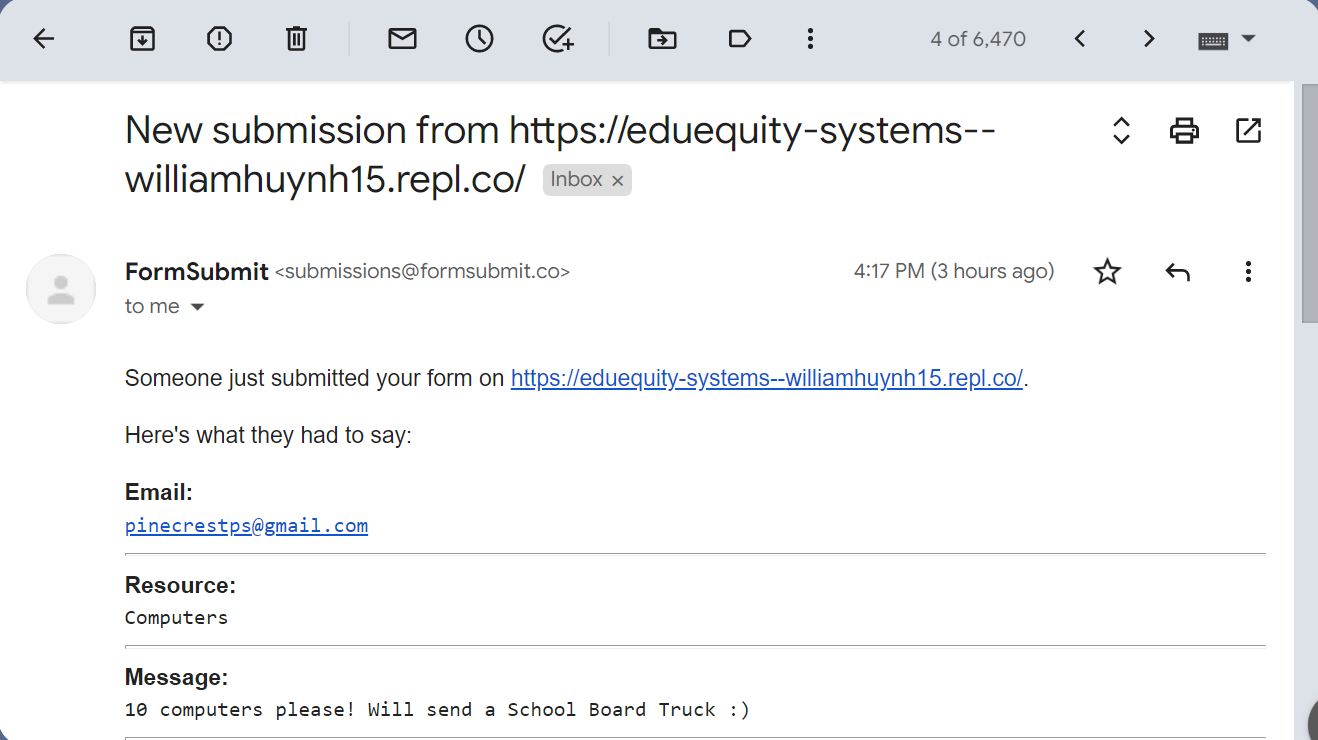
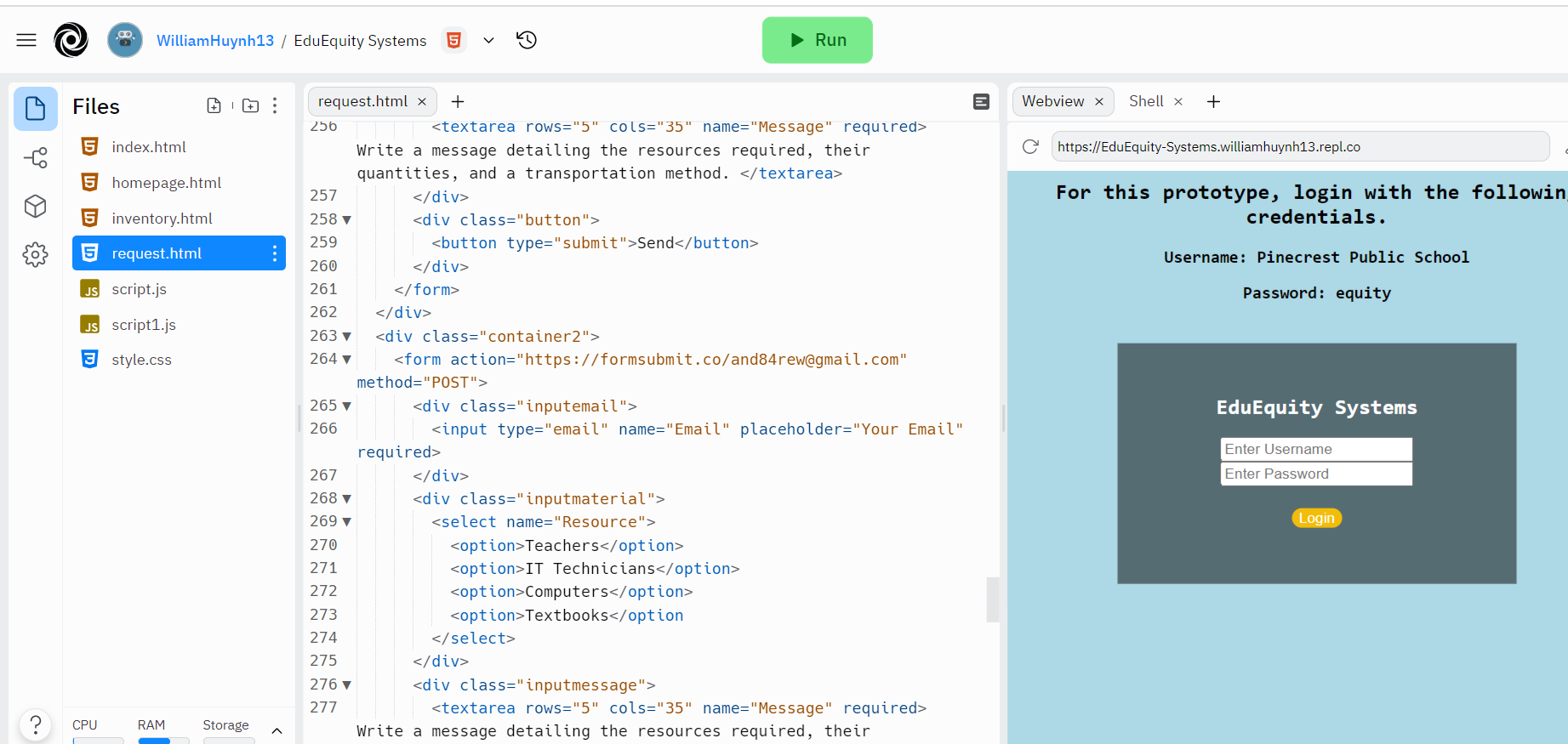
To develop the front-end of our web app, we used HTML, CSS, JavaScript, and Bootstrap. These languages comprised our entire interface, which includes features such as collapsibles, adjustable inventory bars, request forms linked to email through FormSubmit, and a Google Map.
We used JavaScript for the back-end of our web app. When a school inputs their resource stats into inventory.html, script.js calculates resource availability relative to need, while also storing them in our project's console. This proportion is then illustrated on a bar on the front-end of our web app.
Challenges we ran into
Seeing as we had absolutely no prior experience with HTML, CSS, and Javascript, we found ourselves hard-pressed in our attempt to self-learn these languages from online tutorials under the time pressure of the hackathon. During the early stages of the web app’s development, we suffered from low morale as we struggled with even the simplest of tasks, like changing the colour of our web app's navigation bar. Nonetheless, we persevered through our inexperience into the wee hours of the night, tackling our setbacks patiently and gradually becoming fluent enough in the three programming languages to code a final product that we're proud of.
Accomplishments that we're proud of
In less than 28 hours, we were able to self-learn three programming languages and code a functioning prototype that captures our vision for social change. We’re surprised at how rapidly we progressed from clueless beginners to aspiring web developers, though it's our persistence and grit that we're most proud of. Throughout the hackathon, there were many points when quitting (and sleeping) was an attractive option. However, our passion for our project and its potential for social change kept us patient and in retrospect, we’re incredibly glad we spent the weekend adding to our arsenal of programming skills.
What we learned
We learned the basics of coding with HTML, CSS, Javascript and Bootstrap, as well as the fundamentals of developing a front-end and back-end framework for web design.
What's next for EduEquity Systems
Although our prototype was based on 5 schools that are already connected to each other by a school board, EduEquity Systems would ideally connect schools located in remote and disadvantaged communities that function independently from others. For instance, in Canada, there are numerous schools in Indigenous communities that lack sufficient funding from the government. Registering for EduEquity Systems could be a solution by connecting institutions in geographic proximity, allowing them to exchange resources with one another in the name of equity.
In regards to coding, we hope to create a back-end database as we expand our knowledge of JavaScript. This would ameliorate security and efficiency in storing the resource stats of schools while also making them easily accessible in our web app's front end for transparency to the public. Furthermore, we hope to continue to work on our map and provide multiple transportation routes between schools, to give schools various options in the case of a blockage on one path (closure due to weather, construction, etc).
References
- https://www.un.org/en/un-chronicle/recognizing-and-overcoming-inequity-education
- https://www.cbc.ca/cbcdocspov/features/first-nations-schools-are-chronically-underfunded#:~:text=According%20to%20a%20report%20by,Canada%20averages%20around%2030%20percent.
- https://sdgs.un.org/goals/goal4
- https://northernontario.ctvnews.ca/northern-schools-seeing-more-severe-teacher-shortage-more-struggling-students-due-to-pandemic-1.5789136
- https://www.usatoday.com/story/tech/2020/08/23/laptop-shortage-coronavirus-school-remote-learning-covid-19/3424903001/


Log in or sign up for Devpost to join the conversation.