-
-
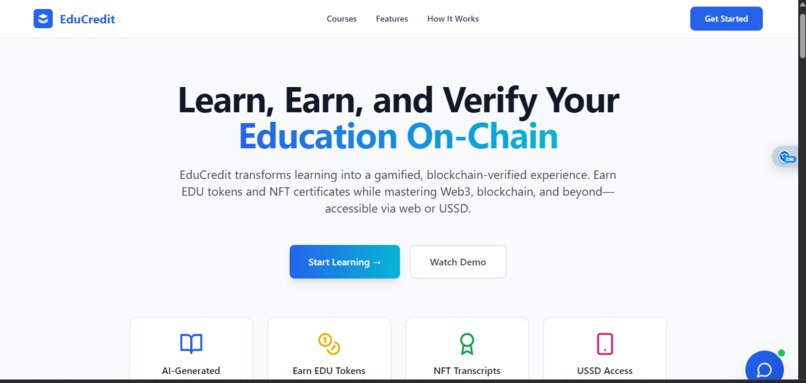
educredit hero/home page

🌱 Inspiration
Access to quality education remains a major challenge for millions of students, especially in underserved communities across Africa. Many learners lack affordable digital resources, trusted credentials, and accessible learning environments. I wanted to create a platform that not only teaches—but economically empowers both students and educators.
EduCredit was inspired by one question:
What if completing a course could generate real on-chain value, and education could be accessible even without smartphones or internet?
🚀 About the Project
EduCredit is a decentralized learn-to-earn platform built on Scroll that empowers learners and tutors through verifiable, reward-based education.
- Students earn EDU tokens after completing an entire course, ensuring rewards represent real learning and commitment.
- Tutors earn EDU tokens when they publish quality educational content through EduCredit, supporting a sustainable and creator-driven ecosystem.
- NFT certificates (ERC-721) provide immutable proof of achievement.
- AI chatbot integration offers real-time, personalized support.
- USSD access enables offline learners to participate without internet.
- Built on Scroll’s zkEVM Layer 2, EduCredit benefits from low fees, instant transactions, and secure on-chain verification.
EduCredit combines Web3, AI, and inclusive offline technology to make education accessible, rewarding, and verifiable for all.
🛠️ How I Built It
- Frontend: React, TypeScript, Vite
- Smart Contracts: Solidity on Scroll
- Rewards & Tokens: Custom ERC-20 (EDU) logic for course completion
- Certificates: ERC-721 NFTs stored on IPFS
- AI Chatbot: LLM-powered learning assistant
- USSD System: Offline gateway for course access and progress tracking
- Storage: IPFS for decentralized metadata
🤖 AI Tools Used
- Bolt.new – rapid prototyping and workflow automation
- Claude – AI reasoning and content generation
- ChatGPT – code assistance, debugging, and documentation
- Lovable AI – UX and design suggestions
- Figma AI – UI/UX design and prototyping
📚 What I Learned
Working on EduCredit helped me understand:
- How zkEVMs like Scroll enable scalable, low-cost transactions
- Secure smart contract design and decentralized credentialing
- Structuring fair, anti-abuse token reward systems
- Integrating AI tools into Web3 platforms
- Designing inclusive learning experiences with USSD
- Improving onboarding for Web3 beginners
⚠️ Challenges
Some of the biggest challenges included:
- Ensuring students complete full courses before earning rewards
- Rewarding tutors fairly while preventing system abuse
- Connecting USSD flows with blockchain interactions
- Designing intuitive UX for non-crypto users
- Managing decentralized metadata and NFT generation
- Debugging multi-step contract interactions on Scroll
🎯 Conclusion
EduCredit demonstrates how Web3 and AI can create accessible, verifiable, and economically empowering learning experiences. By rewarding students for completing courses and rewarding tutors for publishing content, the platform builds a fair and sustainable knowledge economy.
This project strengthened my belief that inclusive technology can break educational barriers and give learners everywhere the tools they need to grow.
Built With
- git
- github
- hardhat
- javascript
- postgresql
- postman
- react
- scroll
- solidity
- typescript
- vite
- vite-backend-/-smart-contracts:-solidity


Log in or sign up for Devpost to join the conversation.