-
-
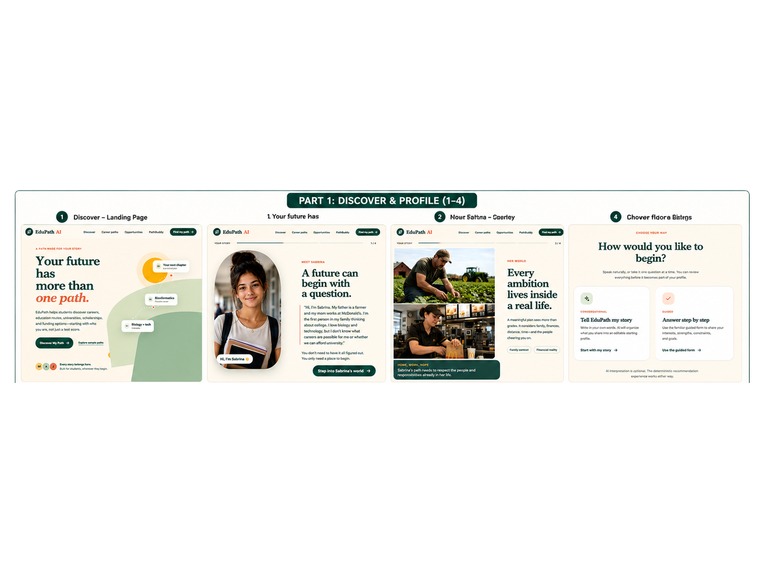
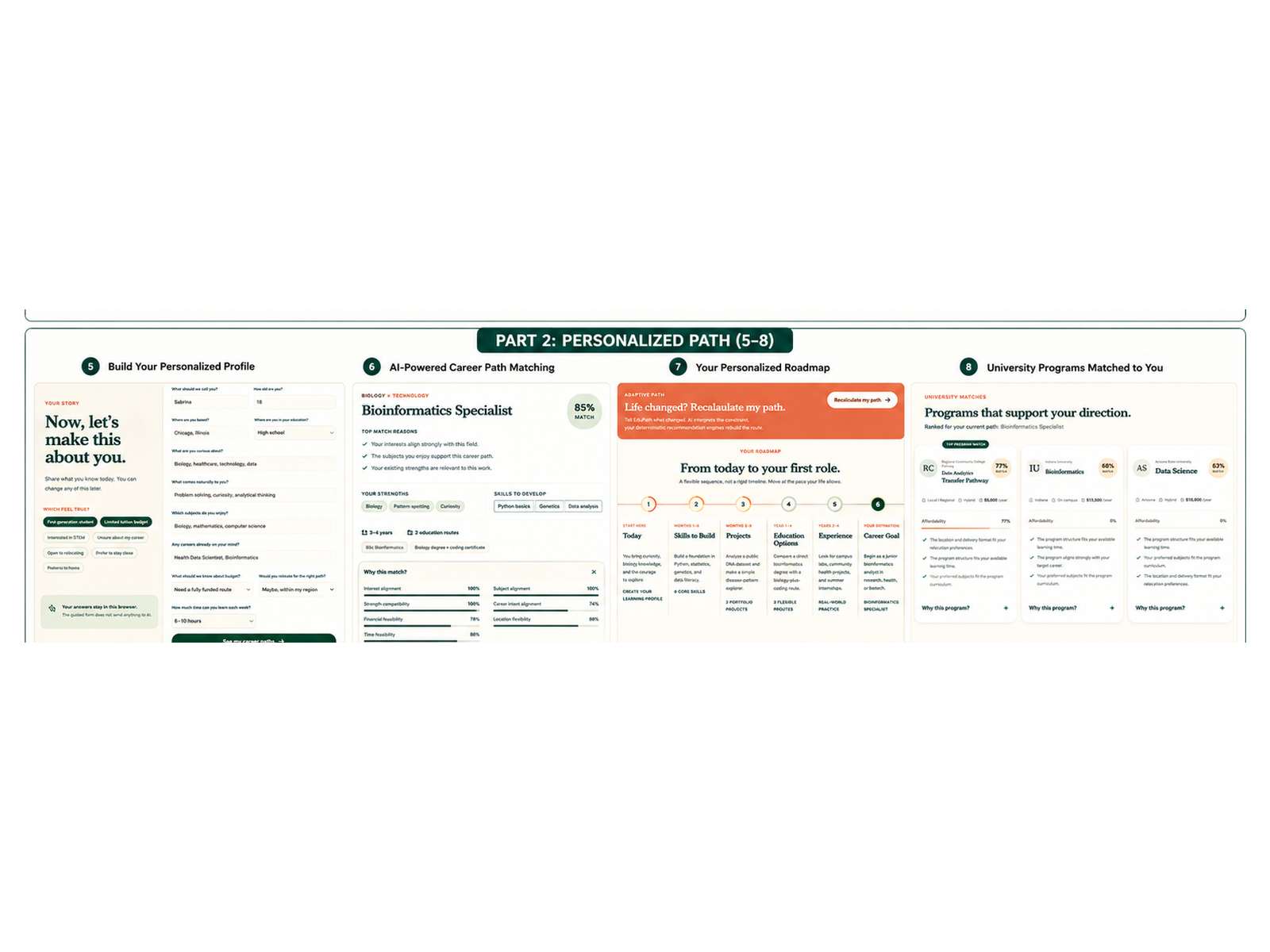
Discover & Profile - Every Student’s Story Starts Here
-
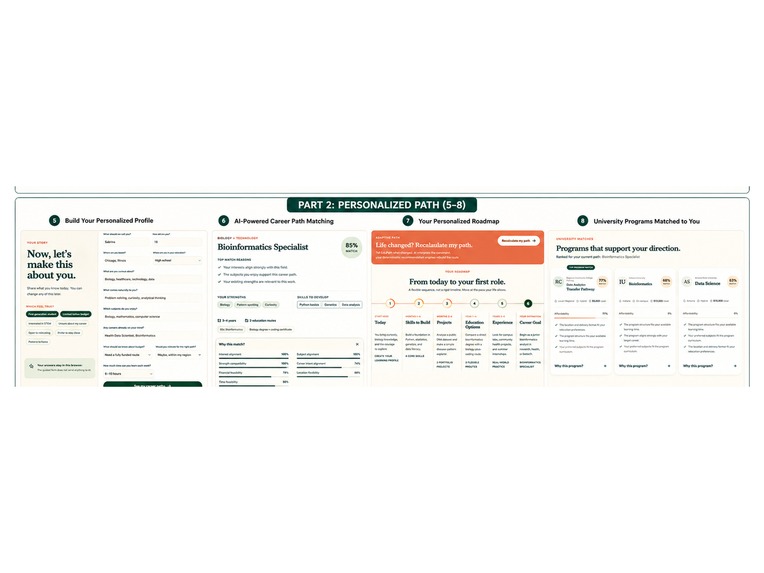
Personalized Path - From Career Match to Education Roadmap
-
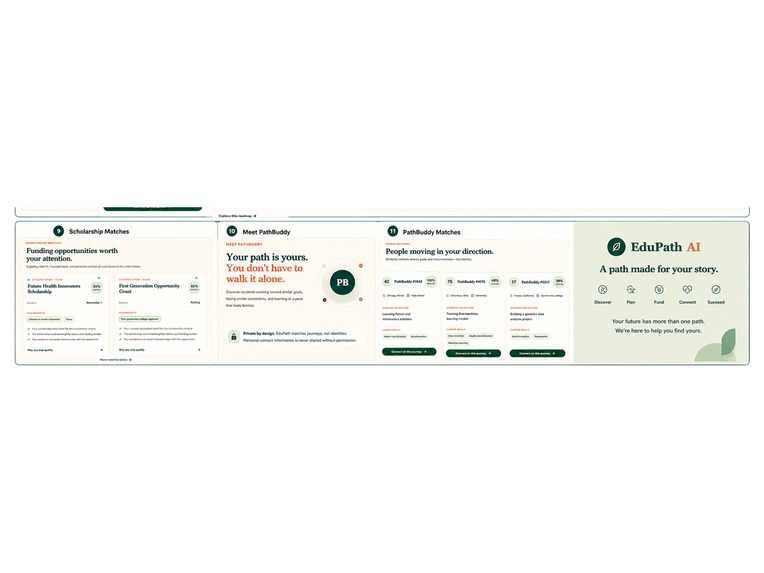
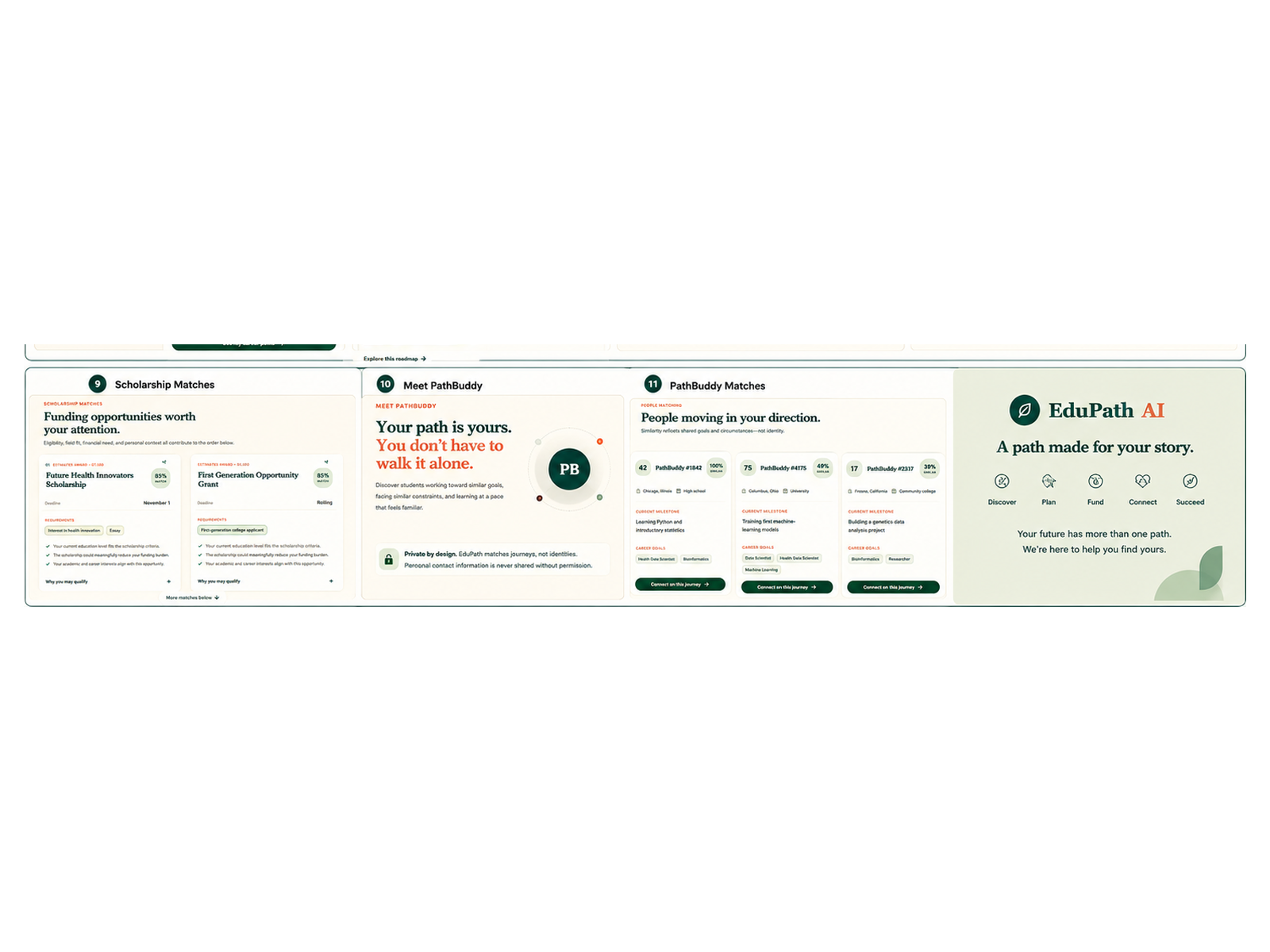
Opportunities & PathBuddy - Find Funding and People on Your Journey
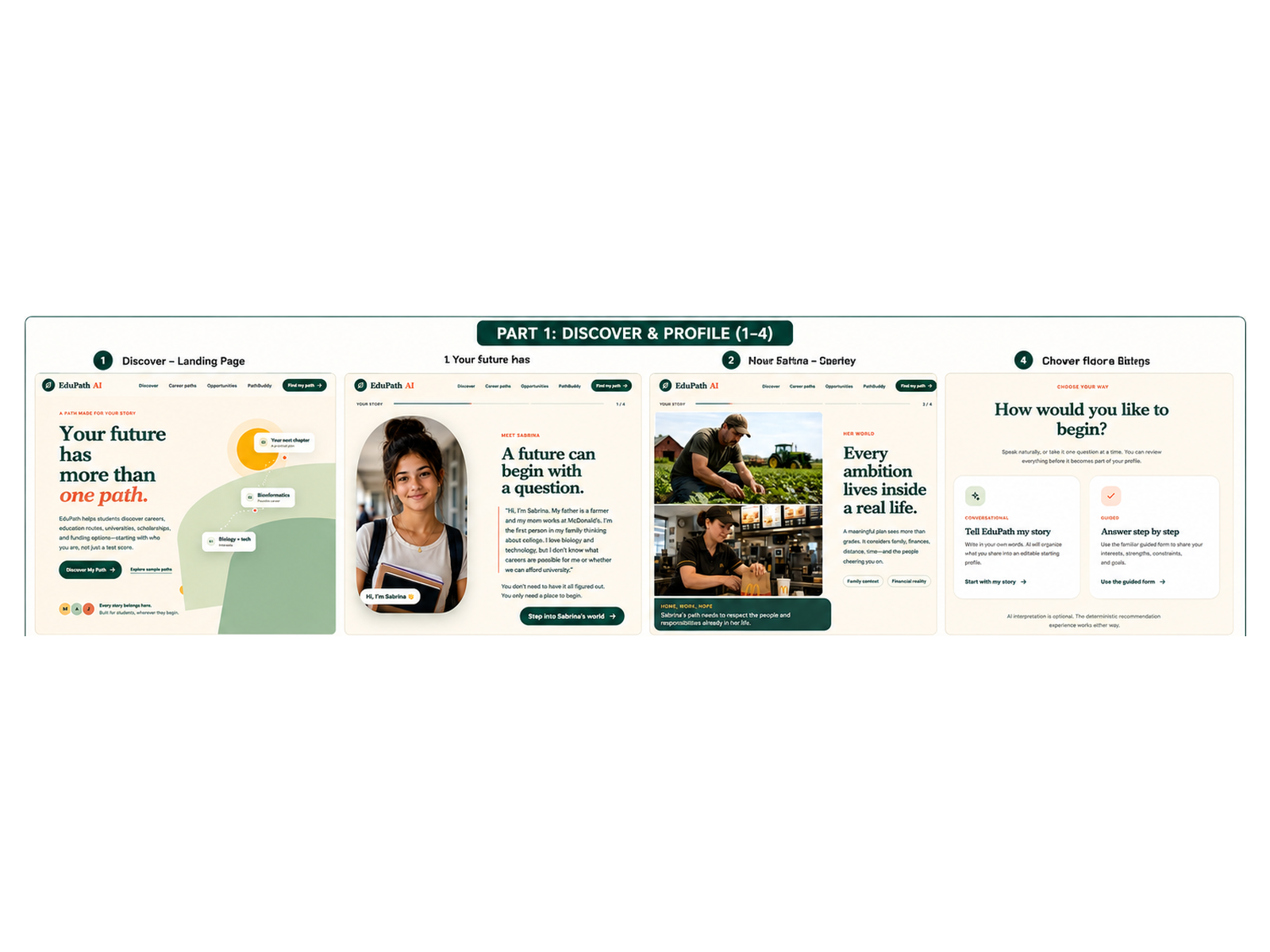
Inspiration
The idea behind EduPath AI started with a simple question:
What happens to a student who has ambition, but does not know what paths are available to them?
Choosing a future is not only about interests or grades. A student's opportunities can be shaped by family finances, where they live, whether they can relocate, how much time they have to study, and whether they even know that certain careers or education routes exist.
I wanted to explore whether AI could help connect all of these pieces into one personalized journey.
EduPath begins with the story of Sabrina, a student whose father works on a farm and whose mother works in food service. She is interested in building a better future, but like many students, she may not know where her interests could take her or how her family could afford the journey.
Sabrina represents the idea that inspired EduPath:
A student's circumstances should shape their path, but they should not prevent them from seeing what is possible.
What it does
EduPath AI is a personalized education and career navigator designed to help students move from uncertainty to an actionable path.
The experience connects the entire journey:
Discover Yourself → Career Paths → Personalized Roadmap → PathBuddy → Education Options → Scholarships → Funding → Adaptive Recalculation
Students can tell EduPath their story naturally or complete a guided profile about their interests, strengths, favorite subjects, education, financial situation, relocation preferences, and available learning time.
From there, EduPath can:
- recommend and rank career paths with explainable match scores
- create a roadmap from the student's current position to a career goal
- identify skills, projects, and education routes to explore
- find anonymized students navigating similar journeys through PathBuddy
- rank education programs based on career fit and real-life constraints
- match potentially relevant scholarship opportunities
- create an estimated funding plan
- adapt the journey when the student's circumstances change
One of my favorite features is Recalculate My Path.
A student might say:
"I can't afford a four-year university anymore."
or:
"I need to stay close to home."
EduPath interprets what changed and recalculates the student's options.
The destination does not necessarily have to change.
Sometimes the student simply needs another route to get there.
How I built it
Codex's role in the architecture
Codex is not presented as a runtime dependency or as the recommendation algorithm itself. Instead, it served as the engineering layer used to build and evolve the system.
This separation was intentional:
- I defined the product problem, user experience, feature direction, and algorithmic approach.
- Codex implemented and integrated those ideas across the application.
- Deterministic engines produce the career, opportunity, and PathBuddy rankings.
- Verification scripts and production checks help ensure that new phases do not break earlier functionality.
This architecture allowed me to use Codex where it was strongest: reasoning across an existing codebase, implementing interconnected changes, and repeatedly validating the complete product.
Building the intelligence behind EduPath
I built EduPath AI using Next.js, React, TypeScript, Tailwind CSS, the OpenAI API, and custom recommendation algorithms.
A key technical decision was to separate AI understanding from deterministic recommendation logic. I wanted AI to understand the complexity of a student's story without making every recommendation an opaque LLM-generated answer.
The AI layer focuses on understanding natural-language student stories and changes in life circumstances. It translates that human context into structured information the rest of EduPath can use.
From there, purpose-built recommendation engines handle the actual ranking and matching.
The career recommendation engine evaluates a student across multiple dimensions:
- interest alignment
- subject alignment
- strength compatibility
- career intent
- financial feasibility
- location flexibility
- available learning time
This produces personalized career rankings while allowing students to understand the factors behind their recommendations.
For PathBuddy, I represent student journeys as multidimensional feature vectors and use cosine similarity with a K-nearest-neighbor-inspired ranking approach to identify anonymized students navigating similar paths. This turns peer discovery into a similarity problem while keeping the experience privacy-first and opt-in.
I also built an opportunity engine that connects a student's recommended career with realistic education and funding options. It ranks programs based on factors such as career alignment, affordability, subjects, location, and flexibility.
A separate scholarship ranking system considers education eligibility, field alignment, financial need, and personal context. The funding engine then brings these results together by combining estimated tuition, potential scholarships, grants, and work-study possibilities to calculate an estimated remaining funding gap.
Together, these layers create a connected journey:
Student Story → Career Match → Personalized Roadmap → PathBuddy → Education Options → Scholarships → Funding
The result is a hybrid architecture where AI understands the human story, deterministic engines provide structured and explainable recommendations, and Codex served as the engineering layer that helped turn those pieces into one cohesive product.
Challenges I ran into
One of the biggest challenges I faced was deciding how much responsibility to give the AI model.
The easiest approach would have been to ask an LLM to generate every career, university, and scholarship recommendation. However, I wanted students to understand why something was being recommended.
Instead, I designed a hybrid architecture where AI interprets unstructured human experiences while purpose-built recommendation engines handle ranking and matching.
Another challenge was representing something as complex as a student's future without pretending that there is one correct path.
A career might be a great match for someone's interests but the traditional education route could be financially unrealistic. A university might offer the right program but require a student to relocate when they cannot leave home.
I wanted EduPath to consider those realities rather than treating them as secondary details.
Building Recalculate My Path introduced another interesting challenge. If a student says they cannot relocate, the system should not suddenly change their interests, strengths, or career goals. I designed the AI interpretation layer to identify the relevant constraint changes first and then let the existing recommendation engines recalculate the path.
Accomplishments that I'm proud of
I am proud that EduPath evolved from a career recommendation idea into a connected student journey.
Instead of stopping at:
"Here are three careers you might like."
EduPath continues to ask:
How could you get there?
What could you study?
Can you afford that route?
Are there other routes?
Who else is navigating something similar?
What happens if your life changes?
I am particularly proud of:
- building explainable career recommendations instead of static AI-generated scores
- creating a working cosine-similarity and KNN-inspired PathBuddy matching engine
- incorporating affordability and location into education recommendations
- connecting career recommendations with programs, scholarships, and funding
- showing students why recommendations were made
- building Recalculate My Path so a route can adapt when circumstances change
- keeping the recommendation engines separate from the language-model reasoning layer
The result is a working prototype where changing a student's profile can affect their career ranking, PathBuddy matches, education opportunities, scholarships, and funding plan.
What I learned
Another major lesson was learning how to work effectively with Codex. I found that the strongest results came not from asking it to “build the whole app,” but from defining clear phases, architectural boundaries, expected behavior, and validation criteria. As the project grew, I learned to use Codex as an engineering partner that could reason across an existing codebase rather than as a tool for generating isolated snippets. Giving it clear integration boundaries and asking it to verify its work helped me move faster while keeping the system coherent.
The biggest lesson I learned while building EduPath is that personalization is about much more than understanding what someone likes.
A recommendation can be academically perfect and still be practically impossible.
Knowing that a student loves biology is useful.
Knowing that they love biology, have limited financial resources, cannot relocate, and have only five hours each week to study creates a completely different recommendation problem.
I also learned that AI does not need to control every part of an intelligent product.
Combining language models with purpose-built recommendation algorithms allowed me to use AI where it is strongest—understanding nuanced human language—while using structured algorithms for consistency and explainability.
Most importantly, I started thinking about education guidance as a dynamic journey rather than a one-time recommendation.
Life changes. A useful path should be able to change with it.
What's next for EduPath AI - Personalized path for students
EduPath AI is currently a prototype, but my larger vision is to build a trusted, personalized education navigator that can support students throughout their journey.
The next step would be connecting EduPath to verified and continuously updated sources for:
- universities and education programs
- tuition and financial-aid information
- scholarships and application deadlines
- alternative education and certification pathways
- career and labor-market information
I would also like to expand PathBuddy into a privacy-first, opt-in system where students navigating similar journeys can support one another without exposing personal information by default.
Over time, EduPath could help students track milestones, discover upcoming opportunities, remember important deadlines, and adapt their plans as their circumstances change.
My long-term vision is not for EduPath to tell every student that there is one perfect career or one correct university.
I want it to help students answer a more useful question:
Given who I am, where I am today, and the realities of my life, what paths are possible for me—and what can I do next?
Because the destination matters.
But there is always more than one path forward.
Built With
- codex
- codexachine-learning
- cosine-similarity
- github
- gpt-5.6
- k-nearest-neighbors-(knn)
- next.js
- node.js
- openai-api
- react
- tailwind-css
- typescript
- vercel


Log in or sign up for Devpost to join the conversation.