Inspiration
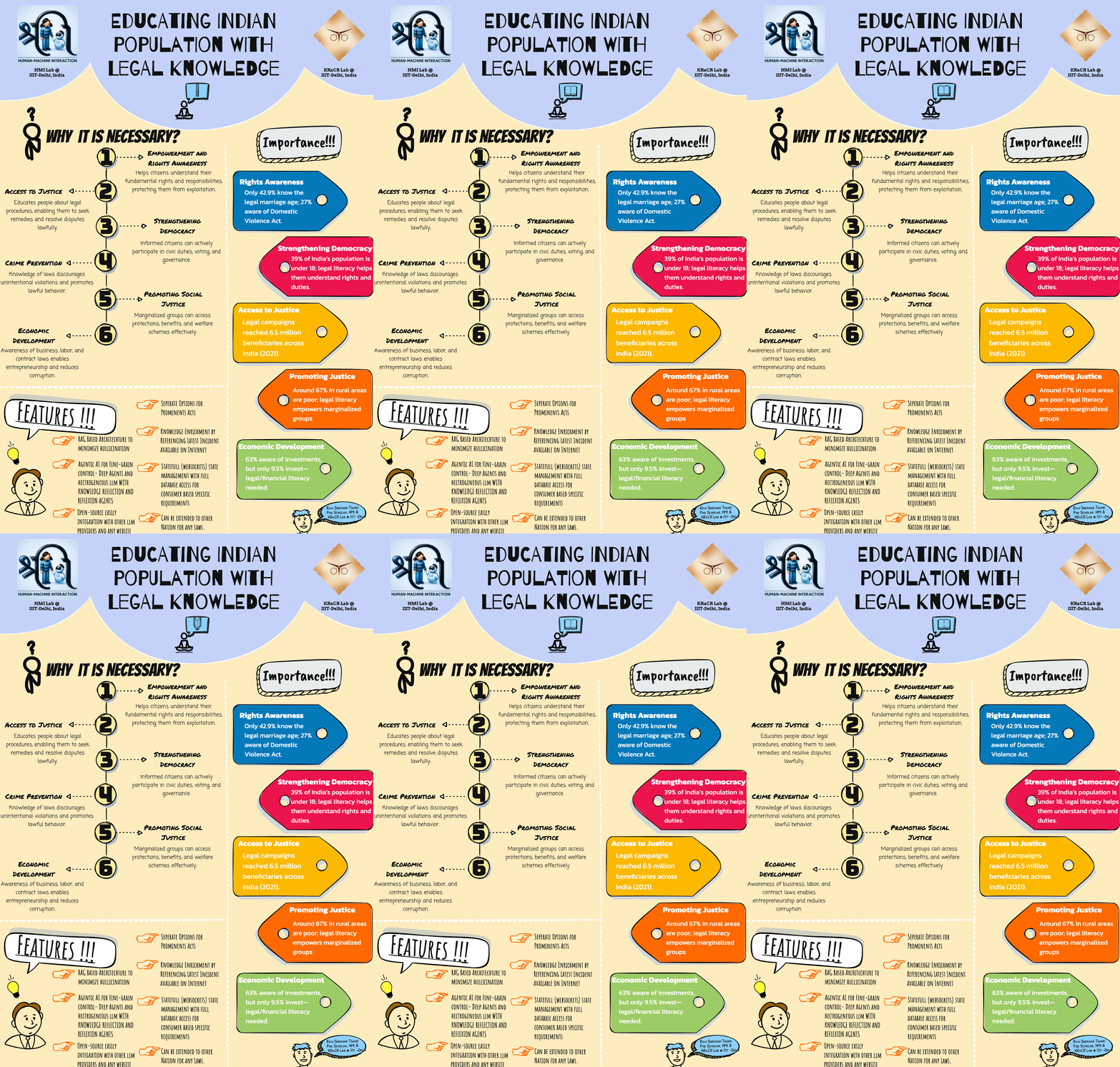
India is undergoing a major legal transformation with the introduction of the Bharatiya Nyaya Sanhita (BNS), Bharatiya Suraksha Adhiniyam (BSA), Information Technology (IT) Act, and the Digital Personal Data Protection (DPDP) Act. Despite this, most citizens are unaware of their rights and responsibilities under these laws. This lack of awareness leads to misinformation, misuse of data, and vulnerability to cybercrimes. Inspired by this challenge, I set out to create an AI-powered legal assistant that helps every Indian easily understand and access accurate legal information.
What it does
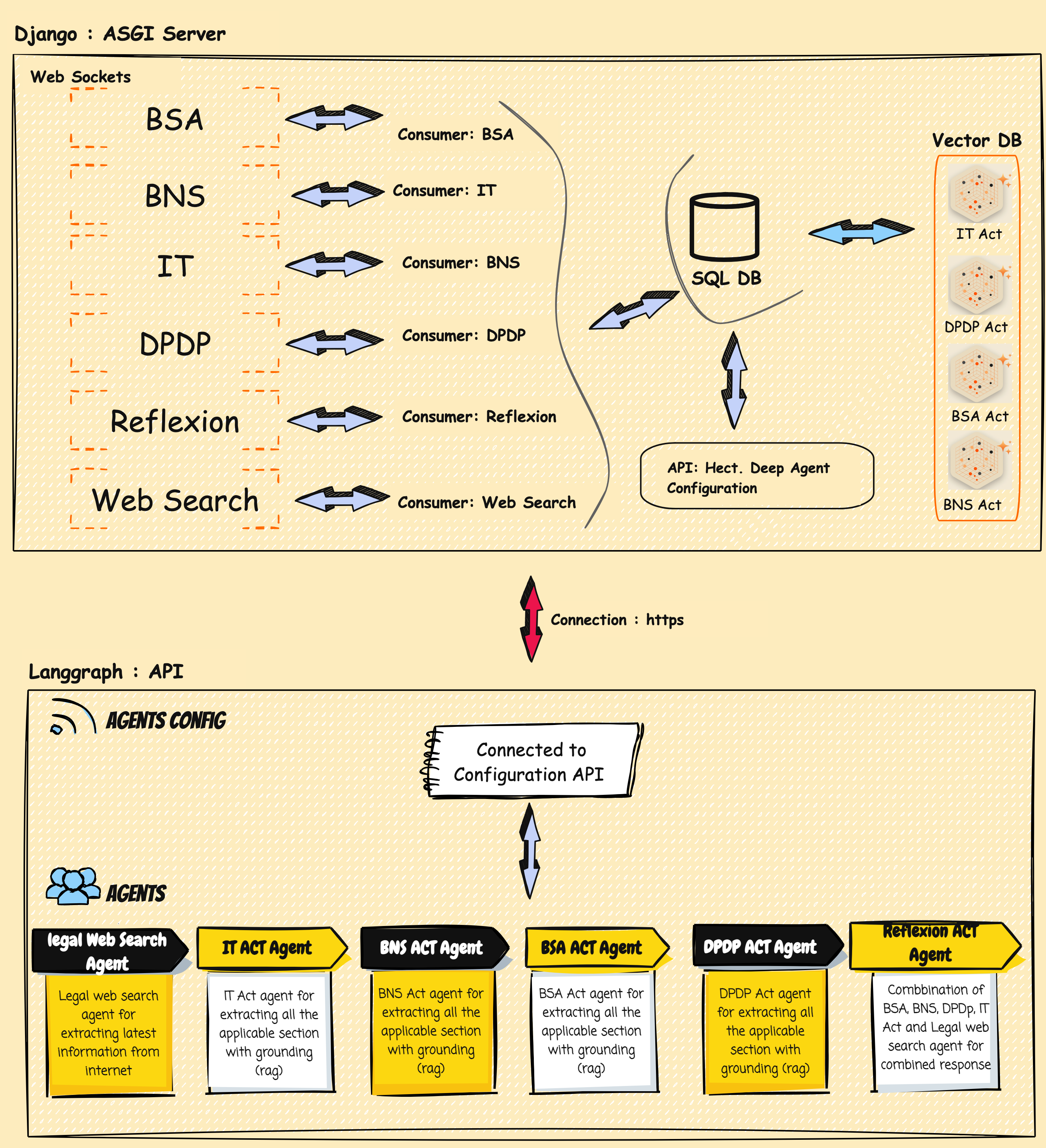
The project is an Agentic AI Legal Application that uses multiple specialized agents — each focused on IT, DPDP, BNS, BSA, and Legal Web Search. These agents retrieve and process relevant legal information using Retrieval-Augmented Generation (RAG). A central Reflexion Agent then integrates and refines the responses to provide clear, accurate, and context-aware legal insights to users.
How we built it
The system was developed using Gemini API, LangChain, LangSmith, and Django WebSockets. Each agent was designed with domain-specific knowledge bases and connected through RAG pipelines for retrieval and reasoning. The Reflexion Agent employs an ensemble approach to merge outputs, ensuring comprehensive legal guidance.
Challenges we ran into
- Synchronizing multiple agent responses in real time.
- Ensuring factual consistency across different legal domains.
- Reducing latency during high-volume queries.
- Maintaining compliance with India’s legal terminology and context.
Accomplishments that we're proud of
- Successfully built a multi-agent RAG-based AI legal system.
- Integrated five distinct legal domains under a unified framework.
- Achieved real-time legal search and reasoning using WebSockets.
- Created a platform that bridges the gap between citizens and legal awareness.
- It can be open-sourced without any expenses and it can be easily extended for other country specic law of and other set of stature such as HIPPA, GDPR, EU AI Act etc
What we learned
We gained a deeper understanding of multi-agent orchestration, knowledge retrieval optimization, and context-aware reasoning. Working with legal datasets also taught me about semantic alignment and bias mitigation in AI-generated responses. We also learned how it can be hosted on the cloud platform using Ngnix and Guvicorn for managing huge requests.
What's next for Educating Indian Population with Legal Knowledge
The next step is to enhance the platform by integrating regional language support, voice-based legal queries, and explainable AI features to make interactions more natural and transparent. Additionally, I plan to collaborate with legal experts and government bodies to ensure compliance, accuracy, and large-scale public adoption. The platform will also incorporate interactive visual graphics, enabling users to engage with legal concepts visually for clearer understanding and improved learning.
Built With
- agentic
- api
- css
- django
- extension
- gemini
- html
- javascript
- langraph
- langsmith
- python
- sqlite
- websockets
- wsgi


Log in or sign up for Devpost to join the conversation.