Inspiration
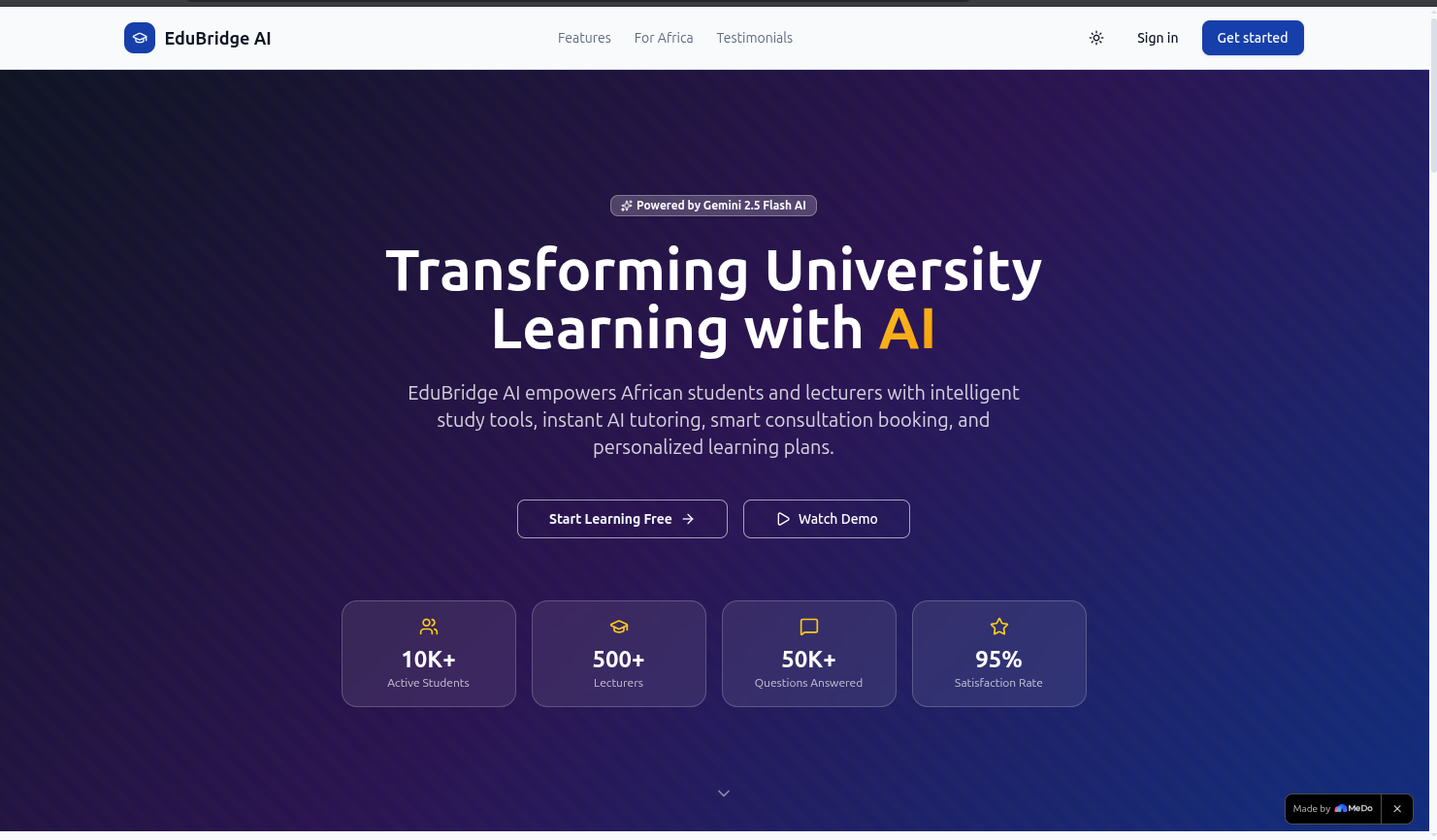
I built EduBridge AI to solve a problem I see in many universities: students struggle to access academic support outside class, while lecturers spend too much time handling repetitive questions and scheduling consultations manually.
I wanted to create a platform that combines AI, smart learning tools, and real-time lecturer consultations into one modern system.
What it does
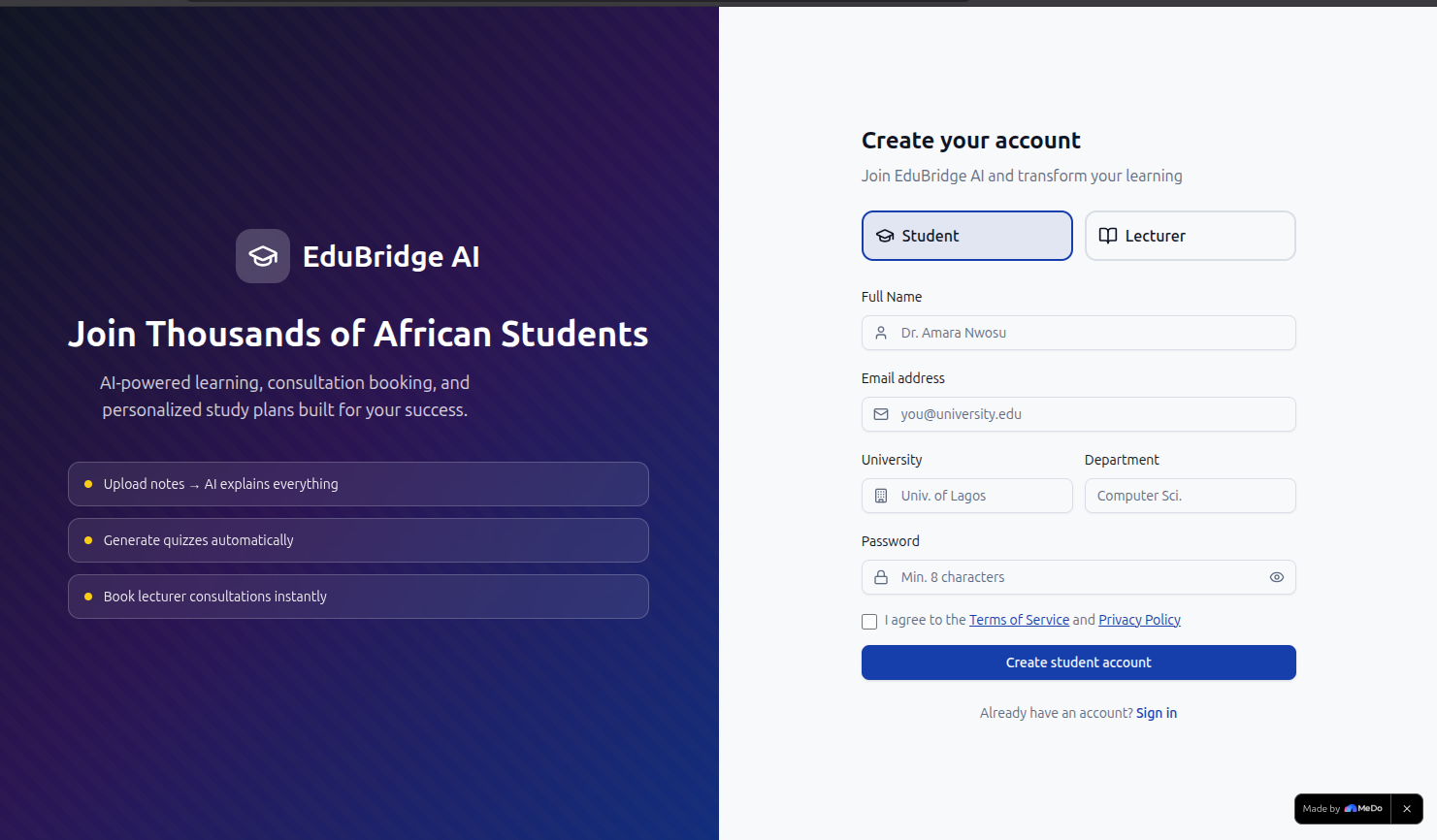
EduBridge AI is an AI-powered university learning platform with three portals:
Student Portal Lecturer Portal Admin Portal
Students can:
chat with an AI tutor, book lecturer consultations, generate quizzes and study materials, track learning progress, and join video consultations directly in the browser.
Lecturers can manage bookings, approve requests, monitor engagement, and manage courses.
One of the most powerful features is: “Explain this like my lecturer” where the AI adapts explanations based on uploaded course materials.
How we built it
I used MeDo AI heavily throughout development to help me:
structure the system architecture, design workflows, improve UI/UX, and rapidly prototype features.
I built the frontend using React, Next.js, Tailwind CSS, and Framer Motion.
For backend services, authentication, database management, and realtime updates, I used Supabase.
I integrated Gemini 2.5 Flash for the AI tutor and Jitsi Meet for browser-based video consultations.
Challenges we ran into
One of the biggest challenges was implementing the real-time consultation workflow between students and lecturers while managing approvals, notifications, and video sessions smoothly.
Another challenge was making the AI responses feel personalized instead of generic, which led me to build contextual AI interactions using uploaded learning materials.
What we learned
Through this project, I learned a lot about:
AI integrations, realtime systems, role-based platforms, scalable frontend architecture, and building complete end-to-end user experiences.
Most importantly, I learned how AI can be used to create meaningful impact in education.
What's next for EduBridge AI
The next step for EduBridge AI is expanding it into a fully scalable university learning ecosystem for institutions across Africa.
I plan to add: offline-first learning capabilities for low-connectivity environments, AI-generated personalized revision plans, smarter lecturer analytics, mobile applications, and institution-wide deployment support.
I also want to improve the AI tutor by integrating Retrieval-Augmented Generation (RAG) so responses become even more contextual using uploaded lecture notes, assignments, and course materials.
Future versions will include:
automated lecture transcription, AI-generated class summaries, collaborative study spaces, smart academic performance prediction, and deeper LMS integrations for universities.
My long-term vision is to make EduBridge AI a modern AI-powered education platform that improves accessibility, communication, and learning outcomes for students everywhere.


Log in or sign up for Devpost to join the conversation.