-
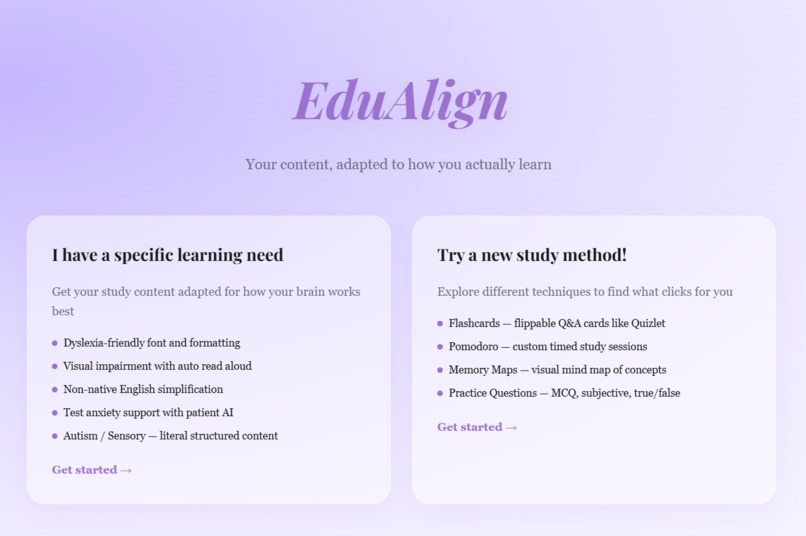
Website Page
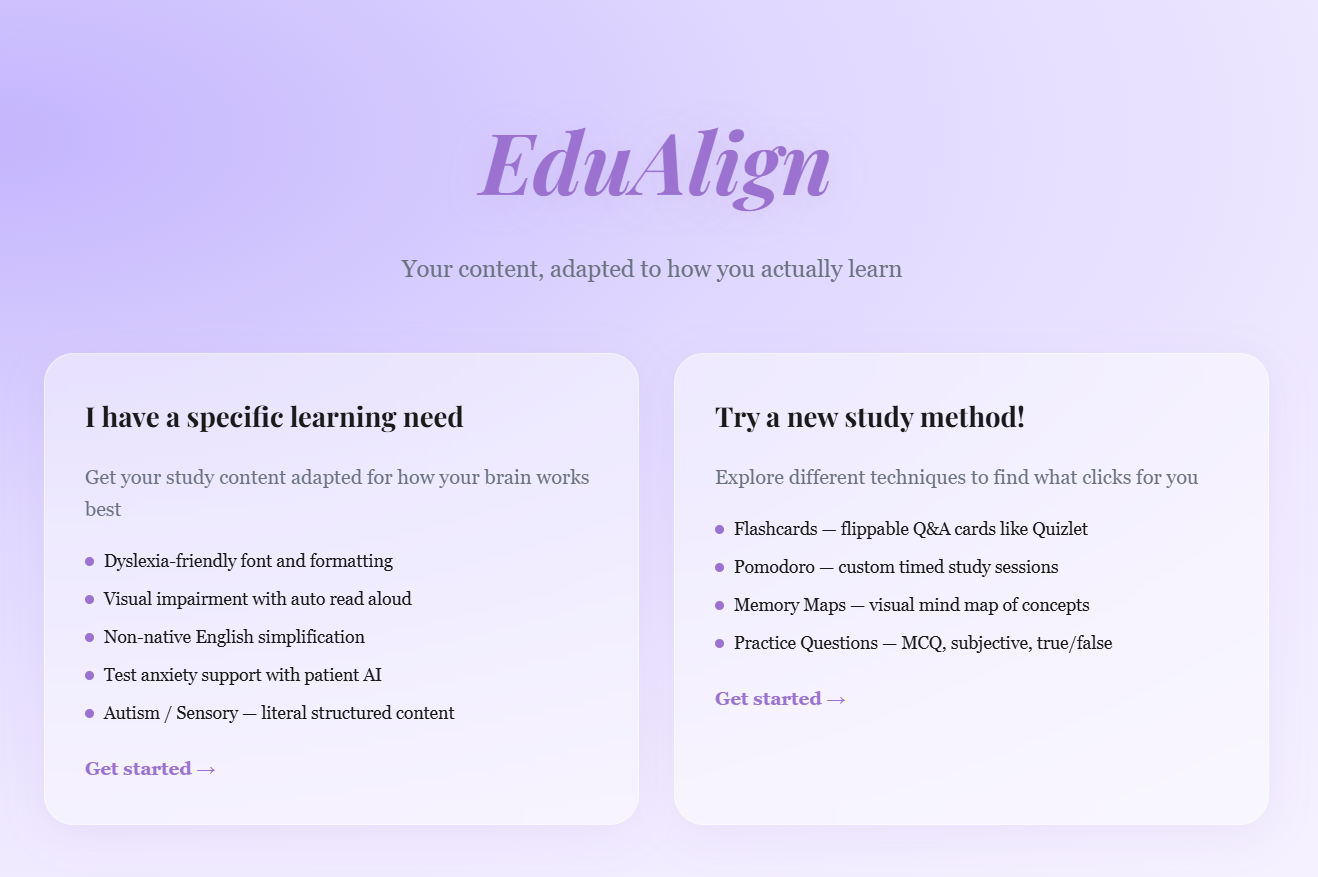
About the project
Accessibility in education is often treated as an afterthought, even though many students struggle not because they lack ability, but because the way content is presented doesn’t match how they learn. Dense paragraphs, complex language, and rigid formats can make studying overwhelming, especially for students with dyslexia, ADHD, autism, anxiety, or language barriers.
Existing tools are often fragmented or purely functional. They don’t make learning feel comfortable, engaging, or enjoyable. EduAlign was built from the belief that students shouldn’t have to adapt to content; content should adapt to them. It is an AI-powered React web application that takes any study material such as lecture notes, textbooks, assignments, or syllabus and transforms both the content and the interface based on the student’s learning needs.
I researched how factors like cognitive load, language complexity, structure, and emotional state affect comprehension, and also spoke to my best friend studying psychology to better design modes like autism and test anxiety in a way that feels supportive and structured.
Using AI for rewriting and structuring content, along with browser APIs like text-to-speech and notifications, I built multiple accessibility modes such as dyslexia (OpenDyslexic font, spacing, reading ruler), visual impairment (large text, high contrast, read-aloud, Scaling feature), ESL (simplified language with bilingual support), autism (clear, literal, step-by-step structure), and test anxiety (gentle tone with emotional check-ins).
Beyond accessibility, I also integrated study methods like flashcards, Pomodoro timers, memory maps, and practice questions, because many students rely on different tools to stay engaged and retain information. One of the biggest challenges was ensuring that the UI and content adapt together as a unified experience rather than feeling like separate features, while also keeping the interface clean despite the number of functionalities.
Building this solo overnight required prioritizing meaningful features and focusing on creating something that genuinely improves the learning experience. Through this project, I learned that accessibility is not just about disability, it’s about reducing friction for all learners, and that thoughtful design combined with AI can make education feel more approachable, personalized, and engaging.
Built With
- css
- javascript
- localstorage
- openrouter-api
- react
- vercel
- vite
- web-speech-api


Log in or sign up for Devpost to join the conversation.