Inspiration
Students learn from many different sources—textbooks, PDFs, presentation slides, lecture videos, and notes. However, these resources are often disconnected, making it difficult to find the right explanation, revise weak topics, and know what to study next.
We wanted to build an AI tutor that does more than simply answer questions.
EduAdapt AI was inspired by the idea of creating a learning companion that understands a student's actual course material, explains concepts using those sources, identifies knowledge gaps, and continuously adapts to the student's learning progress.
Our vision was to turn scattered learning resources into a personalized, source-grounded learning experience.
What it does
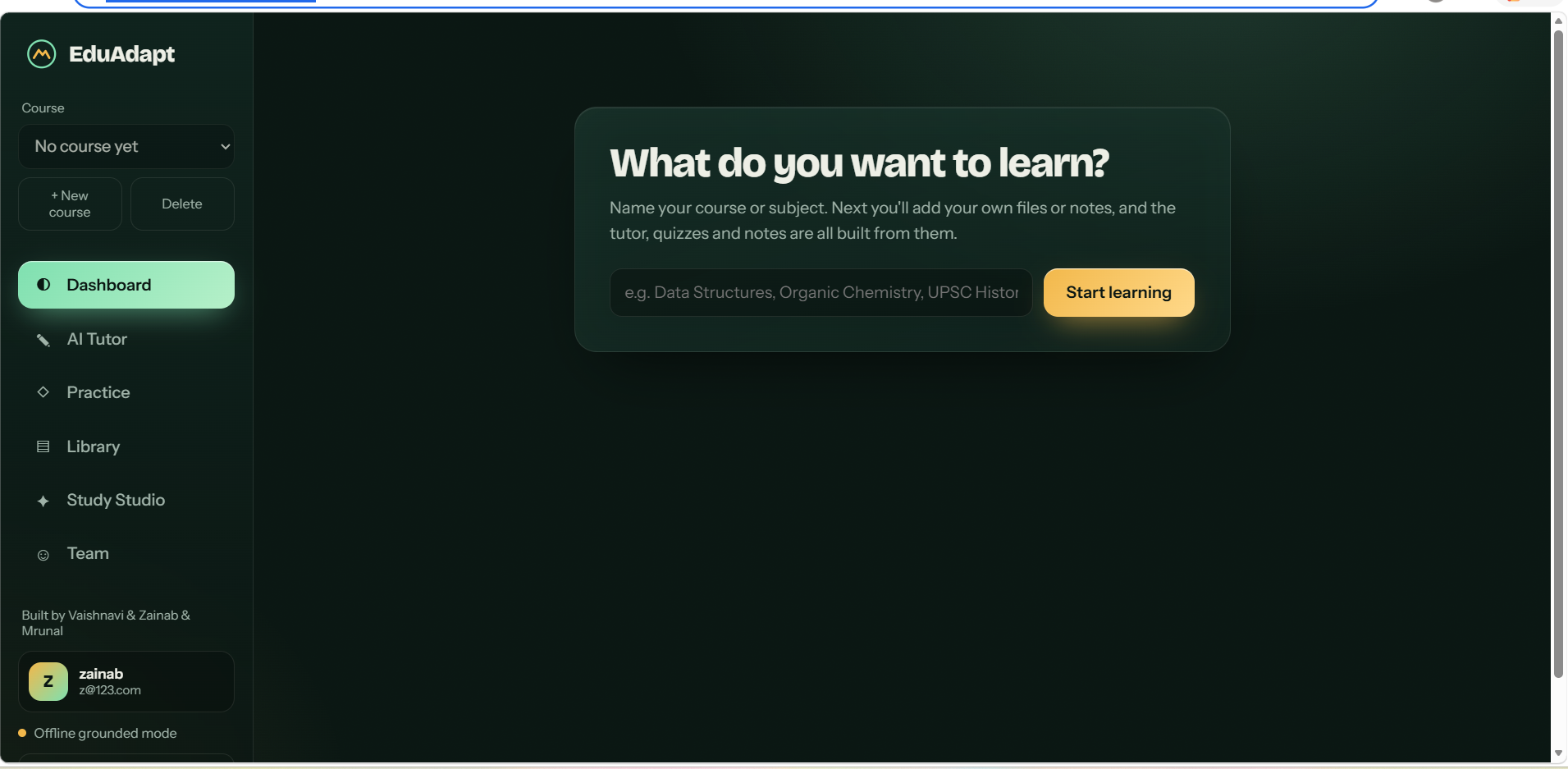
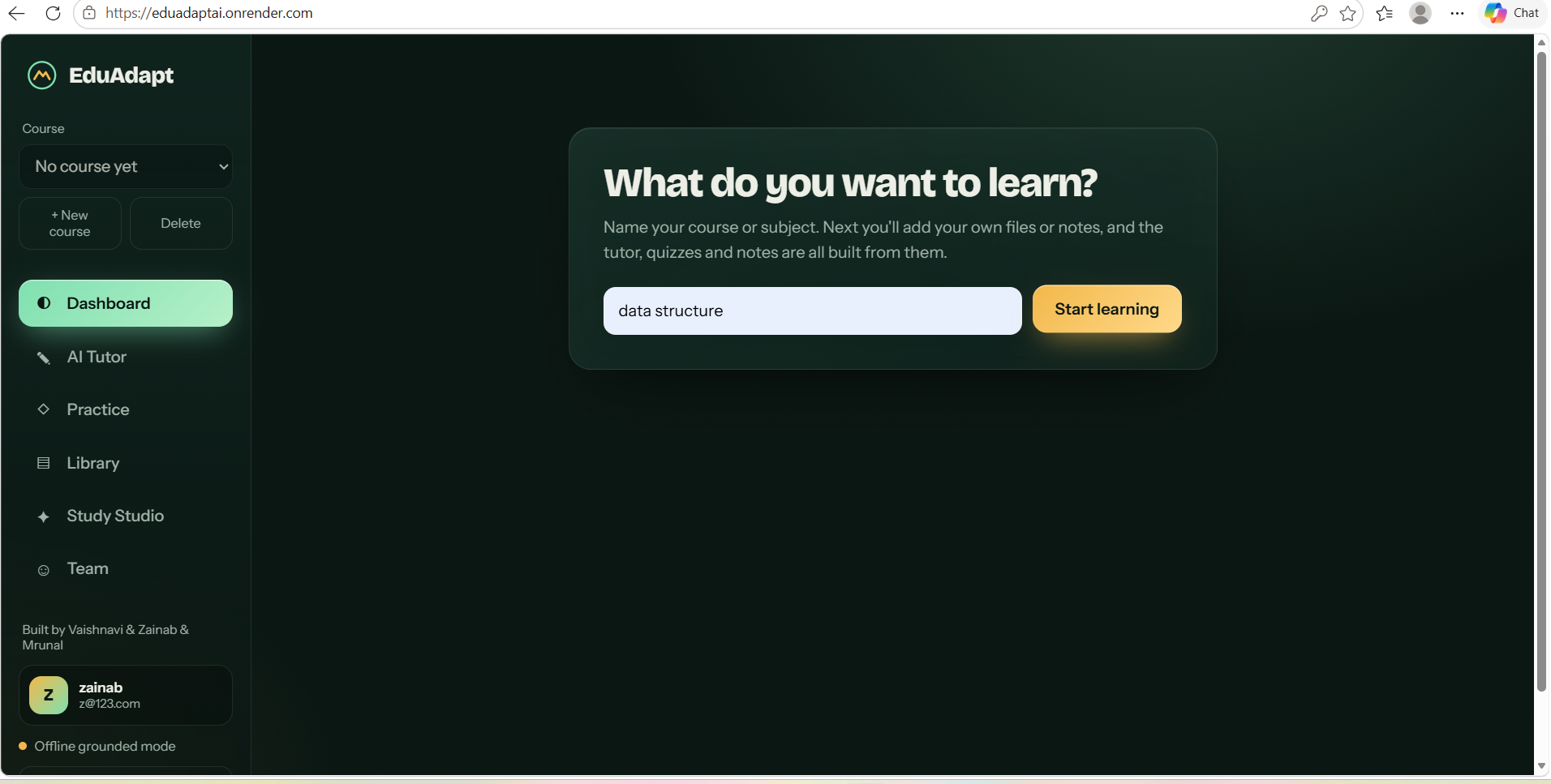
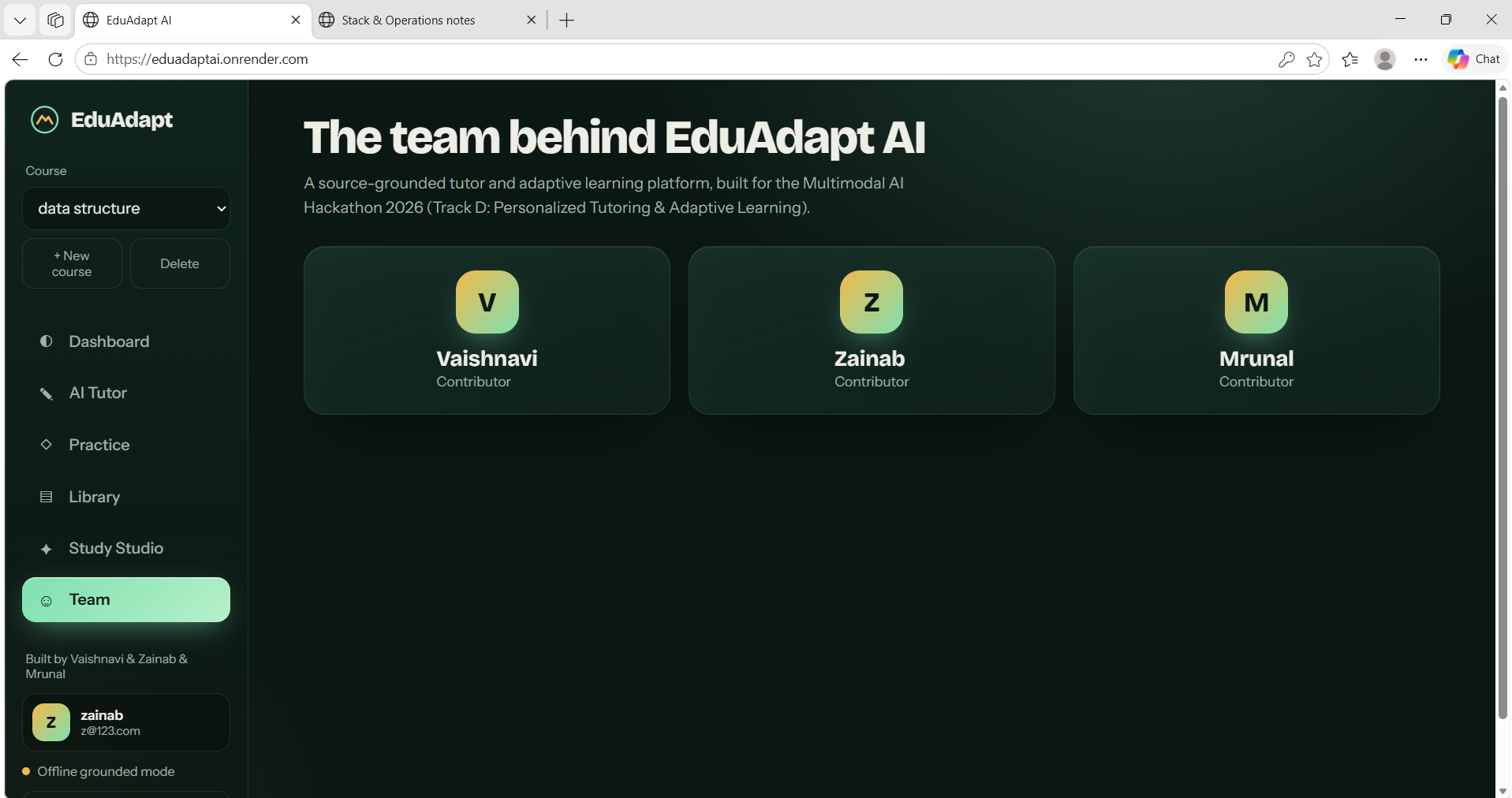
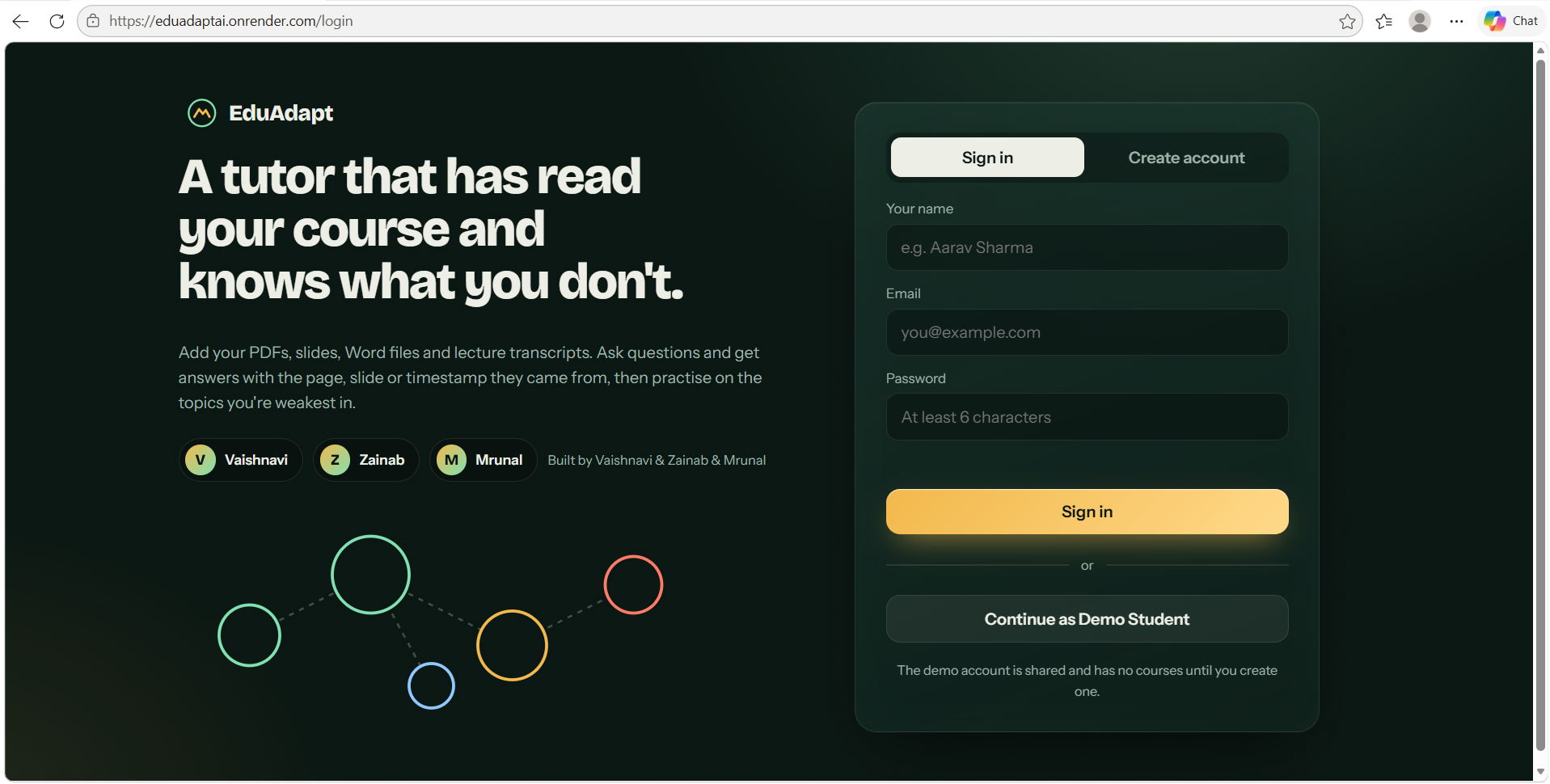
EduAdapt AI is a multimodal AI tutoring and adaptive learning platform.
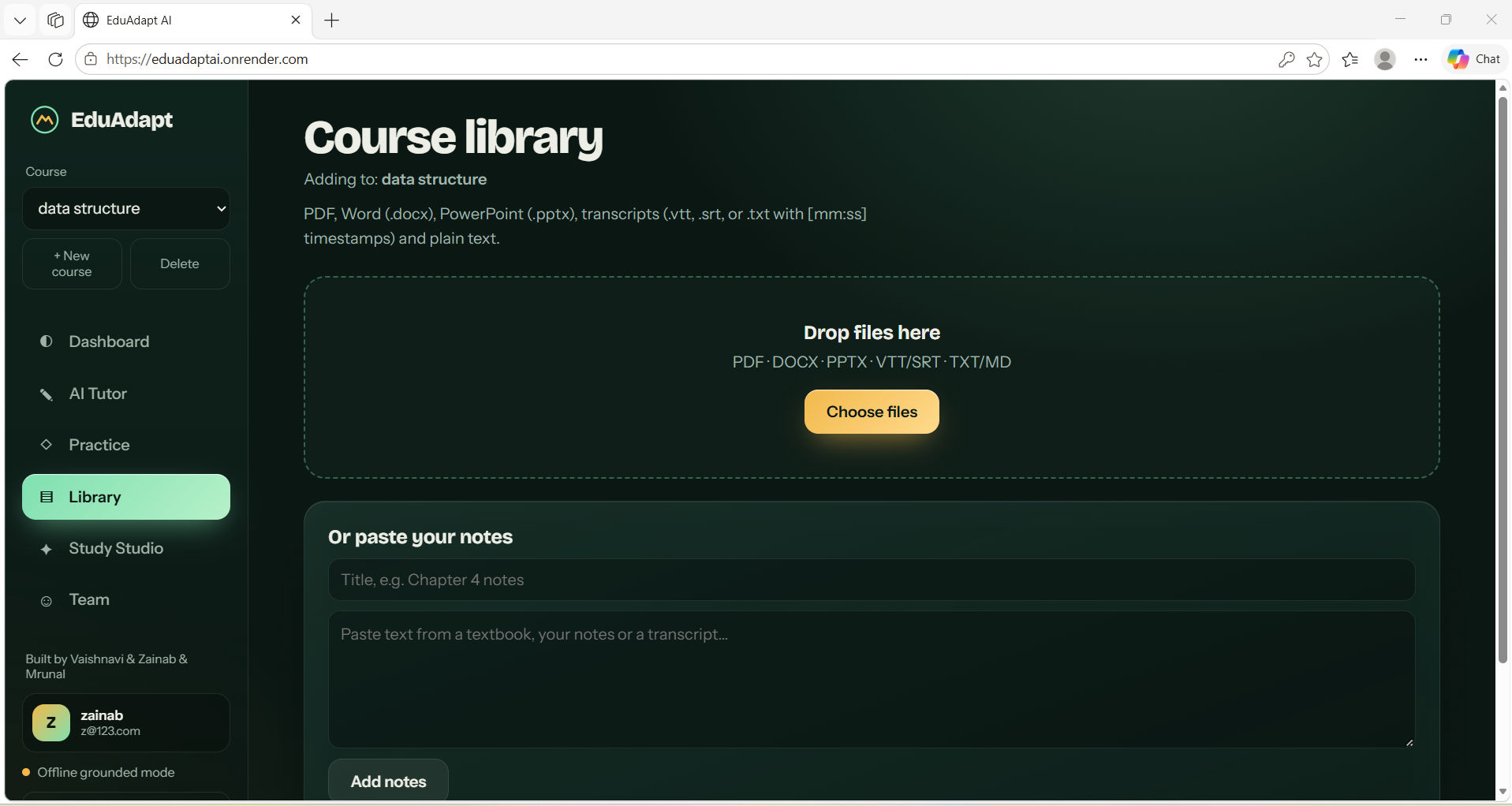
Students can provide course materials such as:
- 📄 Textbooks and PDFs
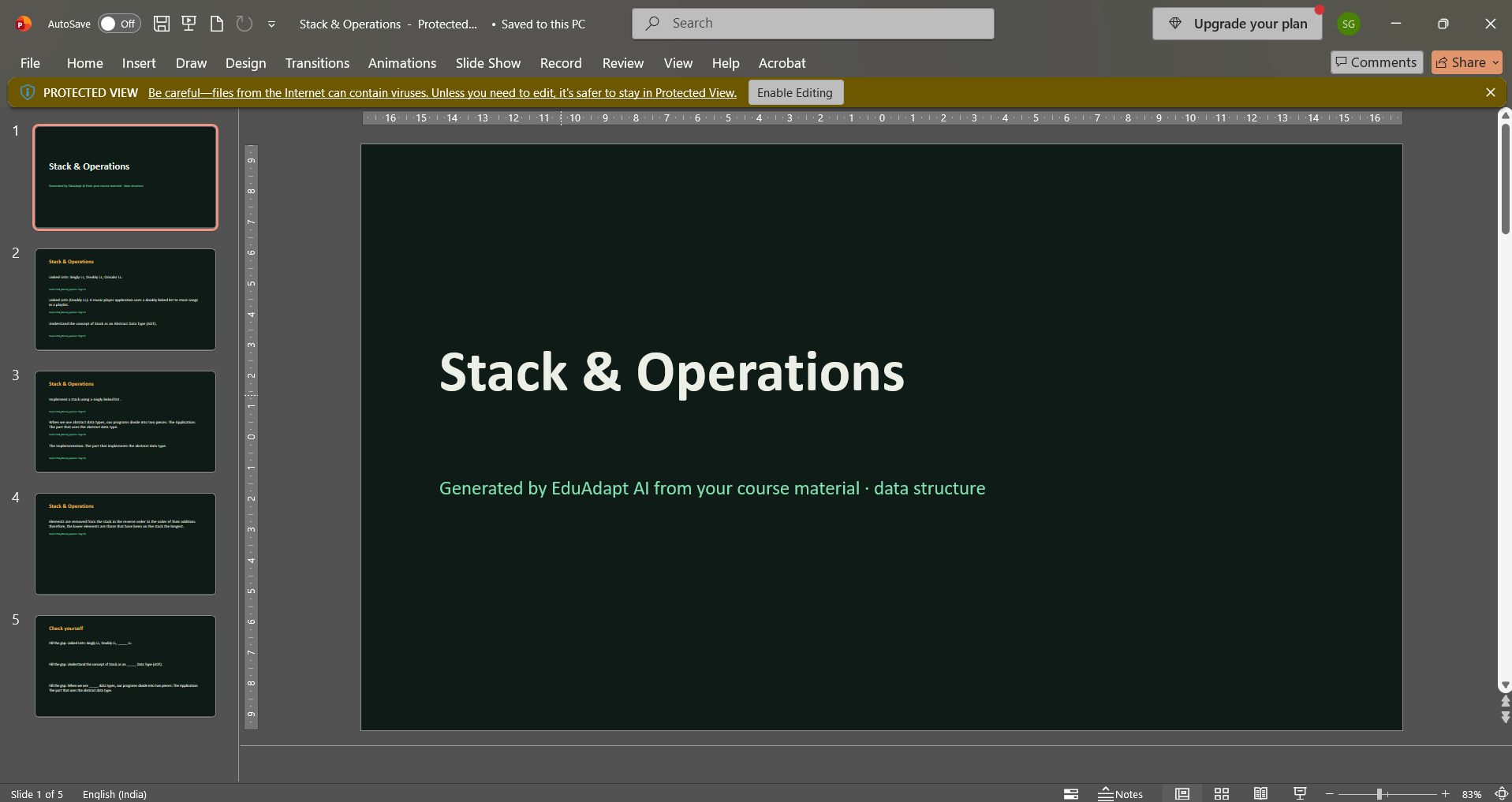
- 📊 Presentation slides
- 🎥 Lecture videos
- 🖼️ Images, diagrams, and figures
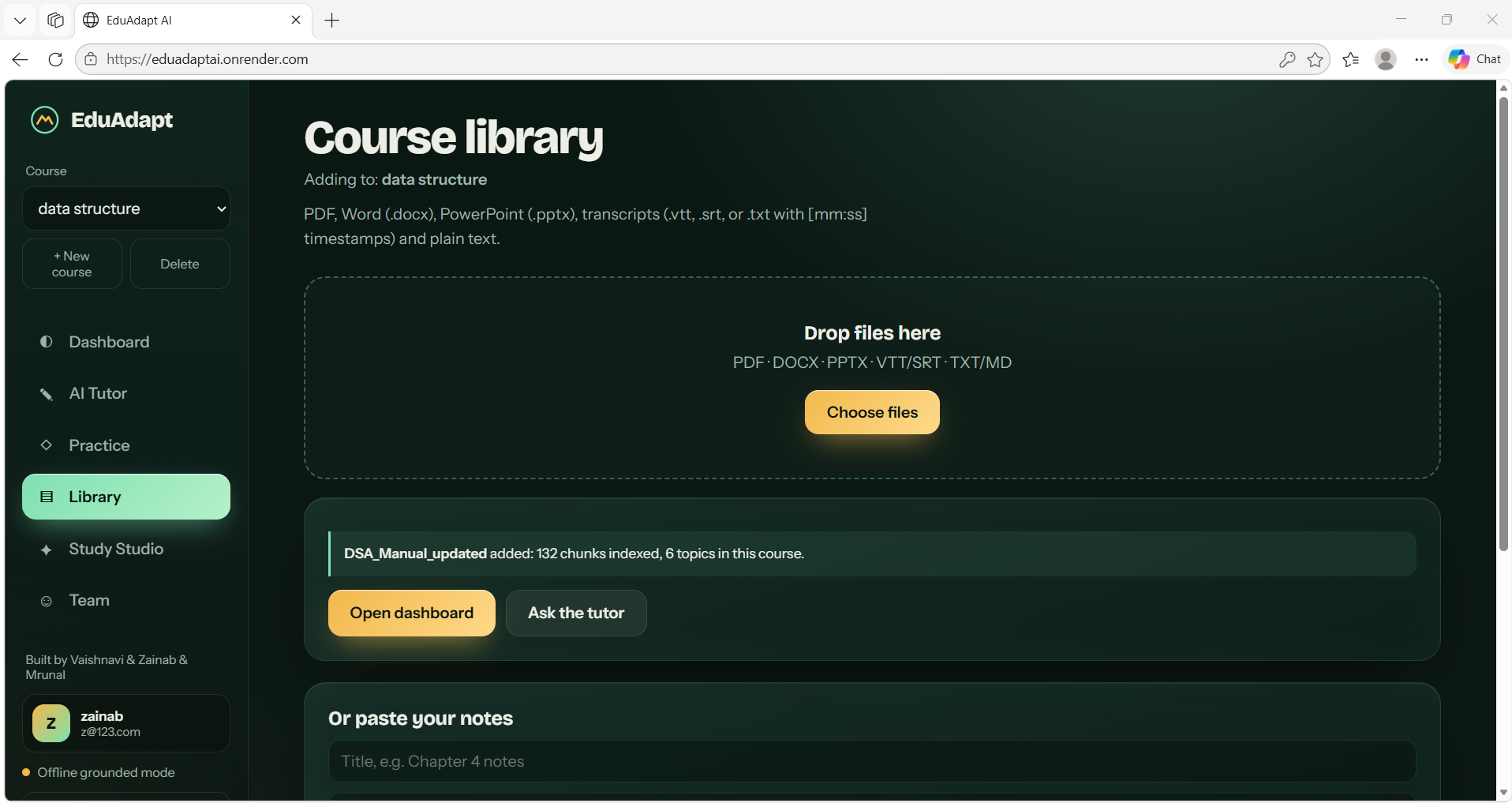
The system processes these materials and builds a structured knowledge base containing topics, subtopics, concepts, prerequisites, and source references.
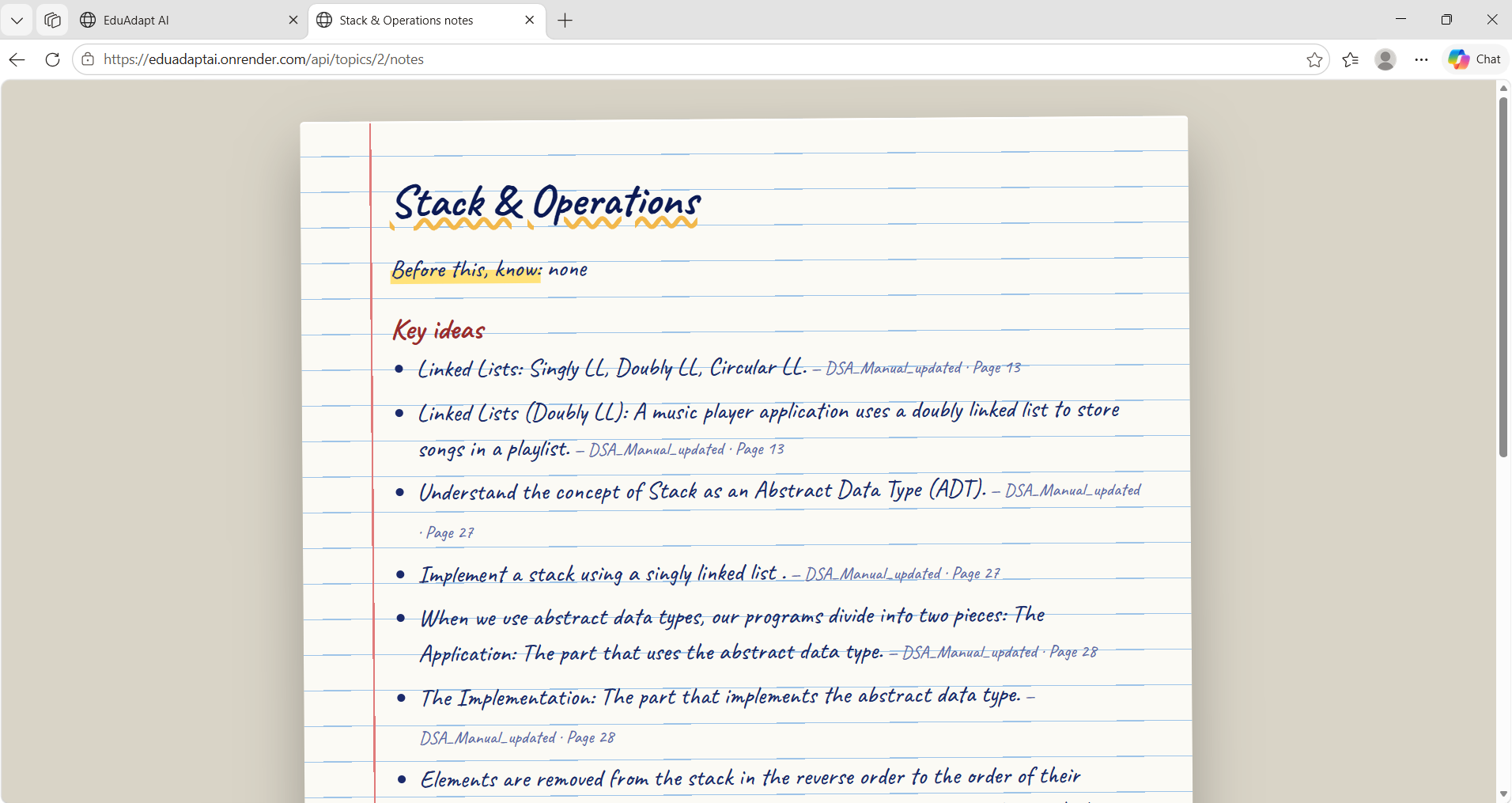
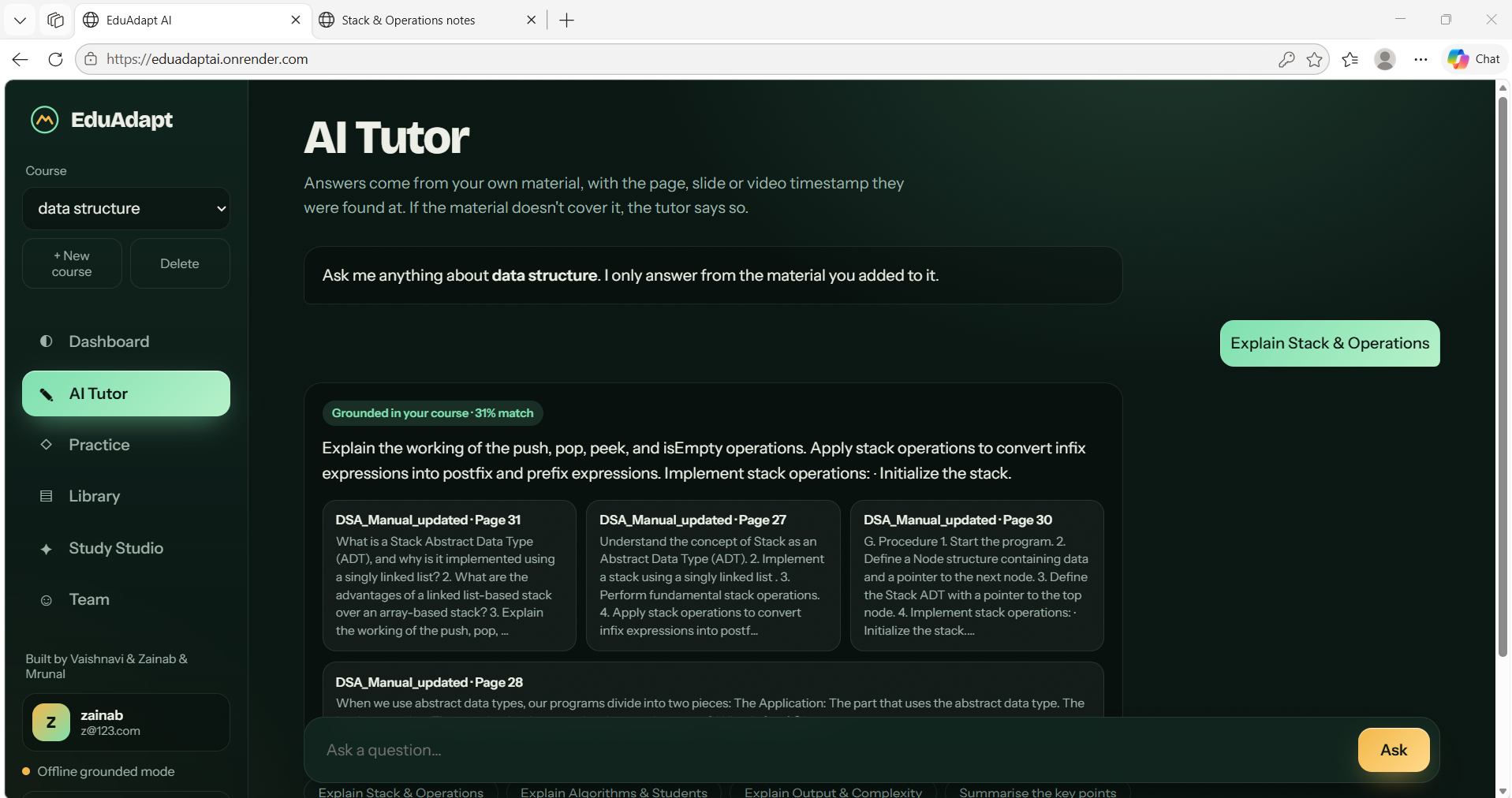
Students can then ask questions through the AI tutor. Instead of relying only on general knowledge, EduAdapt AI retrieves relevant course content and provides source-grounded answers with citations to the corresponding page, slide, or video timestamp.
The platform also provides:
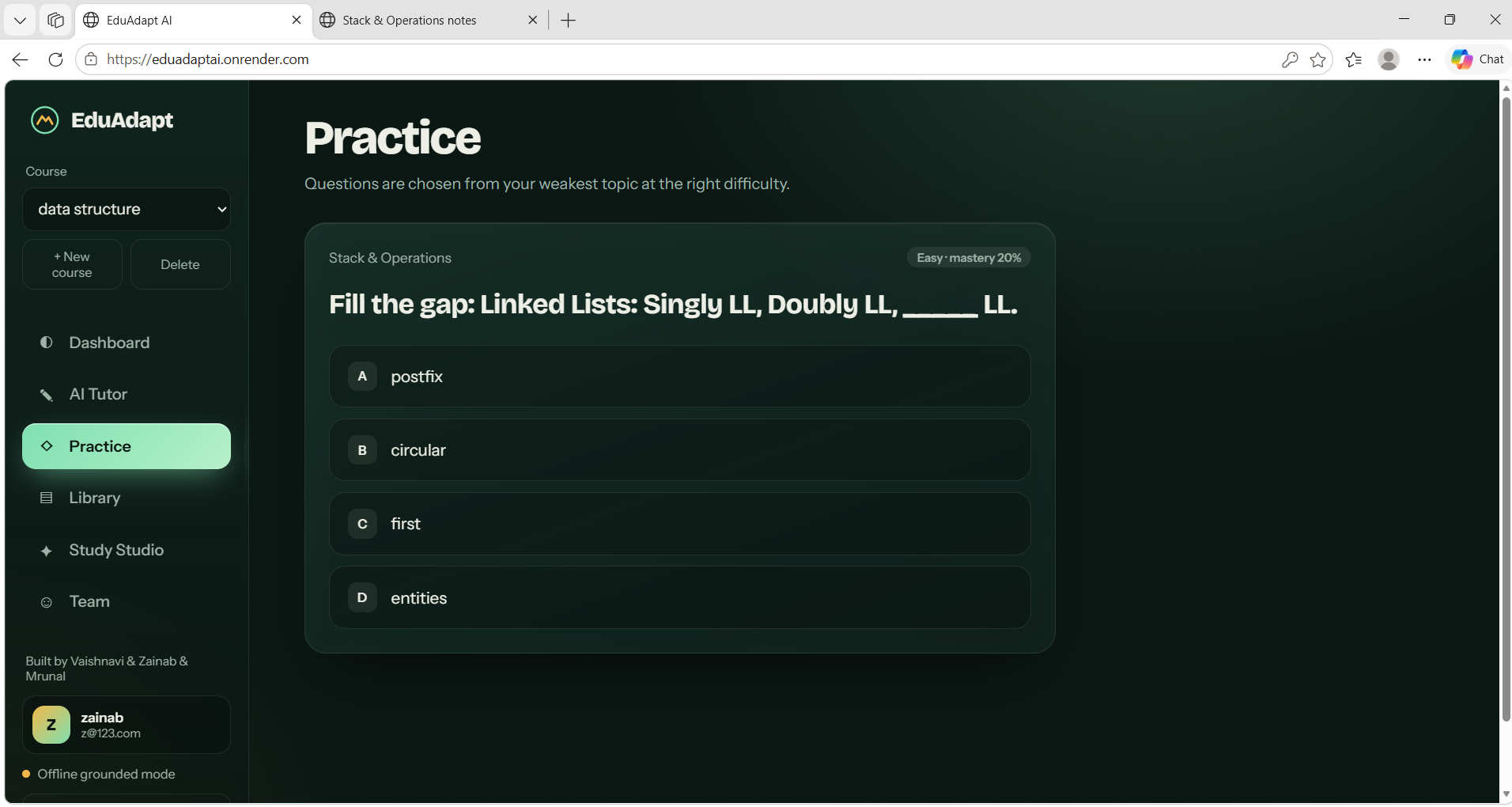
- Adaptive quizzes based on the student's current knowledge
- MCQs, short-answer, and numerical questions
- Topic and difficulty tagging
- Question validation and duplicate detection
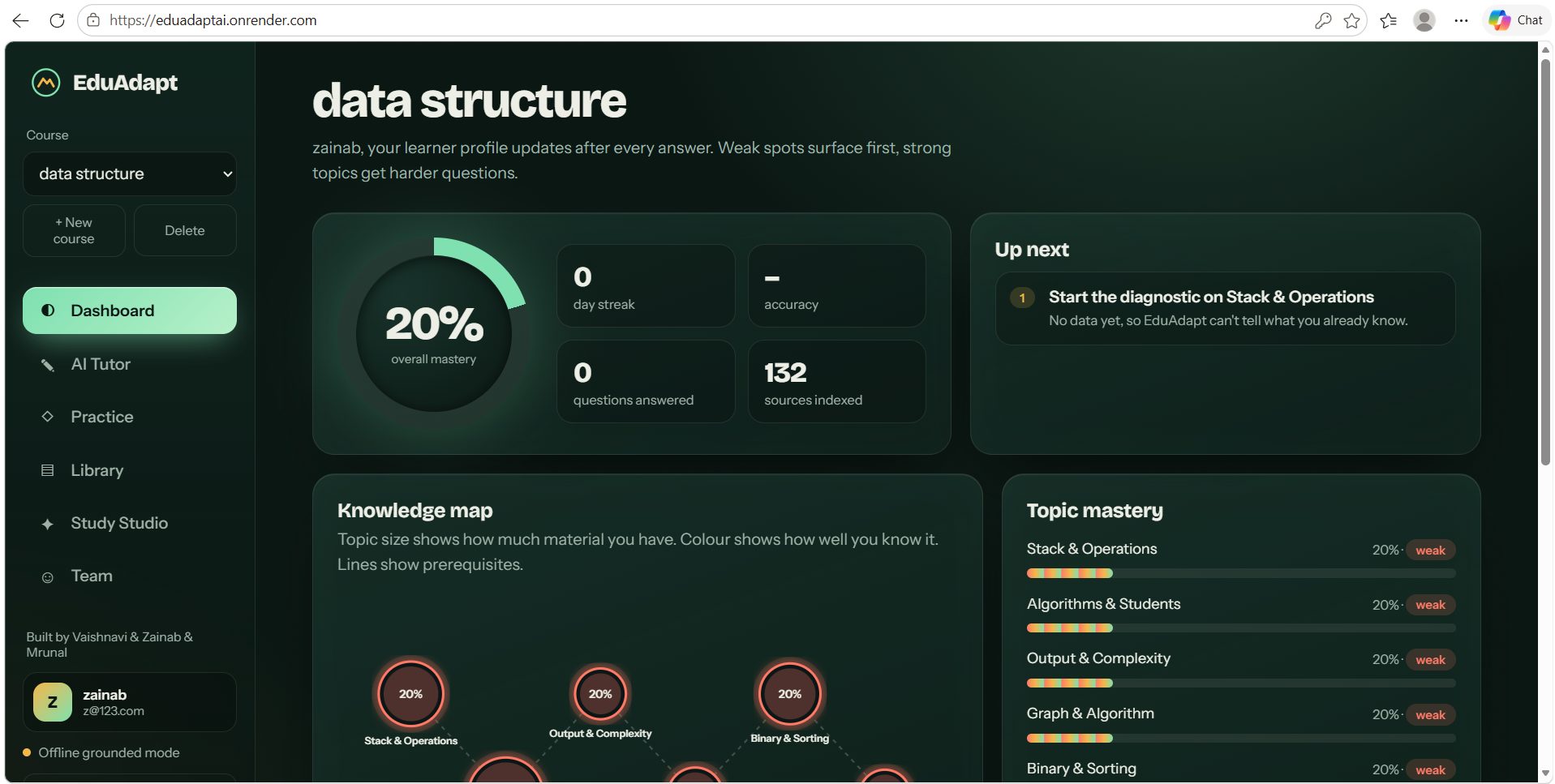
- Diagnostic assessments for new students
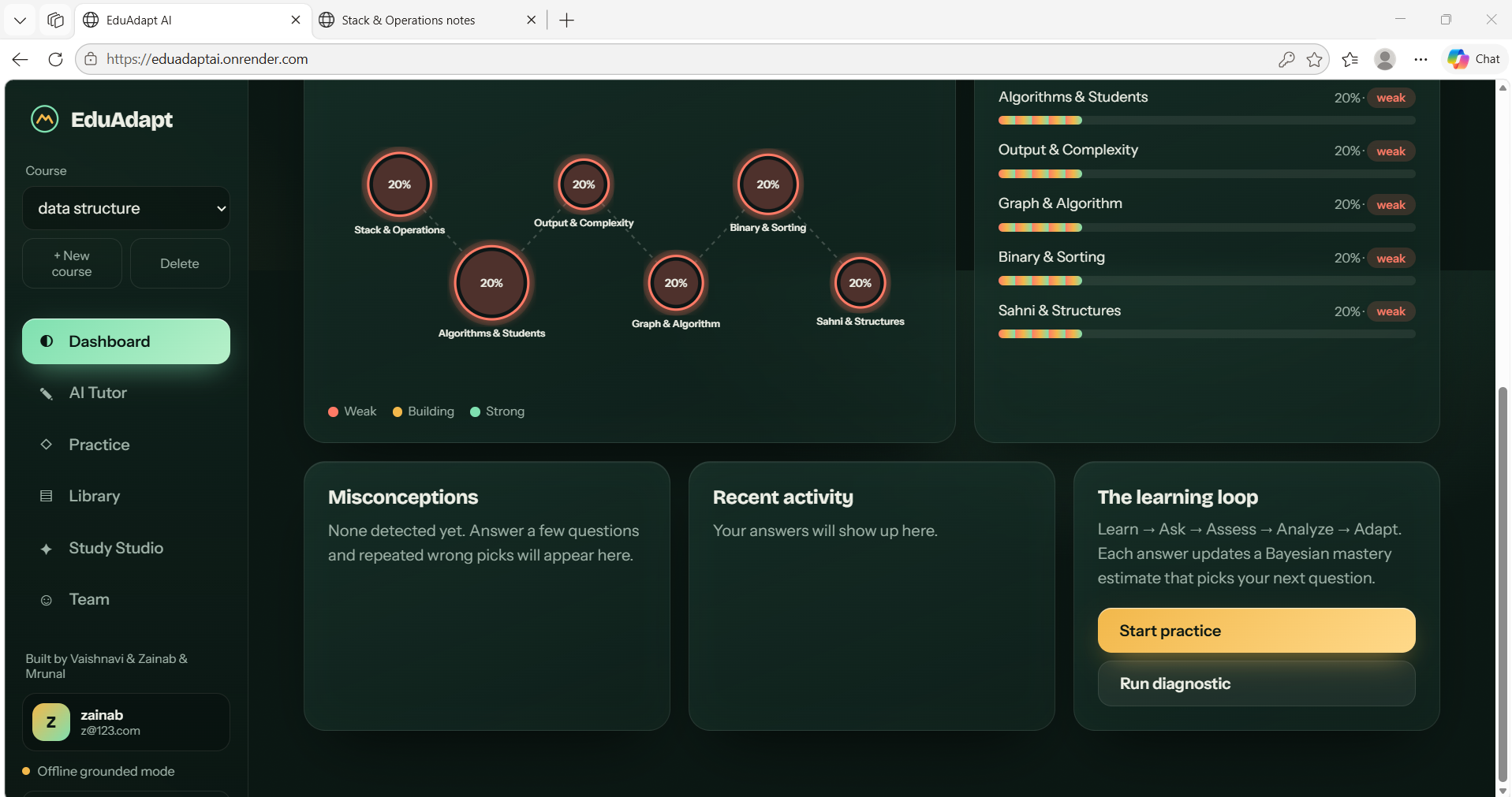
- Topic-wise mastery tracking
- Weak-topic and misconception detection
- Personalized learning recommendations
As students interact with the system, their learner profile is updated and future questions are adapted accordingly.
How we built it
We built EduAdapt AI as a modular AI-powered web application.
Multimodal Knowledge Processing
Different learning formats are processed according to their content:
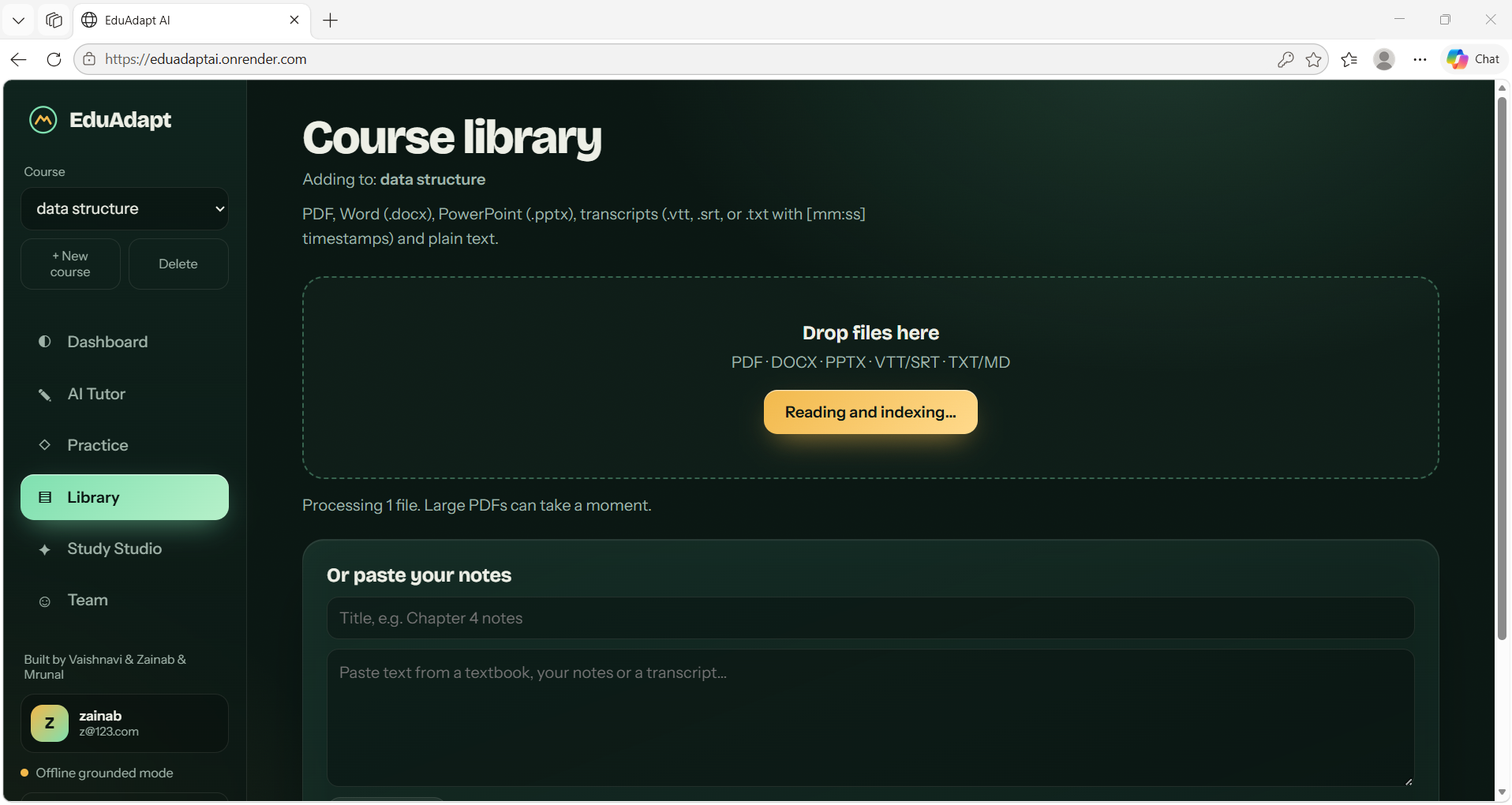
PDF → text, pages, images and figures are extracted.
PPT → slide text, diagrams and visual information are processed while preserving slide references.
Video → speech is converted into timestamped text so that students can trace explanations back to the lecture.
The extracted content is divided into meaningful chunks and enriched with metadata such as topic, concept, page number, slide number, and timestamp.
Source-Grounded AI Tutor
We use a Retrieval-Augmented Generation (RAG) pipeline.
When a student asks a question:
Question → Embedding → Relevant content retrieval → Context verification → AI response → Source citation
This allows the tutor to connect its answer back to the student's actual learning material.
Queries that are not sufficiently supported by the uploaded material are flagged instead of being presented as course-grounded answers.
Adaptive Assessment
Questions are generated from the course knowledge base and tagged with:
- Topic
- Difficulty
- Question type
- Source
- Source location
Generated questions go through validation and duplicate checking before being used for assessment.
Learner Model
The system maintains topic-wise mastery for each student.
After every assessment, the student's performance is used to update their mastery profile. The next learning activity can then focus on topics where the student needs more practice.
The application is built using Python, Django, JavaScript, HTML/CSS, SQL, embeddings, vector search, and LLM-based AI components, along with multimodal processing and evaluation tools.
Challenges we ran into
One of our biggest challenges was handling multiple types of learning material in a single knowledge system.
A PDF, presentation, and lecture video contain information in very different formats. We needed to extract useful information while preserving its original location so that the AI could provide meaningful citations.
Another challenge was preventing hallucinations. A normal chatbot can answer questions using information outside the student's course. For an educational system, this can be confusing and difficult to verify. We therefore focused on grounding responses in retrieved course content and identifying unsupported queries.
We also faced challenges in:
- Extracting useful information from diagrams and figures
- Maintaining page, slide, and timestamp references
- Generating reliable assessment questions
- Preventing repetitive questions
- Identifying student misconceptions
- Updating mastery after every interaction
- Making the learning experience genuinely adaptive rather than simply conversational
- Evaluating the quality of both retrieval and generated answers
Accomplishments that we're proud of
We are proud that EduAdapt AI brings several components of an intelligent learning system together instead of building just another chatbot.
Our key accomplishments include:
- Multimodal course ingestion from documents, slides, videos and visual content
- Structured course knowledge base with topics, concepts and prerequisites
- Source-grounded AI tutoring with page, slide and timestamp references
- Unsupported-query handling to reduce ungrounded answers
- Adaptive assessment generation based on course content
- Question validation and duplicate detection
- Topic-wise learner mastery tracking
- Diagnostic assessment for new learners
- Personalized recommendations based on weak topics
- AI evaluation using measurable retrieval and response-quality metrics
Most importantly, we focused on creating a complete learning loop:
Learn → Ask → Assess → Analyze → Adapt → Learn Again
What we learned
Through this project, we learned that building an educational AI system requires much more than integrating an LLM.
We gained practical experience with multimodal data processing, Retrieval-Augmented Generation, embeddings, vector search, source grounding, prompt design, assessment generation, learner modeling, and AI evaluation.
We also learned the importance of maintaining traceability. For educational applications, an answer becomes much more useful when a student can immediately see where the information came from.
Another important lesson was that personalization should be measurable. Instead of simply claiming that the system is adaptive, we designed the system so that student performance can influence mastery estimates, question selection, and future recommendations.
What's next for EduAdapt AI
We want to evolve EduAdapt AI from a hackathon prototype into a more complete personalized learning platform.
Our next improvements include:
- 🧠 More advanced learner models such as Bayesian Knowledge Tracing
- 🔄 Spaced repetition and forgetting-curve-based revision
- 🗺️ Interactive prerequisite and course-flow maps
- 📚 Automatically generated revision notes and study materials
- 📅 Personalized exam preparation schedules
- 🌐 Multilingual tutoring, especially for Indian languages
- 🎙️ Voice-based AI tutoring
- 🖼️ Better understanding of complex educational diagrams
- 👩🏫 Instructor dashboards and learning analytics
- 📈 Long-term learning progress and mastery analysis
Our long-term goal is to make EduAdapt AI a learning companion that doesn't just answer what students ask, but understands what they know, what they don't know, and what they should learn next.
Built With
- adaptive
- ai
- css
- database
- django
- embeddings
- html
- javascript
- learning
- llm
- machine
- multimodal
- ocr
- powerpoint
- processing
- python
- rag
- ragas
- speech-to-text
- sql
- tutor
- vector


Log in or sign up for Devpost to join the conversation.