-
-
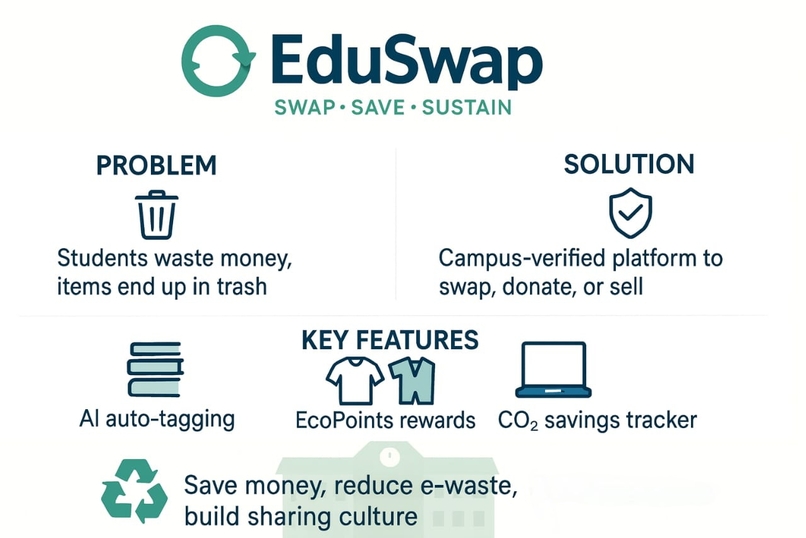
"EduSwap: A smarter way for students to save money and reduce waste."
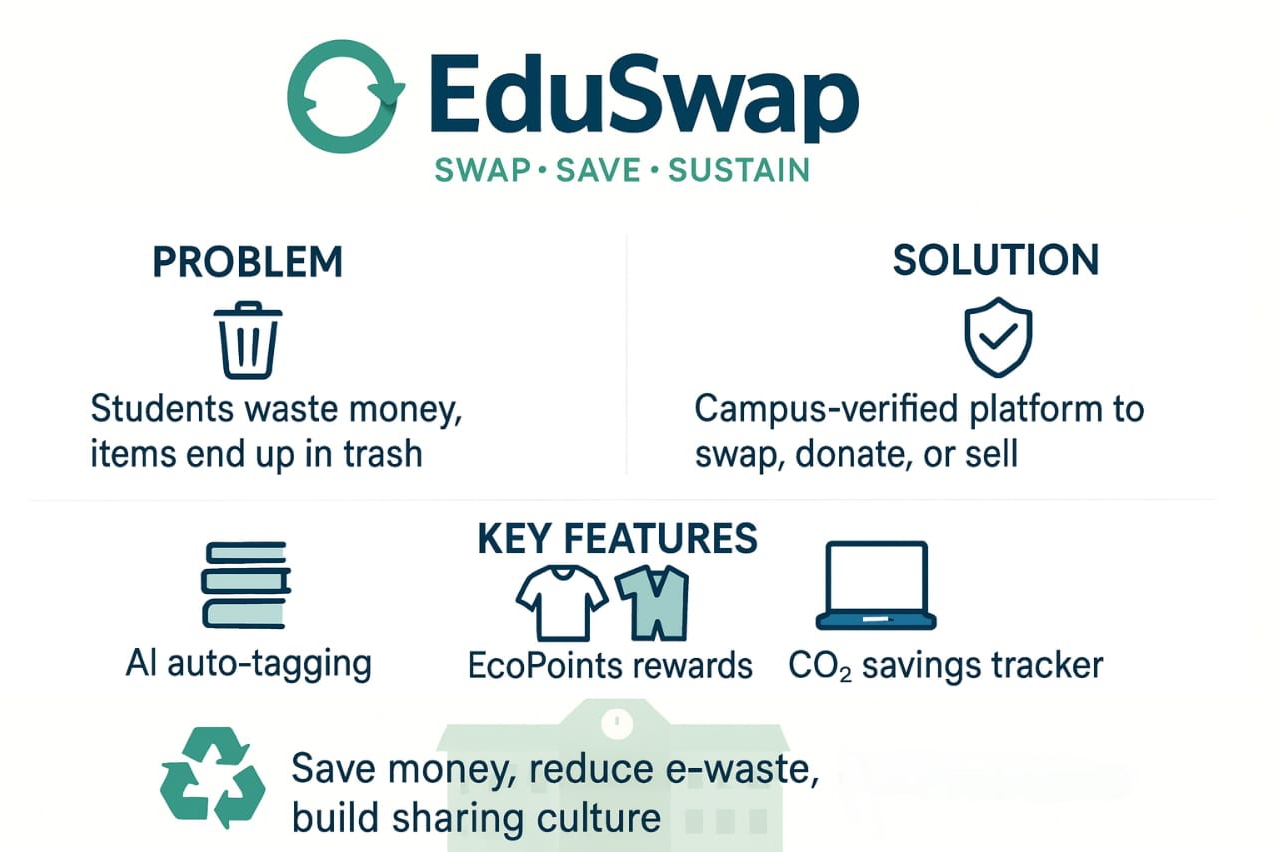
Inspiration
Edu Swap
Every semester, students buy expensive textbooks, lab materials, calculators, notes, and academic tools. But once their exams are over, most of these items lose value to them. They sit unused, gather dust, or are thrown away. At the same time, another student is searching for those exact resources — sometimes unable to afford the high cost.
This gap between waste and need, between unused items and unmet demand, sparked the idea for Edu Swap.
What started as a simple thought — “One student’s waste can become another student’s treasure” — grew into a bigger vision: a platform where students can swap, buy, or sell academic resources, and even earn from the materials they no longer need.
What it does
Edu Swap is a student-focused platform that allows users to swap, buy, and sell educational resources. Students can exchange textbooks, notes, lab equipment, stationery, and other academic materials. The platform helps students:
Save money with affordable used resources
Earn money by selling unused materials
Reduce waste through a reuse-and-recycle culture
Discover study tools quickly using a matching algorithm
In simple terms, Edu Swap turns unused items into useful resources or income for students.
How we built it
We built Edu Swap by breaking the project into small, manageable parts.
Research & Problem Identification We talked to students and realized that they often waste academic materials after each semester, while others struggle to buy new ones. This guided our platform design.
Feature Planning We designed three main modules:
Swap (exchange items directly)
Buy & Sell (marketplace model)
Recommendation/Matching system
UI/UX Design We created simple screens for listing items, searching, and requesting swaps or purchases.
Backend Structure We built a database to store user details, item listings, prices, categories, and swap requests.
5.Testing & Improvements We tested for duplicate listings, UI clarity, and multi-request conflicts, refining the platform step-by-step.
Challenges we ran into
Designing a platform that supports swapping + buying + selling smoothly
Handling multiple requests for the same item
Preventing spam or duplicate listings
Creating an easy-to-use interface that works for all students
Structuring the recommendation logic for accurate item matching
Managing time and dividing tasks efficiently as a team
Finding a simple flow that works for all departments
Ensuring the UI is easy for any student to use.
Designing a beginner-friendly prototype within time limits.
Every challenge taught us something important and improved the final product.
Accomplishments that we're proud of
Turning a simple idea into a functional multi-purpose platform
Successfully integrating three systems (swap, buy, sell)
Building a keyword-based matching algorithm that ranks useful resources
Designing a clean and minimal UI that students can use instantly
Creating a solution that actually solves real student problems
Working effectively as a team despite time constraints.
What we learned
How to convert real-life student problems into technical solutions
Practical UI/UX principles
Basic backend logic and database structuring
How marketplaces and matching algorithms work
How to think critically about user needs
Collaboration, communication, and time management
The importance of simplicity and clarity in design
Edu Swap taught us both technical and human skills.
What's next for Edu swap
We plan to expand Edu Swap with:
- College Tie-Ups & Verified Campus Marketplace
Collaborate with colleges to create campus-specific marketplaces.
Only students from that institution can post or buy items, ensuring safety and trust.
Conduct semester-end swap drives inside college campuses.
- AI-Driven Price Suggestion
Use machine learning to analyze condition, category, and demand.
Suggest the best selling price automatically, helping students earn fairly.
- Demand Forecasting
Predict which items juniors will need each upcoming semester.
Allows seniors to post items early and ensures faster matches.
- Location-Based Smart Delivery
Partner with delivery services inside the campus.
Enable hostel-to-hostel delivery, making the process completely hassle-free.
- Convenience Store Integration
Tie-up with campus stores/bookshops.
Students can sell items through the college store as an official resale center.
- Gamification & Rewards
Reward students with points for:
Posting items
Swapping eco-friendly products
Completing profile verification
Points can be converted into discounts or coupons.
- Community Donation Drives
Integrate a feature where students can donate items to juniors or NGOs.
Run “Zero Waste Campus” campaigns in partnership with environmental clubs.
- Sustainability Dashboard
Track how much waste each student prevents.
Show total carbon footprint saved through reusing items.
Motivate students to participate more.
Built With
- basic-react-structure
- firebase-(authentication
- firestore
- html
- javascript
- mocha-ai-app-builder
- storage)

