-
-
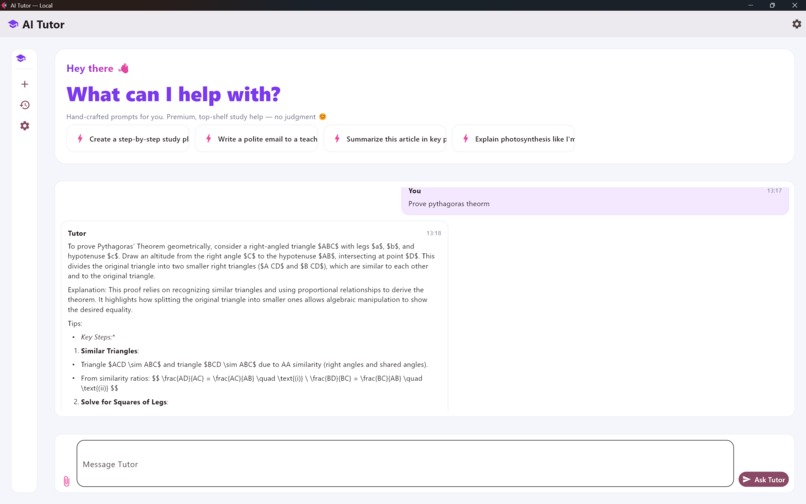
Desktop application
Inspiration
We were inspired by the idea of making AI accessible everywhere, from rural villages to urban centers. Students, teachers, and entrepreneurs should all have equal opportunities to skill up and succeed. Back in our time, such resources didn’t exist. With this project, we hope AI can guide the next generation to learn better and dream bigger.
What it does
Our project is EduBuddy, an AI tutor for students from grades 1–12.
- It answers academic questions across subjects.
- Runs on low-resource hardware (8GB RAM machines) using a distilled version of Qwen3 1.7B.
- In case the smaller model fails, queries are escalated to a master machine running OpenAI OSS 20B, ensuring accuracy.
- Works even in settings like rural schools with limited to no internet access.
How we built it
- Step 1: Generated prompts and labeled them using the Nvidia OpenAI OSS API.
- Step 2: Used a student - teacher training approach: the 20B teacher guided distillation into a 1.7B student.
- Step 3: Fine-tuned and distilled models on a single GPU (RTX 4060) for approx 2 weeks.
- Step 4: Developed a fallback agent framework to route requests between student and master models.
- Step 5: Prepared demo material, slides, and offline-ready setups for schools/universities.
- Step 6: Week 4 was dedicated to testing, demonstrations, and submission.
Challenges we ran into
- Training and distilling large models on a single-GPU machine (slow and resource-limited).
- Handling fallback latency when redirecting from the distilled model to the master model.
- Ensuring everything could run offline for rural schools.
Accomplishments that we're proud of
- Built a distilled GPT that runs on smaller, affordable hardware.
- Successfully demonstrated the system in an Indian rural school, giving students a buddy to learn and interact with.
- Managed to create a working pipeline, from data prep to distillation to deployment, within the hackathon timeframe.
What we learned
- How to efficiently distill large models with limited data and hardware.
- Importance of planning fallback mechanisms for reliability.
- That with collaboration and creativity, even small teams with minimal resources can build AI systems that impact education and humanity at large.
What's next for Edu Buddy
- Fine tune on better syllabus content which covers Multilingual support
- Master machine and Slave machine can share their compute resources to make GPT-OSS 20B work without GPU
- Expand not only in India but worldwide, to provide better education and skill development help to fellow students


Log in or sign up for Devpost to join the conversation.