-
SMART BIN
Inspiration
Walking through our city, we noticed a recurring, frustrating sight: overflowing trash bins. It’s not just an eyesore; it’s a health hazard that attracts pests and creates foul odors. We realized the problem isn't usually a lack of bins, but a lack of data. Garbage trucks often follow fixed routes, picking up half-empty bins while ignoring overflowing ones. We wanted to build a bridge between "trash status" and "waste management action."
What it does
SMART BIN is an IoT-powered waste management solution that monitors trash levels in real-time.
Level Sensing: Using ultrasonic sensors, the bin constantly measures how full it is.
Automated Alerts: Once the waste reaches a pre-defined threshold (e.g., 90%), the system automatically triggers a notification.
Direct Communication: It sends a detailed message to the Municipal Corporation office, including the bin’s unique ID and location, ensuring the collection team can optimize their route and prioritize full bins.
How we built it
We combined hardware and software to create a seamless loop:
Hardware: We used an Arduino/ESP32 microcontroller paired with an Ultrasonic Sensor (HC-SR04) to detect distance.
Connectivity: For the messaging, we integrated the Twilio API (or GSM module) to send SMS alerts.
Logic: We wrote the firmware in C++ to filter out "noise" (like someone just dropping a piece of paper) and only trigger alerts when the bin is consistently full.
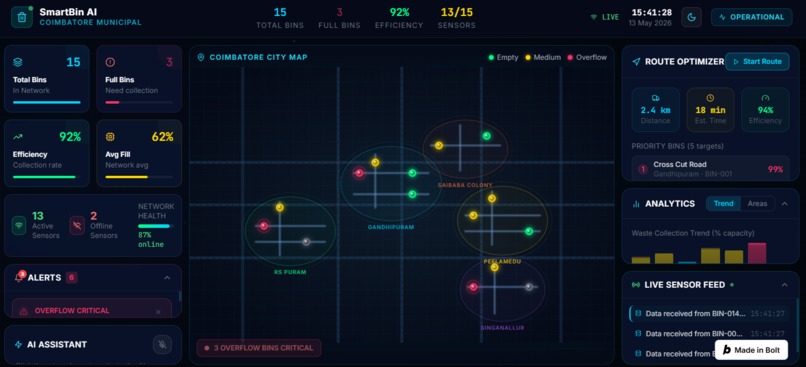
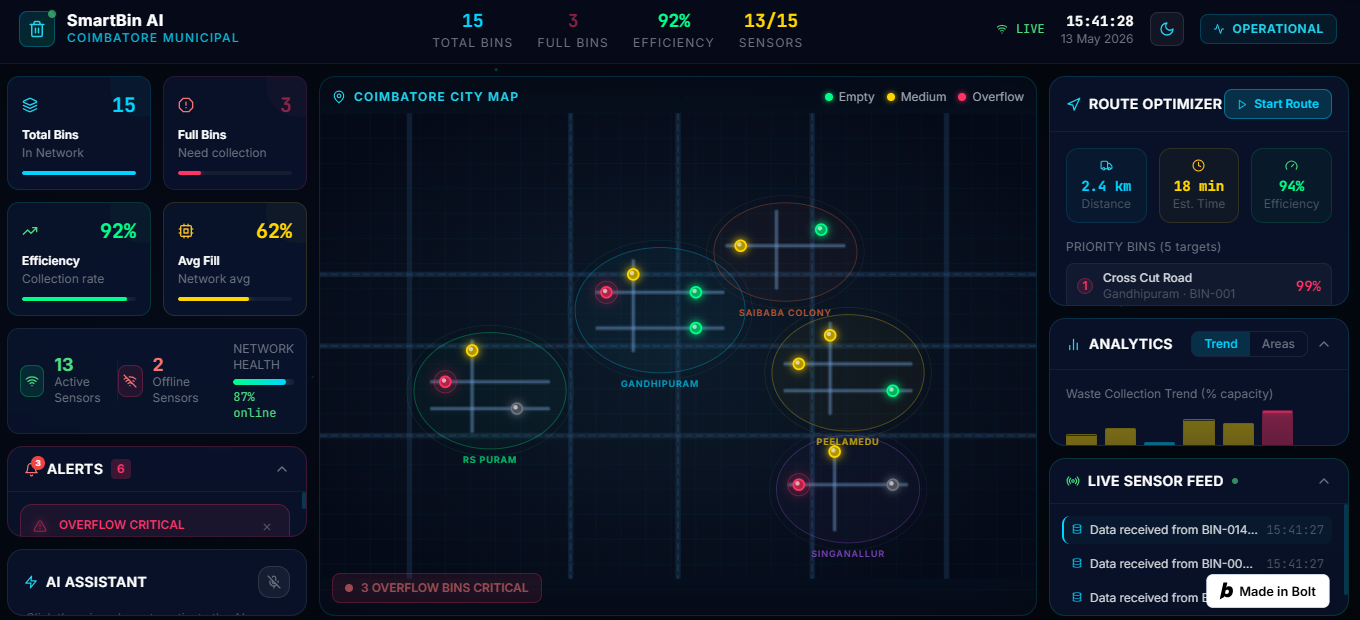
Dashboard (Optional): We built a simple web interface to visualize the fill-status of multiple bins on a map.
Challenges we ran into
Sensor Accuracy: Trash isn't flat! We had to calibrate the ultrasonic sensor to handle irregular shapes and prevent "false full" readings caused by a single bulky item sticking up.
Power Consumption: Since these bins are often outdoors, keeping the device powered without frequent battery changes was tricky. We implemented Deep Sleep modes to save energy when the bin isn't being used.
Signal Reliability: Ensuring the message actually reaches the office from inside a metal bin (which can act like a Faraday cage) required strategic antenna placement.
Accomplishments that we're proud of
Working Prototype: Successfully sending a live SMS alert from the hardware to a phone in real-time.
Scalability: Designing a system that is cheap enough to be deployed across an entire neighborhood, not just a single street.
Resource Efficiency: Our algorithm reduces unnecessary truck trips, which directly lowers carbon emissions and fuel costs for the city.
What we learned
IoT Logistics: We learned how to manage the "handshake" between physical hardware and cloud-based messaging APIs.
Edge Cases: We realized that environmental factors like humidity and heat can affect sensor performance, requiring more robust hardware housing.
Urban Planning: We gained a deeper understanding of how data-driven decisions can transform public utility services.
What's next for SMART BIN
AI Integration: Using a camera and image recognition to identify what is being thrown away (recyclables vs. organic waste).
Route Optimization: A mobile app for truck drivers that automatically calculates the fastest path based only on the bins that are marked as "Full."
Solar Power: Adding small solar panels to the bin lids to make the system entirely self-sustaining.
Odor Sensing: Adding gas sensors (like MQ-135) to detect methane levels and alert the office if a bin becomes a biohazard, even if it isn't full yet.
Built With
- html
- java
- javascript
- sensor


Log in or sign up for Devpost to join the conversation.