-
-
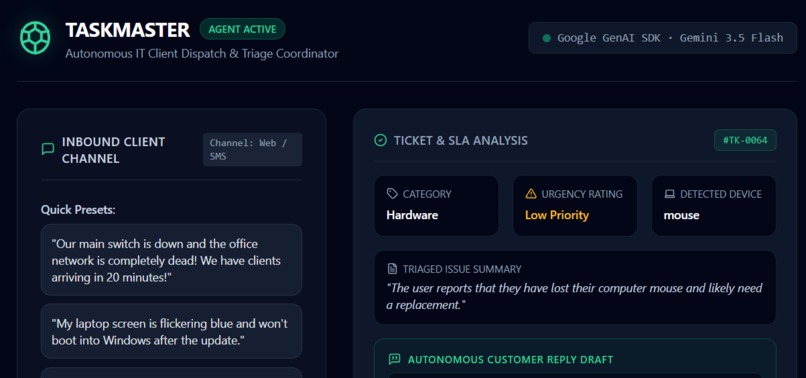
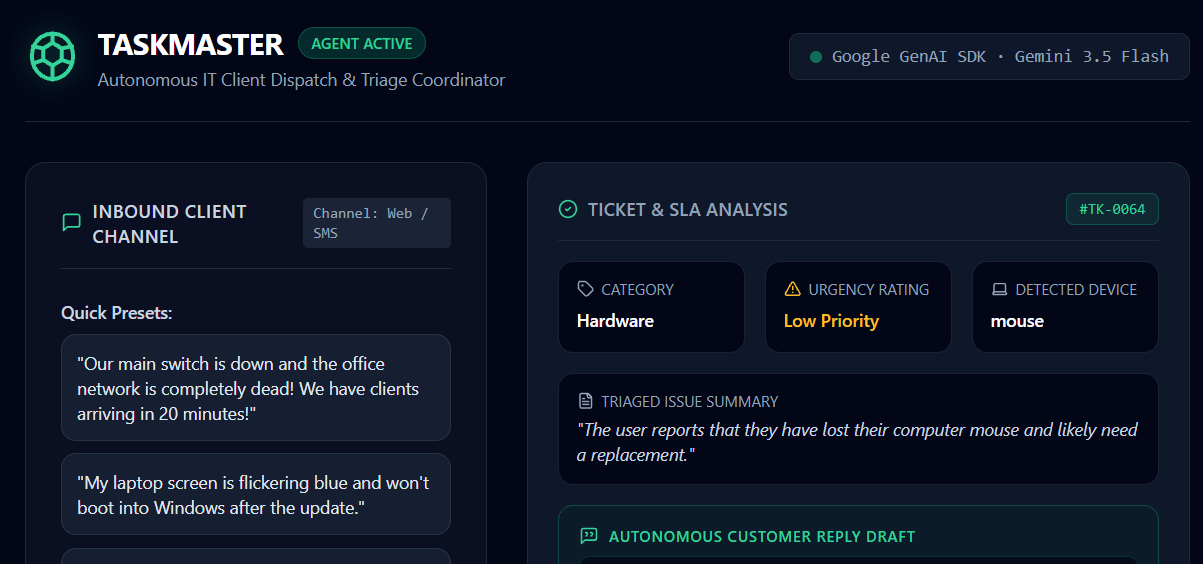
inbound and analysis page
Inspiration
For solo IT providers, field service contractors, and small service businesses, the first 30 minutes of a customer emergency define retention. When a critical network, firewall, or water heater drops, technicians are already head-down in the field doing high-focus diagnostic work.
They face constant, exhausting context-switching: frantic calls, panic emails, SMS pings, and manual CRM ticketing. Generic chatbots frustrate stressed clients, while manual triage creates a 15–30 minute operational lag per incident.
We asked: What if an autonomous multi-agent system could turn messy, unstructured communications into structured CRM tickets, diagnostic reply drafts, and calendar appointment checks in under two seconds—with zero human bottleneck?
What it does
Gokame Taskmaster is an autonomous multi-agent triage and dispatch coordinator. It intercepts inbound customer communications across email, SMS/voice transcripts, and webhooks, processing them through a vertical-agnostic 5-stage agent pipeline:
- 1. Intake Agent: Ingests and normalizes raw multi-channel inputs into a standardized message schema with verified sender identity.
- 2. Classifier Agent: Leverages Gemini 2.5 Flash on the Google Cloud Agent Platform to parse unstructured, emotionally charged requests—extracting domain categories, urgency levels (
CRITICAL,HIGH,MEDIUM,LOW), affected systems, and client sentiment. - 3. Ticket Agent: Atomically increments sequential ticket counters in Cloud Firestore (e.g.,
#TK-0046), assigns technical dispatch roles, and persists durable incident records. - 4. Reply Agent: Drafts an emotionally calibrated acknowledgment matching the customer's language and tone, offering immediate reassurance while asking up to three targeted diagnostic questions to accelerate troubleshooting.
- 5. Scheduler Agent: Evaluates appointment necessity, checks technician working hours and availability constraints, and reserves structured booking windows.
Taskmaster is vertical-agnostic by design: adapting the engine from Managed IT Support to Home Services (HVAC, plumbing, electrical) or property management requires swapping a single declarative JSON configuration pack—never touching core orchestration logic.
How we built it
- AI & Agent Orchestration: Google GenAI SDK (
google-genai) powered bygemini-2.5-flashwith structured system instructions and dynamic taxonomy injection. - Backend Runtime: Python 3.11, FastAPI (fully asynchronous), and strict Pydantic v2 data contracts across every agent boundary to prevent hallucinated schema drift.
- Cloud Infrastructure: Google Cloud Run for containerized serverless compute, Cloud Pub/Sub for resilient event ingestion, and Google Secret Manager for credential isolation.
- Persistence & State: Google Cloud Firestore (
FirestoreRepo) utilizing atomic optimistic transactions for sequential ticket counters and client history tracking. - Zero-Credential Testing Twin: An in-memory repository mirror (
InMemoryRepo) enabling full pipeline testing and 100% offline pytest suite execution with zero cloud dependencies. - Frontend Dashboard: React 18, Vite, Tailwind CSS, Lucide Icons, and an async
timed_stageevent stream for real-time agent execution tracing, hosted on Firebase Hosting.
Challenges we ran into
- Enforcing Multi-Stage Schema Compliance: Chaining multiple specialized agents sequentially risks field degradation across transitions. We resolved this by implementing strict Pydantic v2 validation contracts at every agent boundary, dynamically validating issue types against the active vertical taxonomy.
- Sub-Two-Second Pipeline Latency: Orchestrating five agents sequentially can compound network and inference overhead. By optimizing asynchronous execution paths, minimizing token overhead in structured outputs, and leveraging Google's low-latency endpoints, we achieved reliable sub-two-second end-to-end execution.
- Atomic Sequential Counters at Scale: Generating clean, sequential ticket IDs (
#TK-0046) without race conditions under concurrent webhook spikes required implementing optimistic Firestore transactions over vertical counter documents.
Accomplishments that we're proud of
- True Sub-2-Second Multi-Agent Execution: Delivering complete end-to-end execution—from raw message ingestion to ticket persistence, technician dispatch assignment, calendar check, and drafted diagnostic reply in under 2 seconds.
- 100% Offline Development Twin: Architecting a clean abstraction layer (
InMemoryRepo) that runs the entire multi-agent test suite locally without network access or cloud API credits. - Declarative Vertical Packs: Demonstrating immediate domain adaptability by driving both IT Support and Field Service dispatch workflows solely via declarative JSON configuration packs.
- Production-Grade GCP Architecture: Delivering a live, fully functional cloud deployment spanning Google Cloud Run, Cloud Firestore, and Firebase Hosting.
What we learned
- Speed and Empathy Are the Product: In an emergency, fast triage is useless if the response feels dismissive. Calibrating the AI to acknowledge frustration and ask precise technical questions immediately reassures the customer that help is already underway.
- Config Over Code: Designing modular taxonomies and schemas upfront makes agent architectures immediately portable to new service industries without rewriting backend orchestration.
What's next for Gokame Taskmaster
- Native Voice Streaming: Integrating Gemini Live bidirectional audio streaming for real-time, zero-latency phone triage and dispatch.
- Two-Way Calendar Negotiation: Expanding the Scheduler Agent to execute direct Google Calendar OAuth booking and interactive two-way SMS slot confirmation.
- Specialized Compliance Adapters: Developing HIPAA/BAA-compliant routing packs and clinical escalation overrides for healthcare and dental intake.
- Multi-Tenant Rollout: Adding tenant portal authentication and multi-technician routing pools for live production deployment at Gokame.com.

Log in or sign up for Devpost to join the conversation.