-
-
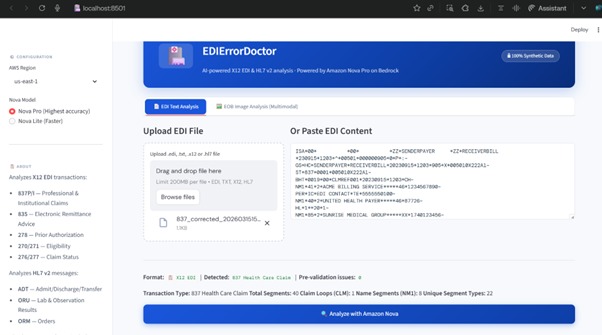
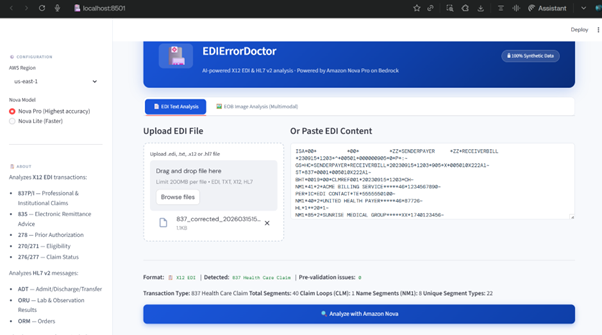
App Landing Page — EDIErrorDoctor — AI-powered X12 EDI analysis interface with Amazon Nova Pro on Bedrock
-
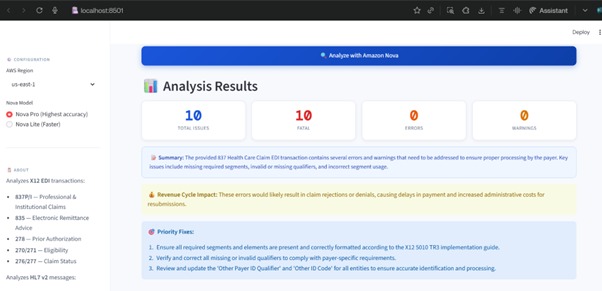
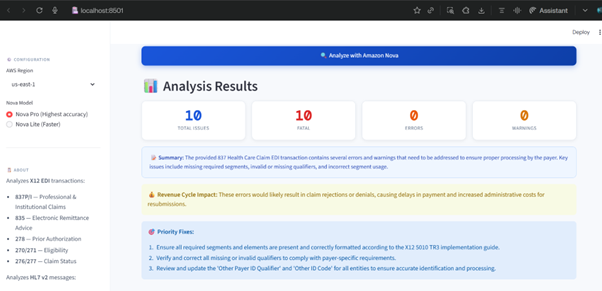
Analysis Results Dashboard — Nova Pro identifies 10 issues instantly — Fatal errors, Revenue Cycle Impact & Priority Fixes
-
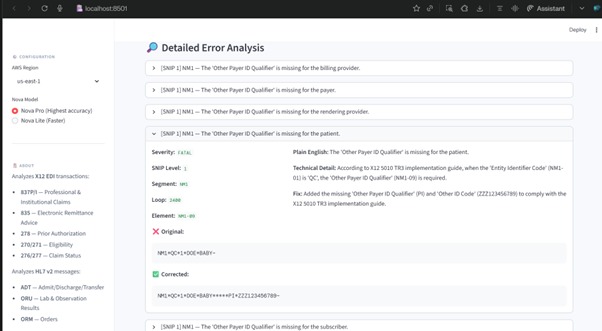
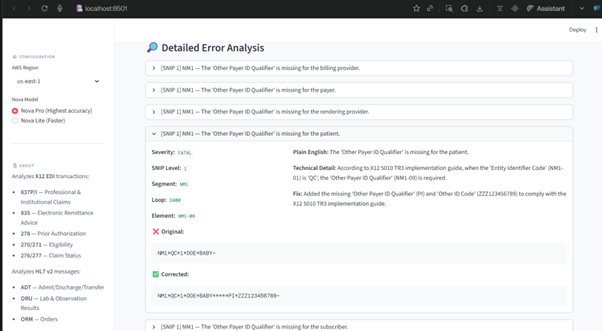
Detailed Error Analysis — Plain English error explanation with exact corrected EDI segment — SNIP Level 1 validation
-
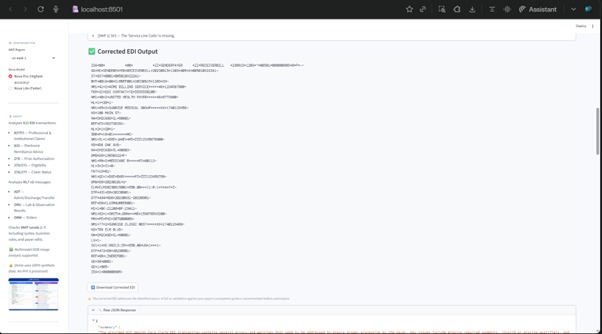
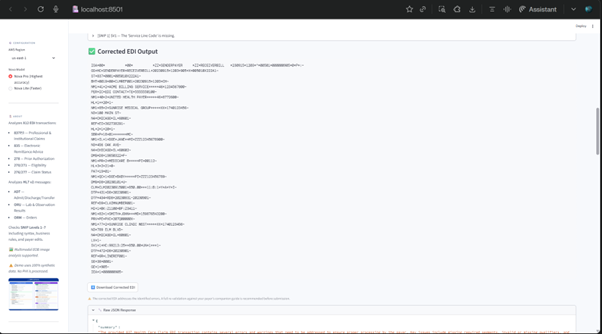
Corrected EDI Output — Complete corrected EDI file generated by Nova — ready to download and resubmit
-
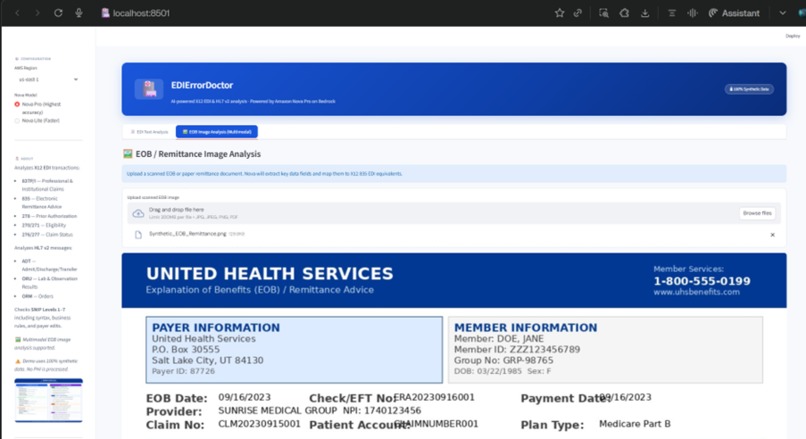
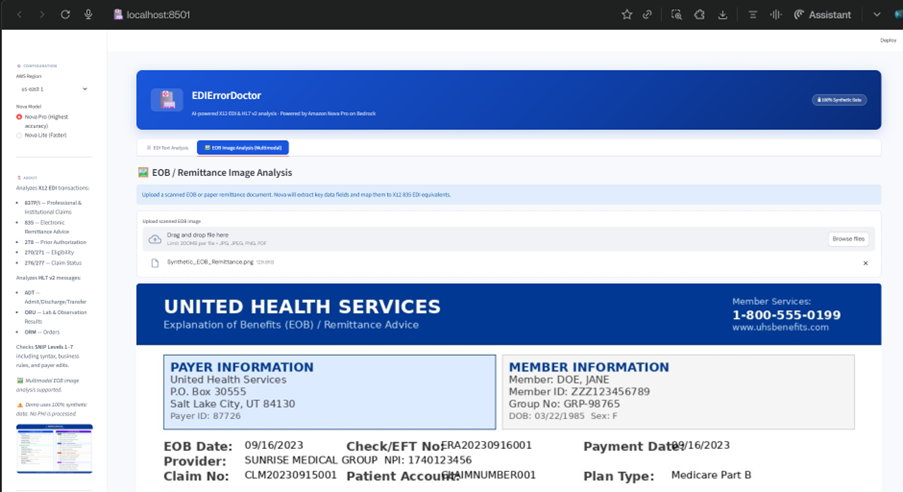
EOB Image Upload — Multimodal EOB image analysis — Nova reads scanned paper remittance documents
-
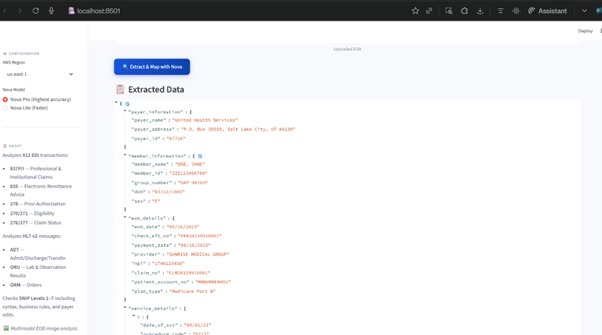
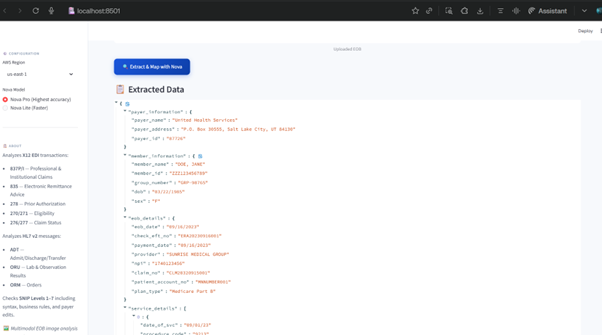
Extracted Data from EOB — Nova extracts all key fields from EOB image — member ID, claim numbers, amounts, plan type
-
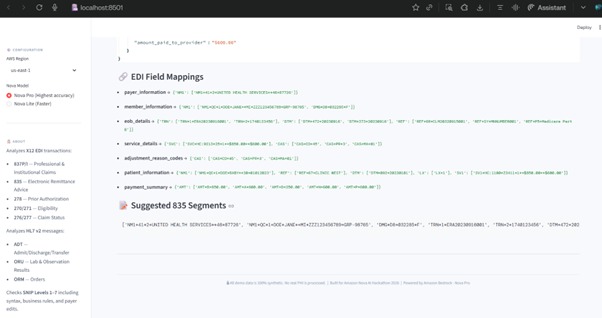
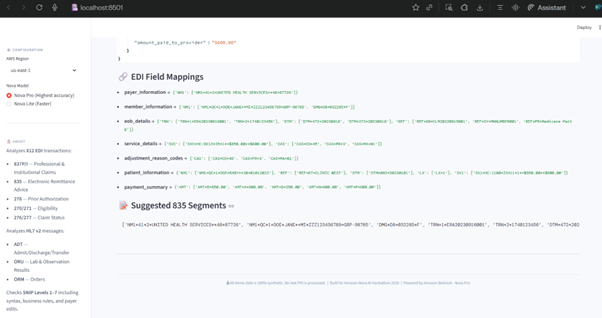
EDI Field Mappings & 835 Segments — Automatic mapping of EOB fields to X12 835 EDI segments — 30 minutes to 30 seconds
-
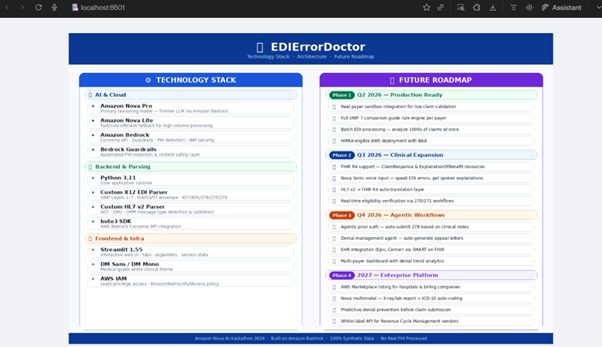
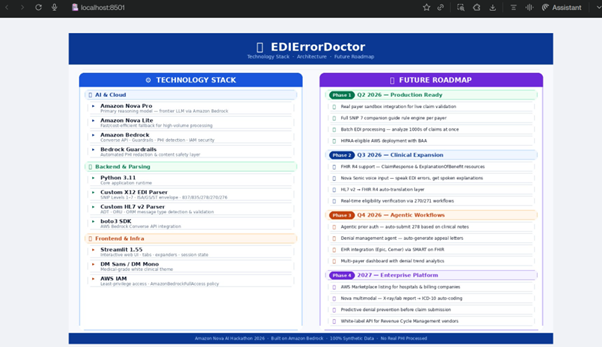
Tech Stack & Roadmap — Technology Stack and 4-phase Future Roadmap — from hackathon to enterprise platform
Inspiration
After 15+ years as a Senior Lead Engineer and consultant in US healthcare interoperability (X12 EDI standards like 837 claims/835 remittances/278 prior auth, HL7 v2, FHIR implementations), I've seen firsthand how manual EDI error troubleshooting wastes hours, increases claim denials, and burdens revenue cycle teams. Traditional tools validate syntax but can't provide contextual, payer-specific reasoning or plain-English explanations. Amazon Nova's advanced reasoning, multimodal understanding, and agentic capabilities inspired me to create an "AI doctor" for broken EDI files — turning complex debugging into fast, intelligent assistance.
What it does
EDIErrorDoctor is a web-based tool that:
- Lets users upload synthetic/invalid X12 EDI files (e.g., 837 professional/institutional claims or 835 ERA remittances).
- Analyzes errors across SNIP Levels 1–7, segment/loop syntax, business rules, and common payer edits.
- Uses Amazon Nova 2 Pro to generate:
- Clear, plain-English error explanations (e.g., "IK3[2300] error: NM1*IL qualifier missing or invalid per payer companion guide for subscriber loop").
- Precise fix suggestions with corrected segment examples.
- A regenerated, clean EDI snippet ready for validation/resubmission.
- Bonus multimodal mode: Upload scanned paper EOB/remittance images → Nova extracts key data → maps to EDI-equivalent issues and suggests corrections.
All processing uses 100% synthetic/fabricated data — no real PHI is ever involved, ensuring full HIPAA/privacy compliance for the demo.
How we built it
- Core AI: Amazon Bedrock Converse API with Nova 2 Pro (or Nova 2 Lite for faster iterations) for reasoning over EDI text/document inputs. Prompts include domain knowledge from my experience + RAG references to X12 TR3 guides and sample payer companion rules stored in S3.
- EDI Parsing & Validation: Custom Python helpers (using libraries like
edi-835-parseror manual segment/loop extraction) to preprocess files before feeding to Nova. - Frontend: Streamlit app for easy file upload, display of errors/fixes side-by-side, and export of corrected EDI.
- Safety Layer: Demonstrated Bedrock Guardrails to detect/redact any accidental PHI patterns in inputs/outputs.
- Deployment: Local dev + AWS Amplify for quick hosting.
Challenges we ran into
- Accurately parsing nested EDI loops/segments without full commercial parsers (solved with iterative custom code + Nova's tool-calling for validation checks).
- Crafting prompts that reliably produce syntactically valid fix suggestions (required multiple iterations and few-shot examples from real-world error patterns).
- Balancing Nova's context window for large 837 files (used chunking + summarization where needed).
- Ensuring demo reliability with synthetic data only while mimicking production complexity.
Accomplishments that we're proud of
- Built a functional MVP in under two weeks that demonstrates real domain impact — reducing EDI rework time from hours to seconds.
- Leveraged Nova's frontier reasoning for nuanced, payer-aware diagnostics that go beyond rule-based tools.
- Maintained strict privacy: Entirely synthetic workflow + explicit Guardrails mention.
- Clean, intuitive UI that non-technical billing staff could use.
What we learned
Nova 2 models excel at domain-expert tasks when combined with precise prompting, RAG, and healthcare-specific context. Gen AI has huge potential in interoperability — bridging gaps between legacy EDI and modern FHIR/agents. This project reinforced the importance of synthetic data pipelines for safe AI development in regulated industries.
Future ideas: Integrate real payer sandboxes, add voice input via Nova 2 Sonic for verbal error queries, or extend to full prior-auth agents.
Built With
- amazon-bedrock-(nova-2-pro-for-reasoning-&-multimodal-understanding)


Log in or sign up for Devpost to join the conversation.