-
-
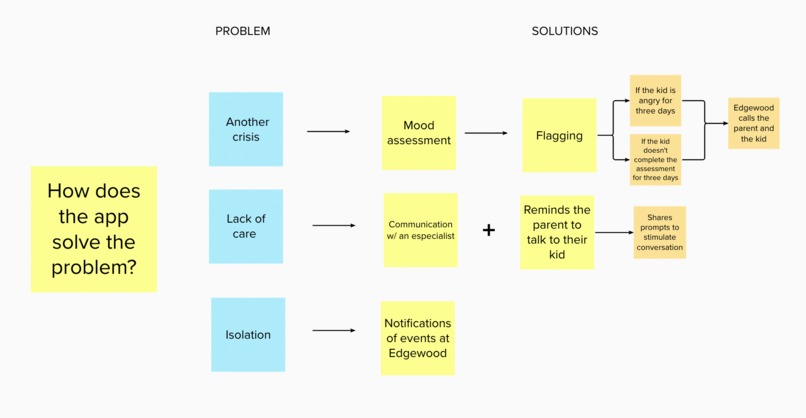
App's solutions to the problems faced by clients in the Recovery Phase
Inspiration
Our inspiration was Edgewood's desire to hold the client's hand from beginning to end of their journey. The recovery phase in the client's journey is crucial. A client can fall back into a crisis, after exiting Edgewood, depending on the support they receive or lack there of. We were inspired to create an app that (a) holds the client's hand in the recovery phase by (b) preventing a crisis, (c) providing care, and (d) preventing isolation.
What it does
Both the child and the parent must download the app. The app does several things depending on the user:
If the user is a kid:
- The app assesses the kid's mood through a short survey (e.g., 'Did you sleep ok?')
- Offers instant communication with a specialist, either via chat or phone call
If the user is the parent:
- The app prompts the parent to assess the kid's mood through a short survey (e.g., 'Has [kid's name] been eating?'
- Offers questions for parents to use with their kids to stimulate conversation (e.g., 'What's on your mind today?). The prompt also reminds parents to check in and communicate with their kid.
The app also:
- Reminds the user (kid and parent) of upcoming events organized by Edgewood
- Remind the user of next face-to-face appointment with an Edgewood specialist
- Flagging. If the kid (a) has been in a bad mood for several days or (b) has not answered the surveys, an Edgewood specialist receives this information so she may (c) call the kid, and (d) call the parent
How we built it
We began sketching the interface in Mural. We finalized the design in Figma
Challenges we ran into
We ran into two challenges:
Two of our teammates, who were in Asia, decided to abandon the project without notifying us, or doing the work we asked them to do. This meant Dana and I did the project on our own.
Edgewood's original goal was to reach everyone who needs a therapist. It took us some time to (a) figure out the user experience journey, and (b) focus on a tech project we could design with the time given that nonetheless helped Edgewood accomplish their goal.
Accomplishments that we're proud of
- The app both (a) solves the problem that patients may experience in the recovery phase, and (b) accomplishes Edgewood's goal to support clients throughout the entire UX journey in an individualized manner
- This app would be, we think, of great service to Edgewood's clients
What we learned
We spent hours understanding the UX journey and then brainstorming ideas on how to hold the client's hand throughout that journey. We also brainstormed places where parents, and teens hang out. We'd be happy to provide Julie (Edgewood) with the ideas we came up with to (a) make Edgewood top of mind, and (b) support clients through the different stages of the UX journey
What's next for Edgewood App for Recovery
The next step is to develop a prototype and test it with users. Once the app is free of bugs, and used by clients, we'd love to conduct UX research to understand: (a) is a daily mood necessary, or would it be more useful to have a three-day mood assessment, for example? (b) are the current mini surveys effectively assessing mood?
Furthermore, it would be ideal to track down some metrics overtime to assess the effectiveness of the app. These metrics include:
- Number of app users who return to Edgewood with a crisis
- Number of pages worth of chat conversation between child and specialist
- Number of hours worth of phone conversations between child and specialist
- Number of users not completing the mood assessments
- Qualitative interviews with kids and parents to ask: is the app helping, and if so, in what ways?
Built With
- figma
- mural

Log in or sign up for Devpost to join the conversation.