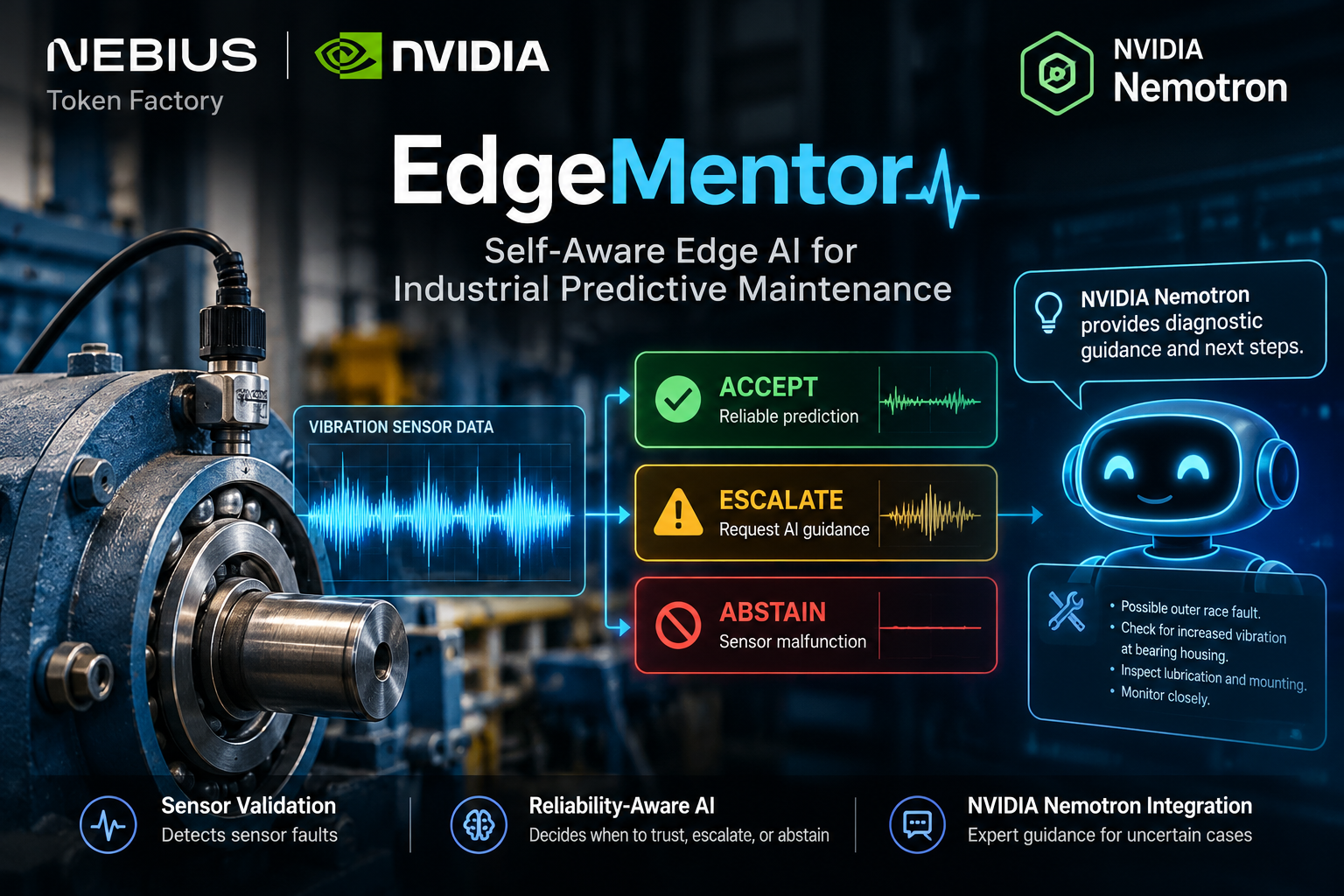
EdgeMentor — Self-Aware Edge AI for Industrial Predictive Maintenance
Inspiration
Industrial predictive maintenance systems use sensor data and machine learning to detect equipment faults before they cause costly failures. But there is a critical problem: what happens when the AI itself becomes unreliable?
A machine learning model can produce a confident prediction even when it is wrong. Sensors can malfunction, measurements can become abnormal, and the operating conditions may differ from the data used to train the model.
Traditional prediction pipelines often return a classification without indicating whether the input or prediction deserves additional scrutiny.
This inspired EdgeMentor, a reliability-aware industrial AI prototype designed around a simple principle:
An AI system should know when to trust its prediction, when to request assistance, and when to refuse to predict.
What We Built
EdgeMentor is an industrial bearing-monitoring prototype that combines vibration-signal analysis, machine learning, sensor validation, anomaly detection, and NVIDIA Nemotron-powered diagnostic guidance.
Instead of treating every model prediction as trustworthy, EdgeMentor introduces a reliability supervisor that evaluates the sensor signal and prediction before deciding what to do.
The system has three possible outcomes:
- ACCEPT: The sensor signal passes validation, and no configured uncertainty or anomaly trigger is detected.
- ESCALATE: Low prediction confidence or an anomaly triggers a request for additional review. The operator can consult NVIDIA Nemotron for suggested diagnostic actions.
- ABSTAIN: Invalid sensor data, such as missing readings or a stuck sensor, causes the system to withhold the prediction.
This separates the machine learning model's prediction from the decision about whether that prediction should be used.
How We Built It
1. Industrial vibration dataset
We used the Paderborn University Bearing Data Center dataset, containing vibration recordings from healthy and damaged bearings.
Our prototype uses nine bearing identities across three categories:
- Healthy bearings
- Outer-race damage
- Inner-race damage
We processed 180 recordings and extracted nine statistical and frequency-domain features, including RMS, peak amplitude, kurtosis, crest factor, skewness, and FFT-band energies.
2. Edge AI classification
We trained a Random Forest classifier using the extracted vibration features to predict bearing condition.
The classifier runs locally in Python, representing the lightweight prediction component of an edge-oriented monitoring pipeline.
3. Reliability supervision
We implemented additional checks around the classifier:
Sensor-health validation: Detects invalid readings, including non-finite values and near-constant signals.
Prediction uncertainty: Uses a configurable confidence threshold to identify predictions that require review.
Anomaly detection: Uses Isolation Forest to identify feature patterns that appear unusual relative to the training data.
These checks determine whether EdgeMentor should accept, escalate, or abstain.
4. NVIDIA Nemotron integration through Nebius Token Factory
When EdgeMentor flags a prediction for review, the operator can request guidance from NVIDIA Nemotron 3 Nano, accessed through Nebius Token Factory.
The model receives structured information about the bearing analysis, including the prediction, confidence, and reliability flags.
Nemotron then generates diagnostic suggestions and recommended inspection steps.
This creates a hybrid workflow:
Local machine learning handles sensor analysis, while NVIDIA Nemotron supports human decision-making when additional guidance is needed.
The language model does not directly control machinery or independently verify a bearing fault. Its role is to assist the operator with next-step reasoning.
5. Interactive monitoring dashboard
We built a Streamlit dashboard where users can select a bearing recording, inspect the vibration waveform, and see the reliability supervisor's decision.
The dashboard supports three demonstrations:
- Normal operating scenario: A prediction passes the configured reliability checks.
- Uncertain or anomalous scenario: A prediction is escalated, and NVIDIA Nemotron provides diagnostic guidance on request.
- Sensor malfunction scenario: A simulated stuck sensor or missing reading causes EdgeMentor to abstain.
The interface makes the decision process visible instead of presenting only a classification label.
Challenges We Faced
Confidently incorrect predictions
One of our most important findings was that a model can be highly confident and still be wrong.
Our initial baseline struggled to generalize to unseen bearing identities. The Random Forest baseline achieved approximately 33.3% accuracy on a held-out bearing evaluation, revealing a significant limitation in its ability to classify new bearings.
Rather than hiding this result, we used it to motivate the reliability-supervision layer.
However, confidence and anomaly checks are not guaranteed to detect every incorrect prediction. EdgeMentor is a prototype exploring how to make these limitations visible and actionable.
Distinguishing sensor faults from machine faults
An unusual vibration pattern does not automatically mean the bearing is damaged. It could also reflect a sensor problem or an unfamiliar operating condition.
We addressed part of this challenge by separating basic sensor validation from model classification and feature-based anomaly detection.
Integrating local ML with cloud AI
We wanted NVIDIA Nemotron to provide meaningful assistance without making every local prediction dependent on a cloud request.
Our solution keeps classification and reliability checks local and calls Nemotron on demand for escalated cases.
What We Learned
Building EdgeMentor reinforced several important lessons:
- High model confidence does not guarantee correctness.
- Evaluating models on unseen physical assets can reveal weaknesses hidden by easier data splits.
- Sensor validation is essential before trusting an ML prediction.
- Anomaly detection and uncertainty estimation provide useful review signals, but neither is a guarantee of safety.
- NVIDIA Nemotron can complement conventional machine learning by translating structured reliability alerts into actionable suggestions for human operators.
- A useful industrial AI system needs understandable decisions, not just prediction outputs.
What's Next
EdgeMentor is currently a software prototype evaluated using recorded industrial vibration data and simulated sensor failures. It is not yet a validated production predictive-maintenance system.
Our next development goals include:
- Integrating live sensor readings from embedded hardware.
- Evaluating additional bearing datasets and operating conditions.
- Improving classification performance and uncertainty calibration.
- Developing explicit distribution-shift monitoring.
- Measuring escalation quality, false alarms, and reliability across unseen machines.
- Exploring lightweight on-device deployment and structured human feedback.
Impact
EdgeMentor explores a different approach to industrial AI: instead of asking only "What does the model predict?", it also asks "Should this prediction be trusted?"
By combining local sensor analysis, reliability-aware decision-making, and NVIDIA Nemotron guidance through Nebius Token Factory, EdgeMentor demonstrates a foundation for more transparent, human-supervised industrial AI systems.
Built With
- edge-ai
- industrial-iot
- isolation-forest
- nebius-token-factory
- numpy
- nvidia-nemotron
- predictive-maintenance
- python
- random-forest
- scikit-learn
- scipy
- signal-processing
- streamlit

Log in or sign up for Devpost to join the conversation.