Inspiration
What it does
How we built it
Challenges we ran into## Inspiration
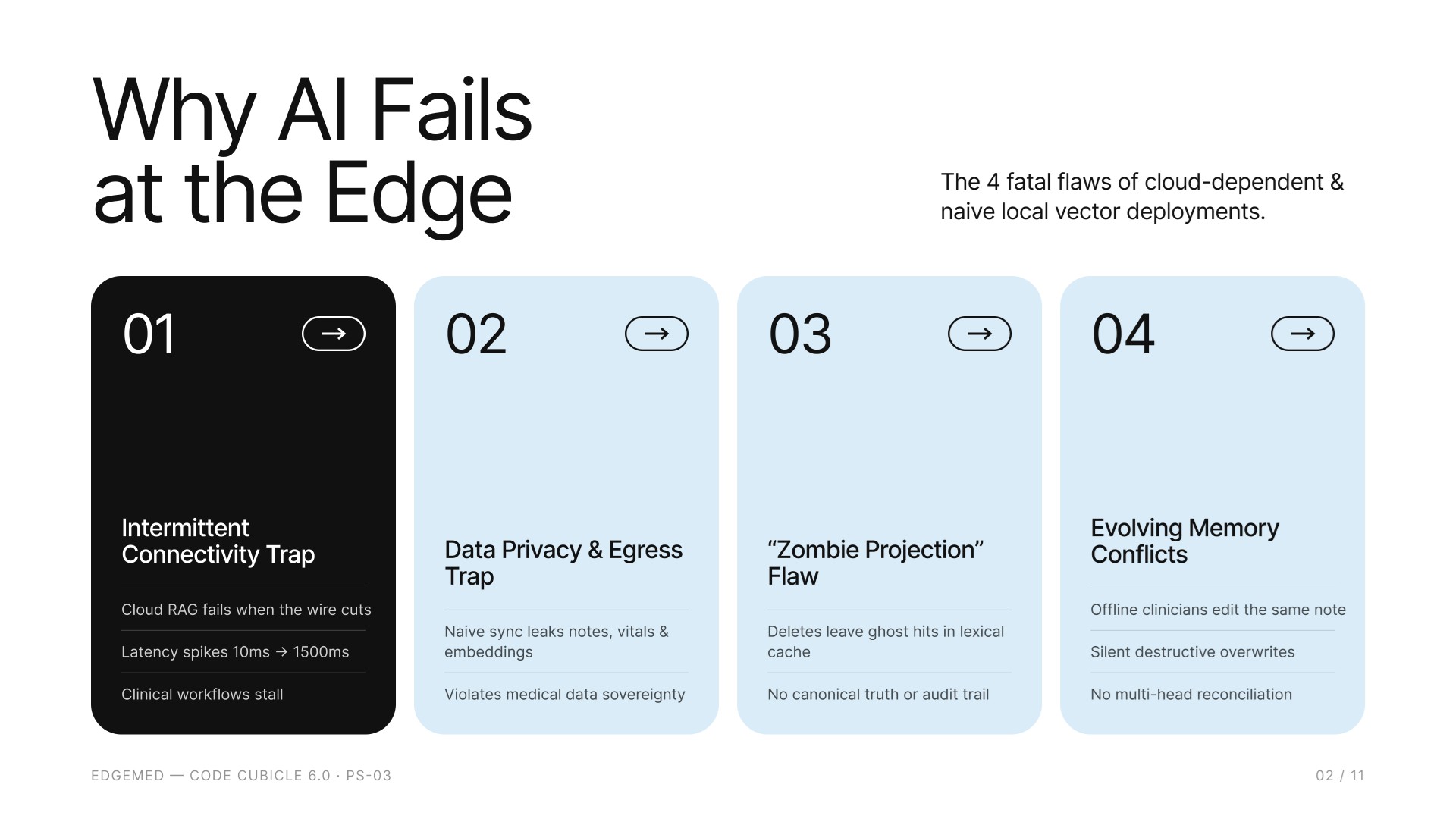
During an emergency, an internet blackout, or in a rural clinic, cloud-dependent healthcare AI completely stalls. Clinicians cannot afford a 500ms network round-trip, and medical data privacy regulations (HIPAA, GDPR) strictly forbid unencrypted patient vitals, clinical observations, and notes from being transmitted to third-party cloud servers.
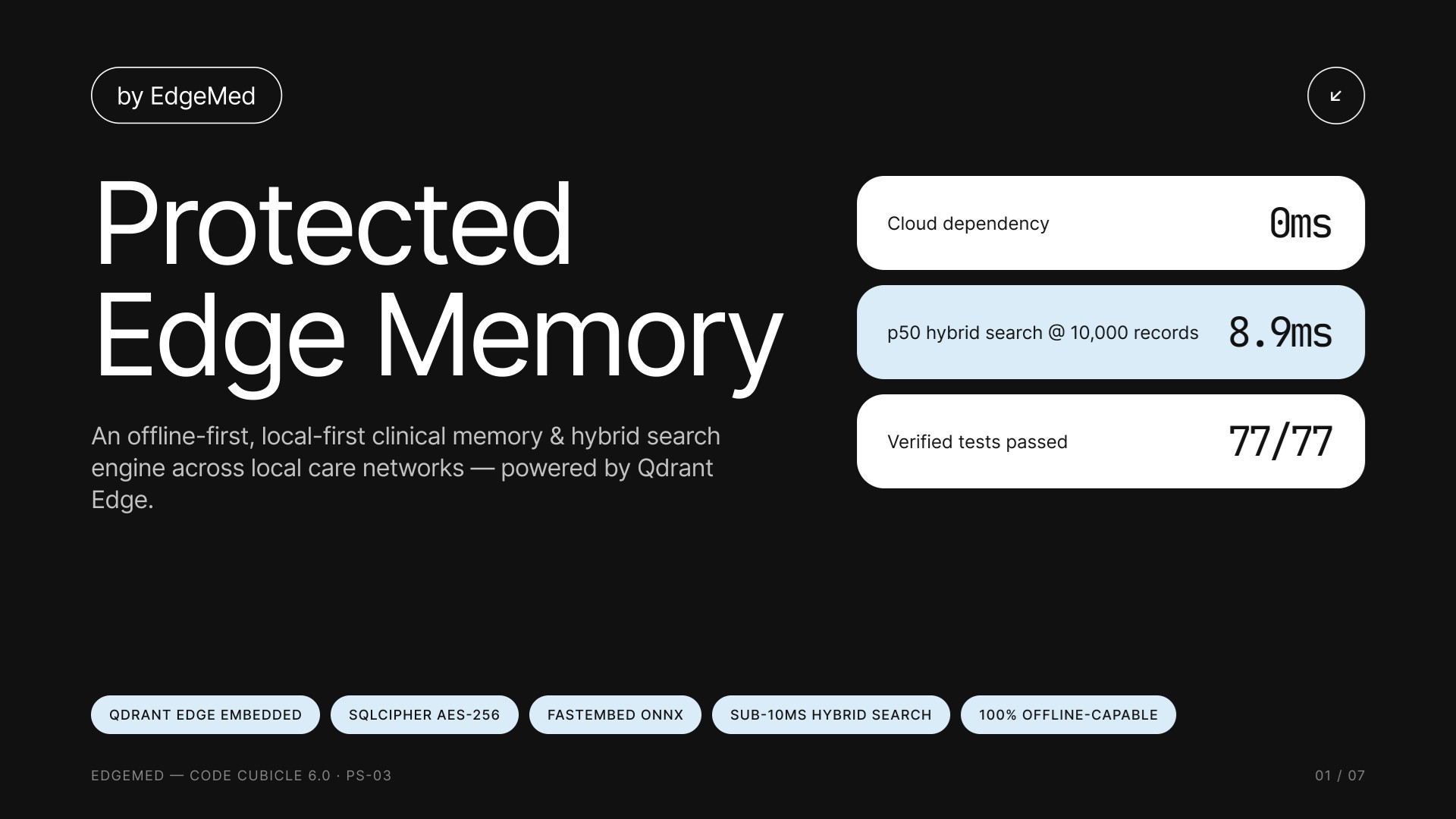
We were inspired to build EdgeMed: an autonomous, 100% offline-first clinical memory platform that brings lightning-fast AI semantic search and structured patient history directly to edge devices at the point of care—without ever requiring an internet connection.
What it does
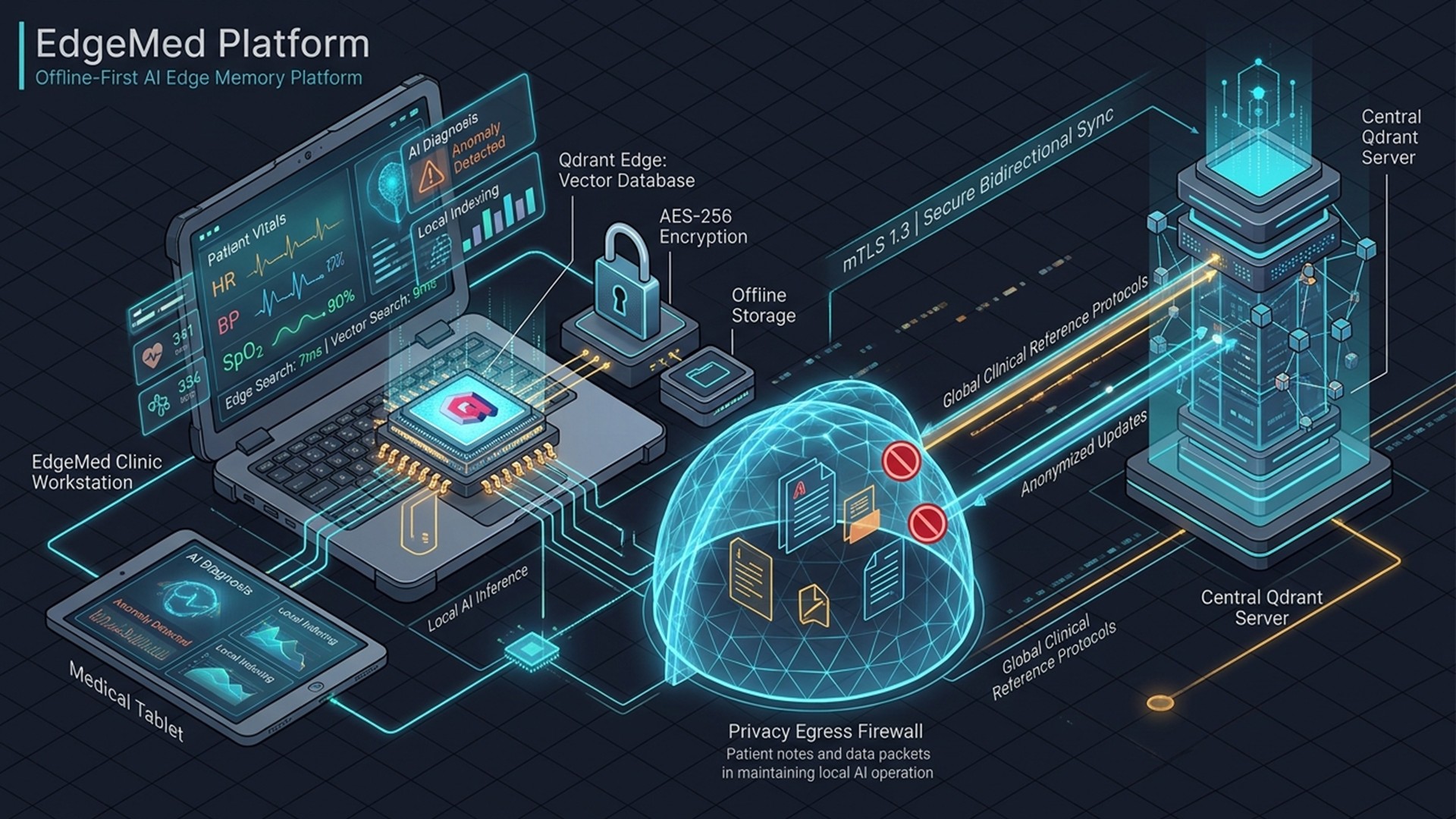
EdgeMed is a local-first clinical decision-support and memory platform powered by embedded Qdrant Edge:
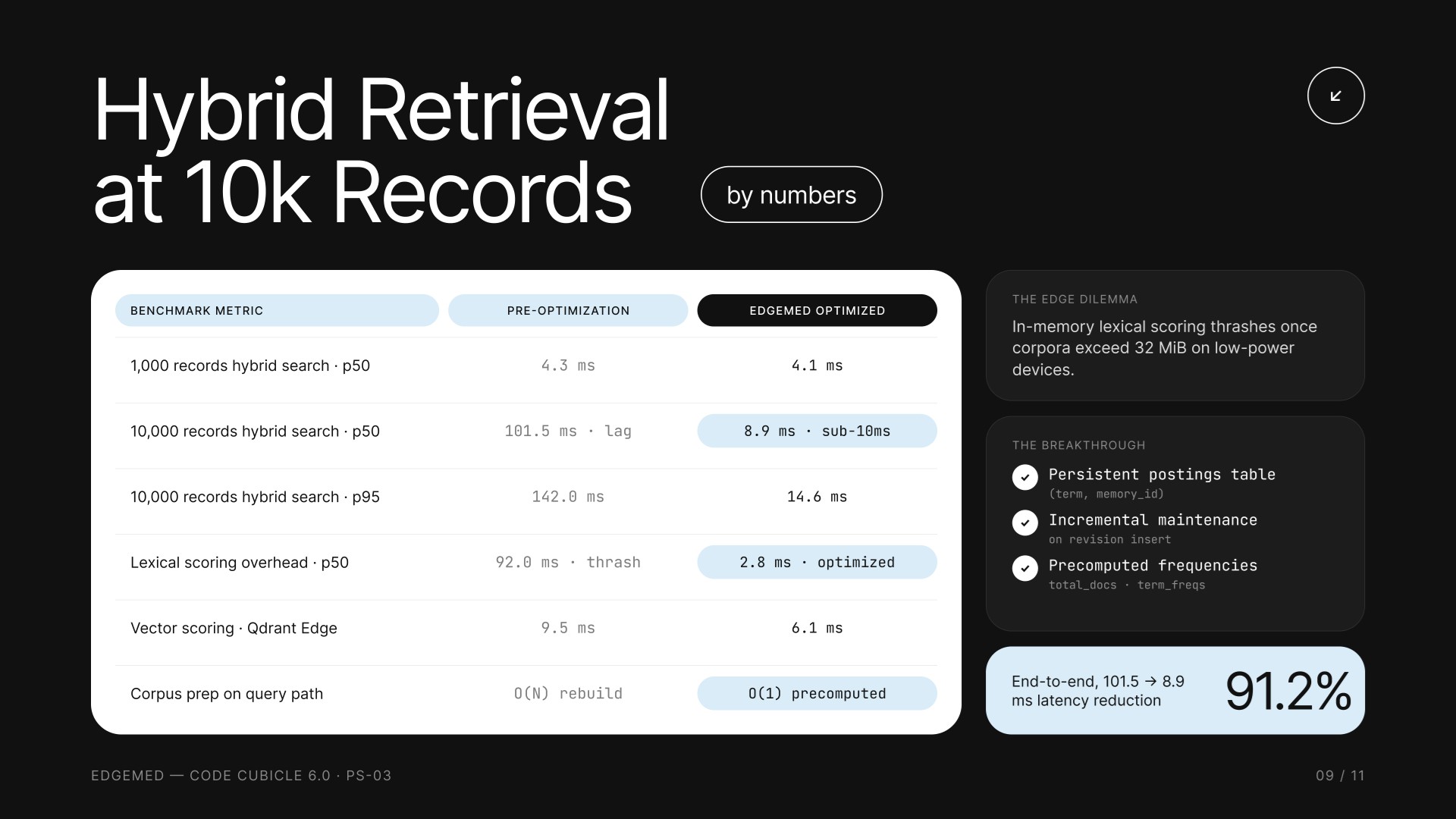
- Sub-10ms Hybrid Retrieval: Combines on-device dense vector embeddings with sparse lexical search using Reciprocal Rank Fusion (RRF $k=60$) to query 10,000+ clinical records in under $8.9\text{ ms}$ ($p50$).
- Encrypted Ground Truth: Stores all records, longitudinal vitals, and revision histories inside a tamper-evident, AES-256-CBC encrypted SQLCipher database with HMAC-SHA256 audit chaining.
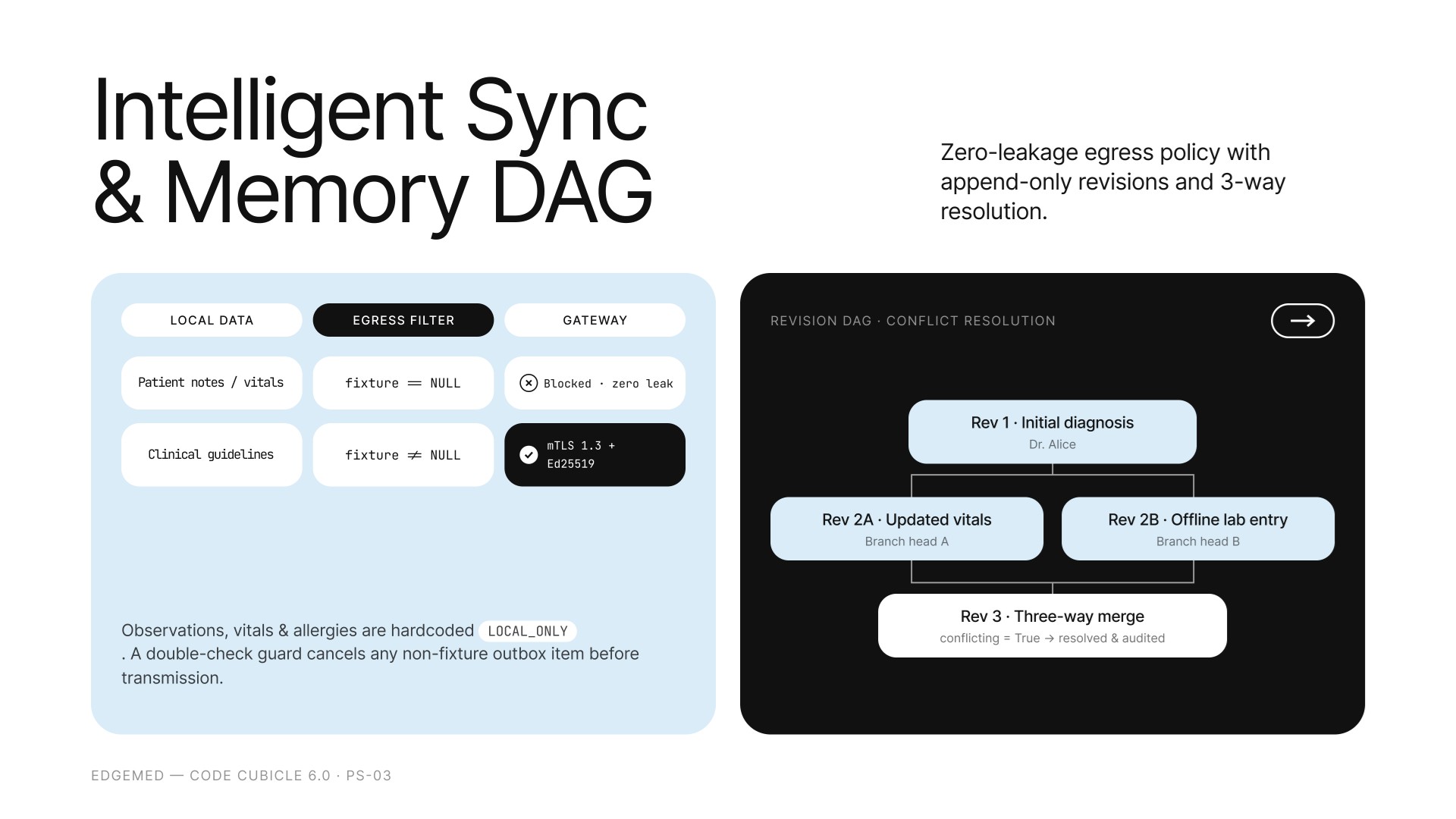
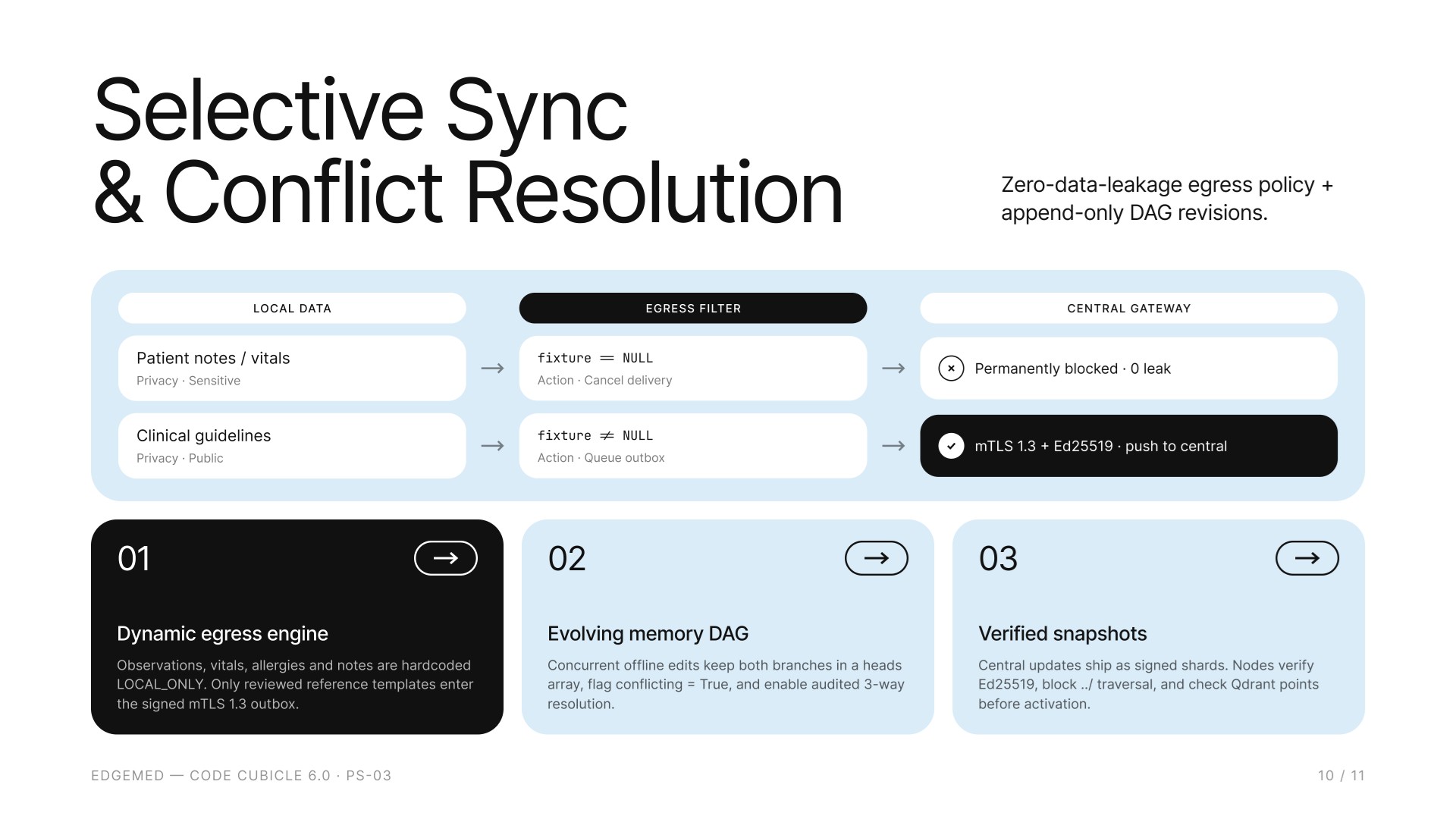
- Offline Multi-Branch Conflict Resolution: When multiple clinicians edit records asynchronously on different tablets during an outage, EdgeMed uses a Git-like Directed Acyclic Graph (DAG) to preserve divergent branches and provide audited 3-way conflict adjudication instead of silent overwrites.
- Zero-Egress Privacy Guard: Enforces physical barrier rules where patient observations remain strictly
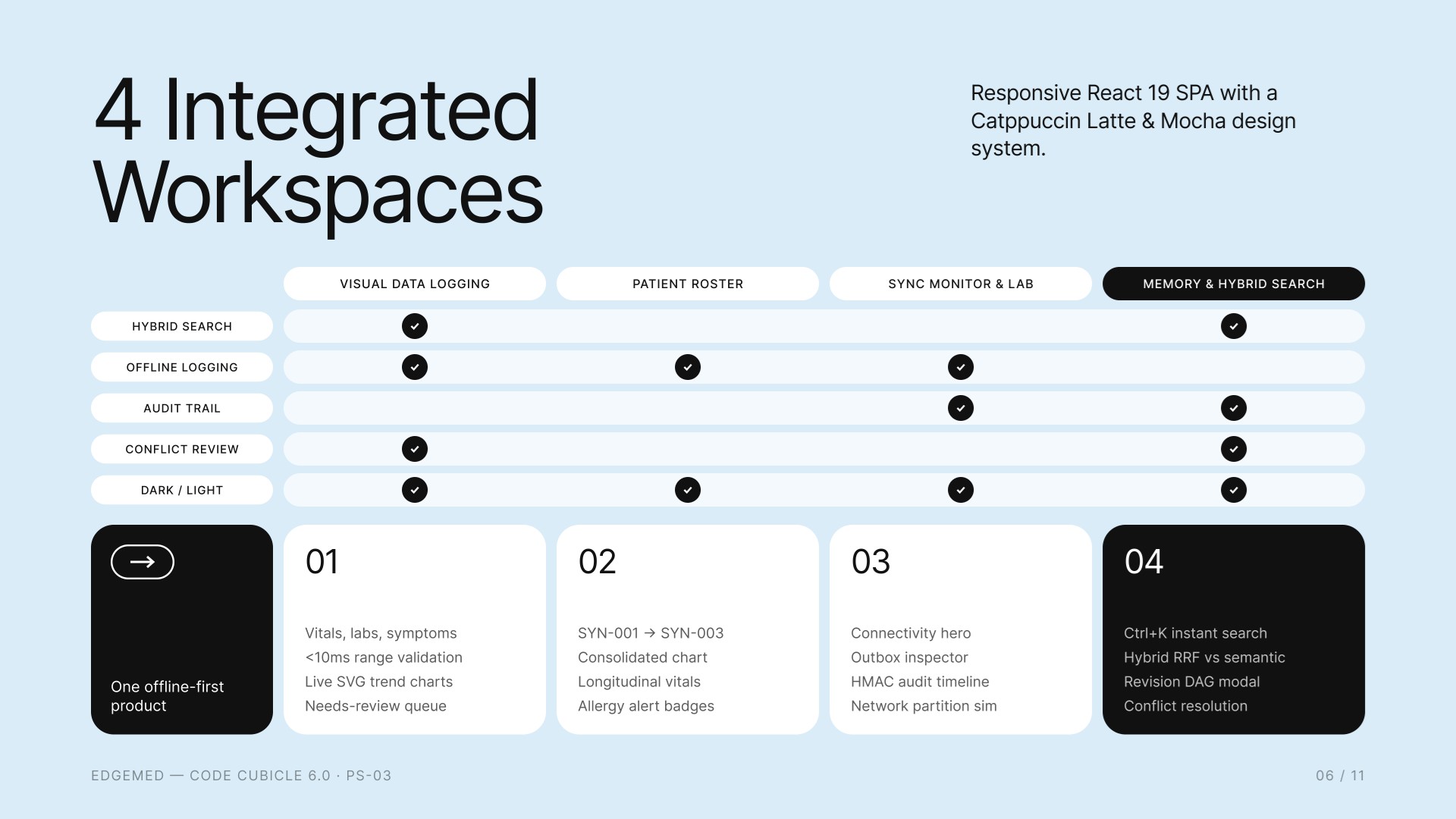
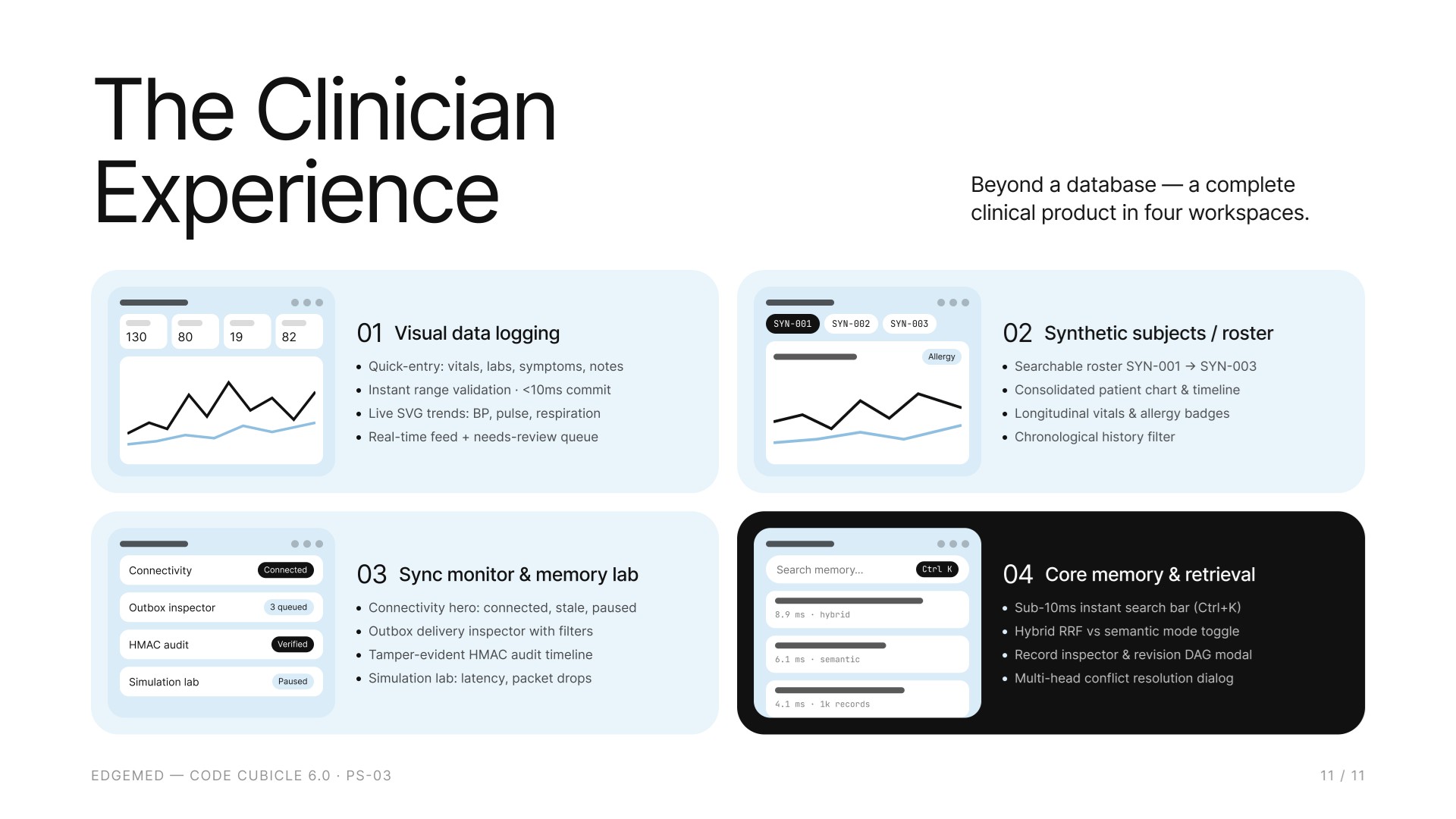
LOCAL_ONLY, while only approved reference guidelines sync to central systems over Ed25519-signed mTLS 1.3 channels. - 4 Integrated Clinician Workspaces: A responsive React 19 interface providing Visual Data Logging, Synthetic Patient Rosters (longitudinal charts & allergy alerts), Sync Monitor & Network Degradation Lab, and Memory & Hybrid Search Engine.
How we built it
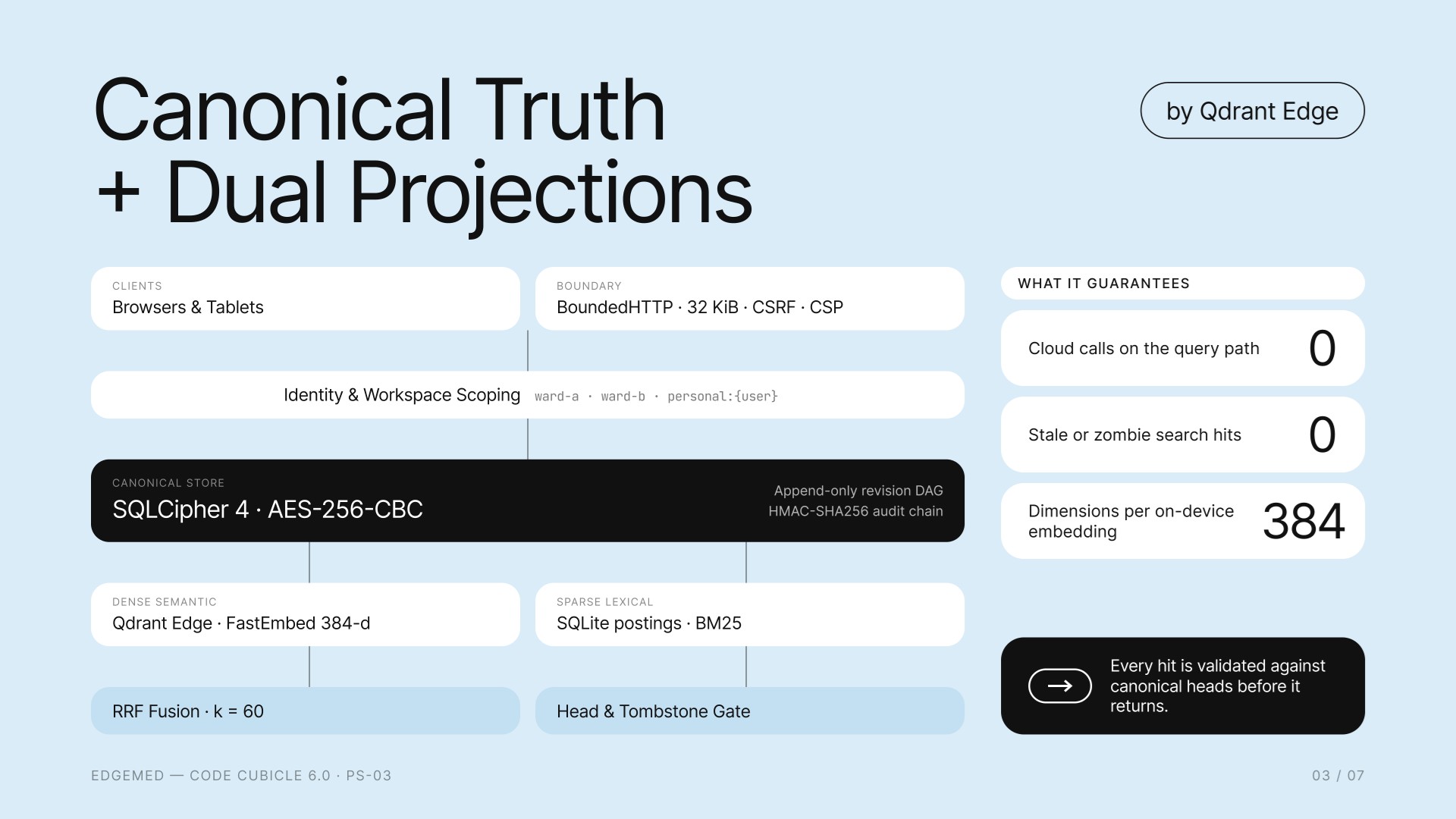
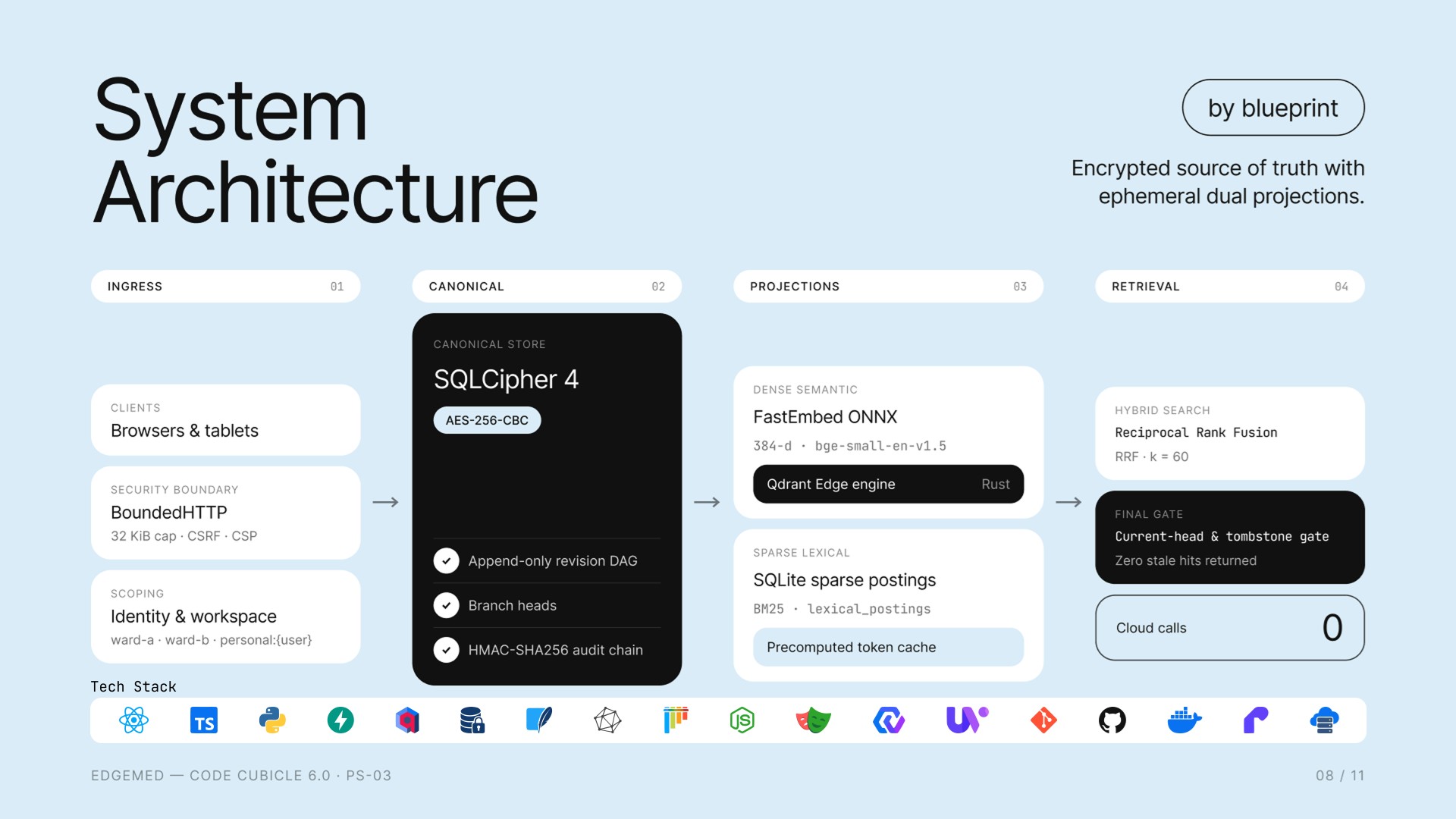
We designed a Canonical-First Dual-Projection Architecture:
- Core Vector Engine: Embedded Qdrant Edge (Rust) running locally on device, indexing 384-dimensional cosine embeddings generated by on-device FastEmbed ONNX (
BAAI/bge-small-en-v1.5). - Lexical Postings Index: A custom, persistent SQLite inverted index (
lexical_postings) powering sub-3ms keyword search without memory thrashing. - Canonical Storage: SQLCipher 4 with PBKDF2 key derivation, strict multi-tenant ward isolation (
ward-a,ward-b), and fail-closed keyrings. - Perimeter Security: FastAPI backend guarded by
BoundedHTTPmiddleware (32 KiB payload cap, timing-safe CSRF tokens, strict Origin/Host validation). - Frontend SPA: Built with React 19, TypeScript, and Vite, featuring custom SVG trendlines and accessible Catppuccin Latte & Mocha themes.
Challenges we ran into
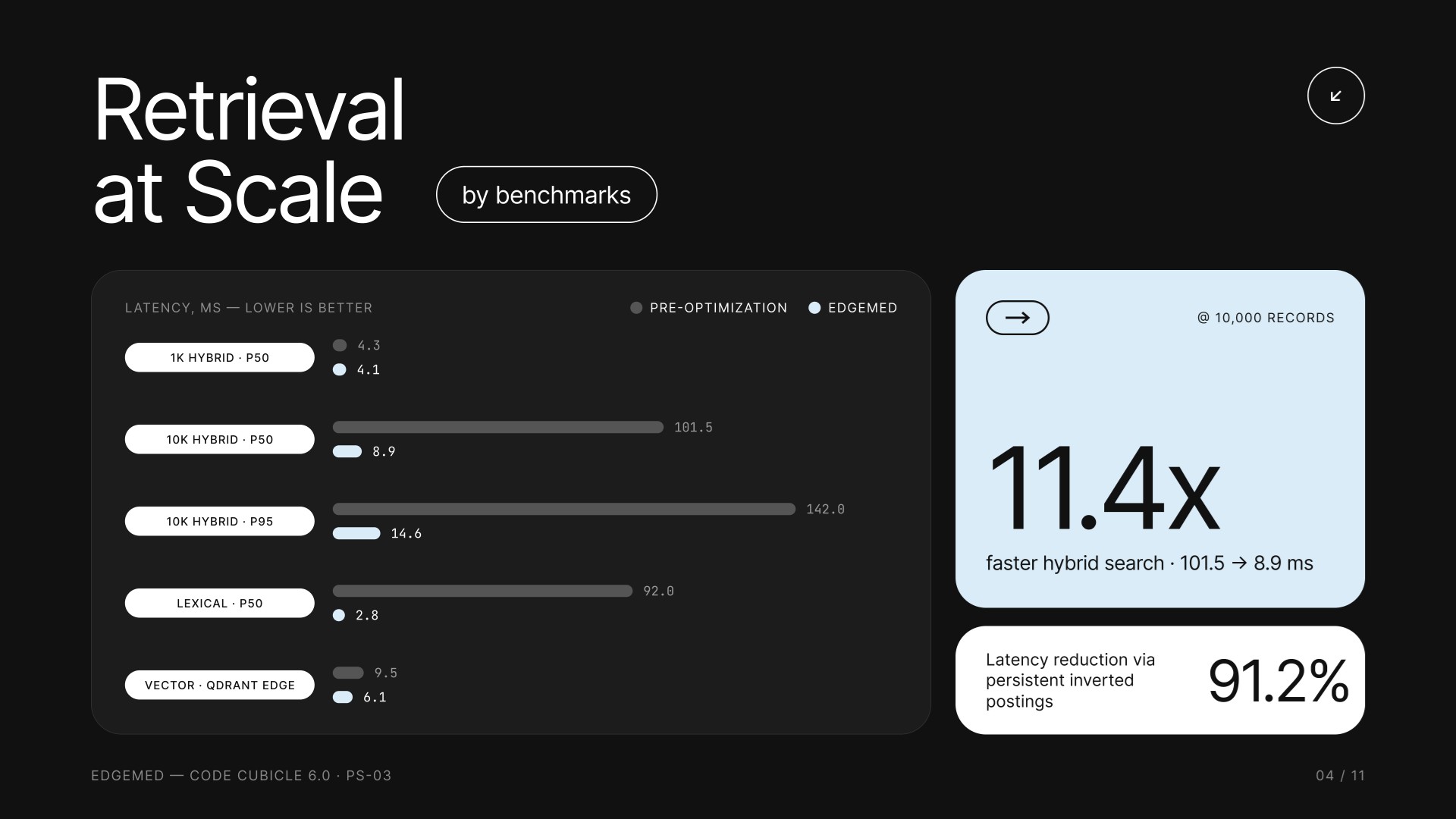
- The 10k-Record Memory Thrashing Bottleneck: Naive in-memory lexical scoring exceeded 32 MiB on low-power devices, causing search latency to spike over $100\text{ ms}$. We engineered a persistent sparse inverted postings index with precomputed document frequencies ($O(1)$ query prep), slashing hybrid search latency from $101.5\text{ ms}$ to $8.9\text{ ms}$ ($11.4\times$ faster).
- The "Zombie Projection" Trap: When records are updated or tombstoned in SQLCipher, naive vector caches often return stale search hits. We instituted a strict Canonical Current-Head Gate that cross-verifies all vector candidates against active database heads before returning results.
- Decentralized Offline Conflicts: Care teams updating the same patient chart concurrently offline caused destructive overwrites. We resolved this by modeling all memory updates as an append-only revision DAG that surfaces multi-head branching directly to doctors.
Accomplishments that we're proud of
- Achieving $8.9\text{ ms}$ $p50$ hybrid search latency across a 10,000-record clinical dataset entirely on local edge hardware with zero cloud calls.
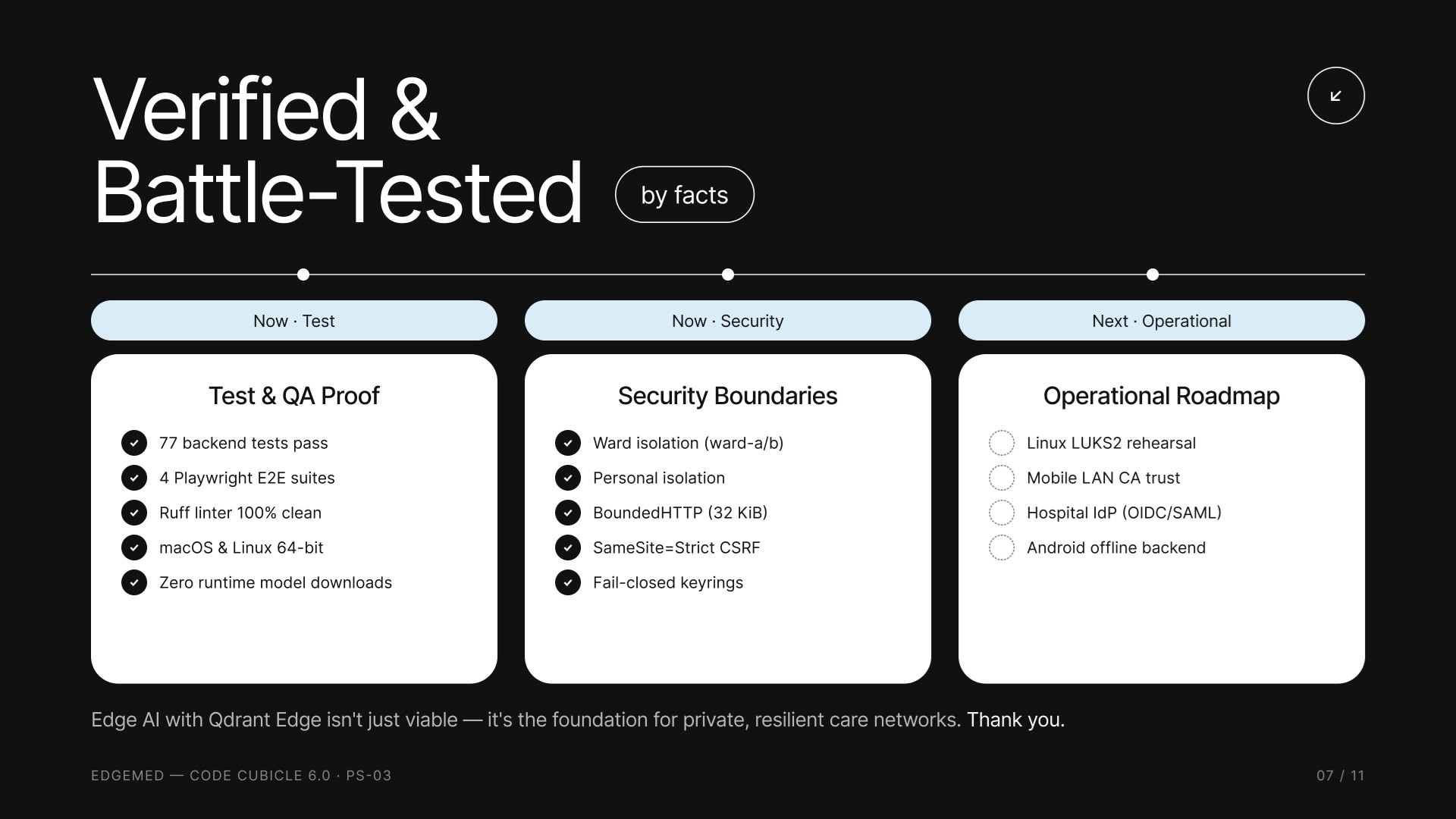
- $77 / 77$ automated backend integration and security tests passing, accompanied by 4 end-to-end Playwright browser test suites.
- Authoring a comprehensive, production-grade Threat Model (
THREAT_MODEL.md) detailing trust boundaries, ward-level isolation, and cryptographic fail-safes. - Delivering a fully usable, polished clinician interface across 4 distinct workspaces with keyboard navigation (
Ctrl+K) and network simulation tools.
What we learned
- How to deeply integrate and optimize Qdrant Edge and ONNX runtimes for resource-constrained edge machines.
- The power of decoupled dual-projection architectures (treating vector search as an ephemeral index subordinate to an encrypted source-of-truth).
- How to implement cryptographic zero-egress guards that mathematically prevent data leaks in distributed networks.
What's next for edgemed
- Native Mobile Packaging: Compiling EdgeMed as an on-device local engine for Android/iOS bedside tablets.
- Hospital IdP Integration: Adding enterprise SAML/OIDC authentication bridges for hospital intranet deployment.
- Wearable Sensor Ingestion: Streaming real-time BLE telemetry from patient monitors directly into EdgeMed's encrypted time-series revision stream.
Accomplishments that we're proud of
What we learned
What's next for edgemed
Built With
- argon2
- bm25
- cryptography
- docker
- edge-computing
- fastapi
- fastembed
- healthcare
- hybrid-search
- offline-first
- onnx
- playwright
- pytest
- python
- qdrant
- qdrant-edge
- react
- render
- sqlcipher
- sqlite
- typescript
- vector-search
- vite


Log in or sign up for Devpost to join the conversation.